The difference between punk and hardcore is mostly about compression and intent. Punk rock is a wide open family of guitar bands built on fast tempos, memorable songs and independence from the music business. Hardcore punk is the tighter, faster, more abrasive corner of that family, where songs run a couple of minutes, vocals are shouted rather than sung, and the live show is part of the music.
Hardcore came out of punk, so it is technically a subgenre, and almost nobody argues with that. What gets argued about is where the line sits. New listeners usually hit the argument before they hear enough music to place it themselves, so this guide starts with sound and ends with what to put on the turntable first.
Both genres are alive and still releasing records in 2026, and the vinyl for both is widely available, so nothing here is nostalgia-only. The scenes have changed a lot since the late 1970s, but the underlying argument has not.
Table of Contents
- Difference Between Punk and Hardcore at a Glance
- What Is Punk?
- How the punk waves and substyles fit together
- What Is Hardcore?
- How Do the Sound and Song Structure Differ?
- Hearing the difference between punk and hardcore by ear
- Instrumentation and guitar tone
- Tempo, song length and arrangement
- Vocals, production and dynamics
- What About Lyrics, Attitude, and the Scene?
- Where Do Punk and Hardcore Overlap?
- Which Should You Choose?
- Frequently Asked Questions
- Is hardcore the same thing as punk?
- What makes hardcore different from punk in sound?
- Are hardcore songs always shorter than punk songs?
- What is post-hardcore and is it still hardcore?
- Is melodic hardcore punk or pop?
- What should a new vinyl collector listen to first?
- Conclusion
Difference Between Punk and Hardcore at a Glance
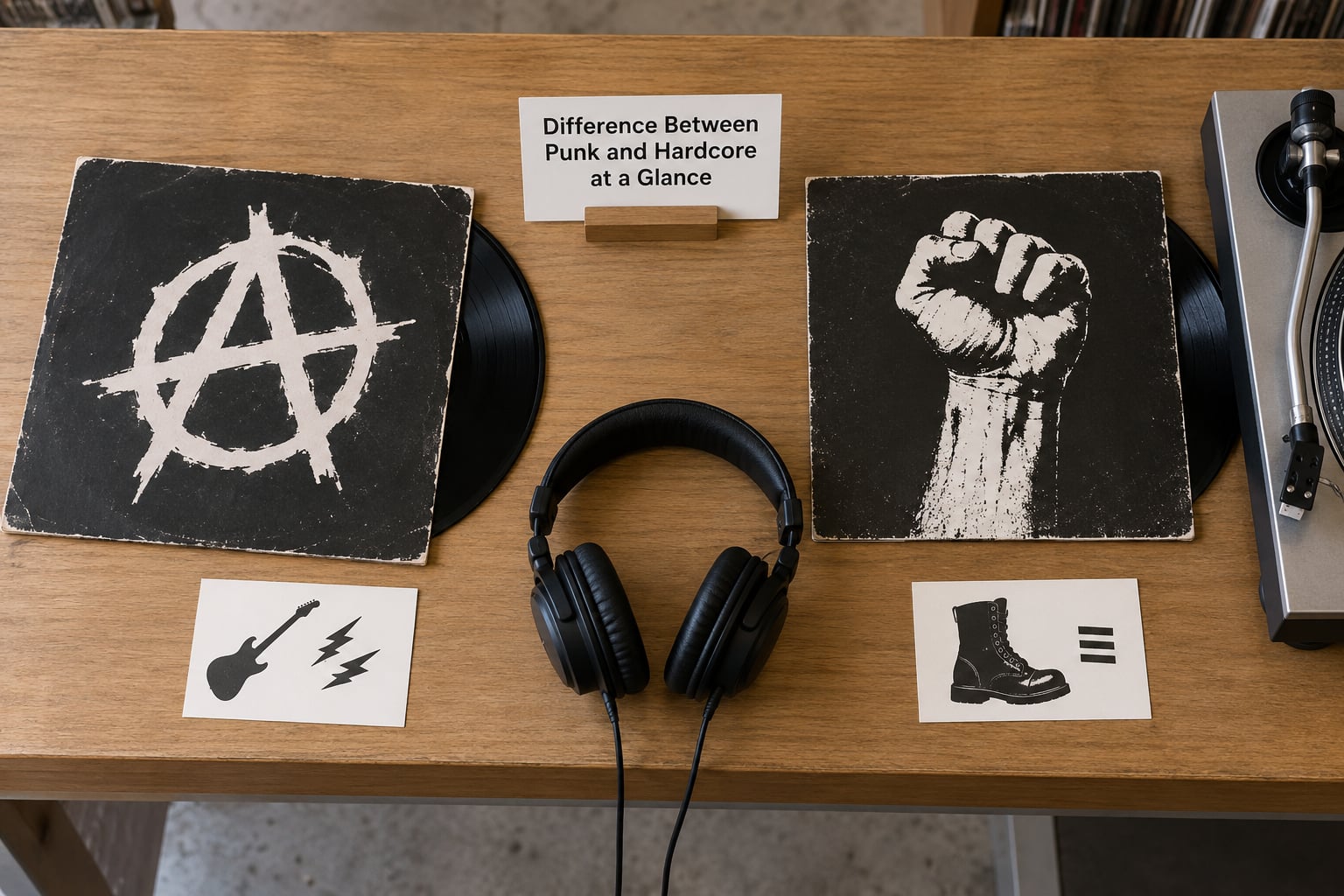
Here is the short version before the detail. Read across each row and the practical distinction becomes obvious.
| Category | Punk rock | Hardcore punk |
|---|---|---|
| Core sound | Buzzsaw or pop-leaning guitars, full band, hook-forward | Tighter, denser, more distorted, less space between notes |
| Typical tempo | Fast, often around 160 to 200 BPM | Very fast, commonly 200 BPM and above |
| Song length | Roughly two to four minutes | Often under two minutes |
| Song structure | Verse, chorus, hook, memorable refrain | Fast verse-like sections, breakdowns, abrupt ends |
| Vocal delivery | Sung or half-spoken, melodic lines in pop-punk | Shouted, barked, pressed close to the microphone |
| Lyrical themes | Rebellion, boredom, romance, politics, irony | Direct address, confrontation, personal grievance, unity |
| Typical instruments | Electric guitar, bass, drums, sometimes organ or synth | Electric guitar, bass, drums, occasional saxophone or tape noise |
| Performance intensity | Energetic, jumping, arms up | Very physical, constant movement, diving and stage fights |
| Cultural attitude | DIY, anti-establishment, independent of labels | DIY taken further, with codes such as straight edge |
| Best entry point | Ramones, Clash, Bad Religion, Green Day | Black Flag, Bad Brains, Minor Threat, Dead Kennedys |
Two rows carry most of the weight. Song structure is where punk keeps a chorus and hardcore usually does not bother, and performance intensity is where the difference becomes physical rather than a matter of taste.
What Is Punk?
Punk rock is a broad approach to making rock and roll, not a narrow sound. It values speed, energy, short songs, memorable riffs and total independence from how the music is sold and produced. The chords are usually simple power chords, the tempo is up, and the songs end sooner than a normal rock song would allow.
The movement is usually dated to the mid 1970s. The Ramones, the Sex Pistols, the Clash and the Damned all broke through around 1976 and 1977 with stripped-down, deliberately rough records, cheap production and hostile press. In the United States the same impulse ran through the Ramones, the Dead Kennedys and a wave of local scenes that toured on their own terms.
How the punk waves and substyles fit together
Punk survived as a family rather than a single style, which is why the word covers so many different records. The Ramones stripped things down to a two-minute sprint with a recognisable hook, while the Clash folded reggae, funk and hip-hop rhythms underneath the same political urgency. Later waves pushed in different directions without leaving the family.
- Pop punk took the speed and added melody. Green Day, Bad Religion and the Offspring wrote choruses you can sing back after one hearing.
- Skate punk kept the tempo high and the song shapes simple, tuned for a board hitting concrete.
- Street punk and Oi! took a working-class, confrontational version of punk to British shows and beyond.
- Punk blues and folk punk slowed it down, swapped the electric guitar for an acoustic one and kept the words pointed.
That breadth matters for this guide. When someone asks about the difference between punk and hardcore, they are usually comparing early seventies punk or the melodic punk that grew out of it against the fast, compact style that appeared around 1979 to 1981.
What Is Hardcore?
Hardcore punk is punk pushed to its limits on speed, brevity and volume. Guitar parts are usually longer and faster, with less mid-song breathing room, and the whole thing is tighter and heavier than comparable punk. Songs often land inside two minutes.
It took shape in the back rooms of small shows rather than on a major label. Black Flag released their first material in 1979 and shaped the Los Angeles and Orange County sound, including the fast breakdowns that made their records tough to play live. The Dead Kennedys did something similar in San Francisco with politics and gallows humour. Bad Brains in Washington D.C. played at breakneck speed and still pulled in reggae. Minor Threat from that same city, released in 1981, is the record most people point to when they describe hardcore’s ethics.
There is also a second meaning of the word, and it confuses people constantly. In everyday use, “hardcore” often describes the wider punk and hardcore scene, including the shows, the zines and the tape trading. Set against “post-hardcore” or “melodic hardcore,” it usually means the compact, forceful style described above. Both usages are normal, so read the sentence before you argue about it.
Straight edge is worth knowing about too. Minor Threat’s title track set out a personal code about abstaining from alcohol and drugs, refusing to pay for a band’s mistakes and sticking to the group’s word. It never became universal, but a lot of hardcore identity grew around codes like it.
How Do the Sound and Song Structure Differ?
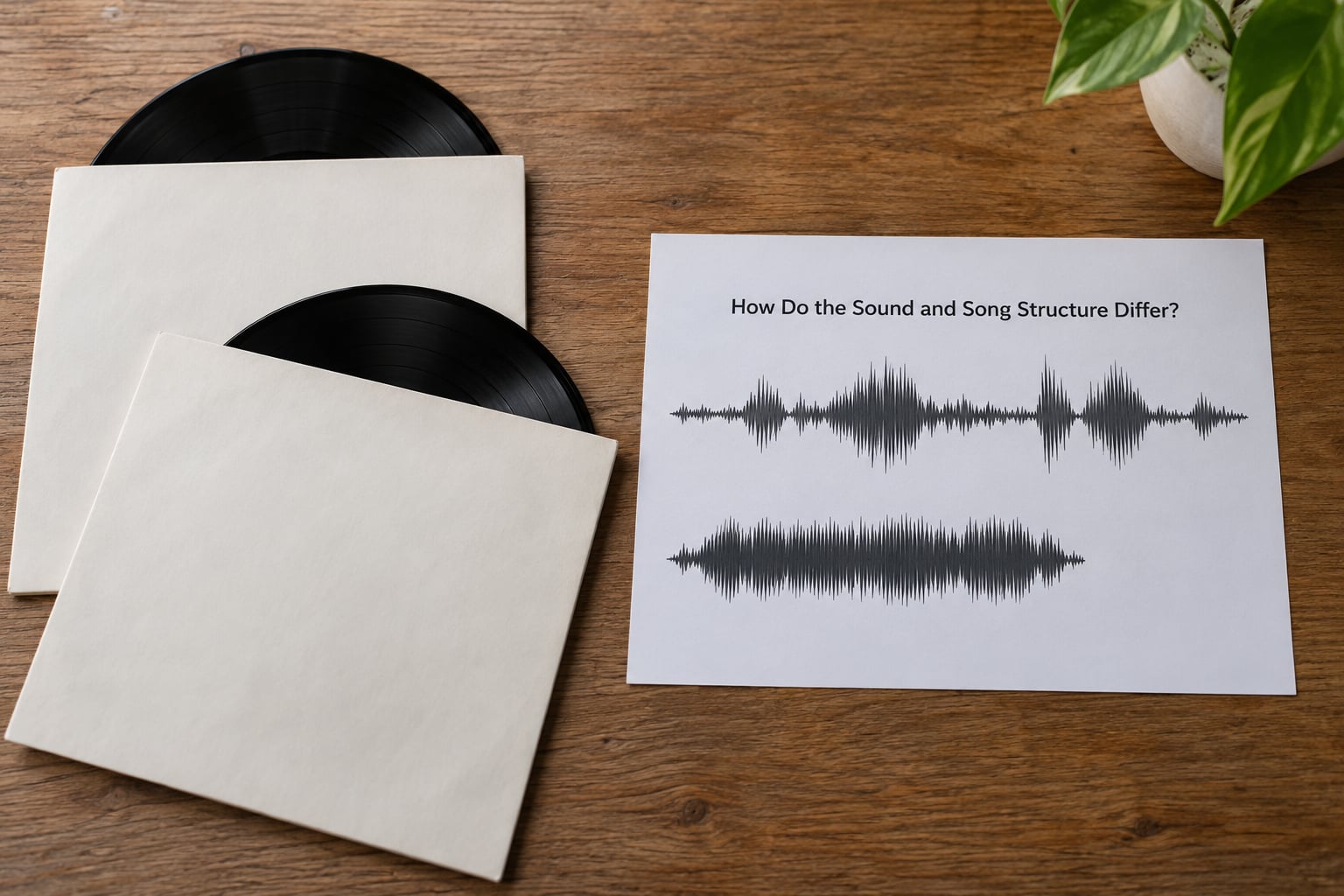
The sound difference is easy to hear once you know what to listen for. Play a Ramones track and a Bad Brains track back to back and the contrast needs no explanation.
Hearing the difference between punk and hardcore by ear
Put on a Ramones record and a Bad Brains record in that order and take notes on three things only: how long the songs run, how much space sits between the guitar lines, and whether there is a chorus you could sing. Those three checks answer the difference between punk and hardcore faster than any amount of argument.
Instrumentation and guitar tone
Punk guitar parts are often chopped power chords, sometimes palm-muted, played over a steady backbeat. The tone can be thin and trebly, sometimes deliberately cheap-sounding. Hardcore guitars tend to be more saturated and lower in the mix, with longer single-note lines rather than stacked chords, and distortion that fills more of the frequency range.
Bass is where the difference shows up first on a small speaker. Punk bass often locks to the root and stays simple. Hardcore bass, especially early D.C. and NOLA records, plays fast descending figures while the guitar holds one ringing note.
Tempo, song length and arrangement
Typical punk sits somewhere around 160 to 200 BPM and hardcore runs faster, with 200 BPM and above being common. Average punk song lengths land in the two to four minute range; many hardcore songs finish in ninety seconds to two minutes.
Arrangement matters as much as tempo. Punk builds around a recognisable hook and a chorus, which is why the songs stay memorable after the tempo drops. Hardcore usually leans on fast verse-like sections, sometimes a breakdown that strips the rhythm to drums or a single guitar note, and an ending that arrives without warning.
Vocals, production and dynamics
Punk vocals range from sung to half-spoken, and pop-punk leans heavily on melodic lines. Hardcore vocals are mostly shouted or barked, recorded close to the microphone so you hear breath and consonants rather than a polished tone.
Production separates the two more than any single instrument. Early hardcore records were tracked fast, sometimes on four-track or tape, mixed hard and often left to sound thin. Punk records, even the cheap ones, tend to leave room for the band as a unit. The most useful single test is this: if the drums and guitar seem to be fighting for the same space and the mix feels blunt, you are probably hearing hardcore.
What About Lyrics, Attitude, and the Scene?
Punk lyrics cover a wide range: boredom, suburbia, love, irony, unemployment, government. Clash and Dead Kennedys wrote sharp political material, while the Ramones wrote about being young and broke with a wink. Humour and irony are normal in punk, sometimes as a way of refusing to be serious.
Hardcore lyrics tend to be shorter, more direct and more confrontational. Bands address the crowd, list demands, talk about the scene itself or describe a specific grievance without decoration. Straight edge lyrics state a personal code plainly. There is political content in both genres, though hardline readings of the scene around some bands are a separate and messier story than the music.
The bigger contrast is at the show. Punk crowds jump, pump their arms and sing the chorus. Hardcore crowds move constantly, and physical participation is normal: slam dancing, running along the barrier, stage diving, crowd surfing. On the stage, hardcore performers move more, and a fight breaking out is not unheard of even now.
That intensity is a real tradition, not a reliable rule for sorting records. Plenty of hardcore bands play still, and plenty of punk shows are more physical than some hardcore ones. Regulars who grew up in these scenes talk about the cultural difference more than the musical one, and they tend to be the harshest about labels that do not match how a band behaves.
Forum threads on r/punk and r/hardcorepunks are full of exactly this argument, and it never fully resolves. That is normal for a genre built on DIY rules rather than a written definition.
Where Do Punk and Hardcore Overlap?
Overlapping cases are where the vocabulary gets confusing, so it helps to walk the branches.
- Oi! and street punk. Oi! started as a greeting among British skinheads and was adopted by punk crowds in the early 1980s. The Exploited, GBH and Discharge carry a working-class, aggressive punk style that sits close to hardcore without being the same thing.
- Skate punk. Fast, simple and melodic, produced in the punk tradition but usually friendlier to hooks than hardcore is.
- Crossover thrash. Late 1980s bands such as Suicidal Tendencies added metal riffs and breakdowns to hardcore and brought major label attention to the style.
- Youth crew. The mid 1980s wave, with bands like Gorilla Biscuits and Judge, played fast melodic hardcore and brought a visual language that changed the scene.
- Post-hardcore. The name describes bands that came out of hardcore and moved away from it, including Fugazi and At the Drive-In. It is not shorthand for “the toughest hardcore.”
- Melodic hardcore. Slower, riff-driven and often screamed over, sitting between hardcore and post-hardcore. A lot of younger listeners meet hardcore through this route and then work backwards.
Metallic hardcore and hardcore-adjacent genres such as metalcore, grindcore and D-beat all borrow heavily from hardcore even when their guitars sound nothing like it.
So how do you tell two bands apart in practice? Use context rather than one clue. Where was the band formed, which labels did they release on, what did the contemporaneous scene press write, and does the band claim the history itself? Records pressed by Dischord, SST, Alternative Tentacles, Revelation or Epitaph usually sit clearly on one side. A single fast song or a shaved head tells you nothing.
Which Should You Choose?
Choose punk if you want guitar-driven energy with melodies you can carry, song structures that reward repeated listening and an easier first step into the history. Choose hardcore if you want brevity, intensity, directness and a live show that is part of the music rather than an accompaniment to it.
For collectors, a side-by-side path works well. Start with a widely recognised punk record on the original pressing, then play a classic hardcore release from a small independent label, then go back to the punk record with headphones on. Write down what changed in the guitars, the vocals and the length of each song.
A few places to start, depending on what you want:
- Punk first: the Ramones’ debut, the Clash’s debut, or Bad Religion’s long-running catalog if you want a band that kept evolving.
- Melodic punk: Green Day or Bad Religion if catchy choruses matter more than weight.
- Hardcore first: Bad Brains for speed, Minor Threat for ethics and songwriting, Black Flag for volume and structure.
- Bridge records: the Dead Kennedys for politics and humour, and Fugazi if you want to hear what came out of hardcore next.
Most listeners end up owning both. Nobody has ever regretted a shelf that is out of order.
Frequently Asked Questions
Is hardcore the same thing as punk?
No. Punk rock is the broad parent style: fast, guitar-driven rock and roll built on hooks and independence. Hardcore punk is a subgenre that came out of it around 1979 to 1981 with shorter songs, faster tempos, heavier guitars and shouted vocals. Bands overlap constantly, which is why the difference between punk and hardcore is often about context rather than a clean rule.
What makes hardcore different from punk in sound?
Hardcore compresses punk. Songs run shorter, usually under two minutes, and the guitar parts are longer and more saturated with less mid-song space. Vocals are shouted close to the microphone rather than sung with a melody, and the mix is rawer. Punk keeps a chorus and a hook; hardcore usually builds fast sections, sometimes a breakdown, and ends abruptly.
Are hardcore songs always shorter than punk songs?
Nearly always in practice, though it is a habit rather than a law. Many hardcore songs land between ninety seconds and two minutes, while typical punk songs run two to four minutes so the chorus has room to land. You will find exceptions in both directions, and songs that sit somewhere in the middle are common at the boundary between the styles.
What is post-hardcore and is it still hardcore?
Post-hardcore describes bands that came out of hardcore and deliberately moved away from its rules: slower tempos, atmospheric textures, longer songs and screaming rather than shouting. Fugazi and At the Drive-In are standard examples. The name means after hardcore, not a harsher version of it, though the early records in the style still carry the tempo and the raw production of hardcore.
Is melodic hardcore punk or pop?
It sits between the two without belonging fully to either. Melodic hardcore keeps hardcore’s tempo range, heavy riffs and vocal style, but adds singable melodies and a more varied song shape. It is not pop-punk, which is punk with catchy choruses and lighter guitars, because the weight and the intensity stay. Bands like Propagandhi and Lifetime are usually placed on the melodic side.
What should a new vinyl collector listen to first?
If you want to understand the difference between punk and hardcore, play one famous punk record and one early hardcore record on the same evening. The Ramones debut and a Bad Brains or Minor Threat record is a good pairing. Small independent label pressings such as those on SST, Dischord or Revelation tend to survive better than reissues, so check the matrix and sleeve when buying.
Conclusion
Punk is the wide, melodic, hook-driven family; hardcore is the faster, shorter, heavier and louder branch that grew out of it around the turn of the 1980s. The differences show up in song length, guitar weight, vocal delivery and how a room moves during a show.
Start with one widely recognised punk record, then play a classic hardcore release straight after it. Write down what you hear, because the difference between punk and hardcore stops being a debate and starts being obvious.