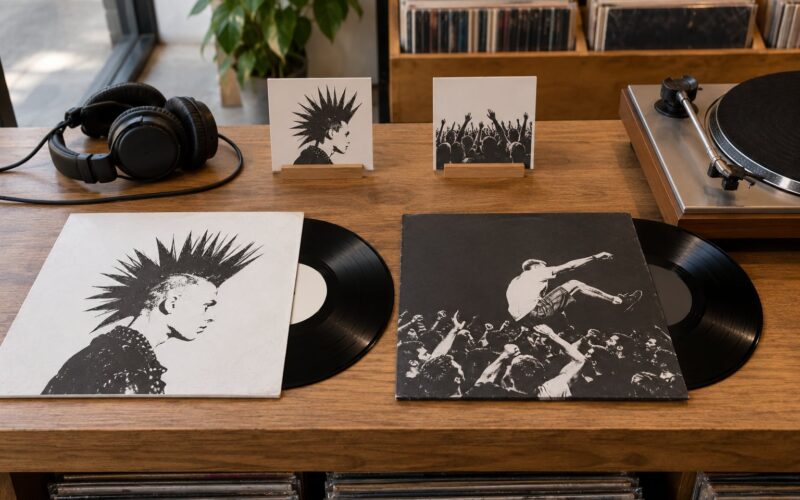
The difference between hardcore and metalcore comes down to what the band does with hardcore’s foundation. Hardcore punk took punk’s speed and DIY ethic and pushed them to the limit: power chords, shouted vocals, songs under two minutes. Metalcore kept the breakdowns and the mosh pit, then added down-tuned guitars, metal riffs, double-kick drumming and clean choruses.
Both genres share a vocabulary, which is why people argue about the border constantly. Here is how to tell them apart by ear, and why some bands sit right on the line.
Table of Contents
- Difference Between Hardcore and Metalcore at a Glance
- What Is Hardcore Punk?
- What Is Metalcore?
- Origins and Influences
- Sound, Tempo, and Instrumentation
- Guitar and tuning
- Drums and rhythm section
- Tempo and song length
- Vocals and Lyrical Themes
- Breakdowns, Clean Sections, and Song Structure
- How the Difference Between Hardcore and Metalcore Gets Confused
- Which Should You Choose?
- Frequently Asked Questions
- Is metalcore heavier than hardcore?
- Is hardcore punk the same as hardcore music?
- Does metalcore always have breakdowns?
- Can a band be both hardcore and metalcore?
- Which genre should a new listener try first?
- Are hardcore and metalcore related to punk and metal?
- Conclusion
Difference Between Hardcore and Metalcore at a Glance
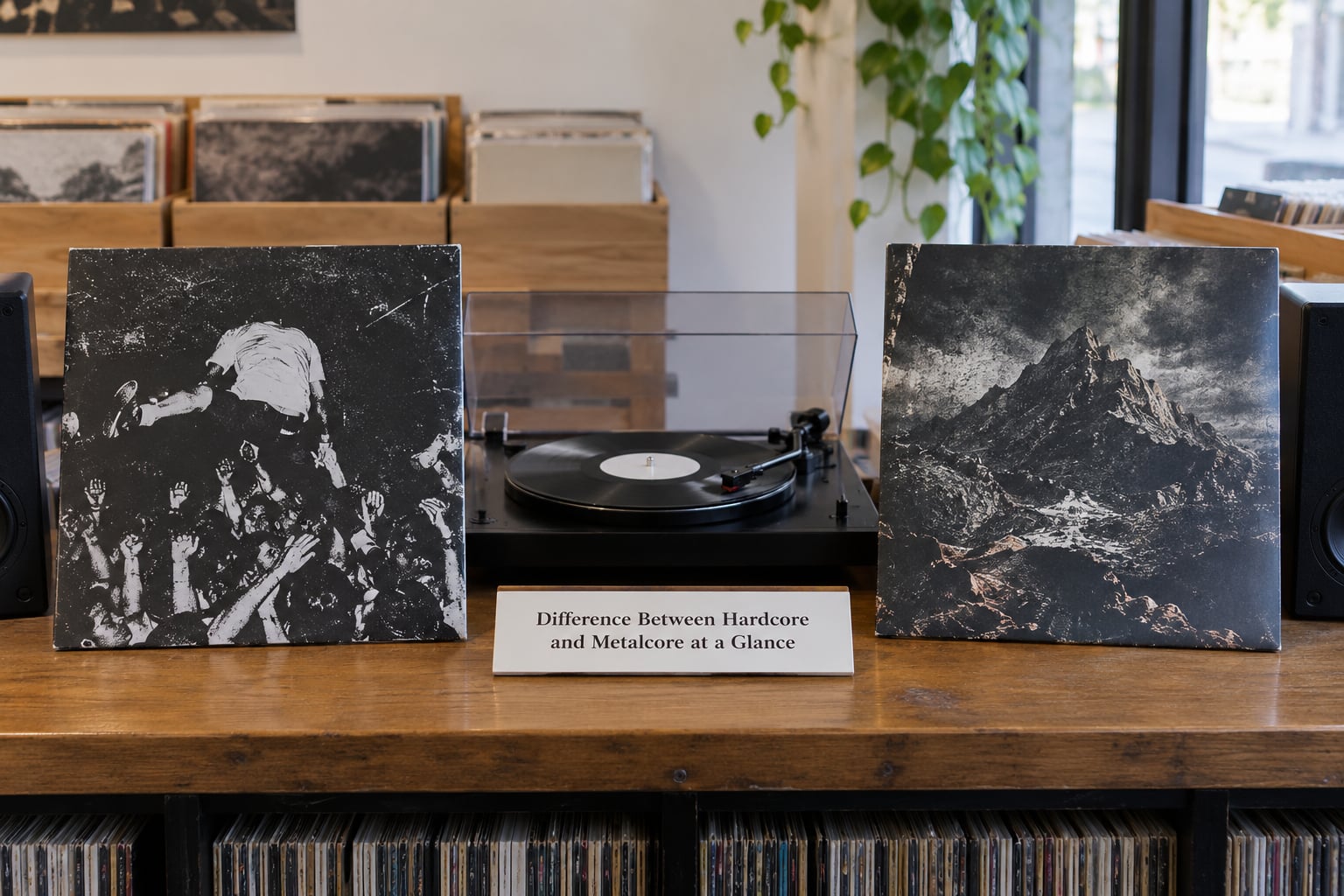
If you remember nothing else, remember this column. Hardcore is fast, short and blunt. Metalcore is slower, longer, more layered and far more polished in the studio.
| Category | Hardcore Punk | Metalcore |
|---|---|---|
| Core idea | Punk pushed to its fastest and loudest | Hardcore fused with heavy metal |
| Tempo | Often 180 to 220 BPM, sometimes faster | Slower, commonly 150 to 180 BPM |
| Song length | 45 to 120 seconds, typically under two minutes | Two to four minutes, often with a long breakdown |
| Guitar | Power chords, stop-start riffs, standard or half-step-down tuning | Palm-muted chugs, sustained riffs, Drop C or lower, often 7-string guitars |
| Drums | Fast two-step feel, D-beats, simple grooves | Double-kick blasting, blast beats, tight quarter-note grooves |
| Vocals | Shouted or barked, rarely melodic | Clean singing that gives way to harsh screams |
| Song shape | Verse, chorus, maybe a breakdown, out | Intro, breakdown or two, chorus, breakdown, outro |
| Production | Rough, cheap, recorded fast, close-miked drums | Polished, layered, wide guitars, tuned vocals |
| Ethos | DIY, anti-authoritarian, straight edge codes | Same punk roots, aimed at festival stages and album sales |
| Live show | Chaotic, close quarters, circle pits and stage dives | Enormous breakdowns built for a synchronized mosh pit |
| Reference points | Black Flag, Minor Threat, Bad Brains, Gorilla Biscuits | Bad Religion, Killswitch Engage, As I Lay Dying, Hatebreed |
What Is Hardcore Punk?
Hardcore punk is punk rock with the decoration stripped off. Where 1977-era punk wrote three-minute songs about boredom and alienation, hardcore took the same three chords, cut the songs down to ninety seconds and pushed the tempo until the drums became a wall of sound.
The DIY ethos matters as much as the sound. In the early 1980s, bands on labels like Dischord in Washington, SST in California and Touch and Go in Chicago released their own records, booked their own tours and slept on floors. That self-reliance is still the reason people say a band is authentically hardcore.
Song structure stayed deliberately simple for a reason: there was no time to develop an idea. Most hardcore songs move from first verse to last chorus in under two minutes, using a single riff the whole way through. Musicianship that draws attention to itself can read as wrong in this context.
What Is Metalcore?
Metalcore is a fusion genre: hardcore punk’s rhythm section, breakdowns and ethos, with heavy metal’s riffing, tuning and production values layered on top. Where hardcore stopped short of complexity to protect its speed, metalcore slows down and builds sections with an arc.
It grew out of the late-1980s and early-1990s crossover between hardcore and thrash metal, and out of regional scenes in Cleveland, Boston, New York and later Orange County, California. Bands like Bad Religion started blending punk craft with metal technique; by the 2000s the formula was everywhere, and by the 2010s it was arena-sized.
The genre has since splintered into melodic metalcore, deathcore, mathcore, nu metalcore and electronicore. What still holds them together is the breakdown, imported wholesale from hardcore and blown up to twice its original size.
Origins and Influences
Hardcore came first, and it came out of punk. Late-1970s punk in California, New York and the UK was deliberately amateur and confrontational. The bands pushed tempo, volume and song length to their limits and turned the whole thing into a movement rather than a style.
Metalcore came later and came from metal’s side of the fence. Crossover thrash in the mid-1980s had already merged hardcore’s aggression with metal’s instrumental vocabulary. By the late 1980s, groups were experimenting with seven-string guitars, drop tunings and breakdowns that had little to do with punk. That groundwork is what metalcore grew from.
The two histories overlap more than most explanations admit. Hardcore was never isolated from metal: Black Flag leaned on metal riffs, and bands like early Bad Religion and Cro-Mags sat between the two worlds. Metallic hardcore, sometimes called beatdown hardcore, is the name for the ground they both stood on.
Sound, Tempo, and Instrumentation
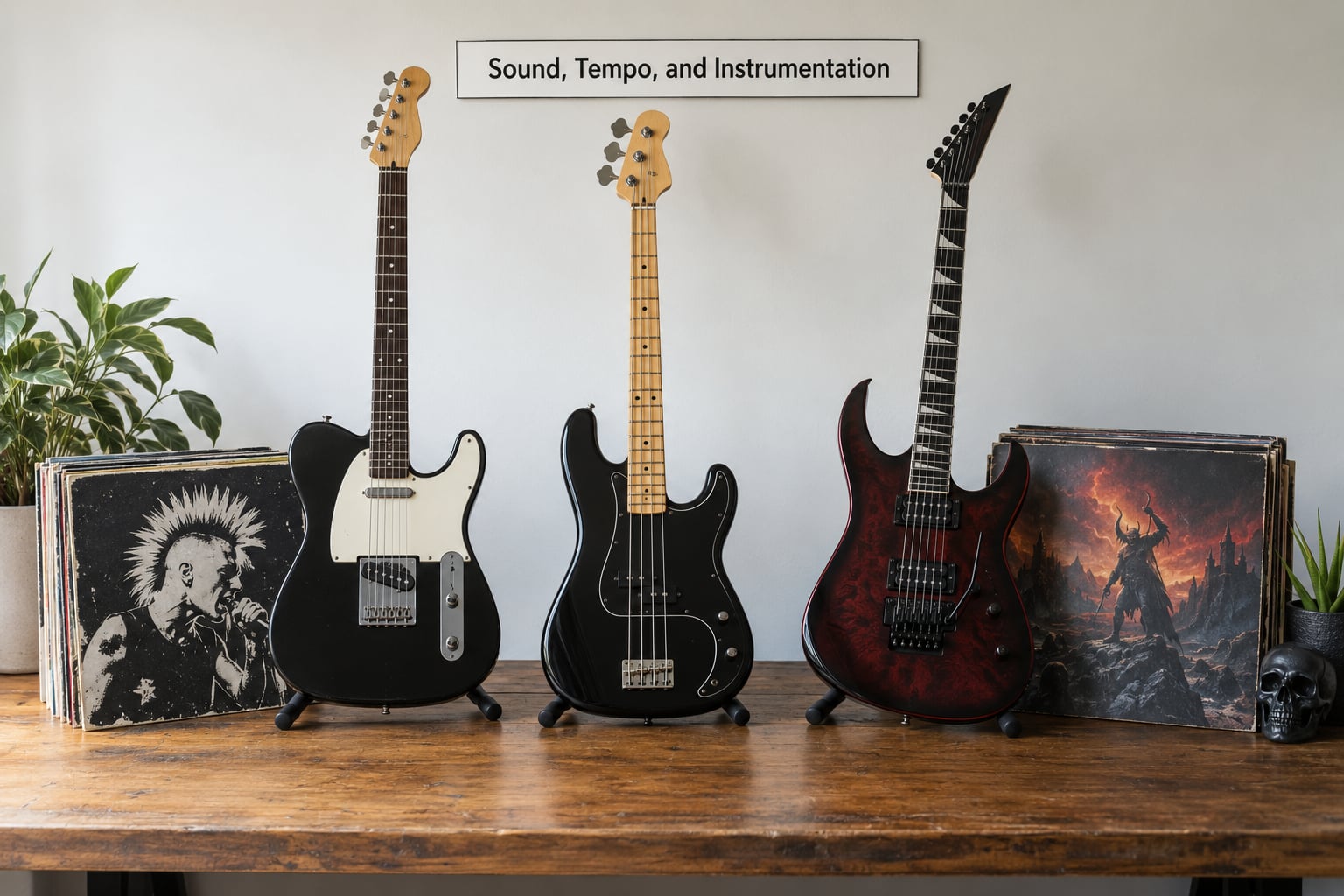
The easiest way to tell the two genres apart with your eyes closed is to listen to the guitars for ten seconds. Hardcore’s riffing sounds clipped and angry. Metalcore’s guitar work has weight and sustain.
Guitar and tuning
Hardcore guitar sits in standard tuning or a half-step down, sometimes lower. Riffs are built from power chords, palm-muted eighth notes and abrupt stop-start patterns that match the vocal phrasing. Think blunt, stabs and single notes that do not linger.
Metalcore typically tunes down to Drop C, Drop B or Drop A, and the extended range lets the low end do the talking. Because the guitar is heavier, the riffs are longer and more sustained. A metalcore riff has room to slide between notes, where a hardcore riff would have simply repeated.
Drums and rhythm section
Hardcore drumming is fast but loose. The classic patterns are a two-step feel, D-beats borrowed from hardcore’s own tradition, and beats that skip around the kit rather than driving straight through it. The bass usually locks to the guitar in the root note.
Metalcore drums are busier and more locked to the grid. Double-kick drumming across the whole bar, blast beats and quarter-note breakdowns built for weight are standard. Bass lines follow the guitar riffs closely, and in the modern era they often add groove and syncopation rather than simply doubling.
Tempo and song length
Hardcore usually runs between 180 and 220 BPM, with songs that last 45 to 120 seconds. Metalcore commonly sits between 150 and 180 BPM and runs two to four minutes, because the format needs room for verse, breakdown, chorus and a second breakdown.
That difference in tempo is not cosmetic. Speed in hardcore creates urgency; space in metalcore creates anticipation. A breakdown only means something if the song has somewhere to fall from.
Vocals and Lyrical Themes
Vocals are the single biggest tell between hardcore and metalcore. Hardcore vocals are shouted, barked or hollered across the top of the mix, rarely with melody and almost never with singing. The delivery matters more than the words, which are often hard to make out on purpose.
Metalcore vocals move between two extremes. A clean vocal sings, sometimes melodically, and then a harsh vocal screams over the same or a different lyric. A listener on their fourth or fifth metalcore album will notice the balance shifting: later bands gave the clean vocal far more room.
Lyrics run along similar lines. Hardcore traditionally deals in direct, socially charged subjects: authority, war, police, boredom, and community. Metalcore leans more often toward the personal and the internal, with struggle, identity, faith, pain and mental conflict dominating. Where a hardcore chorus might name a target, a metalcore chorus usually names a feeling.
One r/PostHardcore thread described the practical test as the singing-to-screaming ratio, how aggressive the song is, and how often the breakdowns appear. It is a rough measure, but it is the one people actually use.
Breakdowns, Clean Sections, and Song Structure
A breakdown is a section where the drums and guitars drop into a slow, heavy groove, usually in half-time, so that each hit lands as a separate event. Some readers will have heard the word used for a breakdown in metalcore specifically, and that usage is not wrong: metalcore made the breakdown its centrepiece.
Hardcore uses breakdowns, but the traditional one is brief. A classic NYHC track might drop into two or four seconds of half-time once, in the middle, as punctuation. A modern metalcore track will open with one, return with another after the chorus, and hold the final one for a full minute.
The purpose is the same in both genres. It is the part of the song the audience moves to: the circle pit during a hardcore show, the synchronized mosh pit during a metalcore one. When the two halves are removed the genre becomes obvious. No clean vocal and no long breakdown usually means hardcore. Clean vocal plus repeated breakdowns usually means metalcore.
How the Difference Between Hardcore and Metalcore Gets Confused
Ask whether Knocked Loose are hardcore or metalcore and you will get both answers in the same thread. An r/corejerk poster put it plainly: no djenting, no big singing chorus, no R&B, only scary hardcore elements. Meanwhile the band is signed to a label with metalcore history, and its records were nominated alongside heavy records.
This is not a naming failure. It is what happens when a genre name covers a spectrum instead of a boundary. The band has been described as metalcore and hardcore by reputable outlets, and has publicly resisted the label, which tells you how little the label settles.
Incendiary and Kublai Khan get argued about the same way. Kublai Khan has said on the Downbeat podcast that they consider themselves metalcore, which is a reminder that band self-identification carries more weight than a genre tag on a streaming page.
Metallic hardcore, also called beatdown hardcore, is the term that actually describes the middle ground: hardcore played with metal weight, down-tuned guitars and a polished studio sound, but without the clean vocal hook. Hatebreed and Merauder are the reference points. If a record has no singing and still feels as heavy as a metal record, that is the category you are in.
None of this is about taste. Knocked Loose and Converge can both be excellent and still sit on opposite sides of the line. The label tells you how the band plays; it does not tell you whether the band is good.
Which Should You Choose?
Start from what you already enjoy rather than from what is heavier. Hardcore rewards listeners who care about speed, brevity and the DIY story. Metalcore rewards listeners who want riffs, dynamic range and choruses you can sing.
If you like punk and want the raw version, go straight to the foundation: Black Flag, Minor Threat and Bad Brains for the original wave, then Gorilla Biscuits or Judge for the melodic side. Agalloch and Converge show where hardcore went next.
If you want the heavier, more produced end, start where the guitar tone is clearest: Bad Religion for the punk-plus-metal formula, Killswitch Engage for the clean-and-scream template, then As I Lay Dying or Parkway Drive once the breakdowns start landing harder.
For a vinyl shop, both eras are still easy to find. Second-wave hardcore from the early 1980s is widely reissued and worth starting with, and the mid-2000s metalcore run has been reissued heavily since streaming changed how people buy records. The sleeve art alone makes the two genres feel different at a glance.
If you want the middle, metallic hardcore is the interesting shelf. It is the least crowded bin in the shop and the most satisfying to dig through.
Frequently Asked Questions
Is metalcore heavier than hardcore?
Usually yes, but heavier is not the clearest distinction. Hardcore pushes tempo and volume to extremes at around 180 to 220 BPM, which can sound more intense than a slower, down-tuned metalcore track. Metalcore is heavier in weight rather than speed: lower tunings, sustained riffs, thick breakdowns and a fuller rhythm section. If you judge by tempo, hardcore wins; judge by low-end weight and production, metalcore usually does.
Is hardcore punk the same as hardcore music?
Yes. Hardcore punk, hardcore and the abbreviated HC all refer to the same genre: the fast, stripped-down branch of punk that emerged in the early 1980s from bands like Black Flag, Minor Threat and Bad Brains. The term hardcore also gets borrowed by other styles, such as hardcore techno or hardcore dance music, where it means something completely different. Within punk and metal, it always points to the punk offshoot.
Does metalcore always have breakdowns?
Nearly always, though not in every song. The breakdown is the signature of the genre, borrowed from hardcore and built into metalcore song structure at the intro, the bridge and the outro. Some bands shorten or remove them as they have evolved toward melodic or groove-focused writing. Metalcore without breakdowns is unusual, and when it happens the genre usually gets described as metallic hardcore or crossover instead.
Can a band be both hardcore and metalcore?
Yes, and plenty are. Metallic hardcore, sometimes called beatdown hardcore, exists specifically to describe that overlap: hardcore energy and ethos with metal tuning, riffs and production, usually without the clean vocal hook. Bands such as Hatebreed and Merauder sit here, and newer groups like Knocked Loose and Incendiary get argued into one category or the other depending on who is talking. Bands also shift styles between albums.
Which genre should a new listener try first?
Whichever one your current taste is closer to. If you came from punk, start with hardcore: it is the direct ancestor and the songs are short enough that an album goes by quickly. If you came from metal, start with metalcore, where the riffs and clean choruses are familiar. The honest answer is that either works as a door into the other, since metalcore simply built on hardcore rather than replacing it.
Are hardcore and metalcore related to punk and metal?
Both are, in different proportions. Hardcore punk descends directly from late-1970s punk and shares its DIY ethic, short songs and anti-authoritarian politics. Metalcore descends from hardcore and adds heavy metal: riffing, drop tunings, double-kick drumming and polished production. Punk came first by roughly a decade, and metalcore is the later branch that carried punk energy into a heavier and more commercially shaped form.
Conclusion
Hardcore is punk with the fat trimmed off: fast, short, raw and built on riffs you can shout back. Metalcore took that engine, dropped the tuning, slowed it down and added clean singing, weight and studio polish. Everything else is a variation on that trade.
If you want somewhere to start tonight, put on a classic hardcore record first so you hear the foundation without any metal on top of it, then move to a metalcore release for the riffs, the breakdowns and the clean chorus. Once you hear both back to back, the difference stops being a debate and starts being obvious.