The history of surf guitar sound is really a story about a guitar tone. In the late 1950s and early 1960s, players fed bright single-coil electric guitars through amplifiers with long spring reverb tanks, and the notes stopped sounding dry and crisp. They smeared, dripped and decayed like water washing back off a beach.
Everything else — the fast tempos, the shouting sax, the revved-up rhythms, the vocal harmonies — grew out of that tone. Get the reverb right and the rest follows. This guide walks the history of surf guitar sound from rockabilly twang to the stereo productions of the mid-1960s, with the records, instruments and effects that drove each step.
Table of Contents
- What Is Surf Guitar Sound?
- How Surf Guitar Sound Began in the 1950s
- The Transition From Rockabilly to Surf Instrumentals
- How Effects Created the Classic Surf Sound
- Which effects actually built the classic surf guitar sound
- Who Shaped the Sound of Surf Guitar?
- How Surf Guitar Sound Changed in the 1960s
- What Makes a Surf Guitar Track Sound Authentic?
- Which Records Are Essential Listening?
- Frequently Asked Questions
- What does surf guitar mean?
- Is Dick Dale the inventor of surf guitar music?
- What guitar did surf guitarists use?
- How did slapback echo and reverb create the surf sound?
- What is the difference between surf guitar and rockabilly guitar?
- Which surf records should a vinyl collector start with?
- Conclusion: Start With the Records, Then Follow the Sound
What Is Surf Guitar Sound?
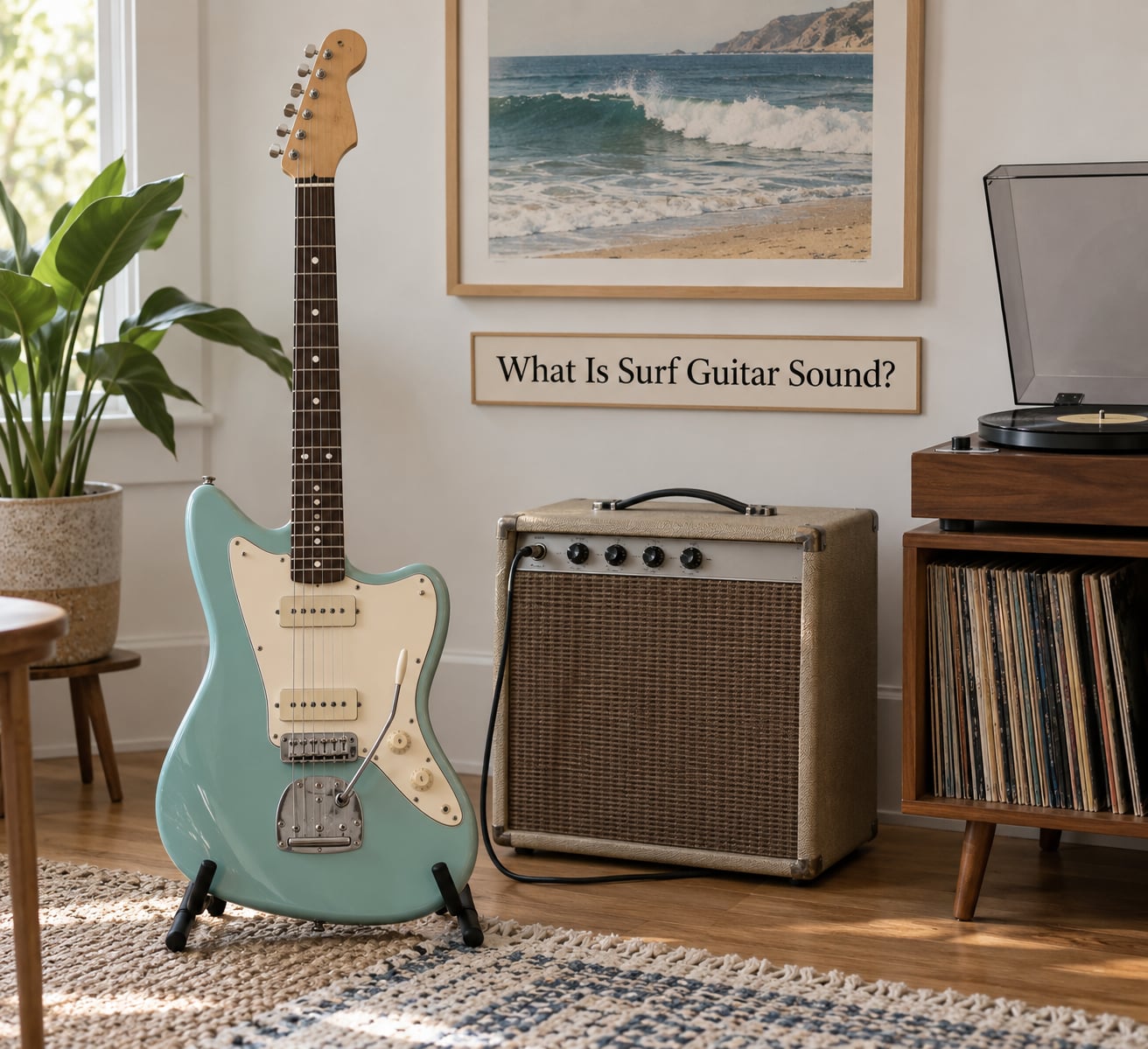
The surf guitar sound is a late-1950s instrumental rock style built around single-coil electric guitars drenched in spring reverb, so each note smears and fades out like a breaking wave. It is usually fast, usually instrumental, and almost always played with rapid alternate picking and heavy vibrato-arm dives over a riff-driven rhythm section.
Six elements define it, and you can hear all six on any classic record:
- Wet, dripping reverb. Notes ring out long after the pick hits the string, so chords blur into each other.
- Bright single-coil tone. Clean, thin and twangy, with no heavy humbucker warmth in the way.
- Rapid alternate picking. Down-up-down-up strokes keep the tempo driving at speeds most players would not attempt with a pick.
- Vibrato-arm dives. Notes bend downward at the end of a phrase to imitate a wave falling away.
- Riff-based leads. Chuck Berry and early rhythm and blues phrasing rather than long melodic solos.
- Energetic rhythm playing. Chugging muted strums, a wailing tenor or baritone sax, and organ or piano fills underneath.
The word surf here is about the surf culture as much as the ocean itself. These were records made for teenagers driving to the beach, and the guitar was imitating the sound they had just left behind.
How Surf Guitar Sound Began in the 1950s
Nothing called surf guitar sound existed before roughly 1958, but every ingredient was already in place. Rock and roll guitar in the mid-1950s was still an extension of country and rhythm and blues: twangy single coils, heavy tremolo picking, a rhythm section that swung rather than drove.
Rockabilly compressed all of that into something faster and meaner. Players began using the palm mute as a rhythmic weapon rather than a volume control, chopping notes into short, dry bursts that sat right under the snare. That muting habit matters enormously later, because surf guitarists kept it even after they drowned everything in reverb.
On the instrumental side, Link Wray and Duane Eddy pushed the electric guitar into the lead. Wray played a hollow-body instrument through a stolen amplifier and got a snarl out of it that had nothing to do with volume alone. Eddy’s twang, produced by Nookie Edwards on a homemade console, became the first widely imitated guitar tone in America.
Then the instruments arrived. Fender’s Telecaster in the early 1950s gave players a solid, bright, single-coil machine with enough sustain to hold a note. Danelectro and Valco-built instruments followed with hollow or semi-hollow bodies, wider single coils and a thick midrange hum. These were the guitars surf players would later push further than their designers imagined.
Instrumental rock and roll ran on records rather than songs during this stretch. The Chantays, the Ventures, the Fireballs and other groups released tracks built for jukebox play and car radios, fast numbers with a guitar hook and no lyric to slow them down. Surf guitar sound was waiting for the right riff.
The Transition From Rockabilly to Surf Instrumentals
The change from vocal rockabilly to all-instrumental surf happened for a simple reason: the guitar already had something to say. Singers needed verses, verses needed choruses, and a chorus is a structural cage. An instrumental has none, so the player has to invent momentum from rhythm alone.
Country and western players had already been using a repeating twelve-bar figure, and guitarist Hank Ballard turned that pattern into a driving instrumental riff in the late 1950s. Duane Allman pushed the vocabulary further with a fluid legato that anticipated the surf lead style by years. When surf guitarists picked those ideas up, they doubled the tempo and added echo.
The shift also changed the riff’s role. In rockabilly the riff was accompaniment. In surf it became the melody, repeated and varied over drums that played fills instead of a backbeat. The harmony underneath it often came straight from blues and rhythm and blues, which is why Chuck Berry’s song structures sit so comfortably underneath the whole genre.
There is a running argument about the first surf record, and it is worth stating plainly. The Bel-Airs released Mr. Moto in June 1961. Dick Dale and His Del-Tones recorded Let’s Go Trippin’ that same year and released it later in the year. Dick Dale’s Misirlou, the track most people know him by, did not arrive until 1962, well after both. Forum arguments about who got there first tend to collapse once those dates are laid out side by side.
What Dale did, more than any single record, was define the playing. His right hand was fast enough to make a solid-body guitar sound like a machine gun, and he leaned into the amplifier’s reverb until notes hung in the air for seconds.
How Effects Created the Classic Surf Sound
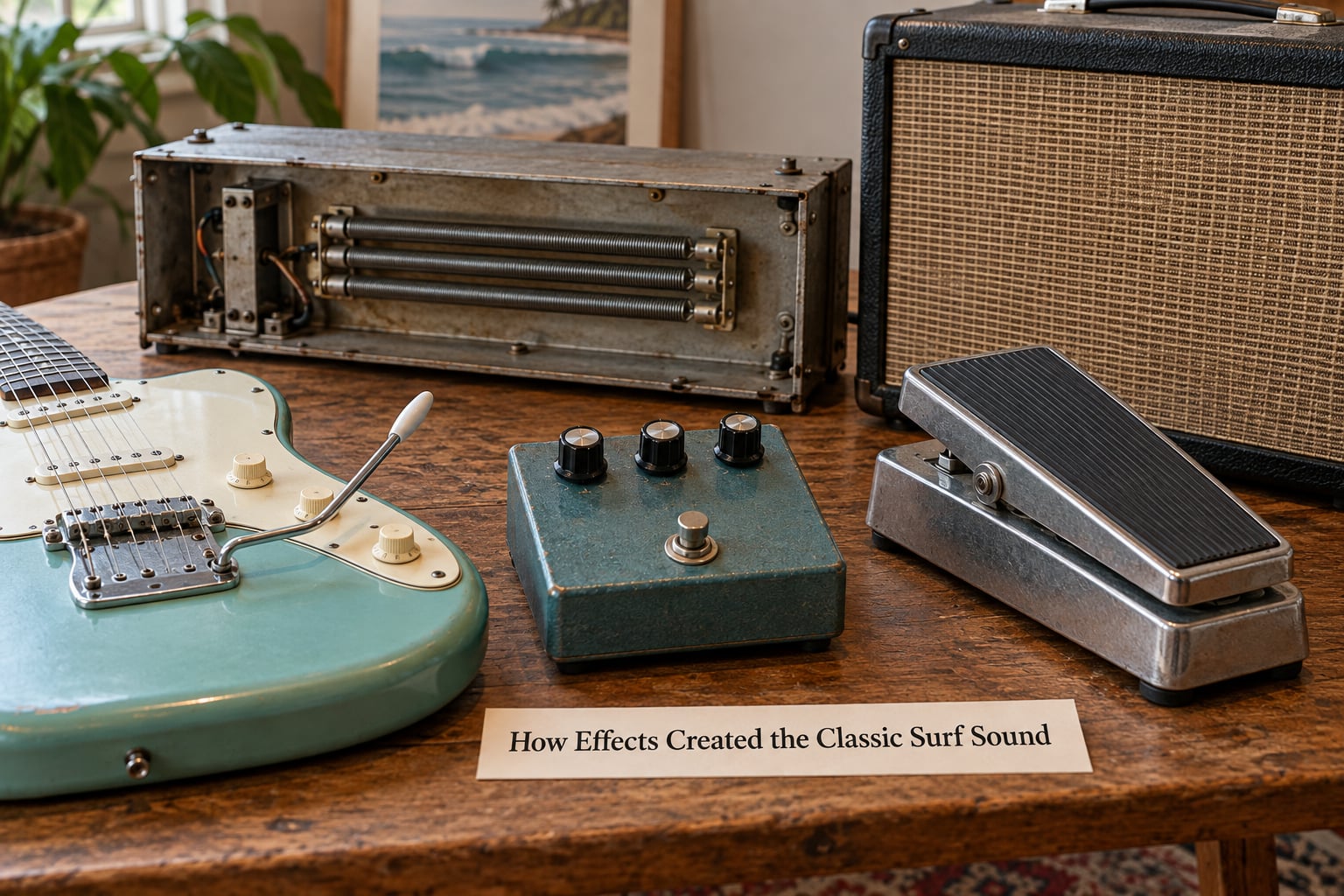
The classic surf guitar sound is a chain, not a single effect. What the player’s hands do feeds a signal path that was usually being invented at the same time as the records.
Which effects actually built the classic surf guitar sound
- Clean single-coil pickup at the bridge, with the amplifier’s bright channel and no overdrive distortion.
- Long-tank spring reverb, cranked further than any modern player would consider tasteful.
- Slapback echo at a delay between 40 and 80 milliseconds, so it lands just after the attack like a slap.
- Tremolo, either a guitar-mounted unit or the amplifier’s own, for the pulsing surge under sustained chords.
- Wide stereo panning in the studio, putting the lead guitar hard to one side and the sax to the other.
- Overdrive, used sparingly and often by the harder 1960s bands rather than the classicists.
The single most misunderstood piece of this is reverb, and the distinction matters. Amplifiers with built-in reverb were common, but Fender also sold a separate Reverb Unit from 1961 onward with a longer spring tank than the onboard circuits. The separate unit produced the wetter, drippier decay that people mean when they describe the vintage surf tone. Players and writers mix these two up constantly, and they are not the same thing.
There is a persistent story that Fender guitarists, Dale especially, used themselves as test engineers for amplifier design, and that Fender built higher-wattage amplifiers partly because of what surf players demanded. Dale drove equipment well past its intended limits and told people about it loudly. Whether the factory was redesigning around him or just absorbing the complaints, the result was the same: louder, wetter, more broken-in amplifiers reached the hands of guitarists by the middle of the decade.
Live amplification and recorded effects were two different worlds. In a ballroom the sound came from amplifiers on stage; in a studio it came from tape echo, spring tanks in the live room, and panning decisions made at the desk. Much of the stereo width listeners associate with the era was studio work, not something the guitar player created.
Guitarists chasing the tone today report the same thing on surf forums: a Telecaster or Stratocaster into a Fender-style amplifier with the reverb turned up gets you most of the way, and the last ten percent is the vintage hardware itself. Some build their own spring reverb circuits rather than settle for a digital emulation that sounds thin.
Who Shaped the Sound of Surf Guitar?
Dick Dale and His Del-Tones set the template, and no discussion of the history of surf guitar sound gets far without him. Dale was born Richard Anthony Monsour and learned Middle Eastern drum rhythms from his Lebanese uncle, which explains the insistent, off-balance percussion running under so much of his playing.
The Ventures brought the guitar sound to the widest audience and proved it could be sold worldwide, and their records from the early 1960s are still the clearest reference for the twangy, echo-soaked style before surf music had a name.
The Chantays, the Surfaris, the Bel-Airs, the Challengers and the Lively Ones each pushed a corner of the format. The Challengers in particular went for the clean, precise, almost classical end of instrumental surf, which is the branch players point to when they argue the genre should stay near-clean. Dale’s noisier, more overdriven approach is the other branch.
The Trashmen straddled genres with Surfin’ Bird, which borrowed a bizarre vocal chant and rode a garage-rock riff to the top of the national chart in 1963. It is surf music by attitude more than by production.
The Beach Boys took a different route entirely. They were a vocal group first, and their surf records were built on layered harmonies, an organ, drums and a rhythm guitar that stayed in the pocket. Dick Dale’s Misirlou and the Beach Boys’ vocal records share a subject, not a sound.
How Surf Guitar Sound Changed in the 1960s
Two things pushed the sound forward at the same time: heavier guitars and louder productions. Fuzz pedals and distortion arrived, and by the middle of the decade bands such as the Trashmen and the Atlantics were deliberately overdriving the surf format into something closer to hot rod rock, which swapped the waves for drag strips.
On the vocal side, Phil Spector’s Wall of Sound technique and the session players who became known as the Wrecking Crew gave surf records a completely different surface. Instead of one guitar and one reverb, you heard multiple guitars, layered vocals and percussion treated as a lead instrument. Producers like Tony Hilder, Gary Usher and Terry Melcher shaped that California studio sound on both sides of the microphone.
Stereo finally arrived in home playback and the genre used it hard, panning a lead guitar to one side and a saxophone to the other. Records that had been cramped in mono suddenly had space around them, and that space became part of how listeners remember the era.
By 1964 the British Invasion pushed the singles chart and surf records stopped charting as often. The style kept developing for a few more years and then fragmented into garage rock, hot rod rock and hot rod-tinged psychedelia. The sound survived in sample, in film scores and, decades later, in the playlist that followed the Pulp Fiction soundtrack.
What Makes a Surf Guitar Track Sound Authentic?
Here is a checklist that works whether you are listening for the first time or trying to judge a record at a shop.
- Tempo. Almost always fast, and the rhythm section plays a driving backbeat rather than swinging eighths.
- Muted articulation. Listen for dead, percussive chugs under the lead. That palm-muted rhythm is the rockabilly inheritance.
- Reverb placement. The guitar is wetter than you are used to. If the dry attack is audible with a long trail behind it, you are hearing the right era.
- Lead phrasing. Short riff-based lines with vibrato-arm dives at the end of a phrase, not long sustained solos.
- Harmony. Twelve-bar blues patterns and rhythm and blues turnarounds, often under a tenor or baritone saxophone that answers the guitar.
- Balance. On instrumental surf the guitar stays audible and forward. On vocal surf the guitars move back and the vocal harmonies come forward.
- Surface noise. Many records were cut close to the limit, so tape hiss and level changes between tracks are normal and period-correct.
One piece of listener’s shorthand worth knowing: collectors and players call the plunky, heavily reverbed attack the drip. If someone says a record has drip, they mean the guitar has that wet, percussive splash on each note.
How much distortion is correct is the argument that never settles. Players chasing the original tone say the amplifier should stay nearly clean with the reverb doing the work. Players in hotter 1960s bands and in later hot rod rock say some fuzz belongs in the mix. Both are authentic to different points on the timeline.
Which Records Are Essential Listening?
Listen chronologically and the sound assembles itself. Use this table as a spine for a listening path, then fill in around it.
| Year | Artist | Record | What to listen for |
|---|---|---|---|
| 1959 | The Fireballs | Torquay | Twang-heavy instrumental rock that points straight at the coming surf sound |
| 1960 | The Ventures | Walk, Don’t Run | Clean echo, wide stereo, the international template for the twang |
| 1961 | The Bel-Airs | Mr. Moto | Among the earliest surf instrumentals, months ahead of the better-known claims |
| 1961 | The Beach Boys | Surfin’ | Vocal surf harmony, surf culture sold as a suburban California life |
| 1961 | Dick Dale and His Del-Tones | Let’s Go Trippin’ | Fast riff-based lead, full wet reverb, the playing style itself |
| 1962 | Dick Dale and His Del-Tones | Misirlou | Middle Eastern rhythmic phrasing under a droning guitar riff, his best-known track |
| 1962 | The Beach Boys | Surfin’ Safari | Vocal group arranging surf as a sound rather than a subject |
| 1962 | The Chantays | Pipeline | Tom Hawaiian on lead guitar, a perfect echo-drenched twang melody |
| 1963 | The Beach Boys | Surfin’ U.S.A. | Vox-recorded drums, stacked vocals, surf taken national |
| 1963 | The Trashmen | Surfin’ Bird | Garage riff and a chant, surf attitude with distortion |
| 1963 | The Lively Ones | Surf Rider | Hot rod-leaning lean into the accelerated riff |
| 1964 | Jan and Dean | Surf City | Laurel Canyon production, close-harmony vocal surf at its peak |
If you only play four, start with Mr. Moto, Let’s Go Trippin’, Pipeline and Surfin’ Bird. Between them they cover the instrumental origin, the definitive playing style, the clean branch and the garage branch.
Frequently Asked Questions
What does surf guitar mean?
Surf guitar is a style of playing rather than a piece of equipment. It describes the guitar part in late-1950s and early-1960s instrumental rock: bright single-coil tones pushed through long spring reverb tanks, played with rapid alternate picking and heavy vibrato-arm dives over fast, riff-driven rhythms. The notes ring out and smear like breaking waves, which is where the name comes from.
Is Dick Dale the inventor of surf guitar music?
Dick Dale is usually called the father of surf guitar, and he arguably invented the playing style rather than the genre. The Bel-Airs released Mr. Moto in June 1961, and Dick Dale and His Del-Tones released Let’s Go Trippin’ later that year. Dale’s Misirlou followed in 1962. He popularized the sound, he did not single-handedly create it.
What guitar did surf guitarists use?
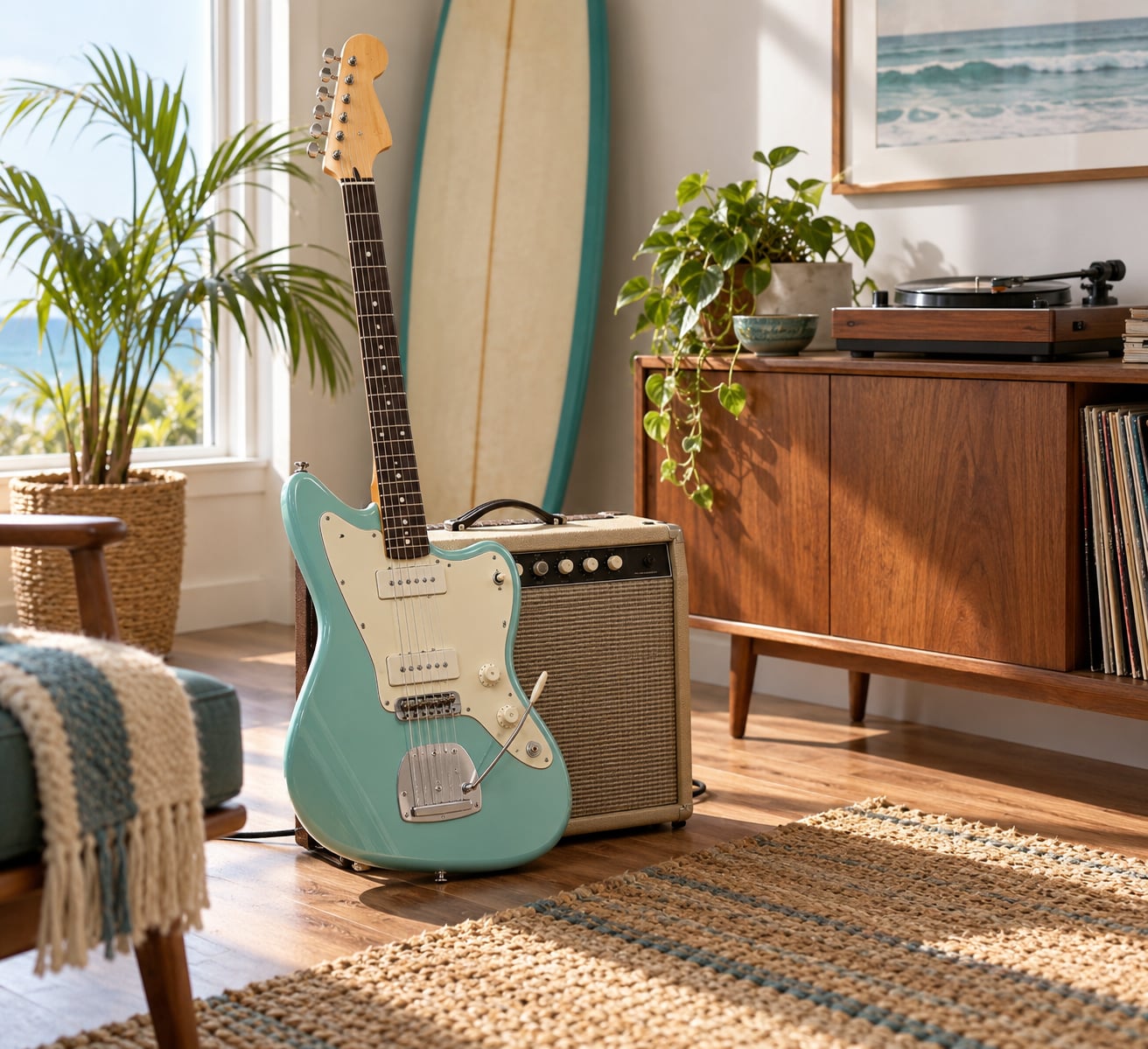
Bright solid-body and semi-hollow guitars with single-coil pickups were the standard: Fender Telecasters, Stratocasters, Jazzmasters and Jaguars, plus Mosrite, Danelectro and Teisco instruments favored by California players. The Precision Bass covered the low end for most surf bands. Baritone guitars showed up often enough to matter, especially for the lower, droning riffs.
How did slapback echo and reverb create the surf sound?
Reverb stretched each note into a long decaying wash that blurred chords together, while slapback echo repeated the attack a fraction of a second later so chords repeated themselves as they faded. A wet guitar plus a short echo delay produces the surf guitar sound: a percussive, watery attack that fills the space behind it instead of decaying to nothing.
What is the difference between surf guitar and rockabilly guitar?
Rockabilly is a vocal genre built on country and rhythm and blues, usually fast, with slapback echo, twangy chords and a driving shuffle. Surf guitar is largely instrumental, faster, and defined by heavy spring reverb, palm-muted chugging and lead riffs built to imitate waves. Guitarists carried rockabilly technique into surf, then drowned it in reverb.
Which surf records should a vinyl collector start with?
Start with the Bel-Airs Mr. Moto and Dick Dale and His Del-Tones Let’s Go Trippin’ from 1961 for the instrumental origins, then add The Chantays Pipeline for the clean twang branch and The Trashmen Surfin’ Bird for the garage branch. For vocal surf, go to The Beach Boys Surfin’ U.S.A. and Jan and Dean Surf City. Pressing quality varies a lot by label, so check the sleeve before buying.
Conclusion: Start With the Records, Then Follow the Sound
Put on Mr. Moto, then Let’s Go Trippin’, then Pipeline, then Surfin’ Bird, in that order. You will hear the history of surf guitar sound arrive rather than get explained: twang turning to wet drip, riff-based leads replacing vocals, drums turning from backbeat to fills, and distortion creeping in at the edges.
Once you have that arc in your ear, everything else in the genre makes more sense. The vocal surf records are a different animal rather than a worse one, the 1963 to 1964 records are where the production peaks, and the revival scenes from the punk era to 2026 are borrowing from a specific moment rather than a vague idea of beach music.