A tour poster flat is the flat, unfolded promotional poster printed to roughly LP size that came inside a vinyl record release as a bonus insert. Collectors also call it a poster flat, a record insert poster or an album insert poster, and the most common sheet measures 12×12 inches. Labels printed it alongside the album artwork and folded it into the record, so today it is bought, traded and framed on its own as music memorabilia.
Most people meet the term for the first time on a marketplace listing, not in a record shop. That is why a lot of the searching behind this question is really about a second question: what is the paper thing in my record, and does anybody care about it?
- What it is: a poster-format sheet included inside a vinyl release, usually promotional.
- Typical size: 12×12 inches, with 12.25×12.25 inches close behind.
- Material: heavier card or paper stock, frequently printed both sides.
- How it arrives: folded into a gatefold or inner sleeve, or wrapped around the record.
- Why collectors want it: it is proof the record was complete, and originals are frequently taken out before a used copy is resold.
Table of Contents
- What Is a Tour Poster Flat?
- What Is a Tour Poster?
- How “Flat” Is Used in Music Collecting
- Tour Poster Flats vs. Standard Concert Posters
- How to Identify a Tour Poster Flat
- Common Types of Tour Poster Artwork
- What Makes One More Valuable?
- Condition Problems Collectors Should Check
- How to Tell an Original Flat from a Reproduction
- How to Store and Display a Tour Poster Flat
- Frequently Asked Questions
- Is a tour poster flat the same thing as a concert poster?
- Should I frame a poster flat or keep it in the sleeve?
- Why are numbered poster flats worth more than unnumbered ones?
- Does old paper automatically make a poster flat rare?
- How can I verify an online listing before buying a poster flat?
- Conclusion
What Is a Tour Poster Flat?
The word doing the work in the phrase is the format, not the event. A tour poster flat is simply a promotional poster that ships with a record rather than one that goes up on a wall or gets handed out at the door. Because the sheet is folded into the packaging, collectors talk about it as a flat, meaning the unfolded single sheet they would frame.
That packaging is not an accident of the vinyl era by luck. Card sleeves scaled to hold an LP became standard after the wrap-around sleeve patent by Garrod and Lofthouse in 1963, which gave labels a large flat surface to design and a natural pocket to put paper extras in. The poster flat is one of those extras.
What Is a Tour Poster?
A tour poster is any poster advertising a specific performance, and the pieces of information on it rarely change: who is playing, where, on what date, and who printed it. Beyond that core, most examples also carry artwork, a sponsor or promoter credit, a printer imprint, and sometimes an edition number or a small disclaimer noting the poster is not for resale.
The distinction that trips people up is that a tour poster and a poster flat often share an identical design. A label can print the same image, change nothing but the size, and release one version as a handbill for the box office and a larger version as the insert. If it came out of a record, it is a flat by provenance, whatever it looks like.
How “Flat” Is Used in Music Collecting
Sellers use flat as a noun the way they use sleeve or pressing, and the usage has a practical reason. Promotional posters were traditionally distributed folded rather than rolled, while retail display posters went out on a tube. A folded sheet picks up sharp horizontal creases that a rolled sheet never has, and a poster with those creases is hard to sell or frame, so listings started describing the flat version separately.
You will see it written several ways: 12×12 poster flat, record store promo poster flat, double sided promo poster flat. Occasionally sellers stretch the term to cover any concert print they can fit in a flat mailer, which is why two items described the same way in the same search can be completely different objects.
The practical takeaway is simple. Flat describes how the sheet is handled and stored, and it tells you it is a single flat piece of paper rather than a tube. It does not promise a particular size, a particular artist or a particular printing method.
Tour Poster Flats vs. Standard Concert Posters
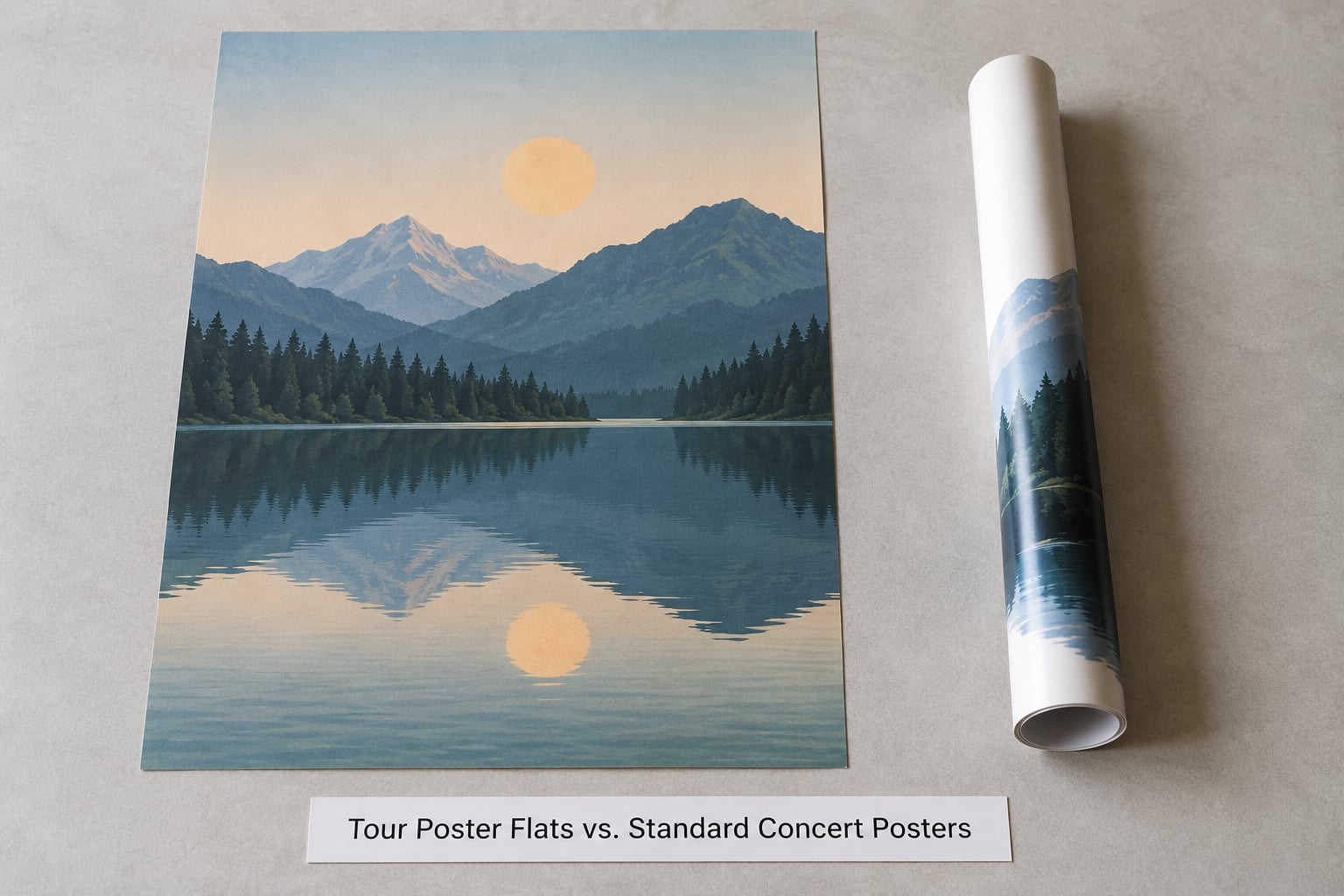
Both are music paper, and the overlap in vocabulary is exactly why collectors get confused. These are the differences that actually matter when you are sorting through a box.
| Point of difference | Tour poster flat | Standard concert poster |
|---|---|---|
| Production method | Offset or screen print on card stock, printed as part of the record run | Offset, litho or digital print made for display and distribution |
| Intended use | Collected, framed or kept in the sleeve as part of the package | Pasted to walls, sold at the venue, posted on phone poles |
| Typical dimensions | 12×12 in, 12.25×12.25 in, or roughly 29.5×12 in double-sided | 18×24 in, 24×36 in and other large formats |
| How it travels | Folded into the gatefold or inner sleeve, so creases are common | Rolled in a tube, so a curl along one edge is common |
| Collecting context | Judged against the record’s completeness, catalog number and edition | Judged by artist, tour, venue, date and whether it was displayed |
| Term drift | Widely used, though some sellers apply it to any flat mailer | Rarely called a flat by anyone |
None of this means a large concert poster is the inferior object. Concert posters have their own serious collecting tradition with its own grading habits. The difference is that the flat belongs to the record first and the poster world second.
How to Identify a Tour Poster Flat
Identification is mostly paperwork and paper. Work through these checks in order and you will know what you are holding within a couple of minutes.
- Read the concert information. Artist, venue, city and date should all be present. A sheet missing the date is usually a modern decorative print rather than a promotional piece.
- Look for the printer or sponsor imprint. Original flats almost always name the printer, a promoter, a sponsor or a licensing company, sometimes in very small type at the bottom edge.
- Check for an edition number. A handwritten or printed number in pencil, often out of a total, is a strong signal the sheet was produced as a limited piece.
- Judge the paper. Flats are printed on noticeably heavier stock than a handbill. Thin, glossy office paper points toward a reprint.
- Turn it over. A blank back is common on a folded single sheet. Full artwork on the reverse usually means a larger double-sided promo.
- Note the folds, pin holes and wear. Horizontal fold lines from packaging, a pair of pin holes near the top, and corner wear all describe how it was stored before it reached you.
- Establish provenance. Did it come out of a record, a mail-order offer, a record store promo, or a tour-only pressing? That single fact changes the value more than any visual detail.
- Look for reproduction tells. Modern reprints usually lack printer marks, show slightly soft typography or register shift between colour passes, and often arrive without any fold history at all.
Common Types of Tour Poster Artwork

Most flats fall into a handful of recognizable production families, and the production method tells you a lot about the date and the run size.
Screen-printed illustrations. A limited number of layers, visible ink build-up, and slight differences between two supposedly identical copies. These tend to come from smaller runs and smaller labels, and the artwork is usually the reason people keep them.
Offset tour prints. The workhorse of the big labels. Four-colour process, smooth gradients, heavy card, and often a fold that matches the gatefold it lived in. This is the most common type of flat you will find inside a mainstream release.
Photocopied and mimeographed promotions. Club nights, student shows, early punk and hardcore gigs. One colour, rough edges, cheap paper, and a handmade feel that later collectors pay well for precisely because nothing about it was mass produced.
Handbill-style sheets. Smaller formats with dense text, a date list and a band logo. When the tour dates are printed rather than handwritten, it is a genuine multi-date promo rather than a one-night advertisement.
Reprints and reproductions. Modern re-issues of a famous flat, sometimes accurate, often printed on thinner stock with no printer imprint. Useful for display, worth far less to a collector than the original run.
What Makes One More Valuable?
Desirability is a stack of factors, and no single one carries a sheet on its own. In rough order of weight, they are the following.
Who it is for. Demand follows the artist, and demand follows a band’s peak rather than its whole career. A flat for a defining period matters more than one from the same artist in a quieter year.
What the event was. A first show in a city, a final tour date, a festival headline slot or a cancelled or infamous booking all add weight that a routine club date never carries.
How good the artwork is. Sheet design is a genuine art form with its own names and its own following, and an illustrator’s name on the print can outweigh the band name for the people who collect it.
How original it is. A confirmed original insert from a specific catalog number beats a visually identical later copy every time. Provenance is doing the heavy lifting here, not the image.
How rare it is. Small printed runs, discontinued inserts and tour-only pressings produce genuinely scarce objects. Pressings that were never reissued stay scarce because supply stopped when the pressing stopped.
Its condition. Full stop. An otherwise identical sheet without creases, tears or fading will always be the more wanted of two.
Whether it is signed. An authenticated signature transforms the object from packaging into memorabilia, which is a completely different market.
Condition Problems Collectors Should Check
Paper does not forgive. Every one of the following issues reduces what a collector will pay, and several of them cannot be undone.
- Creases and fold marks. The defining problem for flats, because they were folded into the packaging. Sharp breaks through artwork are the worst version.
- Curling and cockling. A persistent curl from rolled storage or damp. It relaxes under weight, but paper that has taken a set can stay uneven.
- Trimming. Edges cut slightly short, usually by someone trying to fit the sheet into a frame. This is a permanent reduction in size.
- Corner wear and small losses. Paper softens first at the corners and along fold intersections.
- Pin holes. Two small holes near the top edge usually mean the sheet was once on a wall. Most collectors accept them as history rather than damage.
- Fading and colour shift. Direct sunlight and fluorescent light both bleach inks unevenly, and fading is irreversible.
- Staining, foxing and moisture marks. Small brown spots with a musty smell suggest damp storage.
- Ink transfer and offsetting. Printed areas that have stuck to another sheet, sometimes leaving a mirror image on the back.
- Writing and inventory marks. Ballpoint or marker in the margin, or a dealer’s number, which collectors call writing rather than a signature.
- Restoration. Lifted tears filled with tissue, reattached corners and brushed-in colour. Honest disclosure matters; undisclosed restoration does not.
How to Tell an Original Flat from a Reproduction
Authenticating an insert is a process of accumulated small evidence. No single test settles it, which is exactly why the question comes up so often on collecting forums.
Start with paper. Originals from the vinyl era were printed on stock that feels substantial in the hand, with a slight tooth and a deckle-free machine edge. Modern reprints tend to be thinner, smoother and lighter, sometimes on glossy stock that never existed at the time.
Look at the printing itself. On an original offset print you should find clean registration between colour passes, lettering that holds up under a loupe, and a printer’s mark or union bug somewhere in the margin or on the reverse. Reproductions frequently show soft edges, a colour pass drifting a fraction off, or banding in the gradients.
Then check the paperwork. A catalog number, a matrix number, a release date or a printed copyright line tied to a specific pressing are hard to fake convincingly, and their absence is a warning rather than a verdict. The same goes for fold marks that match the sleeve the sheet came out of.
Finally, compare against known examples. Find photographs of the same release with the flat present, and compare the layout, the type and the colour balance line by line. The limits here are real: a single online image is not enough, because compression, lighting and colour correction can all make a genuine sheet look wrong. If a seller only offers a flat photo, treat the piece as unconfirmed until you have seen the reverse, the edges and the paper in person.
How to Store and Display a Tour Poster Flat
Storage is easy and cheap, and the advice has not changed in decades. Flat, dark, dry and buffered.
Wrap the sheet in acid-free tissue rather than anything glossy, and slip it into an archival folder or a polyester sleeve. Do not use ordinary cardboard, and do not tape anything to the front.
Keep it out of direct sunlight and away from fluorescent fixtures, since both bleach ink faster than almost anything else in a room. Stable humidity matters more than a specific number; swings cause cockling far more often than steady dry air.
For display, use an acid-free window mat so the sheet does not touch the glazing, and choose reversible mounting materials so a future collector can remove it without damage. Museum glazing is worth the extra cost if the sheet is valuable.
There is a genuine disagreement among collectors about framing at all. The common practice is to keep the flat inside the sleeve with the record, treating the package as a single object that should stay together. Others frame them and keep the record separately. Both are defensible; what nobody defends is heat, steam or an iron, all of which damage ink permanently.
Frequently Asked Questions
Is a tour poster flat the same thing as a concert poster?
No, though the designs are often identical. A tour poster flat is a poster-format sheet that came inside a vinyl release as an insert, usually folded into the sleeve. A concert poster is made for display and distribution, usually in a much larger format and often rolled in a tube. A sheet counts as a flat because of where it came from, not because of how it looks.
Should I frame a poster flat or keep it in the sleeve?
Both approaches have supporters and neither damages the sheet if it is handled properly. The more common practice among collectors is to leave the flat in the sleeve with the record, since it was part of the original package. If you frame it, use an acid-free window mat so the paper never touches the glass, and avoid any direct sunlight on the frame.
Why are numbered poster flats worth more than unnumbered ones?
A number tells you the sheet came from a deliberately limited run, usually penciled or printed out of a stated total. That is direct evidence of scarcity, which is hard to prove for an unnumbered piece that could have been printed in any quantity. Numbering also confirms the flat was handled as a collectible from the start rather than packed as an afterthought.
Does old paper automatically make a poster flat rare?
No. Plenty of record inserts from the vinyl era were printed in large runs and survived in quantity because they were never removed from their sleeves. Age alone proves very little. Scarcity comes from a small printed run, a discontinued insert, a tour-only pressing, a known provenance or a genuinely limited design, and the market pays for those, not for yellowing.
How can I verify an online listing before buying a poster flat?
Ask for photographs of the reverse, both edges and the paper held up to light, because a single front-on image hides more than it shows. Confirm whether the sheet is double-sided and whether fold marks match the sleeve it came from. Check that a catalog number or printer imprint is present, and treat a listing that supplies only one flat photo as unconfirmed until you have seen the piece.
Conclusion
A tour poster flat is a promotional poster that shipped inside a record, and the term tells you how it is handled rather than who made it. When you pick one up, identify the event and the artist, confirm the print run or edition, document the condition honestly, and compare what you have with known examples of that release before you buy, sell or frame it. That thirty seconds of checking is what separates a genuine insert from an expensive piece of printed card.