The history of American hardcore punk runs from noisy 1970s proto-punk rooms to the independently released records, regional scenes, and DIY machinery that still shape underground music today. Between roughly 1980 and 1986, bands in Washington D.C., Southern California, and New York shortened punk songs, played them faster, and built their own labels, zines, and all-ages shows because the major-label route had nothing to offer them.
Most people arrive at it backwards, hearing a modern band and working backwards. So here is the honest version, region by region and year by year, with the records and scenes that actually made the difference rather than a tidy list of the usual suspects.
Table of Contents
- History of American Hardcore Punk: Why It Began
- How Did Punk Rock Lead to American Hardcore?
- What changed between punk and hardcore?
- Where Did American Hardcore Begin?
- How Did New York Shape the First Wave?
- What Made the 1980s Underground Scene Grow?
- The infrastructure that made it work
- Which Bands Defined American Hardcore?
- How Did Straight Edge and the 1988 Wave Change the Genre?
- How Did Hardcore Connect to Metal, Grunge, and Alternative Rock?
- What Are the Key Hardcore Records for Vinyl Collectors?
- Why Does American Hardcore Still Matter?
- Frequently Asked Questions
- Where did American hardcore punk begin?
- What is the difference between punk and hardcore punk?
- Who started the straight edge movement?
- What is crossover thrash?
- Did Black bands shape American hardcore punk?
- Is hardcore punk still alive?
- Conclusion
History of American Hardcore Punk: Why It Began
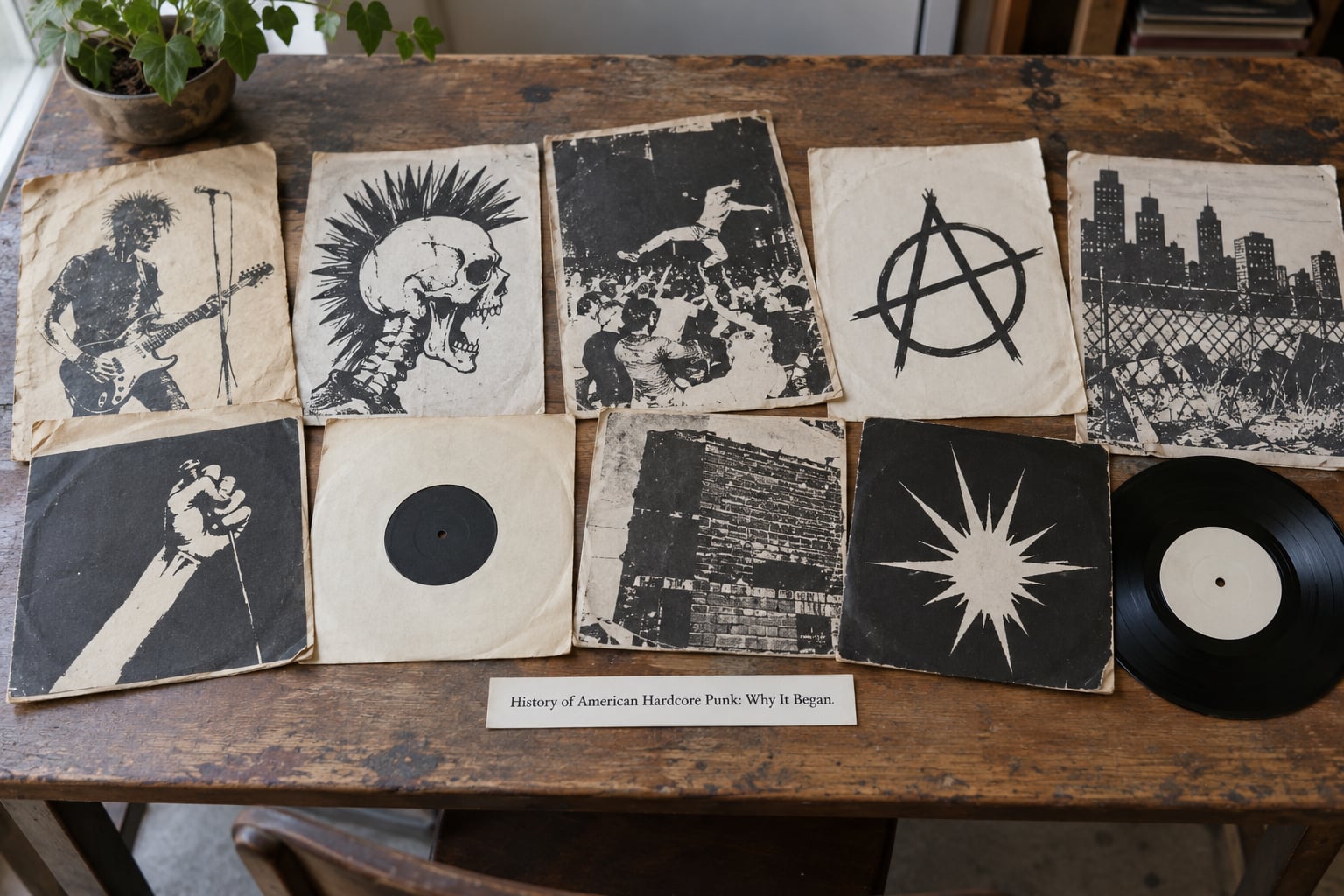
American hardcore punk grew out of the independent punk scene of the late 1970s rather than arriving as a finished genre. It needed a cheaper, meaner, faster version of punk, and the late 1970s recession gave plenty of people a reason to want one.
The economic setting matters more than most histories admit. Between 1979 and 1982, American manufacturing shed jobs at a scale that emptied industrial neighborhoods, and in cities like Washington, Los Angeles, and New York that meant cheap rehearsal space, cheap rental halls, and audiences with little to lose. Young people who had been priced out of clubs a few years earlier found they could rent a VFW hall for a weekend.
There was a practical objection too. By 1979 the major labels had largely decided punk was a sales category with a shelf life, and the independent route that had worked for the Stooges and the Ramones felt out of reach to sixteen-year-olds in Tacoma or Harrisburg. Hardcore’s answer was to shrink every unit of the business: seven-inch singles instead of albums, four-song releases instead of ten, fifty-cent admission, and bands playing shows in places their parents had never heard of.
So the genre’s identity came from three things at once: a sound stripped of everything decorative, an infrastructure built by teenagers, and a set of ideas about how music and politics should sit next to each other. Miss any one of the three and you get a band that sounds fast but does not belong to the movement.
How Did Punk Rock Lead to American Hardcore?
The path runs through the late 1960s and early 1970s, when a handful of American bands made noise that mattered without fitting any category. The Velvet Underground gave guitarists permission to be abrasive and droning. The Stooges made ugliness feel like an act of honesty. MC5 fused punk to funk and machine-gun riffs in a way that later hardcore bands effectively re-discovered.
Then the cities got their own punk. Death, formed in Detroit in 1970 by David Hardy, played fast, nasty garage rock with lyrics about slum life that made Detroit’s underground proud of itself. Pure Hell out of New York, active in the mid-1970s, was racially mixed and genuinely confrontational. The New York Dolls and Television supplied the glitz, the sarcasm, and the New York accent that would define downtown rock for the next decade.
What changed between punk and hardcore?
Four things. Songs got shorter, often under a minute and a half. Rhythms got simpler and faster, with straight eighth-note driving and later the blast beat. Lyrics stopped being wry and became direct, often about police, war, work, and housing. And the presentation got stripped down, because bands were self-releasing artwork designed to survive photocopiers and hand-drawn flyers.
British punk supplied the model and the name, and the Clash and Buzzcocks were not shy about that. What American hardcore added was a different priority. Where British punk often argued with the music industry from within, hardcore tried to build an entire economy outside it, which is why a strange amount of hardcore history is really logistics history.
Where Did American Hardcore Begin?
Southern California is where American hardcore began, and the credit usually goes to Los Angeles, where a specific chain of bands and rooms turned raw punk into something new between 1979 and 1981.
The early Los Angeles punk circuit ran through tiny clubs and rented halls: the Starwood, the Mabuhay Gardens, the Masque, and a rotating set of community rooms and VFW halls. The Bags and X were playing by 1979, X releasing a single that sold well enough to fund the trip to England for the Clash. The Germs and Fear came out of the same rooms and gave the scene an audience.
Then Black Flag arrived. The band’s second lineup, with Greg Ginn on guitar and Keith Morris singing, played short, brutal sets built around speed and pure volume, and they played anywhere they could, including living rooms. Their practice of charging very little or nothing, and putting on shows for audiences half their age, set the template for what followed.
Three results followed quickly. The Circle Jerks arrived with a sharper pop sensibility on Group Sex, mixing hardcore with surf guitar and new wave hooks. The skateboard crowd adopted the music wholesale, because the tempos matched the trick they were already doing. And SST Records, run by Ginn, released so much other people’s music that it became the label other labels were measured against.
How Did New York Shape the First Wave?
New York built the version of hardcore that people outside the city most often picture: fast, metallic, muscular, and physically intimidating. CBGB’s, which opened in 1974 on Bowery, gave it a permanent home, and A7, the punk venue that closed in 1981, gave it a laboratory.
The music that came out of those rooms in the mid-1980s became known as NYHC. John Joseph’s bark and the crew-heavy anthems on Agnostic Front’s Victim of Change (1984) felt physical rather than merely loud. The Cro-Mags mixed reggae pulse and street talk into a groove that was instantly distinct from Los Angeles. Murphy’s Law and Judge went heavier still, with the thick distortion and low tunings that later listeners read as the blueprint for beatdown.
The pit became part of the sound. Slam dancing and a rolling circle pit were New York customs, and so was the crew system that organized it, which could also shade into the pack-style violence associated with the era. That reputation is still attached to NYHC, sometimes fairly for the shows of the mid-1980s and often unfairly applied to the whole scene.
What Made the 1980s Underground Scene Grow?
Washington D.C. ran the tightest scene of the three, and it is where the movement’s most durable ideas came from. Minor Threat, the Teen Idles, Government Issue, and the short-lived S.O.A. traded members like a school clique, played the 9:30 Club, and put out records through Dischord, founded by Ian MacKaye and Jeff Nelson in 1980 to release their own band.
The other scenes had equivalents. Boston had the Lyers, DYS, and SSD. San Francisco had the Dead Kennedys, who mixed hardcore speed with political satire and humor. Austin had the Big Boys and MDC. Seattle had the Fartz and Green River. Each had venues, a small label or two, and one or two groups of people who decided to do all the work themselves.
The infrastructure that made it work
- Zines. Maximum Rocknroll out of Los Angeles and Flipside out of San Francisco carried scene reports, interviews, and ads, and let a teenager in Kentucky know a band existed. Both remain the primary research source for the period.
- Tape trading. Cassettes and mail-order demos moved music between cities before anyone had a photocopier budget for records.
- College radio. DJs who played demos and independent singles gave bands reach that no major label would have offered them.
- All-ages venues. Rooms such as 9:30 Club, CBGB’s, the Masque, and 924 Gilman let fifteen-year-olds into the scene instead of driving them to the street.
- Cheap admission. Five-dollar shows were a business model, and some bands deliberately set admission below what a gallon of gas cost.
- Independent labels. Dischord, SST, Touch and Go, Alternative Tentacles, Frontier, Epitaph, and a long tail of tiny imprints formed a distribution network that did not route through the majors.
That last point is the real legacy of the 1980s. The model of an artist-owned label, a cheap show, and a scene press run by volunteers became the template that a lot of later independent music still uses.
Which Bands Defined American Hardcore?
No short list is the whole story, but a handful of bands show the range. Black Flag set the speed and the volume. Minor Threat set the discipline and the philosophy. Bad Brains set the musicianship, playing lightning-fast hardcore over jazz and funk roots that their members had absorbed. Dead Kennedys and Misfits made it funny and theatrical. The Descendents wrote the pop hooks that made the sound memorable. Agnostic Front defined the New York end, and Gorilla Biscuits and Youth of Today the youth crew end.
| Scene | Sound | Core bands | Key venue | Label |
|---|---|---|---|---|
| Washington D.C. | Fast, melodic, politically sharp | Minor Threat, Bad Brains, Government Issue, Embrace | 9:30 Club | Dischord |
| Los Angeles / Southern California | Brutal, surf and skate inflected | Black Flag, Circle Jerks, Fear, Descendents | Masque | SST, Frontier, New Alliance |
| New York | Metallic, groove-heavy, physical | Agnostic Front, Cro-Mags, Murphy’s Law, Youth of Today | CBGB’s | Revelation, Roadrunner-era independents |
| Bay Area | Political, satirical, tight | Dead Kennedys, Flipper, MDC | Mabuhay, The Deaf Club | Alternative Tentacles |
Two parts of the story get left out too often. Black and Latino musicians were present from the beginning, not added later: Death and Pure Hell were proto-punk, Bad Brains and the Dead Kennedys were core 1980s bands, and later Fishbone and Living Colour carried the lineage into the mainstream.
Women played instruments, sang, and started bands in the same rooms, often without the credit that followed. Kira Roessler played bass on Black Flag’s Damaged and later formed Saccharine Trust, and she has said repeatedly that the harassment she absorbed inside the scene was real and specific. Bands such as 7 Seconds, the Avengers, and later groups built on that foundation. Riot grrrl, which broke out at a 1992 gathering in Olympia, Washington, pushed a different set of issues into the open, and hardcore’s all-ages rooms were one of the few places it ever had a stage.
How Did Straight Edge and the 1988 Wave Change the Genre?
Straight edge began as one forty-five-second song. Minor Threat released it as a Dischord single in 1981, and the terms were plain: no alcohol, no drugs, no smoking, no sex for its own sake. Bands and audiences turned it into a movement that spread well past the United States through touring and zines.
The 1988 Youth of Today tour was the moment the sound and the movement merged in public. Youth of Today and Gorilla Biscuits shared the bill with Agnostic Front on a split run through the United States and Europe, with stage crews, uniform shirts, and clean-cut commitment. Youth crew bands played fast, positive, disciplined hardcore with simple songs about friendship and commitment, and they sold records to an audience that had never been part of the scene before.
The debates came fast. Some in the original D.C. and New York scenes saw youth crew as an image cleaned up for a major label, and they were not entirely wrong: bands like Bold and Judgment largely did move toward major distribution. Others saw straight edge as a moral framework that made touring and community possible. Both readings exist in the oral histories, which is the honest outcome.
How Did Hardcore Connect to Metal, Grunge, and Alternative Rock?
Hardcore fed into metal rather than blending with it, and the meeting point was the 1980s crossover record. D.R.I., Suicidal Tendencies, Corrosion of Conformity, and Cryptic Slaughter mixed hardcore speed with metal riffs, and shows where punks and metalheads stood in the same room were still a novelty well into the decade.
Thrash metal picked up the blast beat and the palm-muted attack. Beatdown hardened NYHC into the half-time riff that judges call the central maneuver of hardcore, and Agnostic Front’s mid-1990s albums and Judge’s later work defined it. That sound became metalcore through bands like Earth Crisis, Converge, and later Hatebreed and Terror.
The other branch ran toward emotional directness. Hüsker Dü, Rites of Spring, and Embrace moved through the 1984 D.C. releases into what listeners now call Revolution Summer and emo. Fugazi took the ethics into something closer to indie rock and released on Dischord, with records of unusual evenness for the genre.
The Melvins and Nirvana carried Los Angeles and Pacific Northwest underground influences into the mainstream by the end of the 1980s and the start of the 1990s, which is the bridge most people crossed to hear hardcore at all. Underground scenes responded by splitting apart into named subsets, fastcore, powerviolence, grindcore, crust punk, screamo, and emoviolence, each with its own tempo rules and its own vocabulary.
What Are the Key Hardcore Records for Vinyl Collectors?
The best collecting path is chronological rather than by importance, because each record answers the one before it. Work through early independent pressings first, and stay with the original small-label editions, since those are the versions the scenes actually circulated.
- Proto-punk from Death and the Stooges, to hear what was already there before hardcore had a name.
- Black Flag’s Damaged (SST, 1981), the album that made speed and self-release non-negotiable.
- Minor Threat’s Straight Edge (Dischord, 1981) as a 7-inch, plus the self-titled EP, to understand the discipline the scene built around.
- Bad Brains’ self-released LP (1981) and Bad Brains Live (Riot City), to hear the musicianship that shocked early audiences.
- Agnostic Front’s Victim of Change (1984) and Cro-Mags’ The Only Truth (1984), the New York core.
- Minor Threat’s In My Eyes (I.R. Voice, 1984), a small-label pressing that shows how scene distribution worked outside the majors.
- Hüsker Dü’s Zen Arcade and Rites of Spring’s self-titled album, the early branch into emo.
Condition matters more for these records than for mainstream reissues, because a beat-up original is still a piece of the scene while a mint reissue is only a component. Look for pressing differences, colored vinyl, hand-stamped runs, and early catalog numbers, and note where the record came from, since provenance is often the difference between a collectible and a common pressing.
For research, digitized runs of Maximum Rocknroll and Flipside, plus the Dischord, SST, and Touch and Go catalogs, will tell you more about what was happening month to month than any retrospective. Tony Rettman’s oral histories and Steven Blush’s American Hardcore, the book that led to the 2006 documentary, are the long-form versions of the same material.
Why Does American Hardcore Still Matter?
American hardcore still matters because the industry it refused is now the industry it shaped. Artist-owned labels, all-ages rooms, cheap admission, scene-run internet radio, and volunteer-run archives all trace back to people doing this in 1981 with a photocopier.
Its language moved too. Straight edge, breakdown, stage dive, slam, crew, and posi are ordinary words inside a specific community now, and the arguments the scene had about politics, policing, war, and animal rights come back up every time a new generation argues about what a band is allowed to say.
The music also never stopped turning over. Bands from the 1990s and 2000s who had no commercial path are now festival staples, and the current generation of bands has taken the DIY ethic further than the people who invented it could have imagined.
If you are starting cold, the fastest route in is five records in order: Damaged, Straight Edge, the Bad Brains LP, Victim of Change, and Zen Arcade. Twenty minutes each, in that sequence, and the shape of forty years makes sense.
Frequently Asked Questions
Where did American hardcore punk begin?
There is no single birthplace. Most accounts put the emergence between 1979 and 1982, across Washington D.C., Los Angeles, and New York, when those scenes first released records on their own labels. Los Angeles gets credit for speed and volume through Black Flag and the Germs, New York for the tough metallic style, and D.C. for discipline and the straight edge idea. Naming one city misses how regional the movement was.
What is the difference between punk and hardcore punk?
Hardcore is punk rock compressed and made faster. Songs are usually shorter, rhythms simpler and quicker, and lyrics tend toward direct social subject matter instead of irony. Punk retains more genre variety, including surf, new wave, and art rock branches. The dividing line is roughly the early 1980s, when independent scenes in several US cities started prioritizing speed, brevity, and self-release.
Who started the straight edge movement?
Straight edge began with Minor Threat’s 1981 single on Dischord Records, written and sung by Ian MacKaye. The song runs under forty-five seconds and sets out the terms: no alcohol, no drugs, no smoking, no sex for its own sake. Other Dischord bands and the youth crew groups that came later turned those rules into a movement with its own look, language, and touring circuit.
What is crossover thrash?
Crossover thrash is hardcore played with metal instrumentation, and it was invented by American bands in the mid-1980s. D.R.I., Suicidal Tendencies, Cryptic Slaughter, and Corrosion of Conformity wrote fast hardcore records that used metal riffs, thrash drumming, and the blast beat. Those records crossed into the metal audience, and metal bands picked up the tempo and the drumming style, which is why crossover sits between the two genres rather than fully inside either.
Did Black bands shape American hardcore punk?
Yes, and the role is regularly understated. Death in Detroit and Pure Hell in New York were proto-punk bands before hardcore existed. Bad Brains came out of Washington D.C., and the Dead Kennedys out of San Francisco, both founding scenes. Fishbone and Living Colour carried the sound into the 1990s, and the Black Rock Coalition, formed in New York in 1986, gave Black artists a shared platform.
Is hardcore punk still alive?
It is alive and mostly underground. The youth crew sound has been revived several times, beatdown and metalcore scenes have been active for decades, and bands from the 1990s and 2000s now play festivals they would never have reached. Venues still run all-ages shows at cheap admission, and independent labels release seven-inch records by hand. The scale changed, not the method.
Conclusion
Start with five records in order. Black Flag’s Damaged for speed, Minor Threat’s Straight Edge for the philosophy, the self-released Bad Brains LP for the musicianship, Agnostic Front’s Victim of Change for New York, and Hüsker Dü’s Zen Arcade for where it went next.
Then go back to the regional scenes and the independent catalog numbers, because the history of American hardcore punk is not one band’s rise. It is a set of cities that decided to do their own paperwork, and the records are the receipts.