60s beat music is a British pop and rock style that grew out of Liverpool in the late 1950s and peaked in the early 1960s, built from American rock and roll and rhythm and blues. It is also called British beat or, in its home city, Merseybeat: short guitar-driven songs with a driving backbeat, tight two-minute structures, and vocal harmonies you can follow without trying.
Ask a record shop regular about 60s beat music and they will probably tell you the same thing I would: put on the Searchers or the Dave Clark Five before the Beatles, because too many people only ever hear four songs.
Table of Contents
- What Is 60s Beat Music?
- What Did 60s Beat Music Sound Like?
- A five-point checklist for recognising what is 60s beat music
- Where Did 60s Beat Music Come From?
- How Did 60s Beat Music Differ From the British Invasion?
- What Instruments and Techniques Defined the Beat Sound?
- Who Were the Most Important 60s Beat Bands?
- The Beatles
- The Searchers
- Gerry and the Pacemakers
- The Hollies
- The Dave Clark Five
- The Animals
- The Zombies
- The Kinks, the Rolling Stones and the Who
- The Small Faces, the Troggs, the Tremeloes
- Which 60s Beat Records Are Essential for Vinyl Collectors?
- How Can You Identify a 60s Beat Record?
- Frequently Asked Questions
- Is 60s beat music the same as the British Invasion?
- Which instruments are most associated with 60s beat music?
- Are the Beatles and Rolling Stones beat music or British Invasion bands?
- What is the difference between beat, rock and roll, and garage rock?
- What are the best first 60s beat records for a new vinyl collector?
- How can I tell which country pressed a 45 rpm record?
- The Short Version
What Is 60s Beat Music?
Beat music, also known as British beat or Merseybeat, is a guitar-led genre that developed in Liverpool between roughly 1958 and 1966. It fused American rock and roll, rhythm and blues, doo-wop vocal groups and folk, then compressed the result into songs that fit on one side of a 45 rpm single.
The word itself has a double life. One reading is the policeman’s beat, the round an officer walks; that pun was doing the promotional work when the music was new. The other reading is the Beat Generation, the American literary movement of the 1950s, which gave the culture its mood rather than its rhythm.
What really fixed the name in public view was a magazine. Bill Harry’s Mersey Beat launched in 1961 and turned a loose collection of local groups into a named scene. Harry used the Merseybeat label, and one of the groups on his early listings changed its name from the Merseybeats to the Beatles in 1960.
| Aliases | Beat music, British beat, Merseybeat, British pop |
|---|---|
| Origin | Liverpool, England |
| Years active | Late 1950s to about 1967 |
| Peak periods | 1963 at home, 1964 in the United States |
| Core instruments | Lead guitar, rhythm guitar, bass, drum kit, occasional keyboards |
| Signature groups | The Beatles, the Searchers, Gerry and the Pacemakers, the Hollies, the Dave Clark Five, the Animals, the Kinks, the Who, the Rolling Stones |
| Song format | Verse and chorus, typically under three minutes |
| Direct descendants | British Invasion pop, folk rock, psychedelic rock, garage rock, mod revival |
The lineage matters as much as the sound. There was no single moment when beat began, but 1963 was the year it stopped being a curiosity and became the default sound of British youth records, and 1964 was the year America noticed.
What Did 60s Beat Music Sound Like?
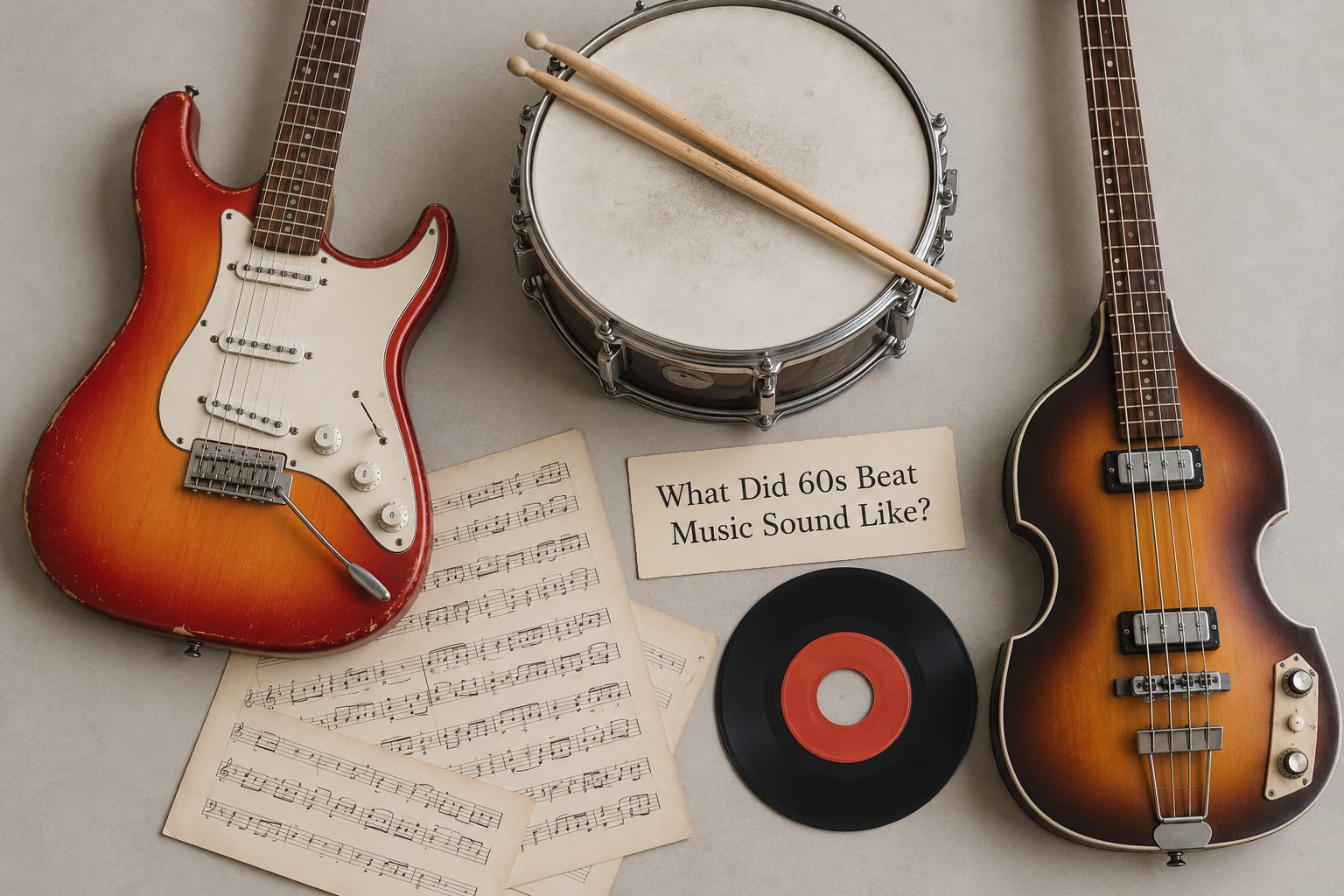
The signature is rhythm, and the rhythm is relentlessly simple. A snare hits hard on beats two and four, the bass walks a steady root pattern underneath, and the rhythm guitar chops short chord strokes between the vocal lines. Nothing is soloing for thirty seconds. Everything is pushing forward.
Vocals sit on top, usually in close harmony, sometimes three or four singers sharing a single microphone. The harmonies came straight from American doo-wop groups, and the phrasing came from Chuck Berry, who made a guitar sound like a rhythm section member.
Production was thin by later standards. Most records were tracked in mono with minimal overdubbing, which is part of why so much of the era still sounds like it was captured rather than constructed.
A five-point checklist for recognising what is 60s beat music
- Two minutes, give or take. If the song finishes before you have settled into it, you are in the right neighbourhood.
- Backbeat first. Count the snare. If it lands hard on two and four with nothing complicated going on underneath, that is beat.
- One guitar doing chords, one doing the melody. Look for clean chord chopping rather than long lead runs.
- Stacked harmonies in the chorus. Several voices on one microphone, mostly above the melody rather than under it.
- A hook you can sing after one hearing. Beat records were written for jukeboxes and dance floors, not for close analytical listening.
If a track has fuzz, feedback, a drum solo and a ten-minute instrumental section, you have probably left beat behind and arrived somewhere in 1966 or 1967.
Where Did 60s Beat Music Come From?
Beat has American parents. British musicians had been listening to Chuck Berry, Little Richard, Buddy Holly and the Crickets, and Elvis Presley, through records, the radio and the Palais Cinema in Liverpool. Cliff Richard and the Shadows turned that listening into a career in 1959 with Move It, often cited as the first home-grown British rock and roll record.
Then there was Hamburg. British groups played residencies in West German bars in the early 1960s playing what German promoters called mach schau beat, a stripped-down, heavily amplified style built for nightclubs rather than ballrooms. The Beatles worked that circuit in 1960 and 1961, backed at various points by Tony Sheridan, and came home with a stage act and a repertoire already tested.
Liverpool itself did the rest. It was a port city full of shipping money, tight working-class communities, and boys who could reach a guitar without having to ask. The Cavern Club gave a cramped stage to dozens of groups, and the ones who wrote their own songs had a real edge on the ones who covered.
London had its own version, and Birmingham and Manchester had theirs. The sound was national before the music was famous.
| City | Scene nickname | Representative groups | Character |
|---|---|---|---|
| Liverpool | Merseybeat | The Beatles, the Searchers, Gerry and the Pacemakers, the Tremeloes | Guitar-forward, folk-pop and R&B flavoured |
| Birmingham | Brum Beat | The Move, the Pretty Things, the Spencer Davis Group | Bluesier, heavier, organ-driven |
| London | Tottenham Sound | The Rolling Stones, the Kinks, the Who, the Small Faces | Rougher edges, R&B cover versions, more attitude |
| Manchester | Manchester beat | Freddie and the Dreamers, the Mind Readers, Wayne Fontana | Poppier, melody-first, big belted choruses |
The 1964 Ed Sullivan appearance of the Beatles opened the American market to all of it, and the flood of British groups that followed is usually called the British Invasion.
How Did 60s Beat Music Differ From the British Invasion?
Beat describes a sound and a scene; the British Invasion describes an event in America between early 1964 and 1966. Beat bands existed for years in Britain before a single one of them charted in the States, and plenty of Invasion records were folk rock, blues rock or psychedelic pop that were never beat at all.
Every invasion act was a beat act; not every beat act went to America. The Kinks, for instance, had enormous influence in Britain and a much smaller US chart presence during the period.
Two more words cause constant confusion. Mod was a youth culture built around sharp suits, scooters, small venues and singles, and its music was part of the same scene, not a separate genre. Big beat is a completely different thing: an electronic dance style from the 1990s associated with acts like Fatboy Slim and The Prodigy.
| Term | What it means | Era |
|---|---|---|
| Beat music | The guitar-led British style and its regional scenes | Late 1950s to 1967 |
| British Invasion | The arrival of British records and groups in US charts and radio | 1964 to 1966 |
| Mod | A working-class youth culture with its own fashion, venues and slang | Early to mid 1960s |
| Big beat | 1990s electronic dance music | Late 1990s onward |
There is also a late-decade offshoot worth knowing: freakbeat, a name applied retrospectively to the harder, weirder 1965 to 1967 beat records, where fuzz, feedback and darker lyrical content pushed past the clean pop formula.
What Instruments and Techniques Defined the Beat Sound?
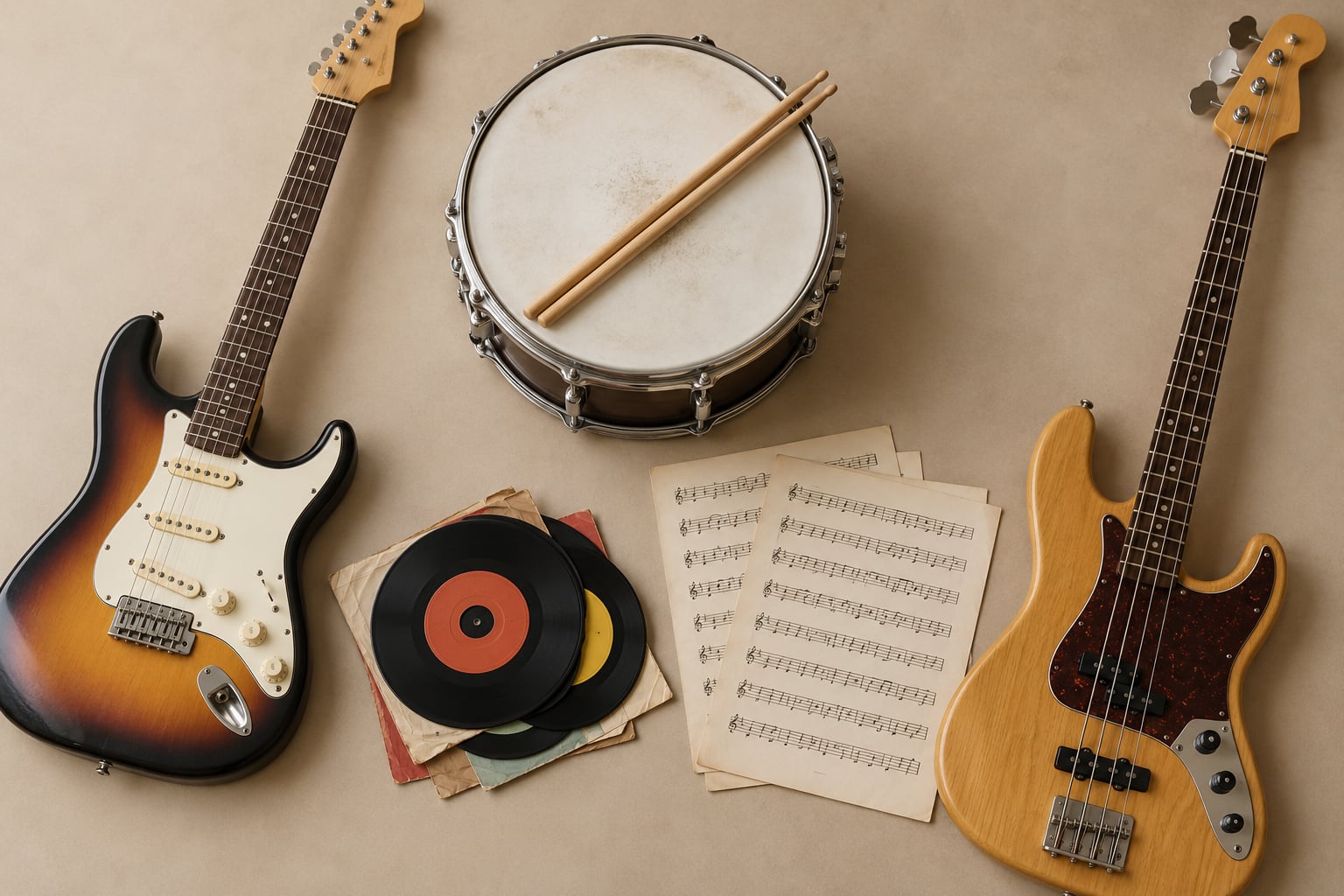
Most beat groups played lead guitar, rhythm guitar, bass and a four-piece kit, and that is genuinely the whole list for a great many records. Vocals were the fifth instrument, which is why so many groups are remembered first for a sound rather than a solo.
The lead guitar took short melodic answers rather than extended solos, an approach lifted from Buddy Holly. The rhythm guitar played clipped offbeat chords, and later groups pushed them harder with fuzz pedals borrowed from the blues. Bass lines were simple and slightly behind the beat, which is what gives the records their rolling momentum.
Drummers played the beat, not around it. Restrained fills, crash cymbals on the turnaround, and a lot of snare. The word backbeat, meaning the emphasis on beats two and four, is usually credited to Dave Clark and Ian Samwell of the Dave Clark Five, who used it to describe what they were playing in 1963.
Close harmony came from doo-wop and from American soul, and vocal groups such as the Swinging Blue Jeans and the Fourmost built whole records around it. Keyboards were used sparingly, though bands like the Small Faces used them heavily enough to become a different sound altogether.
In the studio, mono recording and limited overdubbing shaped the sound as much as the instruments did. Stereo albums began appearing around 1966, which conveniently overlaps with the point where beat was starting to splinter into psychedelic rock, folk rock and harder guitar music.
Who Were the Most Important 60s Beat Bands?
There is no canon of exactly nine bands, and any list claiming otherwise is arguing about taste. Here is a working set of groups worth hearing, with what each one actually added.
The Beatles
The best-known beat group by a distance, and the one that stopped being a beat group soonest. Their 1963 album Please Please Me is pure beat pop; by 1965 their writing, sitar use and studio ambition had moved the whole form somewhere else.
The Searchers
Liverpool group with a folk-leaning streak and one of the tightest vocal lines of the period. Their 1963 single Sugar and Spice reached No. 1 in America while the band itself was still working through a demanding live schedule.
Gerry and the Pacemakers
The group whose You’ll Never Walk Alone made them the first British act with a US No. 1 single, in late 1963. Big belted, brass-assisted, and very much a stage band first.
The Hollies
Manchester, then Birmingham, with unusually sophisticated close harmony for a beat group. Air That I Breathe and Stay were harmonies-first records rather than guitar-first ones.
The Dave Clark Five
A hard-working, brass-heavy hit machine from London with a genuinely distinctive drummer. The name backbeat came out of this group.
The Animals
Newcastle band built around Eric Burdon’s rough voice and a keyboard sound that was rawer than anything else in the genre. Their 1964 version of House of the Rising Sun is the extreme left edge of beat.
The Zombies
Recorded with unusual sophistication and released records that aged better than most. The Rod and the Frame was a small hit in Britain; the later Odessey is a different genre entirely.
The Kinks, the Rolling Stones and the Who
The London wave came out of the R&B clubs and was messier than Liverpool pop. The Rolling Stones covered Chuck Berry in public and moved toward blues rock, the Kinks wrote sharper songs than anyone in the genre, and The Who took the loudest, most destructive route through it. All three are inseparable from the scene even though none of them stayed beat for long.
The Small Faces, the Troggs, the Tremeloes
The names collectors and listeners mention most often when a thread asks what gets forgotten. The Small Faces added mod swagger and organ; the Tremeloes were Liverpool at their most pop-perfect; the Troggs came from up north and leaned on the mystic B side.
Forum threads about the era repeat one complaint: the canon is overwhelmingly Beatles and Stones, so the regional names above and the groups just behind them are where a newcomer finds something new.
Which 60s Beat Records Are Essential for Vinyl Collectors?
A starter set does not have to be expensive or complete. Ten records cover the range, and each one teaches you something specific.
- Please Please Me, The Beatles (1963) — the clearest statement of beat as a genre, before the band outgrew it.
- Move It, Cliff Richard and The Shadows (1959) — the British rock and roll record the whole scene grew out of.
- Love Me Do, The Beatles (1962) — an early, plain, guitar-led single; listen for the beat guitar on the A side.
- You’ll Never Walk Alone, Gerry and the Pacemakers (1963) — brass, handclaps and the first US chart-topper.
- Sugar and Spice, The Searchers (1963) — folk-pop colouring inside the beat formula.
- Stay, The Hollies (1964) — harmony-forward beat, closer to soul than to Liverpool guitar music.
- Glad All Over, The Dave Clark Five (1963) — the biggest snare sound in British pop at the time.
- House of the Rising Sun, The Animals (1964) — darker, bluesier and grittier than the pop norm.
- You Really Got Me, The Kinks (1964) — distorted guitar that rewired what the instrument could sound like in a pop song.
- I Want to Hold Your Hand, The Beatles (1963) — the record that opened America to the whole thing, and the reason most American listeners met beat at all.
Two collecting notes. Mono pressings are the ones most people in this music want, because that is how the records were played in the era and how they still sound best on a turntable. And sleeve condition matters more than label for most of these titles: the music inside a slightly worn sleeve is unchanged, whereas a scuffed cover is a permanent loss.
How Can You Identify a 60s Beat Record?
Most of this is easier than people expect, because UK labels of the period were disciplined about their numbering.
Start with the label and the catalogue number. Parlophone, Columbia, Decca, Pye, Fontana, Deram and Island all issued enormous amounts of beat material in the early 1960s, and each catalogue number on the label matches a specific release. A Parlophone 7X reference in this period points to a Parlophone single; a Pye 7N reference points to a Pye single.
Then look at the centre of the record. UK 45s carried etched matrix numbers, often on both sides, with the same number repeated and a letter at the end for the mix or mastering variant. That letter is often the cheapest way to tell an early pressing from a later one, and later pressings can carry entirely different B sides.
For pressing country, a British 45 usually has plain push-out centre holes and a small tax or code near the label on some labels, while US pressings from the same period typically have a large hole and printed text on the label. German, Dutch, French and Australian pressings exist in quantity for many of these titles and carry their own prefix letters, so do not assume a record is British because the band is.
Format tells you plenty too. A UK single released in 1963 is almost always a 7-inch 45 rpm mono pressing, and the label says so. If you are holding an EP or a 33 rpm LP, you are looking at a later development, and if a record claims to be a 1963 mono single but the sleeve is a modern card replica, the sleeve tells you nothing reliable.
None of this authenticates a pressing on its own. Cover appearance can be reproduced exactly, so the label, the matrix and the playing surface are the parts worth reading closely.
Frequently Asked Questions
Is 60s beat music the same as the British Invasion?
No. Beat music is the British style itself, rooted in Liverpool from the late 1950s, and it existed at home long before America heard it. The British Invasion is the name for the arrival of British groups and records in US charts and radio between 1964 and 1966. Some invasion acts were folk, blues or psychedelic groups that were never beat bands at all.
Which instruments are most associated with 60s beat music?
Lead guitar, rhythm guitar, bass and a drum kit cover most beat records, with vocals treated as the fifth instrument. The rhythm guitar chops short chord strokes, the bass plays a simple line behind the beat, and the drums keep a firm backbeat on beats two and four. Keyboards were used sparingly, though some mod-flavoured groups leaned on them heavily.
Are the Beatles and Rolling Stones beat music or British Invasion bands?
Both, at the start. The Beatles are the best-known band of the Liverpool beat scene, and the Rolling Stones belong to the London group that grew out of the same clubs and records. Both then crossed to America in 1964, which makes them central to the British Invasion too. By 1966 neither was really writing beat records any more.
What is the difference between beat, rock and roll, and garage rock?
Rock and roll is the wider American style from the 1950s, built around blues, country and gospel. Beat music is its British guitar-led answer, tighter and shorter, with close vocal harmonies and a working-class scene behind it. Garage rock is the American sound of small groups recording raw material on cheap equipment in the mid 1960s. It is louder, looser and angrier than beat.
What are the best first 60s beat records for a new vinyl collector?
Start with Please Please Me by the Beatles, You Really Got Me by the Kinks, Glad All Over by the Dave Clark Five, Stay by the Hollies, and Stay or Sugar and Spice by the Searchers. Together they cover the pop end, the guitar end, the harmony end and the Scottish-folk end of the style. Buy mono 45s in decent condition rather than chasing rare first pressings.
How can I tell which country pressed a 45 rpm record?
Look at the label and the sleeve first. UK pressings usually have small push-out centre holes and often show a tax code or catalogue prefix such as a British letter series on the label. US pressings tend to have large centre holes and printed label text. German, Dutch, French and Australian versions exist for many titles and carry their own prefix letters, so check the matrix numbers etched into the runout as well.
The Short Version
Beat music is the guitar-led British pop style that grew out of Liverpool and the industrial towns around it between the late 1950s and 1967, mixing American rock and roll and rhythm and blues with close vocal harmonies and songs short enough for a single.
Start with one record outside the Beatles canon this week. If you like harmony, take the Hollies; if you like a wall of guitar, take the Kinks; if you like a band that simply looked like fun, take the Small Faces. Everything downstream of it, from British Invasion pop to folk rock and Britpop, is easier to hear once the beat records are in your head.