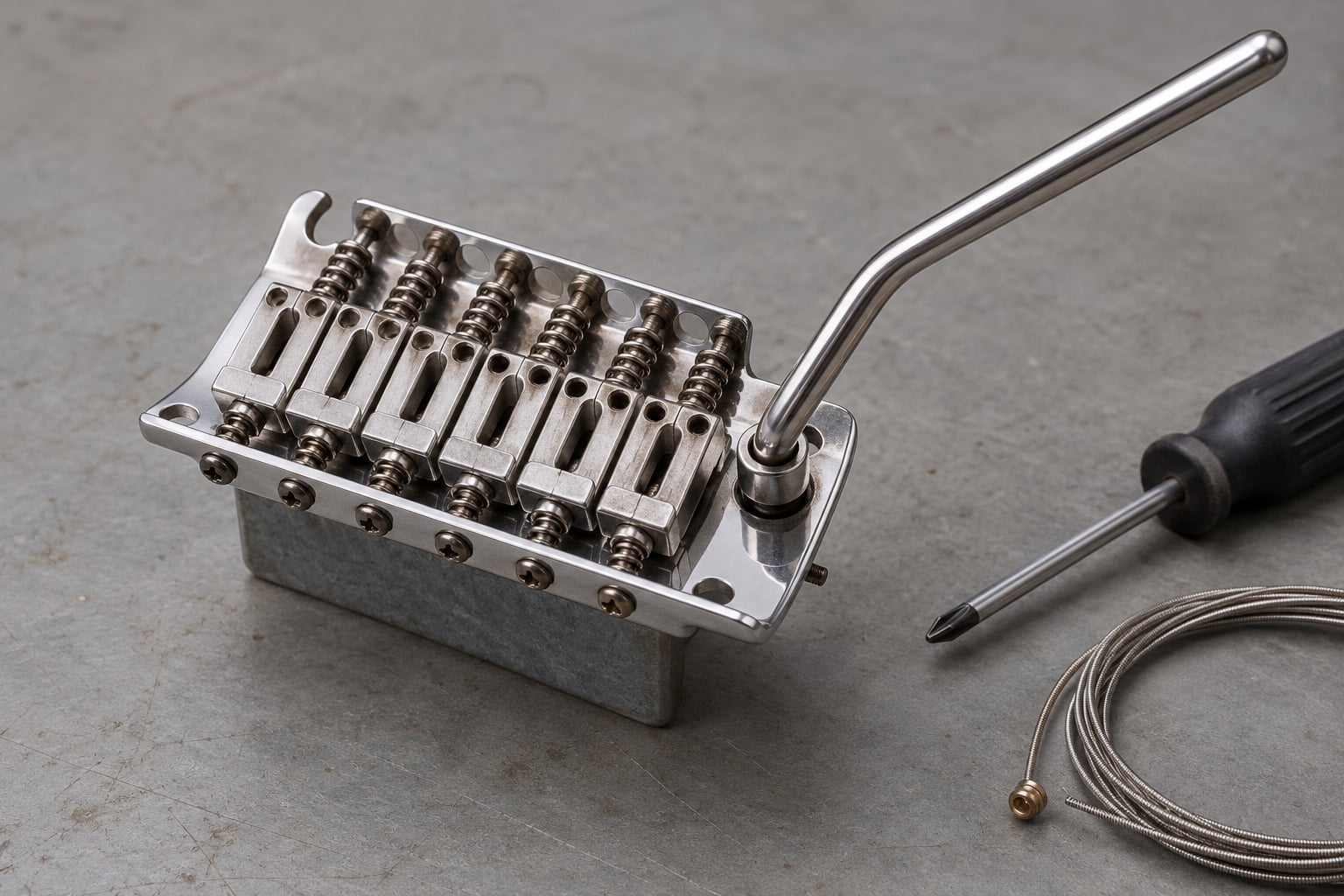
A tremolo arm is the metal lever on an electric guitar’s bridge that lets you raise and lower the pitch of the strings while you play. You push the arm down and the note flattens, pull it back and the note climbs. Put simply, a tremolo arm on a guitar is a pitch control, not a tone knob.
Most players just call it a whammy bar. Fender, Gibson and the rest of the trade call it a tremolo arm. Both names point at the same piece of hardware.
Table of Contents
- What Is a Tremolo Arm on a Guitar?
- How Does a Tremolo Arm Change the Pitch?
- What Are the Main Parts of a Tremolo System?
- What Is a Tremolo Arm on a Guitar Made Of?
- What Are the Main Types of Tremolo Systems?
- How Do Musicians Use Tremolo Effects?
- What Is a Tremolo Arm on a Guitar Used For?
- What Is the Difference Between a Tremolo Arm and a Vibrato Tailpiece?
- How Do You Set Up a Guitar Tremolo?
- Why Does a Tremolo Go Out of Tune?
- How Do You Choose a Tremolo Arm for Your Guitar?
- Frequently Asked Questions
- Does a tremolo arm change the guitar’s tuning?
- Is a tremolo arm the same thing as a whammy bar?
- Should a tremolo arm always be installed at the same height?
- Does adding a tremolo arm make a guitar sound better?
- Can you put a tremolo arm on any electric guitar?
- Start With the Bridge and Match the Arm
What Is a Tremolo Arm on a Guitar?
Strictly speaking, the arm is the only part your hand touches. It is a short lever that screws into a pivot block on the bridge, and it converts the sideways pressure of your hand into a rocking motion of the whole bridge assembly.
That rocking motion is the effect. The bridge, the springs that counterbalance it and the arm together are usually called the vibrato system or the tremolo bridge, and guitarists use the three terms interchangeably.
One naming oddity is worth clearing up before you go any further. A tremolo, in music, is a rapid pulse in volume. What a tremolo arm does is change pitch, which is called vibrato. Fender put the word “Synchronised Tremolo” on the 1954 Stratocaster’s bridge, the name stuck, and every maker since has copied it.
If you want the accurate word, say vibrato bar. If you want to be understood at a gig or in a forum, say whammy bar. Both are correct usage in the real world.
How Does a Tremolo Arm Change the Pitch?
Here is the sequence, in order:
- You push or pull the arm.
- The arm rocks the pivot block it sits in.
- That block tips the bridge plate up or down.
- The saddles move with the plate, and the string tension changes.
- Tension changes pitch: more tension, higher note; less tension, lower note.
On a floating bridge the whole assembly balances on springs, so it can travel in both directions. Push down and the strings slacken. Pull up and they stretch. The springs pull it back to rest, which is why the guitar returns to pitch when you let go.
Not every system is floating. A vibrato tailpiece rocks around a pivot behind the bridge and lifts the strings at the back, so it only makes pitch downward.
Range is limited by how far the arm can travel and how much string tension the springs can pull back. Get greedy with a dive bomb and you will bend past the point where the spring has anything left to give, which is exactly how you break a string.
What Are the Main Parts of a Tremolo System?
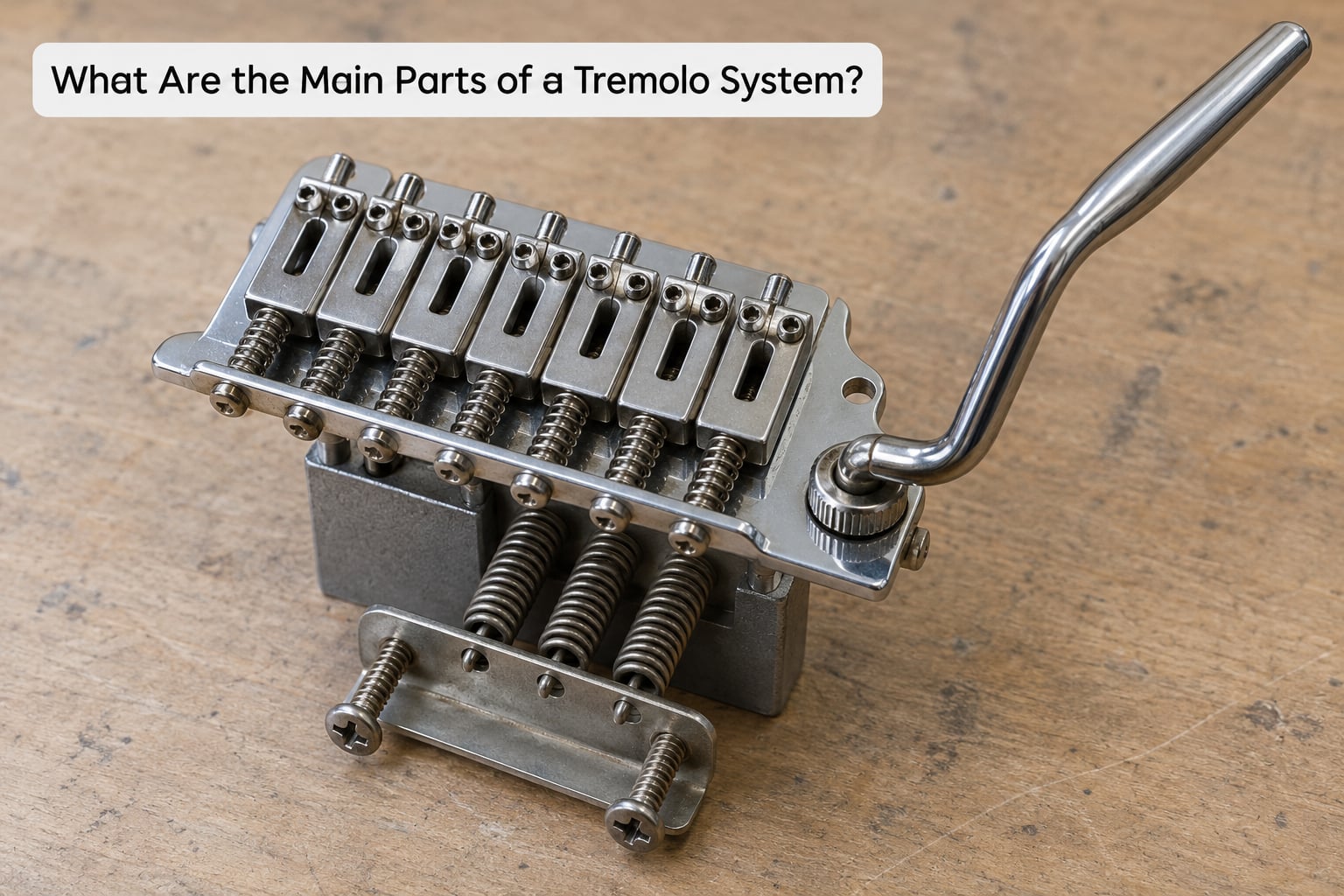
Most systems share the same six pieces, even when the shapes look nothing alike:
- The arm — the lever your hand moves.
- The pivot block or arm block — the part the arm threads into, usually mounted in the tremolo cavity behind the bridge.
- The springs — typically two or three, hooked to a claw that screws to the body, pulling the bridge back to balance.
- The linkage — on some systems a metal rod connects the block to the bridge plate so the two move as one.
- The bridge plate — the metal base carrying the saddles.
- The saddles — the small adjustable blocks the strings pass over, one per string.
Everything above the block carries your hand pressure. Everything below it, the block and springs, carries the counterbalance. Set up wrong, that balance is lopsided and the arm feels stiff on one side and loose on the other.
What Is a Tremolo Arm on a Guitar Made Of?
Steel is the common choice, usually chromed or plain. Steel is dense and stiff, so the arm stays fairly neutral in feel and doesn’t amplify string vibrato the way a loose-fitting arm would.
Aluminium shows up on many entry-level and reissue arms because it’s light and easy to machine. A heavier steel arm returns a bit more energy into the bridge, which is why some players describe an aluminium arm as feeling less solid on big bends.
Arm length matters more than people expect. A long arm gives a large lever and lots of range for small hand movement. A short arm needs more travel for the same effect, and vintage short-arm designs tend to wobble more at the tip. Shaft diameter is another variable: some arms push straight into the block and are held by a set screw, others thread in, and the thread sizes are not interchangeable.
What Are the Main Types of Tremolo Systems?
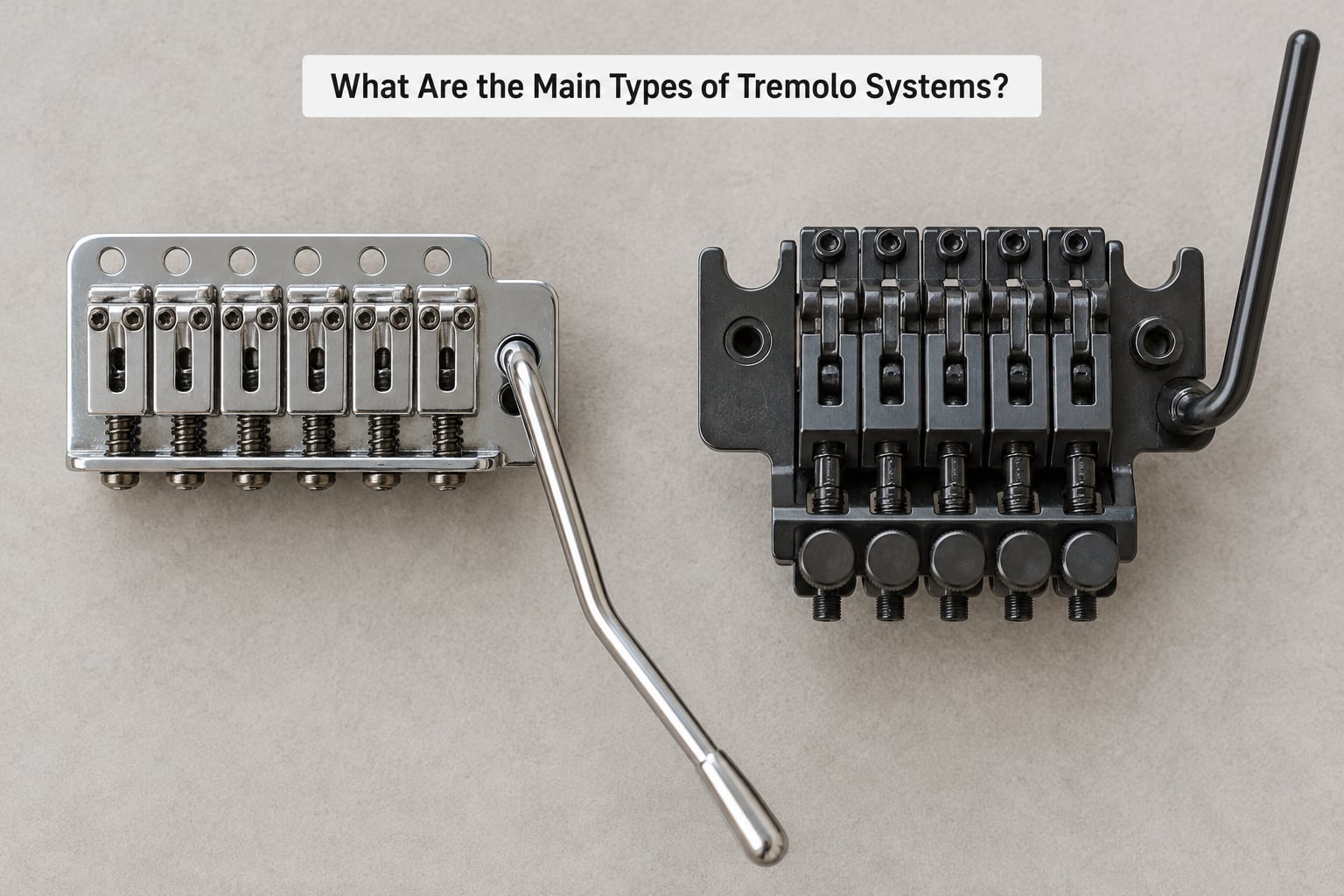
Here is how the common families compare.
| System | Where it mounts | Direction | Range and stability | Feel |
|---|---|---|---|---|
| Synchronized (Strat-style) | Bridge plate on the body | Push and pull | Deep range, detunes with use | Sprung, springy, expressive |
| Maestro Vibrola | Small arm screws into the bridge plate | Push and pull | Moderate range, detunes with use | Light, quick response |
| Bigsby | Replaceable tailpiece behind the bridge | Push and pull | Shallow range, very stable | Smooth, subtle, minimal detune |
| Double-locking (Floyd Rose style) | Bridge plate plus locking nut | Push and pull | Deep range, holds pitch best | Firm, requires setup discipline |
| Vibrato tailpiece | Tailpiece behind the bridge | Push only | Downward only, stable | Slow swell, orchestral fade |
Forum players describe a Bigsby as prettier and subtler but shallower than a Strat, and describe a locked bridge as the most stable option they own while still wishing they could retune it mid-set without a screwdriver. Both complaints are real and both are trade-offs, not defects.
How Do Musicians Use Tremolo Effects?
Rockabilly and surf players use very little travel. A few millimetres in and out, timed to the beat, produces the wobble on a slurred shuffle or a baritone surf line. The motion is small and constant.
Garage and punk players work the middle range. Short downward dips on a chord, a held descent at the end of a riff, or a quick shove under a vocal line. It’s more of a punctuation mark than a decoration.
Lead players and blues players reach further, bending sustained notes down a tone or two and back, then occasionally all the way to a dive bomb on the turnaround.
Tailpiece players get a slower effect. Because the tailpiece lifts the strings from behind, a push produces a gradual downward swell that sounds closer to a bowed instrument than to a Strat wobble.
What Is a Tremolo Arm on a Guitar Used For?
Four practical uses come up over and over: subtle pitch shimmer under a clean chord, exaggerated vibrato on a long sustain, dive bombs that make a chord sound like something falling down a stairwell, and getting a period-correct texture on vintage-style guitars.
Worth saying plainly: the arm does not make the guitar louder or cleaner. It moves pitch. If you have a humbucking guitar with a fixed bridge and you want more bite, a pickup change will do more than a new bridge.
There are times a hardtail is simply better. Sharp funk chord stabs, ringing open chords in a busy mix, and fast tempos where any movement from the bridge muddies the rhythm all argue for a fixed bridge or a blocked trem.
What Is the Difference Between a Tremolo Arm and a Vibrato Tailpiece?
The difference is where the fulcrum sits. A tremolo arm rocks the bridge itself, and the strings change tension because the whole anchor point moves. A vibrato tailpiece rocks a separate piece behind the bridge and the strings change tension because their break point lifts.
Because the bridge stays put, a tailpiece usually stays in tune better through a bend. Because it can only pull down, you get no upward pitch change. It also looks completely different — a small lever on the bridge versus a substantial piece of hardware at the end of the strings.
Players call both effects tremolo, which is technically wrong but entirely standard. Knowing the difference helps when you’re reading a used-guitars listing or talking to a repair shop.
How Do You Set Up a Guitar Tremolo?
Work in this order and make small changes, checking after each one:
- Check the action at the 12th fret before touching anything else. Too low and the bridge may not have clearance to move.
- Balance the springs so the bridge sits level, or at the shallow angle the manufacturer specifies. Players who move to three springs usually report more resistance and better hold.
- Match spring spacing to your string gauge. Heavier strings need more counterbalance.
- Set saddle height, then check intonation at the 12th and 5th fret for each string.
- Stretch the strings properly and tune again.
- Work the nut slots with a very thin lubricant. Pencil graphite in the slot is the fix most often repeated on guitar forums for post-dive detuning.
- Use the tremolo manufacturer’s specification for spring balance, claw position and range, and change one variable at a time.
If you feel the arm go stiff, loose or scratchy, stop and check spring balance before bending harder. If the guitar will not return to pitch, that is a setup problem you can fix, not a broken bridge.
Why Does a Tremolo Go Out of Tune?
Common causes, most frequent first:
- Strings binding in the nut — the leading cause by a distance. Moving the bridge can rotate strings in their slots so they grip and hold the old length.
- Springs out of balance — too little counterbalance and the bridge never returns to the same place.
- New strings not stretched — they creep, and the bridge settles with them.
- String gauge too heavy for the system — a set the bridge can’t balance will drift every time.
- Bending past the usable range — especially on a single-hinge-point design with no fine adjusters.
- Temperature and humidity — the same problem any stringed instrument has, made obvious by a moving bridge.
- Dry or worn saddles — a groove in a saddle can make a string behave differently as it moves.
On the question every new player asks: no, using the arm does not wreck a guitar. Strings and springs wear out before the bridge does, and the thing that actually fails is usually a string broken at the saddle during an over-the-top dive. Players who panic about damage usually just need a setup and a string change.
How Do You Choose a Tremolo Arm for Your Guitar?
Identify the system first. Look at the bridge and work out whether it’s a Strat-style plate, a small-arm design, a tailpiece or a double-locking unit. The arm must match that system; a mismatched part will not fit and, forced in, can damage the block.
Then match four details:
- Thread or push-in style — check whether the block takes a screw or a press-fit arm.
- Shaft diameter — this is the one that catches people out most often.
- Length and shape — a straight, short, bent, offset-tip or ergonomic handle is a preference thing, and longer gives more leverage.
- Condition — on vintage guitars, original and correct beats shiny and wrong.
For vintage instruments, matching the original part is worth more than any upgrade, and parts for discontinued systems are still made. For a modern guitar, replacing a whole tremolo assembly is sometimes cleaner than hunting for an arm that fits a discontinued mount.
Frequently Asked Questions
Does a tremolo arm change the guitar’s tuning?
On a floating bridge it changes tuning slightly every time you move it, because the bridge settles somewhere new. It should return close to where it started once the strings settle, and stay there if the setup is right and the nut slots aren’t binding. A locked system with a locking nut holds pitch through almost any movement, but takes longer to retune when you do change strings.
Is a tremolo arm the same thing as a whammy bar?
Yes, they’re the same part. Manufacturers use tremolo arm or vibrato arm, players tend to say whammy bar, and some call it a vibrato bar or dive bar. The word whammy bar is often used more loosely to mean using the arm dramatically, so a shop asking which one you want usually wants the make and model of your guitar instead.
Should a tremolo arm always be installed at the same height?
No. The arm has to clear the strings and the guitar’s finish, but beyond that its resting height and the bridge’s angle are set by spring balance rather than by the arm. A system that sits flat with the bridge level is a starting point on most instruments. Some makers specify a slight forward tilt, which gives more downward range before the string hits the saddle plate.
Does adding a tremolo arm make a guitar sound better?
Not by itself. A tremolo arm changes pitch, not tone, so a fixed bridge guitar will not sound cleaner or fuller once one is fitted. It gives you expression that a hardtail cannot produce. If your goal is more bite or more output, a pickup change will move the sound much further than swapping the bridge.
Can you put a tremolo arm on any electric guitar?
Only where the body has a tremolo cavity, a pivot block and springs, or where a vibrato tailpiece can physically mount. Most solid-body electrics from the 1950s onward have one. A guitar routed for a hardtail usually can’t take a floating bridge without cutting new routes, and a nylon-string acoustic has nowhere to put the hardware.
Start With the Bridge and Match the Arm
Your first move is simple: identify what the guitar already has. Look at the bridge, decide whether it’s a floating plate, a small-arm design, a tailpiece or a double-locking unit, and only then look for a replacement. A tremolo arm is a lever for a specific mechanism, not a universal accessory.
From there, treat the system as one piece of engineering. It changes pitch, nothing else, and the expressive wobble you hear on rockabilly, surf, garage and vintage rock records all comes from the same movement. Set the springs, keep the nut slots clean, stretch the strings, and change one setup variable at a time.