Proto punk is a retrospective label for raw, stripped-down rock music from the mid-1960s to the mid-1970s that foreshadowed the sound, style and rebellious attitude of punk rock before punk officially arrived. No band in 1965 called itself proto-punk, and no scene had a name for itself.
The word was applied afterwards, mostly by critics, to separate scenes that had no idea they belonged together: garage bands in California and the Pacific Northwest, the loud rooms in Detroit, a strange underground in Cleveland, a handful of acts in New York, and rougher groups in London and Australia. The point of collecting this stuff is that you can hear punk’s entire vocabulary being invented in real time.
It is also the honest answer to a question every new punk listener eventually asks. What happened between the Kinks and the Ramones? About ten years of records that barely sold, got almost no radio play, and turned out to be the actual blueprint.
Table of Contents
- What Is Proto Punk? Definition and Meaning
- Where Did Proto-Punk Come From?
- The 1950s and early 1960s groundwork
- Garage rock, 1963-1966
- The 1966-1973 window
- Where the name came from
- What is proto-punk in music history?
- Is there an agreed starting point?
- Who Are the Main Proto-Punk Artists?
- How Does Proto-Punk Differ From Punk?
- Are the Rolling Stones proto-punk?
- Are the Ramones punk or proto-punk?
- How Can Collectors Recognize Proto-Punk on Vinyl?
- Why Does Proto-Punk Matter?
- Frequently Asked Questions
- Is proto-punk an actual music genre?
- What is the earliest proto-punk record?
- Is garage rock the same as proto-punk?
- Who was the first proto-punk band?
- Are The Stooges and The Velvet Underground proto-punk?
- What are the best proto-punk records for vinyl collectors?
- Conclusion: Where to Start
What Is Proto Punk? Definition and Meaning
Proto-punk describes music that came first, not music that was less good. The sound sits somewhere between the rough edges of 1950s rhythm and blues and the tight, angry efficiency of 1976-1977 punk.
Here are the characteristics most writers agree on:
- Not an official movement. Nobody signed up. Bands in Detroit, Tacoma, London and Sydney had no contact with each other and no shared manifesto, which is exactly why critics use a word for them instead.
- A raw, stripped-down sound. Short songs, simple structures, a handful of chords, guitars pushed into distortion, and recording that leaves the edges showing.
- A subversive attitude. Song titles about sex, drugs, boredom and authority. Lyrics that treated the audience as an equal rather than an audience to be impressed.
- DIY conditions. Self-released singles, cheap instruments, borrowed rehearsal rooms, tiny audiences. Several of these records were pressed on a label run by the band or a friend.
- Presence over polish. Performers who looked like they were daring you to do something about it.
AllMusic’s standard description is the one most writers borrow: proto-punk was never a cohesive movement, nor was there a readily identifiable proto-punk sound. What there was, it says, was a certain provocative sensibility that didn’t fit the prevailing counterculture of the time.
That last clause matters. Late 1960s rock was busy being expansive, mystical and technically virtuosic. Proto-punk bands went the other way, which made them sound small and crude at the moment when the industry was rewarding the opposite.
Where Did Proto-Punk Come From?
Proto-punk came out of rock ‘n’ roll, rhythm and blues, rockabilly and skiffle in the 1950s, got pushed through the distortion of 1960s garage rock, and hardened in a few city scenes between 1966 and 1973.
The 1950s and early 1960s groundwork
The lineage usually starts with folk and country material, then with skiffle, where British acts like Lonnie Donegan built fast, simple records out of a guitar and a washboard. Lonnie Donegan’s records sold in the millions to teenagers who had no reason to be interested in American roots music.
Across the Atlantic, Elvis, the early Beatles and Buddy Holly supplied the tempo and the swagger. Ritchie Valens’ La Bamba, recorded when he was seventeen, is the clearest early example of the combination proto-punk would later chase: a rock song played fast, flat and slightly out of tune, refusing to be polished.
Garage rock, 1963-1966
The proper fuel came from the garage. Groups recorded a single on a basic tape machine, pressed it themselves or on a tiny label, and sold it out of a friend’s record store. The Sonics in Tacoma were the extreme version, cutting Chuck Berry and Little Richard numbers to a razor edge with distorted guitars that sounded broken on purpose.
Louie Louie, a 1963 hit for the Kingsmen, started the argument when the FBI got involved and the band still could not agree on the lyrics. In Britain, beat groups such as the Kinks and the Who pushed the same instinct with harder chords and more volume. You Really Got Me, released as a single in 1964, sounds like a garage accident that somebody eventually decided to keep.
The 1966-1973 window
Between about 1966 and 1973, several scenes sharpened the same instincts in isolation. The Velvet Underground pushed distortion and independence rather than simplicity. Detroit bands played fast and loud in rooms where nobody was famous yet. Cleveland groups attacked their instruments. New York bands looked like they had crawled out of a fight.
Punk arrived commercially in 1976 and 1977, mostly in Britain, then immediately went back to America. The bands listed above had already been playing in front of tiny audiences for years.
Where the name came from
The label is generally traced to Lester Bangs, whose 1971 Creem essay on the garage bands used the word proto-punk to describe what came before the wave he knew was forming. Later writers argued about it, since the era he was describing was already mostly over by the time he wrote about it, and his selection of bands was pointed rather than neutral.
That is why every definition of the genre comes with a caveat attached. The term is convenient, not precise, and different critics reach for different dates.
What is proto-punk in music history?
In music history, proto-punk functions as a critical tool rather than a genre. Historians use it to describe a period and an attitude, and they rely on it to explain cause and effect: these bands, in these cities, did these things, and punk later picked up the results.
That flexibility is the source of constant argument. There is no agreed start date, no fixed lineup and no canonical record list, because the categories were never clean. A band can be included because of how it sounded, how it looked, how it was released, or because it existed before a certain year.
Is there an agreed starting point?
No. Defenders of the term pick 1963 and Louie Louie, others pick 1965 and the Sonics’ Here Are The Sonics, and others push it back into the 1950s. The more useful question is not where it starts but what it shares with punk, because that is what you can actually hear.
Who Are the Main Proto-Punk Artists?
The bands usually called proto-punk cluster by city and scene, and the grouping matters because most of them never heard each other.
Detroit: the Stooges and MC5 are the core, with the Up, Death and Sonic’s Rendezvous Band alongside them. Kick Out the Jams, released in 1969, is the document: short, brutal songs, two guitars, and a rhythm section playing like it was trying to get out of the room.
The Pacific Northwest and garage rock: the Sonics, the Wipers and the Kingsmen. Here Are The Sonics (1965) is regularly named the record where you can already hear a Ramones drum beat. The Ramones, who named the Sonics as an influence and covered Rocket Cecilia live, came out of this same amplified guitar tradition.
London and the British scenes: the Kinks, the Who, the Pretty Things and the Modern Lovers, plus the rougher pub rock and glam edges that fed the Sex Pistols. Dr. Feelgood, Eddie and the Hot Rods and The Stranglers sit on the British side of the divide, and Joe Strummer played in the 101ers before he formed the Clash. Readers looking for the British names for roughly the same instinct will find pub rock, freakbeat and glam rock.
New York: the Velvet Underground took a different route, favouring long-form, drone and self-released records over short sharp songs. The New York Dolls came later and sat almost exactly on the line, which is why they get argued about more than any other band.
Australia: the Saints and Radio Birdman built the same sound in Brisbane and Sydney, a decade before those cities became famous for it. Deniz Tek fronted Radio Birdman; the Saints’ (I’m Stranded) is the record collectors point to.
Elsewhere: Los Saicos in Peru played garage rock that was sharper than most of its American equivalents, Simply Saucer in Canada recorded material that drifted into proto-punk territory, and Japan’s Zuno Keisatsu did something similar in Tokyo. Hawkwind and the Stooges’ Detroit neighbours on the krautrock side also get included by some writers.
Bands that kept the sound alive into the late 1970s and beyond include the Cramps, the Gun Club, the Fleshtones and the Scuds. If you want to hear where the thread runs without leaving the vinyl aisle, that is where it picks up.
For collectors, the fastest way to orient yourself in a shop is to work by band, city and year rather than by genre label, because the label disagrees with itself.
| Band | Year | City | Key track | Why it counts |
|---|---|---|---|---|
| The Kingsmen | 1963 | Portland, Oregon | Louie Louie | The first garage record most people hear, and the one the FBI could not decode |
| The Kinks | 1964 | London | You Really Got Me | Distorted guitar power chords as a single, four years before punk |
| The Sonics | 1965 | Tacoma, Washington | Here Are The Sonics | Garage pushed to its limit; a direct ancestor of the Ramones sound |
| The Velvet Underground | 1967 | New York | Heroin | Distortion, drones and self-release; an adjacent lane rather than a short-song lane |
| The Stooges | 1969 | Detroit | No Fun | Raw attack and confrontational performance; the most cited proto-punk band |
| MC5 | 1969 | Detroit | Kick Out the Jams | Tight, fast Detroit rock with political teeth |
| Modern Lovers | 1971 | Boston | Modern World | Outsider art and confessional writing, stripped of decoration |
| The New York Dolls | 1973 | New York | Personality Crisis | Glam presentation with proto-punk songs; the most contested case |
| The Stooges | 1973 | Detroit | Raw Power | The late, abrasive record that most directly precedes punk |
| Death | 1974 | Detroit | For the Whole World to See | Private-press hardcore that circulated mostly by word of mouth |
| The Saints | 1977 | Brisbane | (I’m Stranded) | Fast, economical songs made outside the Anglophone centre |
| Radio Birdman | 1976 | Sydney | Aloha Steve | Surf-punk guitar trading and a scene built from scratch |
Note what is missing from most tables like this: nothing from 1977-1978 belongs here, and that boundary is deliberate. Those bands are punk, however rough they sound.
How Does Proto-Punk Differ From Punk?
Proto-punk predates punk’s commercial breakthrough and shares its instinct, but the two differ in period, sound, production, independence and intent. Comparing the two side by side is the fastest way to understand why the label exists at all.
| Aspect | Proto-punk | Punk rock |
|---|---|---|
| Period | Mid-1960s to mid-1970s | 1976 onward, first fully commercial in 1977 |
| Sound | Raw, abrasive, deliberately unpolished; often improvisational | Tighter, faster, more uniform in structure |
| Production | Basic recording, sometimes two-track, hiss and distortion left in | Still cheap and DIY, but usually tracked more carefully |
| Attitude | Anti-establishment, outsider, deliberately awkward | Confrontational and rebellious, but with a recognisable scene identity |
| Independence | Almost invisible; released on regional or tiny labels, sold at gigs | Its own subculture, press, fanzines and scene venues such as CBGB |
| Key acts | Stooges, MC5, Sonics, Kinks, New York Dolls, Saints | Ramones, Sex Pistols, Clash, Dead Kennedys, Black Flag |
The categories overlap rather than forming a strict divide. Some proto-punk bands, particularly the New York Dolls, behaved like punk bands years before punk existed, which is why the label keeps being argued about.
Are the Rolling Stones proto-punk?
Occasionally, and usually as a comparison. The Stones were never stripped down or abrasive in the way this music demands, and they had a very large audience. They get mentioned because their rebellious image and late-1960s guitar sound pointed somewhere punk later went. The Rolling Stones are better described as an influence on rock’s attitude than as proto-punk themselves.
Are the Ramones punk or proto-punk?
Punk. They arrived with a complete package: a look, a name, a pace, a scene and a debut record in 1976 that could be played straight through without context. What makes them interesting for this article is what they took from the Sonics and the Stooges. A band that copied the vocabulary had to have found it somewhere first, and that somewhere is proto-punk.
How Can Collectors Recognize Proto-Punk on Vinyl?
You will not find a genre sticker on these records, so the cues are musical and physical instead. This is where browsing a shop is more useful than reading a list, because the pressing tells you as much as the music does.
Listen for the guitar. Distortion used as a texture rather than a solo sound. Power chords, feedback at the end of a riff, and a preference for the shortest possible song.
Listen for the recording. Close-micced drums, a narrow stereo image, bass that gets lost, and noise that was left in because there was no budget to remove it. If a record sounds like it was recorded in a hurry, it usually was.
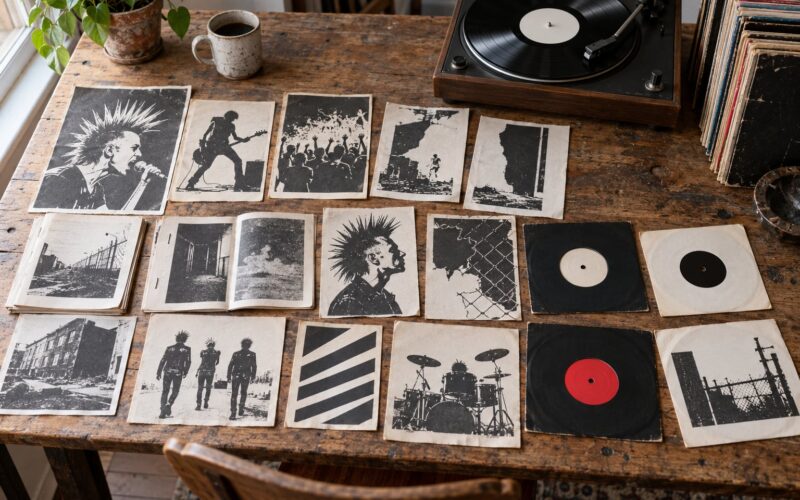
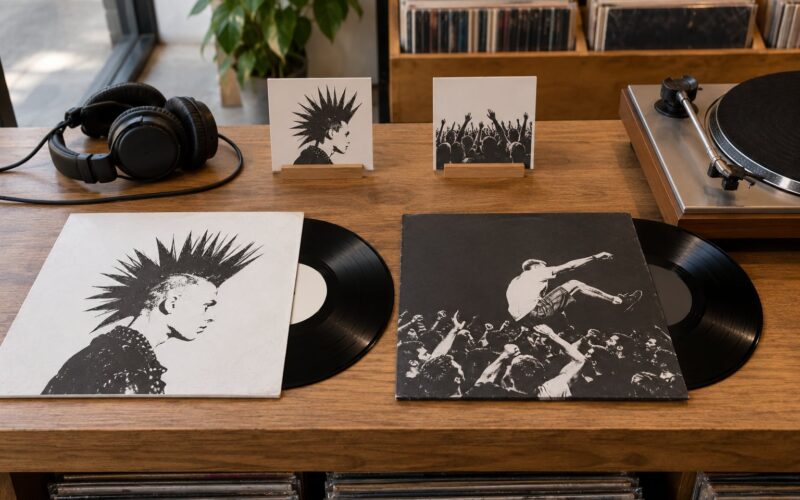
Look at the sleeve. Self-released labels, hand-stamped sleeves, photocopied inserts, addresses typed on the back cover. The Kingsmen, the Sonics and Death all released material this way, sometimes years before a major label would touch it.
Check the pressing. Private pressings vary enormously between copies. That variation is normal, and it is worth knowing what you are holding before you pay more for it.
Some essential proto-punk records are among the easiest in the whole catalogue to find, because their labels kept them in print for decades. The Stooges’ first two albums, the Kinks’ Kinks and the Sonics’ compilation-era releases have all stayed available in multiple editions.
Others depend heavily on which copy turns up. Death’s …For the Whole World to See, MC5’s Kick Out the Jams and anything from an early Stooges pressing change a lot from copy to copy, and that variance is the main reason collectors argue about them.
A useful habit: judge the music first and the pressing details second. A common copy of a crucial record will always be a better record to own than a rare one you have not listened to twice.
Why Does Proto-Punk Matter?
Proto-punk matters because it explains where punk actually came from. Almost every convention punk is known for, short angry songs, three chords, cheap instruments, anti-establishment lyrics and self-released records, was already in use in the late 1960s by bands most listeners have never heard.
It also corrects a common assumption. Punk did not begin as a reaction to polished 1970s rock. The bands that fed it were not rejecting slickness for the first time; they had rejected it a decade earlier, from a completely different set of influences.
The honest criticism is that the label can flatten very different artists. The Velvet Underground and the Stooges shared a label and almost nothing else, and grouping them neatly makes it easier to skip both. The term works best as a question rather than a category.
For new listeners, the practical payoff is a better starting point. Someone who plays the Stooges, the Sonics and the Saints before the Ramones hears continuity instead of invention, and usually keeps digging.
Frequently Asked Questions
Is proto-punk an actual music genre?
No, not in the way punk or blues is a genre. Proto-punk is a critical label applied afterwards to separate scenes in Detroit, Cleveland, New York, London and Australia that shared a stripped-down, confrontational instinct. No band called itself proto-punk, no scene named itself, and critics still argue about who belongs in the category.
What is the earliest proto-punk record?
There is no agreed first record, but the usual early candidates sit around 1963 to 1965: the Kingsmen’s Louie Louie, the Kinks’ You Really Got Me and the Sonics’ Here Are The Sonics. Some histories push the starting line further back into 1950s rock ‘n’ roll and rhythm and blues, which supply the tempo, the guitar attack and the attitude.
Is garage rock the same as proto-punk?
Not the same, though they overlap heavily. Garage rock is a scene-based sound built on distorted guitars, simple riffs and cheap recording, and it stretches into psychedelic garage and freakbeat. Proto-punk is the narrower retrospective judgement about attitude and purpose. Much classic 1960s garage gets filed as proto-punk because of how it was played rather than how it sounded.
Who was the first proto-punk band?
There is no single answer. Defensible early choices are the Sonics, the Kinks and the Pretty Things from 1964 and 1965, followed by the Stooges and MC5 in 1969. Historians who want one starting point usually point to the Sonics’ Here Are The Sonics, released in 1965, because it sounds like punk several years before punk existed.
Are The Stooges and The Velvet Underground proto-punk?
The Stooges, almost universally. No Fun and Raw Power are the most cited proto-punk records in existence. The Velvet Underground is the harder case. Their distortion, drone and DIY independence influenced a great deal of punk, but their structures were long-form and avant-garde rather than short and three-chord, so most guides list them as an adjacent influence.
What are the best proto-punk records for vinyl collectors?
Start with records that have stayed in print for decades: the Sonics’ Here Are The Sonics, the Kinks’ Kinks, the Stooges’ debut and Raw Power, the New York Dolls’ New York Dolls, the Modern Lovers and the Saints’ (I’m Stranded). Records such as Death’s …For the Whole World to See and MC5’s Kick Out the Jams vary far more from copy to copy.
Conclusion: Where to Start
Proto-punk is what writers call the rough, DIY rock of the mid-1960s to mid-1970s that handed punk its sound and its attitude. Nothing about it was planned, which is why the label still argues with itself.
If you are starting tonight, play three records in this order: Here Are The Sonics for the raw guitar, the Stooges’ debut for the volume, and the New York Dolls for the moment the line almost disappeared. After that, work outwards by city, because that is how the scenes actually formed.
Look for small-label pressings, hand-stamped sleeves and records that sound recorded in a hurry. Those are the clues that tell you this is proto-punk and not just an early punk record.