Doo wop music is a subgenre of rhythm and blues in which a lead singer carries simple romantic lyrics over close vocal harmonies, while three or four backing singers stack chords and intone rhythmic nonsense syllables like “doo-wop” to imitate the instruments. It grew out of African-American communities in the late 1940s and became a teen-market pop staple by the middle of the 1950s.
If the dictionary definition reads like a technical spec sheet and you still can’t picture what it sounds like, that is the usual reaction. Doo wop is easier to recognise than to define, so below I break down what you are actually hearing, where the style came from, and which records are worth a first listen.
Table of Contents
- What Is Doo Wop Music?
- What Does Doo Wop Music Sound Like?
- How doo wop music creates its signature sound
- Where Did Doo Wop Music Come From?
- How Did Doo Wop Change in the 1950s?
- Who Invented Doo Wop?
- What Are the Best Doo Wop Groups and Artists?
- What Songs Best Introduce Someone to Doo Wop?
- Is Doo Wop the Same as Soul or Vocal Jazz?
- How Can Vinyl Collectors Find Doo Wop Records?
- Frequently Asked Questions
- What is doo wop music?
- Is doo wop a music genre?
- Is doo wop the same as rhythm and blues?
- When was doo wop most popular?
- What are good doo wop songs for beginners?
- Conclusion
What Is Doo Wop Music?
Doo wop music is a style of vocal-group rhythm and blues built on close harmony and rhythmic nonsense syllables. A lead singer sings the melody and the words, a small set of backing singers holds chords beneath and above it in tight intervals, and a bass voice supplies the rhythmic pulse with syllables that stand in for a rhythm section. Most records sit on a simple beat with very little instrumental clutter.
It grew out of African-American communities in the late 1940s and crossed over into the mainstream pop chart by the early 1950s. Gospel harmony is its spine, but the delivery is relaxed, romantic and danceable rather than devotional.
It also helps to draw a few lines, because a lot of the confusion comes from neighbouring genres being filed under the same shelf in record shops. Doo wop is not soul, which grew out of gospel and rhythm and blues with a heavier, bluesier vocal weight. It is not vocal jazz, which is largely instrumental with singers as colour. And it is not exactly barbershop, which is a formalised competitive tradition built around a different harmonic discipline.
| Quick fact | Answer |
|---|---|
| Genre | Subgenre of rhythm and blues; vocal-group pop |
| Emerged | Late 1940s, African-American communities |
| Peak commercial period | 1950s into the early 1960s |
| Parent influences | Gospel, spirituals, jazz, rhythm and blues, barbershop |
| Defining feature | Close vocal harmony with rhythmic nonsense syllables |
| Typical lineup | One lead, three to four backing singers, small rhythm section |
| Early landmarks | The Chords, The Penguins, The Clovers, The Platters |
What Does Doo Wop Music Sound Like?
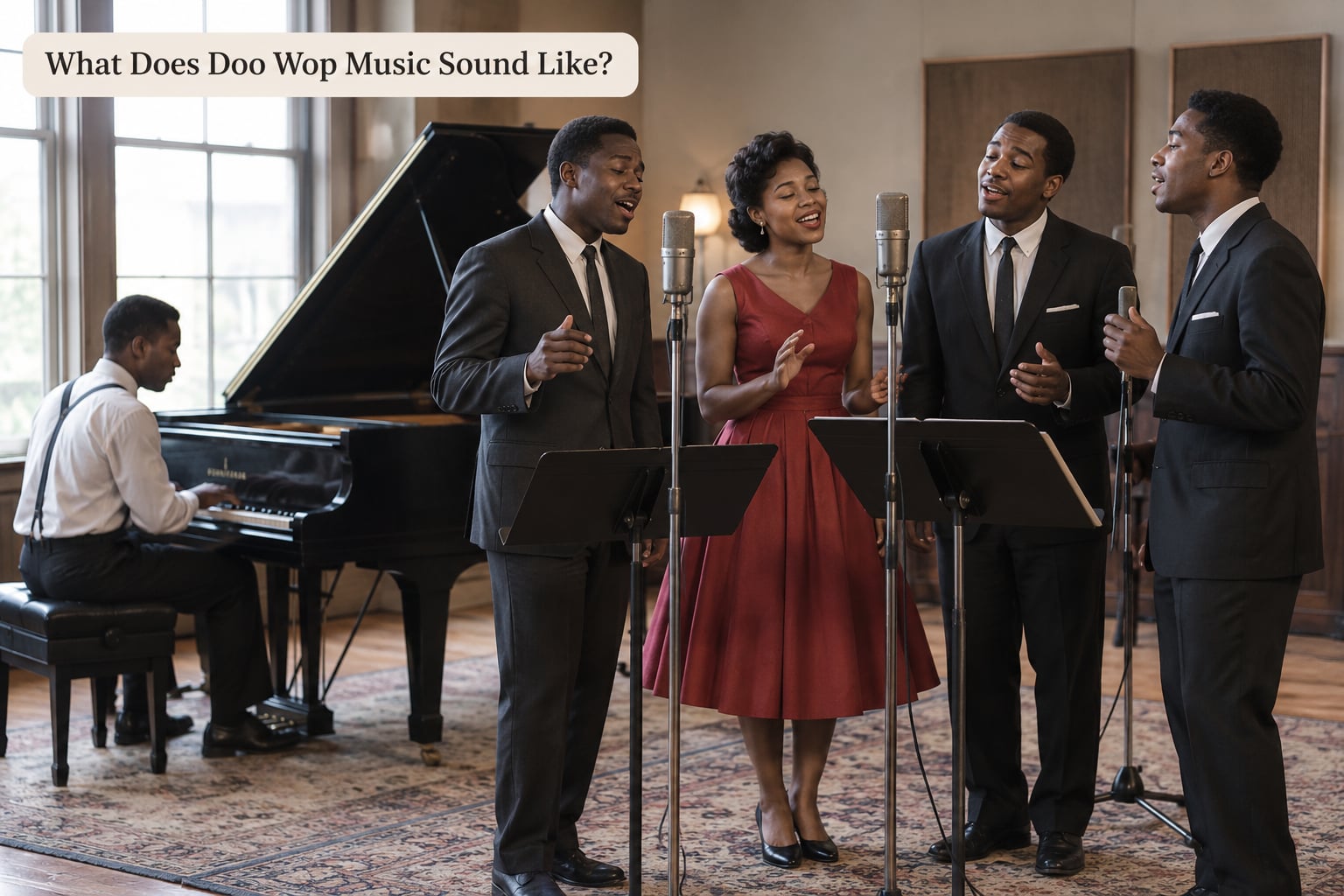
You hear a lead voice on top, tight three- and four-part harmony underneath, a rhythm section kept deliberately small, and a bass singer marking the beat with syllables instead of an instrument doing it. The effect is dense at the top of the mix and almost bare everywhere else.
A useful way to hear it is to strip the song back. Play something like “Earth Angel” by the Penguins, then “Only You” by the Platters, then “Why Do Fools Fall in Love” by Frankie Lymon and the Teenagers. Every record uses a handful of the same ingredients, so the pattern becomes obvious within three tracks.
How doo wop music creates its signature sound
It stacks a narrow band of voices in close position. Supporting singers sit a third, a fifth or an octave from each other rather than spreading out across an octave and a half, which is what gives the harmony its dense, blended texture instead of a thin, exposed sound.
- One lead, several backups. The lead sings the words, the rest of the group holds and decorates.
- Close intervals. Harmonies cluster near the lead’s note, producing the characteristic blend.
- Nonsense syllables. “Doo-wop,” “sh-boom” and “sh-be-doo” are timekeepers, not vocabulary.
- Restrained orchestration. Often piano, guitar, a bass line, brushed snare and stand-up bass, or almost nothing.
- Rhythmic phrasing. The backup parts move with the beat instead of droning under the melody.
Many of these records follow what fans call the “50s progression”, a four-chord loop known in music notation as I-vi-IV-V. It is the same underlying movement behind a huge amount of 1950s pop, and hearing it on a lead-plus-harmony arrangement makes the harmonic language click in a way a chord diagram never does.
Where Did Doo Wop Music Come From?
It came out of African-American musical tradition, specifically the layered close-harmony singing of gospel and spirituals and the jazz vocal arranging of the 1930s and 1940s. Quartets and larger groups had been singing in close harmony for decades, often in churches, on street corners and in apartment building stairwells and hallways, where acoustics made tight unison and rich bass lines easy.
The direct ancestors include the barbershop quartet, whose four-part arrangements prized clean tone and exaggerated vowel matching, and the earlier race records of the 1940s, which put vocal ensembles on disc alongside the solo blues singers and jump bands that already dominated the market.
What changed in the late 1940s was the format. Instead of an a cappella performance for a room, you got a short record built for radio and jukeboxes, with a rhythm section cut down to almost nothing and the vocal group doing the work the instruments used to do.
That business side mattered as much as the sound. Independent labels in New York, Philadelphia, Baltimore, Chicago, Detroit and Los Angeles sold to Black audiences through a network of record shops, clubs and touring venues, and those same small labels had the nerve to record unknown groups when the majors were not listening.
How Did Doo Wop Change in the 1950s?
Doo wop moved from neighbourhood and club audiences onto national radio and the pop chart. Earlier R&B was sold almost entirely to Black listeners; by the early 1950s vocal groups were landing at the top of the mainstream pop chart, and white teenagers heard Black harmony singing as a matter of course rather than as something exotic.
Three things drove that shift: independent labels competing for airplay, local scenes producing their own stars, and hit records crossing over to wider audiences. Groups also became stylistically distinct. The Chantels and the Chiffons in New York favoured a lighter, girl-group sound, while the Chords and the Clovers kept a more bluesy edge.
Italian-American groups became central to the form as well. Dion and the Belmonts, the Crests and earlier the Four Aces helped turn close-harmony singing into mainstream teenage pop, without the African-American origins getting any less central to the sound.
By the end of the decade the style was everywhere on radio. A churn of imitative vocal groups followed the hits, and the R&B chart, long known as the race records chart, shed that older name as the music moved into the mainstream.
Who Invented Doo Wop?
Nobody invented it. Doo wop has no single founder, and any answer naming one person is oversimplified. It is a collective development by singers, songwriters, arrangers, producers, session players and label owners working across several cities at once.
The credit for the name itself is genuinely muddled. Merriam-Webster dates the first known print use of “doo-wop” to 1961 in the music pages of the Chicago Defender, and the songwriter Gus Gossert is frequently named as the person who coined it, though the attribution is disputed. Many singers were already using “sh-boom,” “sh-be-doo” and similar syllables before the word appeared in print, and record-store customers were calling the music “old town music” or “rock and roll” in the meantime.
As for the style itself, the Chords, the Penguins, the Clovers, the Orioles, the Flamingos and the Platters were all recording it within a couple of years of each other in the early 1950s. Credit belongs to that whole first wave.
What Are the Best Doo Wop Groups and Artists?
These are the acts worth building a shelf around. Each one brought something different to the form.
| Group | Signature record | What they contribute |
|---|---|---|
| The Orioles | Crying in the Chapel | Widely credited as the first vocal group to top the pop chart, and a lean, gospel-tinged early sound |
| The Chords | Sh-Boom | One of the earliest records to use nonsense syllables as a hook, and a hit on both the R&B and pop charts |
| The Penguins | Earth Angel | Close, almost a cappella upper harmonies over a whisper-quiet arrangement |
| The Platters | Only You, The Great Pretender | Smooth vocal tone and precise phrasing; the most polished early vocal-group production |
| The Clovers | One Mint Julep | A bluesy edge and a jumped-up beat; the first R&B group to reach number one on the pop chart |
| The Flamingos | I Only Have Eyes for You | The high male lead pushed into the range that later became the doo-wop falsetto |
| The Drifters | There Goes My Baby | Street-corner authority that carried the form into the 1960s |
| Frankie Lymon and the Teenagers | Why Do Fools Fall in Love | Terrifying teenage lead vocal, technically precise at fifteen years old |
| The Dells | Whispering Grass | Group harmony that never rushed, with a relaxed, behind-the-beat feel |
| The Spaniels | Goodnite, Sweetheart, Goodnite | A gospel-shaped closer that makes the group sound larger than the band behind it |
Two things are worth saying about this list. First, most of these singers were teenagers, and the personnel changed constantly, so groups of the era can be hard to follow as continuous acts. Second, a great deal of excellent doo wop sits slightly outside it, from the Five Satins to the Moonglows and the Chiffons.
What Songs Best Introduce Someone to Doo Wop?
Here is a short listening path. Each record teaches you something different, so give them a few listens rather than skimming through once.
- Earth Angel, the Penguins, mid-1950s. Start here to hear close harmony without much instrumental cover, and to catch the genre’s melancholy streak.
- Only You, the Platters, mid-1950s. The clearest early example of a polished vocal-group production and disciplined phrasing.
- Why Do Fools Fall in Love, Frankie Lymon and the Teenagers, mid-1950s. A teenage lead vocal doing things few adults of the era could match; the emotional high point for most listeners.
- In the Still of the Night, the Five Satins, mid-1950s. Small-town storytelling and a vocal blend that feels effortless, which is the hardest thing to fake.
- I Only Have Eyes for You, the Flamingos, late 1950s. The moment the falsetto becomes the lead, and where the style starts pointing toward soul.
- The Great Pretender, the Platters, mid-1950s. A perfect AABA pop song that shows why the form became standard for a generation.
- The Wanderer, Dion and the Belmonts, late 1950s. A rock and roll edge on a doo-wop frame, and a good bridge into early sixties vocal pop.
- Goodnite, Sweetheart, Goodnite, the Spaniels, mid-1950s. A gospel reading of the style, useful for hearing the sacred root rather than hearing it as nostalgia.
If you want depth rather than hits, the Chiffons and the Chantels in the late 1950s and early 1960s, and the Moonglows on Sincerely, reward patience with warmer, looser arrangements.
Is Doo Wop the Same as Soul or Vocal Jazz?
No. Doo wop is a distinct branch of rhythm and blues, and it is often confused with barbershop, close harmony, soul and vocal jazz because all of them put singing at the centre.
| Category | Doo-wop | Soul | Vocal jazz | Barbershop |
|---|---|---|---|---|
| Period | Late 1940s into the early 1960s | Late 1950s onward | 1930s onward, in parallel | 1900s onward, as an organised tradition |
| Musical centre | Close vocal harmony and a simple beat | Blues and gospel vocal weight, deep grooves | Instrumental composition and arrangement | Barbershop tags, resonance and precision |
| Vocal structure | One lead plus three or four close-harmony backups | Usually a single strong lead over rhythm and blues harmony | Singers used as texture, not as a full group | Four fixed parts with a highly codified tag |
| Rhythm section | Small, often nearly absent, partly mimed by the bass voice | Full band, prominent bass and drums | Full jazz rhythm section | Rarely used at all |
| Orchestration | Sparse, mostly piano, guitar and light percussion | Full horn sections and layered keys | Large and deliberate | None |
| Relation to rhythm and blues | A subgenre of it, and its most vocal branch | Another branch, evolving in parallel | Separate tradition, later shared audiences | A separate tradition that shaped it |
| Hear these first | Earth Angel, Only You | Anything on a classic soul single from the early 1960s | Standards with vocalists on the edges | Traditional quartet tag recordings |
The single most useful distinction is this. Barbershop is a discipline with rules, competitions and a fixed structure, learned deliberately and performed entirely without instruments. Doo wop grew out of community singing and gospel, kept a band behind the voices, and was written for the record.
How Can Vinyl Collectors Find Doo Wop Records?
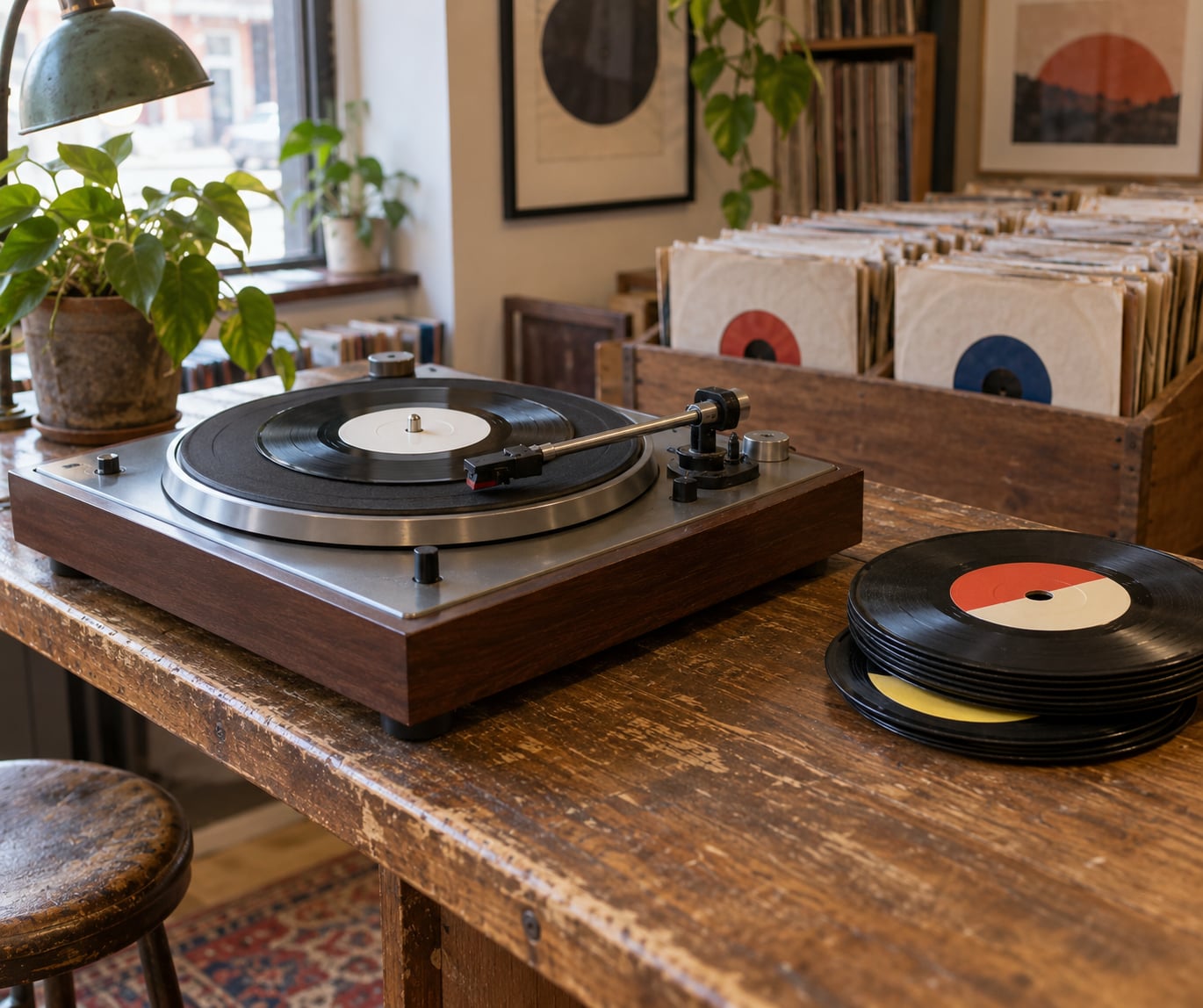
The material is out there, but doo wop reissues badly in a way that confuses newcomers. Original 45 RPM pressings from the early 1950s are the prize: tight, unvarnished sound and a small, easily graded label surface. Later LP compilations are easier to find and much easier to play, but the group personnel on a compilation track often have nothing to do with who was in the group when the song was written.
A few practical points for the hunt. Most singles of this era exist in mono only, so do not treat stereo pressings as the authentic version. Labels pressed the same single many times across a run, and the matrix number etched into the runout groove tells you which mastering it is. Condition grading matters most on the label and the vinyl: sleeve wear on a generic company cover costs less than a dog-eared original with a flat, scuffed label.
Common beginner mistakes are buying an unplayed promo, paying a premium for a reissue because it is listed first, and assuming a record is a group recording when the artist credit has changed hands by the time of issue. Check that the group on the label matches the group you want, and read the runout before you commit.
What a given pressing costs, and how common it turns out to be, changes with the title, the edition and the condition, so shop carefully and listen before you buy.
Frequently Asked Questions
What is doo wop music?
Doo wop music is a subgenre of rhythm and blues in which a lead singer sings simple romantic lyrics over close vocal harmonies, while backing singers stack chords and intone rhythmic nonsense syllables to keep time. It emerged in African-American communities in the late 1940s and reached the mainstream pop chart by the early 1950s.
Is doo wop a music genre?
Yes. Doo wop is generally treated as a subgenre of rhythm and blues rather than a genre of its own, and the distinction matters less than it sounds. Historians place it inside Ru0026amp;B because of its origins, rhythm and vocal approach, while listeners and collectors still use doo wop as a label in its own right.
Is doo wop the same as rhythm and blues?
They are not the same. Doo wop is one branch of rhythm and blues, distinguished by putting close vocal harmony at the centre and keeping the instrumentation small. Rhythm and blues was much wider, covering solo blues singers, jump bands and instrumental Ru0026amp;B. Those solos and bands are rhythm and blues but not doo wop.
When was doo wop most popular?
Doo wop peaked between the early 1950s and the early 1960s. Vocal groups first topped the pop chart in the early 1950s, the style dominated teenage radio through the decade, and the girl-group era carried its close-harmony vocal approach into the early 1960s before soul, pop and rock absorbed it.
What are good doo wop songs for beginners?
Start with Earth Angel by the Penguins, Only You by the Platters, and Why Do Fools Fall in Love by Frankie Lymon and the Teenagers. Then add In the Still of the Night by the Five Satins and I Only Have Eyes for You by the Flamingos. Together they cover close harmony, teenage emotion, storytelling and the falsetto era.
Conclusion
Doo wop is rhythm and blues where the voices do what the instruments usually do: one lead on top, close harmony stacked beneath it, and a bass singer counting the beat out loud in nonsense syllables.
Your first move should be simple. Play Earth Angel, then Only You, then Why Do Fools Fall in Love, and listen specifically for how tightly the backing voices sit under the lead. From there, follow one group you like into the 1950s vocal-group canon, and your ear will sort out the rest of the genre for you.