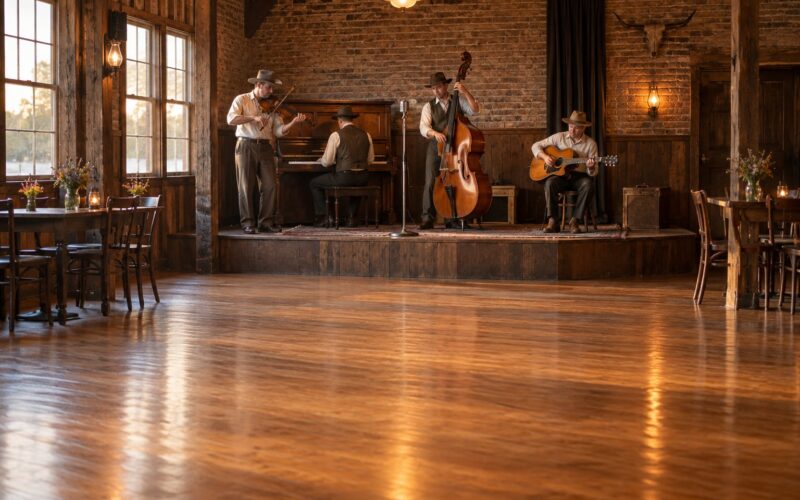
What is lounge and easy listening music? Lounge is the atmospheric, place-driven branch of mid-century pop built on exotica and cocktail-bar mood. Easy listening is the broader 1950s to 1970s radio format of lush, unobtrusive orchestral arrangements. They share a palette but not a purpose, and telling them apart changes what you should buy first.
I’m a longtime digger of mid-century vocal sleeves, and the confusion between these two names comes up constantly, usually from someone who just played a Martin Denny record and asked why nobody recommended Herb Alpert. This guide sorts out the terminology, traces where each style came from, and gives you a first handful of records that make the whole family click.
Table of Contents
- A Brief History of Lounge and Easy Listening Music
- What Is Lounge and Easy Listening Music in Practice?
- The Main Styles of Lounge and Easy Listening Music
- Classic exotica
- Cocktail lounge
- Easy listening and MOR vocals
- Space age bachelor pad music
- Surf, organ and instrumental pop
- The 1990s revival
- Modern lounge, chillout and downtempo
- Lounge and Easy Listening Music: A Style Comparison
- How Lounge Music Differs from Easy Listening
- How to Recognize Lounge and Easy Listening Records
- Where to Start Collecting Lounge and Easy Listening Vinyl
- Frequently Asked Questions
- Are lounge and easy listening music the same thing?
- Is lounge music still being recorded today?
- What instruments are most associated with lounge music?
- Why was music called easy listening in the 1950s?
- What is the difference between lounge, exotica, and cocktail music?
- Are original lounge and easy listening LPs worth collecting?
- Conclusion: What to Listen For First
A Brief History of Lounge and Easy Listening Music
The genre family starts after the Second World War, when American record companies discovered that listeners would buy music with no lyrics to follow and nothing to protest about. Small-combo jazz, Latin rhythmic forms like the mambo, cha-cha and bossa nova, and novelty songs about faraway places all fed into the same pot.
Two commercial categories emerged from it. One was built for listening, the other for living around. Easy listening grew out of radio formats designed to be switched on at any hour of the day, with arrangements that never raised their voice. Lounge grew out of the hi-fi and cocktail culture, where music had a job: paint a room.
By the late 1950s, record labels were naming this music explicitly. Capitol built a tower for the format and released Martin Denny’s jazz-improvised exotica and Les Baxter’s lush instrumentals on it. Liberty and Kapp sold Jackie Gleason’s big-band mood records alongside Henry Mancini’s film scores. Columbia’s Dot imprint handled the smooth side of the business.
The 1960s split the audience further. Herb Alpert and the Tijuana Brass put a whistle on the record and sold millions to people who had never owned an exotic record. Vocal easy listening kept its own lane with Perry Como, Doris Day and Nancy Sinatra, whose bossa nova albums were aimed squarely at adults who found rock and roll too loud.
Then the format went quiet. Easy listening records stopped charting under their own name in 1979, when Billboard folded the chart into Adult Contemporary. The catalogs kept selling, though, mostly through discount bins, which is exactly where a lot of collectors now find them.
By the late 1980s and 1990s the sound came back in a costume. Combustible Edison put a smoke machine behind a Bond-girl pastiche, Pink Martini recorded with a genuine Cuban orchestra and invented lounge singer Pinky P, and Mike Flowers Pops recorded fictional cocktail versions of show tunes. Later, St Germain and Thievery Corporation turned the palette toward electronic production, which is where most of today’s streaming lounge playlists come from.
What Is Lounge and Easy Listening Music in Practice?
In practice, the sound is defined less by melody than by texture. Both styles sit in a mid tempo range, both lean on instruments that ring rather than bark, and both are mixed so the vocal or the lead sits forward and everything else spreads out behind it.
Five things give the music away:
- Percussion you feel more than hear. Bongos, congas, shakers, muted timbales and brushed drums doing a lazy shuffle, rarely a backbeat you could dance hard to.
- Vibraphone and marimba as lead voices. The mallet percussion is often melody-carrying, not decoration, which is what separates these records from generic instrumental jazz.
- Nylon-string guitar, softened and amplified. Major sevenths, no sustain pedal, a clean tremolo, often panned slightly to one side of the stereo field.
- Muted brass and a full string section. Harmon muted trumpet and flugelhorn, violins writing long legato lines, sometimes with an octave-doubled harp or piano underneath.
- Reverb-heavy, hi-fi-forward mixes. Wide stereo, long room tails, very little grit. Anything mixed this cleanly in 1958 was made for the living room and the cocktail bar, not the dance floor.
Vocal records in the family replace the instrumental hooks with a croon: close-mic’d, low-register, sometimes barely projected. Percussion still marks the tempo and the strings still fill the gaps, so a vocal easy listening record and a lounge instrumental often share a producer’s entire approach to the rhythm section.
The Main Styles of Lounge and Easy Listening Music
Classic exotica
The commercial invention of the 1950s: imaginary tropical destinations, novel percussion, and a jazz soloist placed in charge of the mood. Martin Denny’s Firecracker and Explosive, Les Baxter’s Thunderbirds and Fireballs, Yma Sumac’s Mambo!, Tak Shindo’s Luxurious Tiki, and Webley Edwards are the reference points. Roughly 1955 to 1962, almost entirely instrumental.
Cocktail lounge
Bigger, moodier, and built around a record label’s in-house orchestra. Jackie Gleason’s albums for Capitol traded on the television show’s lounge set, Henry Mancini’s Pink Panther and Breakfast at Tiffany’s brought the same sensibility to film, and Les Baxter’s Jewels of the Orient set the high water mark for lushness. This is where the “lounge” label was most honest.
Easy listening and MOR vocals
The broadcast half. Unobtrusive, all ages, always singable. Perry Como, Nat King Cole, Doris Day, Bing Crosby, Andy Williams and the broader crooner tradition. When the charts mattered, this was the format with the highest audience share in the United States. The arrangements come from session players, the songs are standards, and the vocal sits at the front of a mix designed to be heard over conversation.
Space age bachelor pad music
The futuristic corner of the family, tied to sci-fi films, atomic-age optimism and bachelor-pad record sets. Electronic keyboards standing in for strings, theremin, oddly processed percussion, and titles full of rockets, satellites and automation. George Duning scores, Jack Shaindlin’s Flight to Hong Kong and the Wire and Space Age Record Club compilations are the reference points.
Surf, organ and instrumental pop
Where the format grew pop hooks without really growing vocals. The Ventures’ Penetration and Millions of Guitars, the Champs’ Tequila, and Herb Alpert’s sessions sit here. Higher tempo than pure lounge, often rougher mixes, and the bridge between the format and the instrumental pop that would dominate the late 1960s charts.
The 1990s revival
A deliberately costume-drunk lounge movement that sampled the source material and added irony. Combustible Edison’s Supper at Eight, Pink Martini’s Hang On Sloopy, Mike Flowers Pops, Nouvelle Vague with the C(l)ub Sounds From The Past compilations, and the whole Ultra-Lounge label orbit. On r/LoungeMusic the ongoing argument is whether this counts as lounge or as parody of lounge, and both camps listen.
Modern lounge, chillout and downtempo
The palette rebuilt with electronics. St Germain’s Rhodes and breakbeats, Thievery Corporation, The Gotan Project’s tango electronica, Bebel Gilberto, JJ Strimalong. Search results for “lounge” now return mostly this, which is why a beginner’s first playlist can be decades away from Martin Denny without anyone noticing.
Lounge and Easy Listening Music: A Style Comparison
These six terms get used as if they were interchangeable. They are not. Here is how they actually separate.
| Style | Peak era | Typical sound | Vocals | Best starting record |
|---|---|---|---|---|
| Lounge | 1956 to 1965 | Atmospheric, place-evoking, cinematic | Rare, often wordless vocalise | Les Baxter, Jewels of the Orient |
| Easy listening | 1955 to 1979 | Even, unobtrusive, melody-first | Central, crooned | Perry Como, Hello, Dolly! |
| Beautiful music | 1960s, mostly Japan | Delicate, refined, quietly romantic | Sparse, often wordless | Takeshi Terauchi and Blue Jeans |
| Mood music | 1970s | Slower, darker, more electronic | Rare | Space-age library records by library labels |
| Exotica | 1955 to 1962 | Novelty percussion, imaginary tropics | Occasional, gimmicky | Martin Denny, Firecracker |
| Space age pop | 1957 to 1965 | Electronic, futuristic, odd meters | Mostly instrumental | Jack Shaindlin, Flight to Hong Kong |
Two details worth keeping in your head. First, beautiful music is the Japanese branch of the same lineage, and its collectors are exactly as obsessive as the American ones. Second, mood music is the darker, colder successor that arrived when the format needed to fit through darker hours on late-night radio.
How Lounge Music Differs from Easy Listening
Rhythm. Easy listening is more often built on a plain 4/4 that can sit under a clock and a coffee pot. Lounge is likelier to open up: odd meters, mambo and bossa inflections, conga breaks that ignore the bar.
Vocals. This is the cleanest divide. Easy listening is a vocal format and a vocal market. A lounge instrumental is built around a hook for the instrument to play, and a vocalise counts as texture rather than message.
Instrumentation. Both use strings and mallets. Lounge leans on exotic colour: marimba, vibraphone, kalimba, effects units, bamboo flute. Easy listening leans on standard session orchestration with a piano and a small rhythm group and a few synthesised pads.
Cultural setting. Easy listening was sold to households and, more importantly, to radio programmers, which is why it had to be unfussy and all ages. Lounge was sold to a room, a drink and a mood, which is why the covers showed destinations rather than singers.
Marketing. This is where the two terms collided. Labels used “lounge” as a sales word for instrumental mood records while radio used “easy listening” as a format name, so by the mid 1960s any album of lush arrangements could sit under either banner in a catalogue. The interchangeable usage is a marketing artifact, not a musical truth.
So why do collectors still need the distinction? Because it decides whether you are looking for a croon and a standard, or an arrangement and a place. If you buy a Nelson Riddle record expecting Martin Denny timbres, you will think something went wrong with your speakers.
How to Recognize Lounge and Easy Listening Records
Start with the percussion. If you can tap your foot and it lands on two and four, you are probably in easy listening territory. If the groove wanders through a mambo figure and then a cha-cha, you are in exotica.
Next, listen to the top of the mix. Vibraphone and marimba carrying the melody tells you lounge. Piano and voice telling you, tells you easy listening. A crooned baritone means you are almost certainly on the vocal side of the line.
Then check the stereo image. Lush, hi-fidelity, wide and glossy means a record pressed for the stereo market, usually with the percussion hard left and the strings sweeping right. Narrow, centred, closer and drier suggests a mono record, which usually means an earlier pressing and often a better one for the tape hiss and cassette warmth that collectors of this music tend to prefer.
For shopping, catalog numbers do more work than covers. Capitol’s Capitol Records and Tower series, Liberty’s L series, Columbia’s CL and CS series, Dot’s, and Kapp’s K series all sat in or next to this territory. Mono and stereo versions usually carry different numbers with an S in the stereo code, so a single cover can hide two very different records.
Pay attention to mastering and sleeve wear too. Lush instrumental records ask a lot of a cartridge and a lot of a surface, so scuffs are more audible here than they would be on a vocal record. A clean, well-kept sleeve matters more than it would for a punk single, because the art is a large part of why people collect these at all.
Where to Start Collecting Lounge and Easy Listening Vinyl
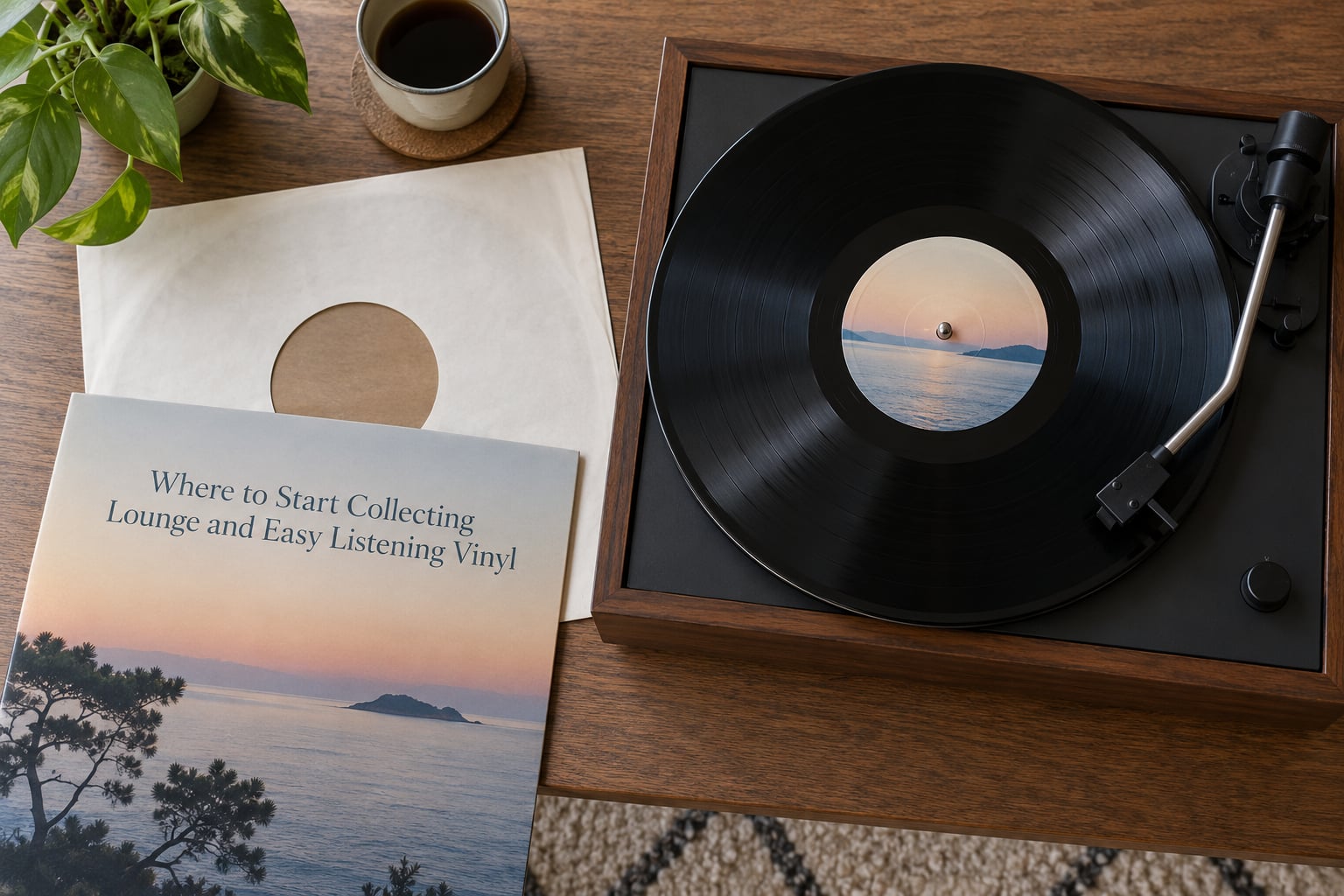
Collectors on r/vinyl and the Soul Strut community tend to treat cheap presses of the era as shelf-fillers rather than grails, so the realistic way in is breadth first. Buy one record per row below, learn what each one teaches, and only then go hunting for specific pressings.
| Record | Sub-style | What it teaches you |
|---|---|---|
| Martin Denny, Firecracker | Exotica | The jazz soloist as bandleader; the definition of the genre’s first wave |
| Les Baxter, Jewels of the Orient | Cocktail lounge | Lushness at maximum; heavy, cinematic arrangement |
| Henry Mancini, Pink Panther | Cocktail lounge | How the same palette works in film music |
| Perry Como, Hello, Dolly! | Easy listening vocal | The clear, crowd-free version of the crooning side |
| Herb Alpert and the Tijuana Brass, The Lonely Bull | Instrumental pop | The format with a hit record attached, and where lounge went commercial |
| Nancy Sinatra, Boots | Easy listening vocal | The youth-culture crossover at the end of the format |
| Sergio Mendes and Brasil ’66, Brasil ’66 | Bossa lounge | The Latin rhythm side; a bridge to Brazilian jazz |
| Jack Shaindlin, Flight to Hong Kong | Space age pop | Electronic lounge, keys and theremin, no jazz at all |
| Combustible Edison, Supper at Eight | 1990s revival | How the source sound was dressed up and made knowingly silly |
| Nouvelle Vague, C(l)ub Sounds From The Past | 1990s revival | Bossa and 1960s pop heard as a DJ set |
Two practical notes from people who dig this music regularly. On the Soul Strut forum, the usual first question is whether a record is genuine or a cheap novelty cash-in, and the honest answer is that both can be good listening; the tell is usually whether a real arranger is credited. Separately, compilations such as the Tiki Sampler are often a cheaper way into an artist than hunting a single original pressing.
If you want to hear the format outside the USA, add a Takeshi Terauchi and Blue Jeans record for beautiful music, and look for Japanese pressings with obi strips intact, since those were made for their home market rather than exported.
Frequently Asked Questions
Are lounge and easy listening music the same thing?
No. They overlap heavily but they are not the same thing. Easy listening is the broad 1950s to 1970s radio format built around vocal standards and unobtrusive orchestral arrangements. Lounge is a narrower, mostly instrumental branch that pushes the same palette toward atmosphere and place. The labels were merged by record marketing, not by musicians.
Is lounge music still being recorded today?
Yes, constantly, though rarely under the label lounge. Modern artists in the lineage include St Germain, The Gotan Project, Thievery Corporation and Bebel Gilberto, and streaming playlists tagged lounge usually mean this electronic chillout branch. If you want something closer to the 1960s sound, revival projects from the 1990s revival period are a better reference point.
What instruments are most associated with lounge music?
Vibraphone and marimba usually carry the melody. Behind them sit nylon-string guitar, muted trumpet and flugelhorn, a string section, and percussion like bongos, congas, shakers and brushed snare. On the 1960s vocal side you add piano, a small rhythm group and synthesised pads. Space age pop substitutes electronic keyboards and theremin for the strings.
Why was music called easy listening in the 1950s?
Because it was designed to be switched on at any hour without demanding attention. Radio programmers needed music that worked at breakfast, at work and at dinner, so arrangements stayed at a moderate tempo with an even mix and nothing that demanded concentration. The name described a programming habit rather than a musical style, which is why the category resisted strict definition.
What is the difference between lounge, exotica, and cocktail music?
Exotica is the 1955 to 1962 novelty wave, full of imaginary tropical destinations and unusual percussion. Lounge is the broader and later style aimed at atmosphere, often cinematic and place-driven. Cocktail music is the record-label lounge catalogue itself: Jackie Gleason’s big-band records and similar in-house orchestra albums, which were lounge music sold for a specific room.
Are original lounge and easy listening LPs worth collecting?
It depends on what you are after. Original mono pressings from the late 1950s sound noticeably closer and drier, and collectors of this music often prefer that, but they are scarce and expensive. Later stereo pressings and reissues are plentiful and inexpensive, and most of the genre’s interest lies in the music and the sleeve art rather than in pressing variation. Buy for the record, not the matrix.
Conclusion: What to Listen For First
The whole confusion resolves into one line. Easy listening is music for passing time, built around a voice and a standard. Lounge is music for a room, built around an arrangement and a place. Once you know which one you actually like, the record bins stop looking random.
Start with Martin Denny’s Firecracker if you want the 1950s exotica sound, then move sideways to Les Baxter for the lush end, and only after that go looking for vocal easy listening with Perry Como or Nancy Sinatra. If what you really want is what Spotify calls lounge today, sample St Germain first and work backwards from there. Either way, listen to one full side without doing anything else, which is the only reliable way to hear a hi-fi mix properly.