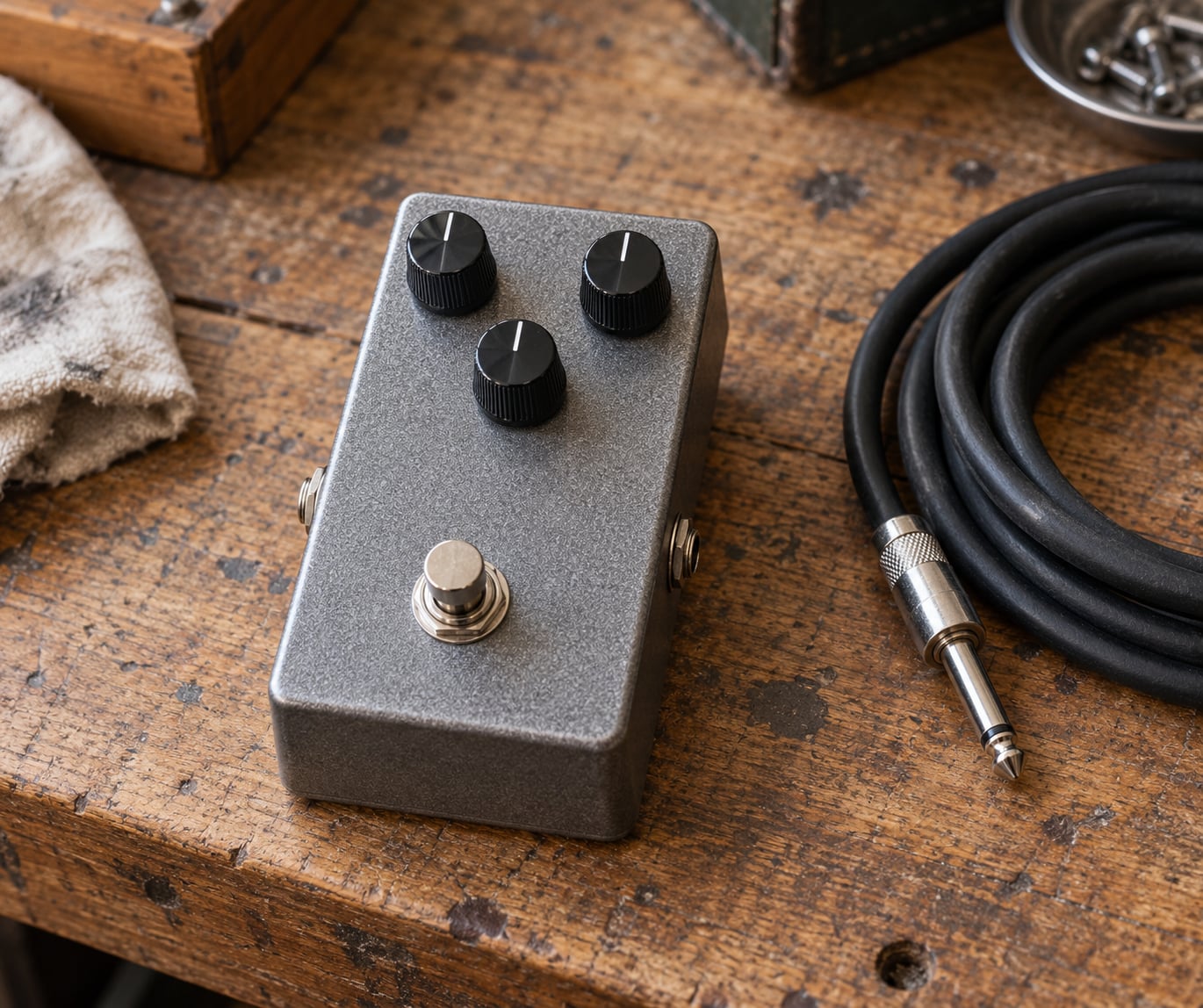
A fuzz pedal is used for turning a guitar or bass signal into a thick, buzzing, heavily saturated tone that chimes under the fingers and holds together at high gain. It gives you the compressed, flat-topped sound heard in garage rock, punk, psychedelia, stoner and doom, grunge, and a lot of modern shoegaze. This guide covers what the effect does, how it works, what each knob controls, and where it fits in your chain.
If you have never used one, the first thing to know is that a fuzz pedal does not add volume or polish. It removes options. That trade is why guitarists who love fuzz keep one on the board next to three cleaner pedals.
Table of Contents
- What Is a Fuzz Pedal Used For? A Quick Guide
- How Does a Fuzz Pedal Create Its Sound?
- What Does Each Fuzz Pedal Control Do?
- Fuzz or gain
- Volume
- Tone
- Bias, gate, and mix controls
- Which control matters most on a first fuzz pedal?
- Fuzz, Overdrive, and Distortion: What’s the Difference?
- What Fuzz Style Should You Choose?
- How Do You Set a Fuzz Pedal for a Usable Tone?
- How Should You Use Fuzz with Guitar and Bass?
- Can You Use a Fuzz Pedal with Other Effects?
- What Musicians and Genres Are Known for Fuzz?
- Frequently Asked Questions
- Is a fuzz pedal the same as a distortion pedal?
- What type of amplifier works best with a fuzz pedal?
- Why does my fuzz pedal disappear when I turn up the volume?
- Can bass players use a fuzz pedal?
- Should a fuzz pedal go before or after overdrive and distortion?
- Conclusion
What Is a Fuzz Pedal Used For? A Quick Guide
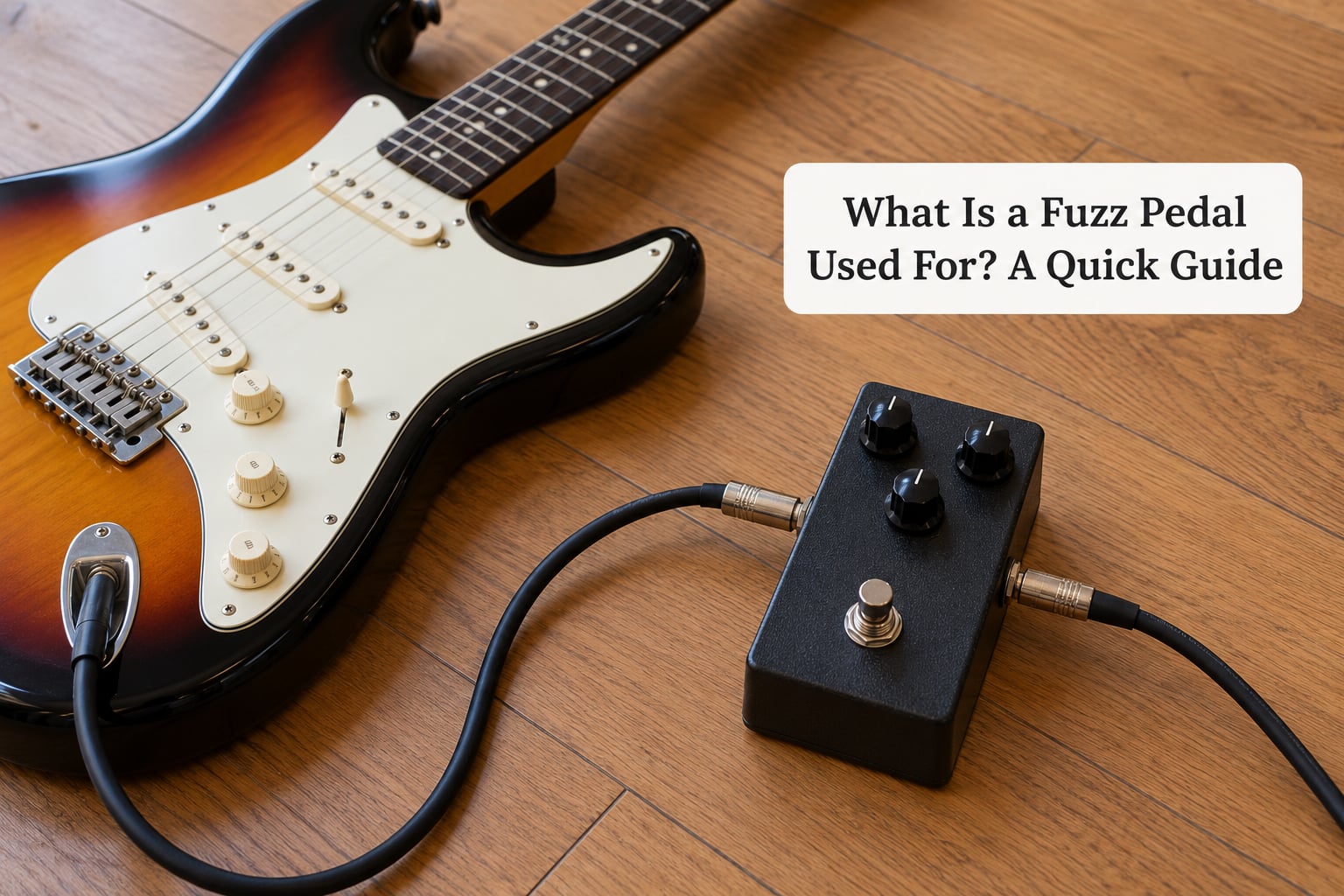
In short, a fuzz pedal is used for saturating the instrument signal so hard that the note stops sounding like a single pitch and turns into a wall of overtones. The practical results are a fat sustain that holds through a bend, a percussive edge that cuts through a mix, and a touch-sensitive response where backing off the guitar volume thins the sound out.
It differs from overdrive and distortion in how hard the signal is pushed. Overdrive gently rounds the peaks of a clean tone. Distortion clips harder but keeps some of the original waveform shape. Fuzz clips so hard that the waveform flattens into something close to a square wave, which is why fuzz can sound woolly, sputtery, and sometimes chaotic.
These are the main styles you will run into:
| Fuzz style | Characteristic tone | Typical use |
|---|---|---|
| Fuzz Face | Spongy, bristly, cleans up well with the guitar volume | Lead playing, octave riffs, 1960s psychedelic leads |
| Tone Bender | Scooped mids, aggressive upper register, vocal sustain | Blues leads, hard rock riffs, cutting through a band |
| Big Muff style | Smooth, huge sustain, plenty of low end | Sustain solos, doom, big slow riffs |
| Maestro Fz-1 style | Raspy, splattery, gated and uneven | Garage rock, noise textures, lo-fi production |
| Fuzzrite | Thin and reedy with a fast attack | 1960s rock and roll riffs, rhythm playing |
| Octave fuzz | Adds a note an octave below what you play | Synth-like melodic lines, funk, experimental playing |
| Hybrid fuzz | Fuzz blended with a clean or overdriven channel | Players who want one pedal to cover rhythm and lead |
How Does a Fuzz Pedal Create Its Sound?
Three things happen inside the circuit, in this order:
Signal clipping. The incoming signal is deliberately pushed past the point where a transistor or diode can handle it linearly. The peaks and valleys get flattened instead of following the original wave shape.
Square wave conversion. Flat-topped peaks push the waveform toward a square. A square wave is rich in odd harmonics, which is where the buzzy, reedy quality comes from.
Harmonic saturation. Because the original fundamental frequency is buried under so many overtones, the perceived pitch of the note becomes less obvious. The result is the thick, woolly character people describe as fuzzy.
On top of that, the circuit compresses the dynamic range. Soft picking and hard picking end up closer together in loudness, so chords feel enormous and single notes sustain far longer than they would through a clean signal. Many fuzz circuits also gate the tail of each note, so it cuts off abruptly. That gating is part of the sound, not a fault.
What Does Each Fuzz Pedal Control Do?
Control names vary between manufacturers, and a knob labelled tone on one pedal does not behave like a knob labelled tone on the next. The four controls below cover almost every fuzz pedal.
Fuzz or gain
This sets how far the signal is pushed into clipping. Turned down, most fuzz pedals behave like a mild overdrive. Turned up, the waveform flattens and the tone gets thicker and noisier. On some circuits the usable range is narrow, and a small movement makes a big difference.
Volume
This is the control to look for first on a first fuzz pedal. Because fuzz compresses and boosts the signal, the output level often jumps when you switch the pedal on. A volume knob lets you match it to your amp or other pedals. On a decent single-knob fuzz, pulling volume down genuinely cleans the sound up, because the clipping stage is still there but the level into the amp is lower.
Tone
Tone usually acts as a passive filter, often a capacitor that rolls off the high end as you turn it down. On a Tone Bender style circuit the tone control is famously interactive, sweeping the mids and changing the character of the whole circuit rather than simply darkening it.
Bias, gate, and mix controls
A bias control changes where the transistors sit in their conducting range, changing from splattery and loose to smooth and compressed. A gate control engages the noise gate. A clean blend or mix control keeps a portion of the untouched signal alongside the fuzz, which is a common modern solution to the muddiness problem.
Which control matters most on a first fuzz pedal?
The volume control, without much debate. A fuzz without one is limited to whatever amp you happen to own and at whatever gain setting you happen to use, and many players find that limitation so frustrating they stop using the pedal.
Fuzz, Overdrive, and Distortion: What’s the Difference?
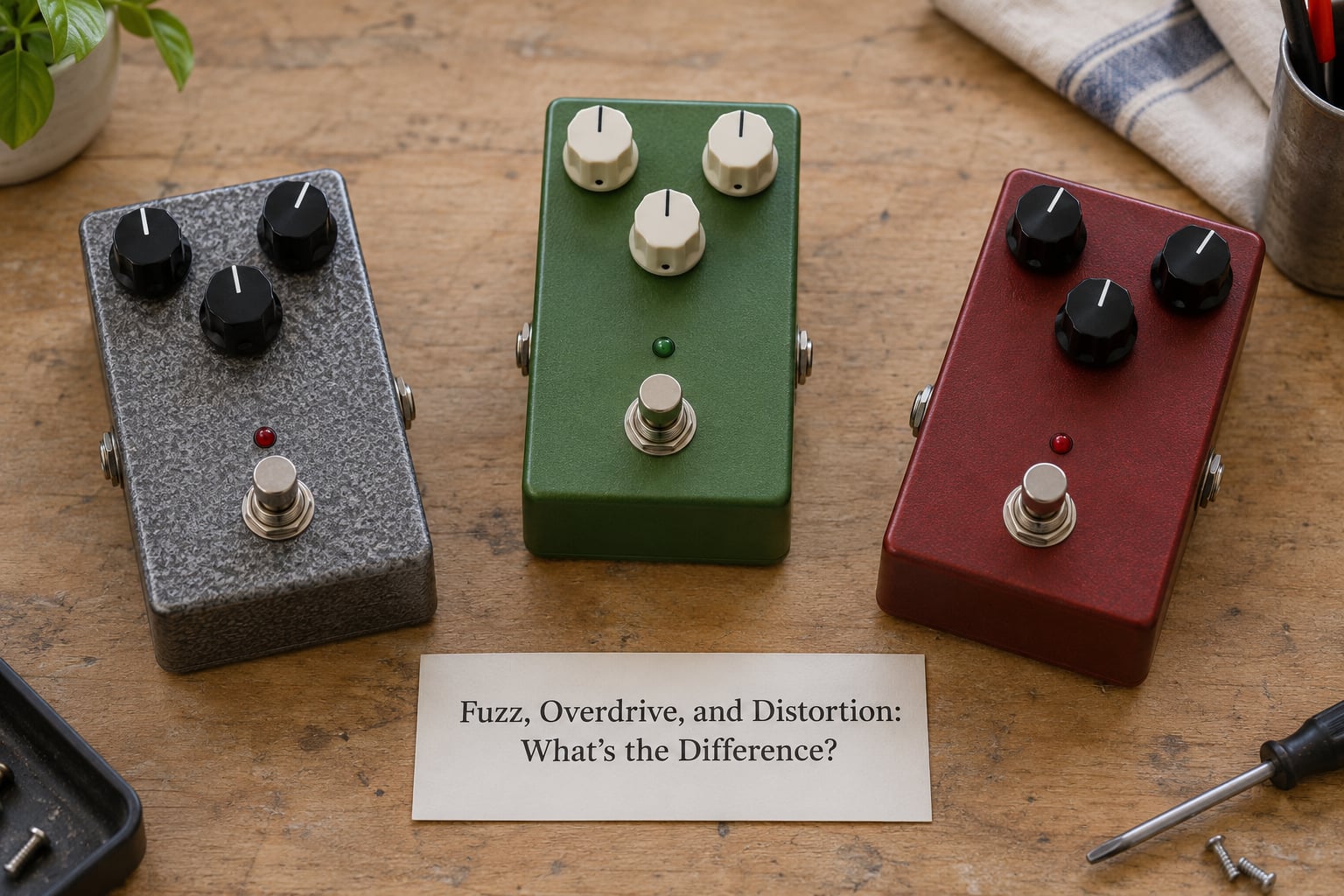
The three effects share a circuit principle and differ in degree. Here is the short version.
| Fuzz | Overdrive | Distortion | |
|---|---|---|---|
| Clipping | Very hard, often into square wave shape | Gentle, rounded peaks | Hard, but preserves more of the original waveform |
| Dynamics | Heavily compressed, notes blur together | Mostly left alone, touch sensitive | Moderately compressed |
| Sustain | Very long, notes feed into each other | Natural, with a musical decay | Long but structured |
| Noise at full gain | Noticeable hiss, sputter, sometimes oscillation | Low | Moderate |
| Cleans up with guitar volume | Usually yes, when a volume control is present | Yes | Varies by unit |
| Best for | Fats, leads, drones, texture | Rhythm warmth, blues, stacking | General rock rhythm and lead |
A useful way to hear the difference: play the same single-note riff clean, then with overdrive, then with distortion, then with fuzz. Overdrive thickens the note and leaves the rhythm intact. Distortion fattens it further. Fuzz turns the note into a sustained tone that smears into the next one, which is why fuzz is a rhythm instrument in the right hands and a liability in the wrong ones.
What Fuzz Style Should You Choose?
Match the style to the playing you already do rather than to a song you want to copy.
Fuzz Face circuits respond strongly to picking dynamics and back off noticeably when you lower the guitar volume. That touch response makes them a natural fit for lead players who move their right hand as much as their fretting hand.
Tone Bender circuits are brighter and more aggressive, with a scooped midrange that leaves room for bass in a full mix. Blues and classic rock lead players gravitate here, and the midrange scoop interacts strongly with the tone control.
Big Muff style circuits deliver the biggest sustain and the lowest output of the traditional fuzzes. They suit slow riffs, drones, and doom, and they behave more predictably with crowded signal chains.
Maestro Fz-1 style circuits are the most abrasive of the group, with gated, splattering notes that sound unpolished on purpose. If you play garage rock or write with lo-fi production, that ragged quality is the point rather than a problem.
Octave fuzz circuits trigger a second, lower note an octave down from what you play. Playing single-note lines produces a synth-like doubled melody. It divides opinion more than any other fuzz type, so try one before committing.
Hybrid fuzz designs blend a clean or overdriven channel with the fuzz channel. If you play both rhythm and lead in the same song, this style covers both without asking you to swap pedals.
Transistor choice matters too. Germanium circuits are warmer, softer on the low end, and more sensitive to temperature and to the specific unit you buy, which players describe as inconsistent and others describe as the reason they keep the pedal. Silicon circuits are tighter, quieter, and behave the same every time. For a first pedal or a pedal that must handle a loud amp, silicon is the safer bet.
How Do You Set a Fuzz Pedal for a Usable Tone?
Start at a moderate setting and change one thing at a time. This order works better than turning knobs randomly.
1. Set the guitar volume at ten. The cleanup technique depends on it, and a lower starting position will confuse your ear during setup.
2. Put the fuzz knob at about half. Where half actually is depends on the circuit, but begin in the lower half of the travel. Too little fuzz and you are just using an overdrive.
3. Set the tone control near the middle, then trim the low end. If the sound gets muddy as you add gain, roll the tone down a touch or pull the guitar tone control back. Mud in fuzz is almost always too much low end, not too much gain.
4. Set the pedal volume to match your amp. Match by ear, not by reading the knobs: switch the pedal on and off at the same playing volume and adjust until the jump in loudness is gone.
5. Play at realistic volume. Fuzz settings that sound thin at low bedroom volume often turn into mush on stage. Make the final call at the volume you actually play at.
6. Learn the guitar volume cleanup. Pick a note at full guitar volume, then roll it down until the note thins out, and keep rolling until it approaches clean. The useful range sits somewhere in the bottom third of the knob. Practise finding it without looking.
Two practical notes. Give the pedal its own isolated power supply when possible, because a shared supply is a common cause of hum, gating, and random behaviour. And if the pedal oscillates into a high whistle, back the fuzz off slightly; you are pushing the circuit past stable operation.
How Should You Use Fuzz with Guitar and Bass?
On guitar, fuzz rewards players who use their right hand. Volume swells, light picking, and single-note lines let you open and close the effect without touching the pedal. Octave picking, where you alternate the pick between the string and the octave below it, sounds enormous through a Fuzz Face style circuit and is close to the traditional psychedelic vocabulary.
On bass, fuzz is common in stoner, punk, and experimental music, but it needs a different approach. The trick most players use is to run the bass volume wide open, dial the fuzz almost all the way down, and then treat the instrument volume as a switch between clean and dirty. That keeps the low end defined on the quiet parts and lets the fuzz swell for the loud ones.
Pickup choice changes how a fuzz sits. Single coils feed a fuzz a brighter signal with more noise, which suits lead lines. Humbuckers give a fatter, more compressed input that works better for riffs and bass work. A treble booster ahead of a fuzz is a long-standing trick for making an already saturated sound cut through a mix without adding more gain.
Can You Use a Fuzz Pedal with Other Effects?
Yes, and placement changes the result more than most people expect. Fuzz is a source of gain, so it usually belongs early in the chain.
Guitar into fuzz into overdrive or distortion. This is the traditional order. A low-output fuzz feeding a saturated drive pedal produces a thicker, more layered crunch than the reverse.
Fuzz before a wah. The fuzz adds sustain and the wah shapes it afterward. This works well for lead lines.
Fuzz before an octave. Stacking a fuzz into an octave pedal thickens both halves of the effect, and the low octave can get undefined, so keep the octave volume modest.
Delay and reverb after the fuzz. Time-based effects belong downstream. Fuzz into reverb gives the classic space-pedal wash.
Fuzz after overdrive. This saturates an already saturated signal and is usually harder to control, though some players like the extreme result.
Fuzz after a volume pedal. A volume pedal ahead of the fuzz means the volume pedal controls how hard the fuzz is hit, so it changes character rather than only level. That is workable, but a guitar volume knob in front of the fuzz gives you the same range with more control.
What Musicians and Genres Are Known for Fuzz?
Fuzz has been around since the mid-1960s and it shows up wherever tone with attitude mattered more than clarity.
Keith Richards used a Maestro Fuzzrite on the 1965 recording of Satisfied, the sound that made the effect famous almost overnight. A broken studio mixing console in London is often cited as the origin story: an engineer pushed the wrong console channel and heard what fuzz would later become.
Jimi Hendrix is closely tied to the Fuzz Face, the pedal Arbiter built and rebranded, and to Tone Bender style circuits. The scooped, bristly leads in his late 1960s work come from exactly this family of circuits.
Garage rock picked it up through those same circuits, and the Fz-1 style sound with its gated, splattering character became shorthand for deliberately rough production.
Punk later pushed the idea toward speed and simplicity: fast single-note riffs, minimal chord work, and distortion settings that avoided the squish of too much low end. Grunge inherited the volume-knob trick, where the same pedal gives a wall for chords and something thinner for leads. Nirvana recordings from the early 1990s are routinely discussed in those terms, and the Fuzz Face style circuit comes up constantly in that conversation.
Stevie Ray Vaughan is another name that comes up whenever Tone Benders or Big Muff style fuzz comes up, because sustained blues leads on a clean amp are the natural home for that circuit. Kim Thayil and other Seattle players pushed fuzz into heavier, slower territory.
Stoner and doom use fuzz for weight rather than melody, treating the pedal as a second instrument. Shoegaze and noise rock use it as a texture layer under a wash of reverb and delay, where the loss of note definition is the point. Funk and bass players use octave fuzz for doubled melodic lines that sit on top of a groove.
Frequently Asked Questions
Is a fuzz pedal the same as a distortion pedal?
No. Both clip the signal, but fuzz pushes far harder, flattening the waveform toward a square and burying the original pitch under harmonics. Distortion clips hard enough for grit while preserving more of the original waveform, so notes stay defined. Fuzz gives you more sustain and more chaos, which suits leads, riffs and drones. Distortion suits ordinary rhythm and lead playing.
What type of amplifier works best with a fuzz pedal?
A clean or lightly overdriven tube amp at moderate gain is the classic pairing, because the fuzz supplies all the saturation and the amp only needs to move the speakers. Fender-style cleans and Bluesbreaker-style amps are traditional. Solid-state amps work but leave less headroom, and digital modelling amps can sound thin or fizzy with heavy fuzz. Whatever you use, leave more clean headroom than you normally would.
Why does my fuzz pedal disappear when I turn up the volume?
That is signal clipping in your amplifier. A fuzz pushes far more level into the amp, so a preamp that was fine at clean settings runs out of headroom and compresses hard, which dulls the tone. Turn the amp down, use the pedal volume to feed less level into it, or pick a lower-gain voice. Some players report the tone returning when they lower the guitar volume too, since that reduces the input.
Can bass players use a fuzz pedal?
Yes, and it is common in stoner, punk and experimental music. The usual technique is to run the bass volume fully open, set the fuzz near the bottom of its range, and use the bass volume as a switch between clean and saturated. Many bass players also add a boost in front of the fuzz or place an octave fuzz after it for a doubled melodic line. Single-coil pickups tend to work better than humbuckers.
Should a fuzz pedal go before or after overdrive and distortion?
Put the fuzz first. Fuzz belongs early in the chain because it generates its own gain, and a low-output fuzz feeding a saturated drive pedal produces a thicker, layered crunch than the reverse order. Boosters and wah pedals also work well ahead of a fuzz. Time-based effects like delay and reverb belong downstream, where they receive the full fuzz signal.
Conclusion
A fuzz pedal is used for saturating a guitar or bass signal into a thick, sustained, harmonic-heavy tone that stays loud and compressed regardless of how hard you pick. It suits garage rock, psychedelia, punk, grunge, stoner and doom, shoegaze, noise rock and octave lines, and it rewards players who work the guitar volume rather than just the knobs.
If you have never dialed one in, start at a moderate fuzz setting, run it into a clean amp in your normal chain, and turn the tone down a touch if it turns muddy. Then practise rolling the guitar volume until the note thins out. That single move will tell you faster than anything else whether a fuzz pedal belongs on your board.