The difference between rockabilly and rock and roll is mostly one of emphasis. Rockabilly is the early, country-inflected branch of rock and roll, built on a galloping rhythm, slapping upright bass and hollow-body guitar. Rock and roll is the wider 1950s form that grew toward heavier drums, piano, horns and vocal groups.
Both genres were born in the American South within about five years of each other, and neither invented itself out of thin air. Each one pulled on a different half of the same fusion. If you can hear which half a record leans toward, the label stops being a mystery.
This guide breaks both genres down by origin, rhythm, instrumentation, vocals, lyrics, artists and dancing, then gives you a repeatable listening method for sorting out any record in your crate. Updated for October 2026.
Table of Contents
- Difference Between Rockabilly and Rock and Roll at a Glance
- Where Rockabilly and Rock and Roll Come From
- Difference between rockabilly and rock and roll in one sentence
- The name was an insult before it was a badge
- How the Two Genres Sound Different
- Instruments: Country Color and Early Rock and Roll Swings
- Lyrical Themes and Cultural Attitudes
- Artists That Show Each Style Clearly
- The overlap zone
- Dance and Listening Context
- How Vinyl Listeners Can Tell What They Are Hearing
- Can a Song Be Both Rockabilly and Rock and Roll?
- Which Should You Choose?
- Frequently Asked Questions
- What came first, rockabilly or rock and roll?
- What is rockabilly a mix of?
- Is Elvis Presley considered rockabilly?
- Is Johnny Cash country or rockabilly?
- How do you tell if a song is rockabilly or rock and roll?
- Is rock and roll the same as rock?
- Start with the Beat and Work Back to the Label
Difference Between Rockabilly and Rock and Roll at a Glance
Here is the short version, side by side. Nothing in this table is a hard rule, because plenty of records sit in the middle, but it is accurate often enough to be a useful sorting tool.
| Attribute | Rockabilly | Early rock and roll |
|---|---|---|
| Origin | Early 1950s, Memphis and surrounding South, built on hillbilly, western swing and country | Mid to late 1950s, built on rhythm and blues, gospel, blues and pop, with country as a secondary input |
| Typical tempo | Fast, nervous, often slightly rushed | Medium to fast, with a heavier and more settled pulse |
| Beat feel | Galloping two-beat rhythm with the bass leading | Stomping backbeat with a stronger, straighter downbeat |
| Bass | Slap bass or upright bass, the star of the mix | Electric bass, piano or a walking line under the vocals |
| Lead guitar | Twangy hollow-body or solid-body with tremolo and chicken picking | Blues-based electric guitar with sustained notes and bends |
| Piano and horns | Rare, and often just a honky-tonk piano accent | Central: boogie-woogie piano, saxophones and horn sections |
| Drums | Pared-back kit, often brushed or light on the snare backbeat | Full kit, kick and snare driving the groove |
| Vocals | Hillbilly twang, yodel touches, hiccups, stutters and shouts of encouragement | Range from blues phrasing to doo-wop close harmony and gospel weight |
| Song length | Short, often two to three minutes, three-chord structures | Short to medium, with more room for verse-chorus and 12-bar blues |
| Recording fingerprint | Tape slapback or echo bouncing off bare room walls | Cleaner early studio sound, heavier use of echo on vocals |
| Lyrical themes | Young romance, cars, frustration, independence, heartbreak, working-class life | Teen culture, freedom, ambition, faith, social change, plus everything rockabilly covers |
| Dance and look | Jive and rockabilly dance, greaser and Teddy Boy dress | Rockers, couples twisting, wider teen fashion |
| Signature artists | Carl Perkins, Jerry Lee Lewis, Johnny Burnette, Gene Vincent, Wanda Jackson | Elvis Presley, Chuck Berry, Little Richard, Fats Domino, Bill Haley and His Comets |
| Signature songs | Blue Suede Shoes, Be-Bop-A-Lula, Great Balls of Fire | Heartbreak Hotel, Maybellene, Rock Around the Clock, Rocket 88 |
The single most useful row is the bass. Rockabilly records practically announce themselves in the first second, because the bass is doing the talking and the drums are keeping out of the way.
Where Rockabilly and Rock and Roll Come From
Rock and roll developed as a broad, African American-rooted form that fused rhythm and blues, gospel, blues, country and pop. It spread fast through radio, records, film and television, and by the mid-1950s it was a mass sound with several distinct strains running through it.
Rockabilly emerged slightly earlier as a specific hybrid. Country, western swing, hillbilly boogie and honky tonk met rhythm and blues in the studios and dance halls of Memphis, Tennessee, and the result kept the country half of the fusion front and center. When people ask what came first, the honest answer is rockabilly: the hybrid appears in the early 1950s, and rock and roll is what grew out of it and out of its siblings.
Difference between rockabilly and rock and roll in one sentence
Rockabilly is rock and roll with the country engine still showing, whereas rock and roll is the broader category that let the rhythm and blues engine dominate.
That makes rockabilly closer to a first cousin than a rival genre. Ask anybody on a rockabilly forum which genre rockabilly belongs to and you will get the same answer, usually with a short lecture attached about how the two got conflated once rock and roll became the marketing term for everything with a beat.
The name was an insult before it was a badge
The word itself is a portmanteau of rock and hillbilly, which is exactly the fusion in the music. Early on, though, southern rockers used it as a put-down, aimed at white musicians who played country music for teenagers. The label stuck because it described what people were actually hearing, and it is still the most accurate one-line description of the sound available.
The place to hear the difference at its clearest is Sun Records in Memphis under Sam Phillips, where the small rooms and single-microphone technique produced that hollow, echoing slapback sound. Those sessions are the template every revival band and every audiophile chase has been chasing since.
How the Two Genres Sound Different
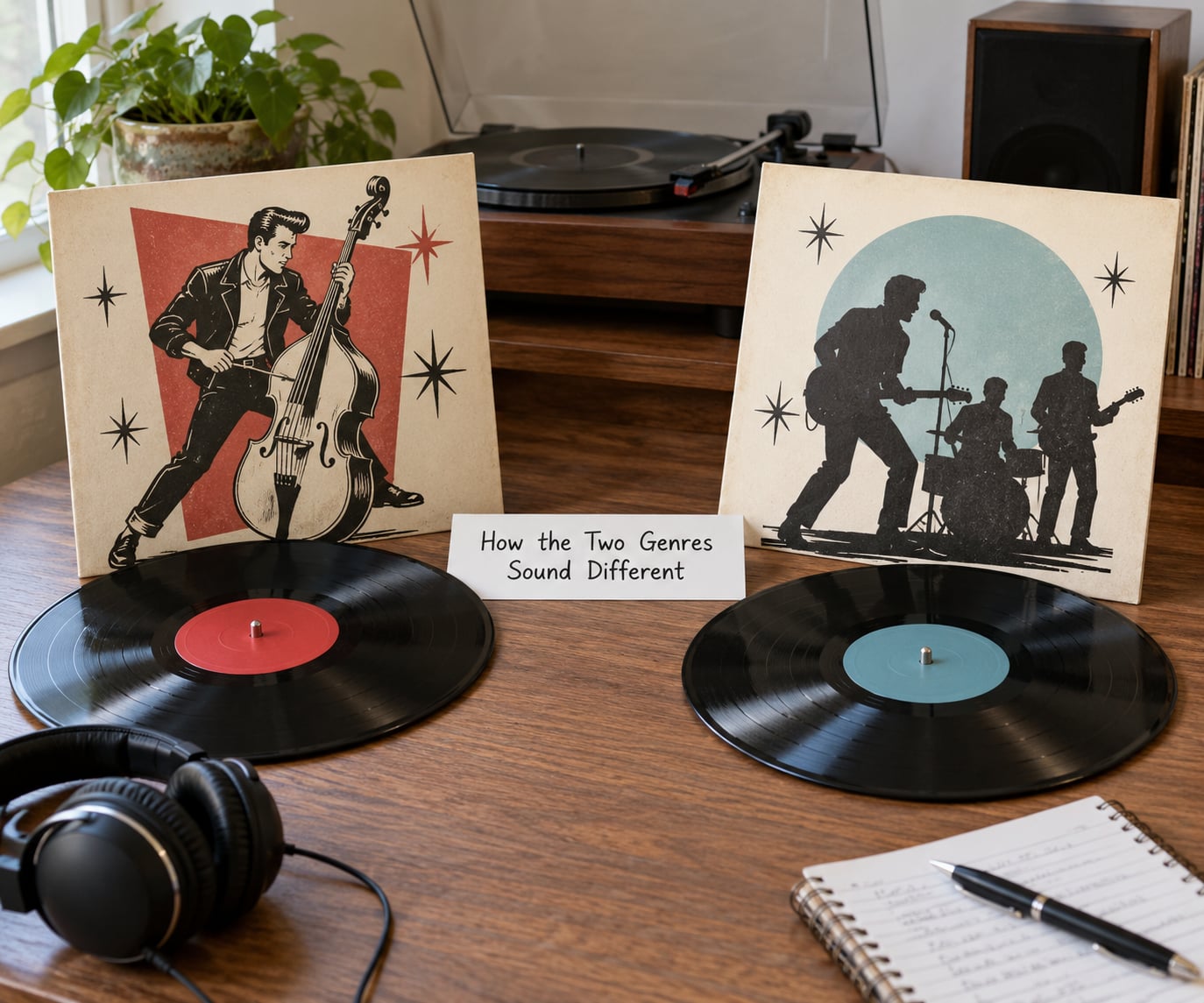
Put on a Carl Perkins record, then a Chuck Berry record, and the difference lands in about eight seconds. Rockabilly feels hurried and skeletal, like it might fall apart if the band slowed down. Rock and roll feels heavier and more grounded, with the rhythm section pushing the song forward.
Tempo is one of the markers. Rockabilly was often recorded fast, sometimes so fast that the band sounds slightly tense, and that nervous energy is part of the style rather than a flaw. Early rock and roll sits more comfortably in the pocket.
Rhythm is the bigger marker. Rockabilly uses a galloping two-beat pattern in which the bass drives on beats one and three while the guitar answers, and the effect feels like a horse running. Early rock and roll tends toward a stomping backbeat, where the kick and snare sit on a heavier downbeat.
Structure separates them too. Rockabilly songs are usually short, built on a few changes, and often stop without ceremony. Rock and roll tracks are more likely to run a verse-chorus form or work through a 12-bar blues progression.
Vocals carry the biggest cultural signal. Rockabilly singing is up in the chest and nasal, a hillbilly twang pushed hard by a small PA, with yodel echoes, stutters and shouts from the band. Rock and roll covers a lot more ground, from blues phrasing and gospel weight to the close-harmony doo-wop style.
Mood follows from all that. Rockabilly can sound gleeful, cheeky and hungry at the same time. Rock and roll tends toward swagger, longing, or plain teenage certainty, depending on the song.
Recording technique gives you a final hint. Rockabilly sessions are drenched in slapback and tape echo, because the rooms were small and the echo was a feature. Early rock and roll sessions are generally cleaner and lean on echo more selectively, usually on the vocal.
Instruments: Country Color and Early Rock and Roll Swings
Slap bass is the signature sound of rockabilly. The player thumps the upright or electric bass strings against the fingerboard on the backbeat, so the rhythm and the bass line become one thing. Bill Black’s playing on the Sun sessions with Scotty Moore is the version everybody imitates.
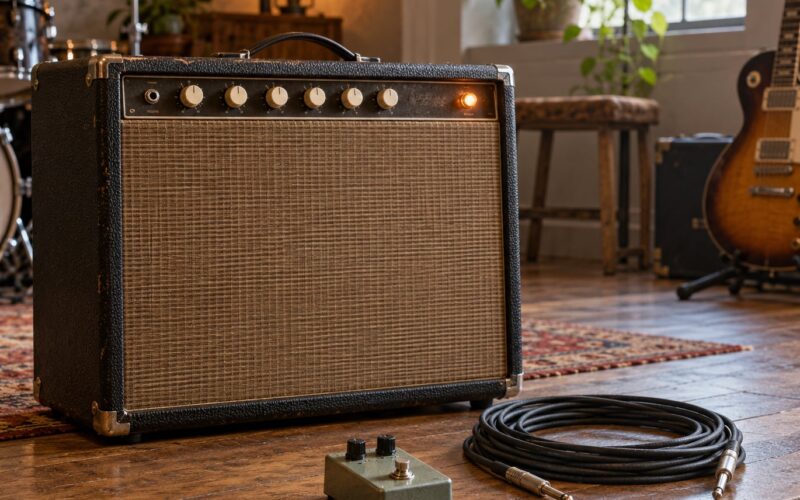
Rockabilly guitars tend to be hollow-body or solid-body instruments played with a pick, and the vocabulary is twang: tremolo picking, slides, chicken picking and a lot of chugging on the low strings. That guitar sits in front of the mix rather than under it.
Early rock and roll leans on boogie-woogie piano, walking bass lines and saxophones. The piano carries the harmony and the riff, the horns answer phrases, and the guitar mostly bends notes and holds chords. Think of the piano-driven sound of Jerry Lee Lewis or Fats Domino, where the bass can get out of the way.
Drums tell the story too. A pared-down rockabilly kit opens gaps and keeps the snare light, so the bass line stays exposed. A rock and roll session usually has a drummer working the backbeat properly, which is why the two genres feel different in your body, not just your ears.
Plenty of instruments cross over. Hollow-body guitars show up in both, saxophones turn up on rockabilly tracks as a joke or an accent, and upright bass turns up on rock and roll records when the song wants a boogie or a hillbilly colour. Classification is about which trait leads, not about a rulebook of parts.
The distinction gets sloppier the further you get from 1955. By the time you reach roots rock, cowpunk, neo-rockabilly, psychobilly and gothabilly, the instruments can be identical and the labels still differ. Genre naming in those scenes tends to be about attitude and audience rather than sound.
Lyrical Themes and Cultural Attitudes
Rockabilly songs keep circling a small set of subjects: wanting someone who is not available, being broke and driving anyway, being lied to and driving off, being told what to do and driving off anyway. Cars, independence, frustration and heartbreak show up over and over. The tone is usually wry rather than bitter.
Rock and roll takes all of that and adds a great deal more. Early rock and roll records talk about faith, about ambition, about social change and about the pressure of being young in a decade that was moving fast. The subject matter is much wider, which is partly why the label ended up covering so much music.
Neither genre is culturally uniform. Rockabilly was not exclusively a white rural story, and rock and roll was not a single movement. Black vocal groups, gospel singers and blues players shaped the form as much as the country bands did, and plenty of early rock and roll records carry no country influence at all.
Where the attitudes differ is in presentation. Rockabilly culture is often nostalgic on purpose, dressed in drape jackets, rolled jeans and slicked hair, and it looks backward on purpose. Rock and roll in its first decade was mostly forward-leaning, about teenagers in the present tense.
Artists That Show Each Style Clearly
Carl Perkins is the reference point for rockabilly. Blue Suede Shoes is the song most people picture when they hear the genre, with its triad riff, its baritone vocal and its furious pace. Be-Bop-A-Lula shows the hiccups and the double bass more clearly.
Jerry Lee Lewis sits at the piano and blurs the line on purpose, which is part of why he is interesting. Great Balls of Fire is pure galloping rockabilly energy with a boogie-woogie piano doing the work.
Gene Vincent and Johnny Burnette supply the darker, bluesier end of the rockabilly sound, while Wanda Jackson carries the hillbilly vocal tradition straight into the style and then into later country rock.
Chuck Berry is the clearest early rock and roll counterweight. Maybellene is blues guitar, piano and a rolling backbeat with country bounce underneath, and almost no twang in the vocal. Rock and Roll Music argues for the genre as a form in its own right.
Little Richard brings the piano, the falsetto and sheer force, and Fats Domino brings the boogie-woogie groove that a generation of New Orleans players built on.
Bill Haley and His Comets matter because Rock Around the Clock reached the widest audience of any 1950s record of this family, and it shows the overlap clearly, with a country-leaning band playing a record built on a blues shuffle.
Buddy Holly and Roy Orbison mark the edges of what rock and roll could absorb, from Holly’s hiccup-laden bop ballads to Orbison’s operatic growl. The Stray Cats later brought rockabilly back to chart position in 1981 without changing the template underneath.
The overlap zone
Some names genuinely belong to both conversations and picking one camp only misleads. Elvis Presley is the biggest, and his Sun recordings are rockabilly in instrumentation while his whole career belongs to rock and roll. Johnny Cash recorded in a style far closer to rockabilly than to smooth country, yet he was always billed as country. Jerry Lee Lewis and Bill Haley sit in the same border country.
Sam Phillips himself described his label’s output as a mixture, and that is the honest way to think about all of it. Sun Records was selling one continuous early rock and roll sound, and rockabilly was the Memphis branch of it.
Dance and Listening Context

Dancers feel the difference faster than listeners do. Rockabilly sits in a fast two-beat that pulls the body forward and works well for jive and rockabilly dance, where the kicks and the hops come in bursts. Dance floor talk about rockabilly often describes more hand movement and a more definite beat, and that is the gallop showing up in the legs.
Early rock and roll dancing is generally looser in framing, from the rockers and their slides to couples moving to slower R&B numbers. Tempo decides which one you get. Play a shuffle and nobody on the floor is doing jive.
Clothing tracked the split. Greasers and later Teddy Boys, with drape jackets and quiffs, leaned into rockabilly and R&B styling. Rockers in leather and boots leaned into rock and roll, and then carried that look into every subculture that followed.
A single live show often crosses the line without announcing it. Revival bands walk a rockabilly set straight into rock and roll covers and nobody blinks, because the two share a beat family. That is normal and not a compromise.
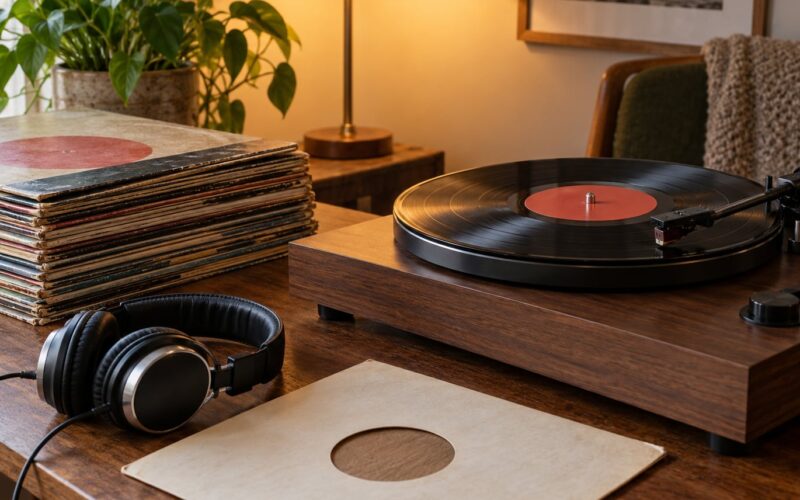
How Vinyl Listeners Can Tell What They Are Hearing
Here is a repeatable method. Run it in order and you will get a defensible answer most of the time, even on an instrumental with no singer to give it away.
- Find the bass first. Slap or upright bass playing the lead means rockabilly. Electric bass sitting behind the drums points toward rock and roll.
- Count the beat feel. A galloping two-beat that feels like it is running ahead of itself is rockabilly. A straight, weighty backbeat is rock and roll.
- Check the guitar tone. Twang, tremolo and chicken picking lean country, so rockabilly. Sustained bent notes and blues phrasing lean rock and roll.
- Look for piano or horns. A boogie-woogie piano or a saxophone answering the vocal usually means rock and roll.
- Hear the vocal. Hillbilly twang with stutters, hiccups and shouts means rockabilly. Blues phrasing, gospel weight or close harmony means rock and roll.
- Notice the room. Thick slapback and flutter echo point to early Sun-era and Decca-style rockabilly sessions.
- Ask whether the drums lead. A pared-back kit that keeps space around the notes points to rockabilly. A full kit on the backbeat points to rock and roll.
- Check the label and year. Sun, Decca and Capitol country-and-R&B imprints lean rockabilly. Chess, Specialty, Atlantic and Vee-Jay lean rock and roll, though Chess cut rockabilly too.
Sleeve labels are a hint, not a verdict. Records were filed, priced and marketed loosely, and a Sun single could be listed as country, pop or blues depending on the quarter. Trust the playing over the back cover.
One last practical tip. Check the tempo by tapping the foot before you check anything else, because listeners consistently misjudge tempo on a turntable that is running slightly slow.
Can a Song Be Both Rockabilly and Rock and Roll?
Yes, and quite often. Rockabilly is one of the earliest branches of rock and roll, so many tracks reasonably carry both labels. Heartbreak Hotel is described as a rockabilly record and a rock and roll record in the same sentence, and nothing is wrong with either description.
What is wrong is using the labels loosely in the other direction. A record is not rockabilly simply because it is early, fast and guitar-driven. Chuck Berry at full tempo is not rockabilly, and neither is Bill Haley when the band is playing shuffle rather than boogie.
The useful test is proportion. If you removed the guitar and the vocal twang, would the song still read as country blended with blues? If yes, it is rockabilly. If what is left is straight rhythm and blues with a country bounce under it, you are in rock and roll territory.
For a collector building a 1950s shelf, treat overlap as a reason to keep both copies rather than pick a winner.
Which Should You Choose?
Choose rockabilly if you are after the twangy hollow-body sound, slap bass, tight fast dance rhythms and the country-and-blues fusion in its earliest and most concentrated form. It is the narrower door and the more rewarding one to stand inside. Start with Sun and Decca rockabilly from 1954 to 1957.
Choose early rock and roll if you want the wider survey: rhythm and blues, blues, gospel, doo-wop, country and pop all in one period, with the genres sitting next to each other rather than blended. Rock and roll is the better entry point for someone who wants to understand how many kinds of 1950s music fed into it.
For a beginner, start with rock and roll for range, then move to rockabilly once the era makes sense. For a dancer, pick whichever tempo you like moving to. For a collector, follow the labels first, since pressing details and label history make a far more reliable collecting game than genre naming.
Where the styles meet, start with Elvis and Chuck Berry, then pull back to Carl Perkins, Wanda Jackson and Jerry Lee Lewis, then return to Little Richard and Fats Domino. That path covers both genres without repeating yourself.
Frequently Asked Questions
What came first, rockabilly or rock and roll?
Rockabilly came first. The country-and-Ru0026amp;B hybrid was already being recorded in the early 1950s, with Memphis sessions leading the way, and rock and roll grew out of that work plus its rhythm and blues, gospel and pop siblings. Because rockabilly is an early branch of the wider form, the difference between rockabilly and rock and roll is closer to a difference of emphasis than of era.
What is rockabilly a mix of?
Rockabilly mixes hillbilly and country music with rhythm and blues, with western swing, boogie woogie and honky tonk feeding it along the way. The result is a fast, galloping two-beat song built on slap bass, twangy hollow-body guitar, a light drum kit and vocals carrying a strong hillbilly twang. It is often described as rock and roll with the country half still audible.
Is Elvis Presley considered rockabilly?
Yes, especially for his Sun recordings, which use slap bass, hollow-body guitar and a fast tempo. His broader career belongs to rock and roll as a whole, and his later work moved toward pop, gospel and country. That is exactly the overlap zone: when people argue about the difference between rockabilly and rock and roll, Elvis is usually the example that proves the categories blur.
Is Johnny Cash country or rockabilly?
Both, and country is how he was always billed. His early Sun recordings, and much of his driving uptempo material, sit close to rockabilly in tempo and instrumentation, while his slower ballads and his prison-era records are closer to country and folk. Cash also recorded his own rock and roll album, which shows how comfortable he was moving between the categories rather than picking one.
How do you tell if a song is rockabilly or rock and roll?
Listen for the bass and the beat before anything else. Slap or upright bass leading the groove points to rockabilly, and so does a nervous galloping two-beat. A straight, heavy backbeat with a full drum kit, boogie-woogie piano or horns points to rock and roll. Then check the vocal for hillbilly twang and stammers versus blues phrasing or close harmony, and the echo-heavy room sound of early Sun sessions.
Is rock and roll the same as rock?
No. Rock and roll is a specific 1950s style with a clear origin in African American rhythm and blues, gospel and blues, and it describes what those records sound like rather than everything that came after. Rock is the much broader family that grew out of it, including the British Invasion, folk rock, garage, punk and everything since. Rockabilly sits inside rock and roll, not beside it.
Start with the Beat and Work Back to the Label
Play an early rockabilly track, then an early rock and roll track, and change only one thing in your listening: focus on the bass. One record puts a slapping upright bass in front, running a fast two-beat that the guitar answers. The other sits behind a heavier backbeat with piano, guitar and sometimes horns doing the work.
Once your ear catches that, everything else follows. Vocal twang, the light drum kit and the echo-soaked room point one way; blues phrasing, a boogie piano and horns point the other. Check the tempo, the guitar tone, the production and the label, and you can place almost any 1950s single in seconds.
Keep the distinction practical rather than rigid. Genre names describe the dominant traits a record leans on, not rules a record has to obey, and the overlap zone is where the most interesting listening happens anyway.