Space age pop is a loose label for futuristic, electronic-forward pop music built around synthesizers, odd time signatures and science-fiction imagery, usually traced to the late 1960s and 1970s. Plenty of listeners use the term far more loosely, covering polished mid-century easy listening with the same appetite for the future. That spread is the first thing to sort out, because it decides what belongs on your shelf.
I have pulled this music at record fairs for years, and the honest answer is that space age pop is a listening habit rather than a genre with a founding document. Records turn up filed under art rock, post-psychedelia, new wave, library music and Shibuya-kei as often as they turn up under the obvious name. What holds the pile together is a sound rather than a scene.
Table of Contents
- What Is Space Age Pop?
- What Is Space Age Pop, Exactly?
- What Music Sounds Like Space Age Pop?
- How Did Space Age Pop Develop?
- How Is Space Age Pop Different From Prog Rock?
- What Are the Key Space Age Pop Records?
- How Do Collectors Recognize Space Age Pop on Vinyl?
- Frequently Asked Questions
- Is space age pop the same as progressive rock?
- What is the first space age pop record I should hear?
- Is space age pop only music from the 1960s?
- What instruments are commonly used in space age pop?
- Are space age pop records worth collecting on vinyl?
- Conclusion
What Is Space Age Pop?
Space age pop is futuristic pop music that leans on electronic instruments, sci-fi themes and rhythmic experiments instead of conventional verse-chorus songwriting. That single sentence is the clean answer, and it is the one most search engines lift into their summaries.
The wider definition covers a lot of ground. Collectors often reserve the term for art rock and prog-adjacent records, while shop tags and streaming categories hand it to anything with a synth line and a spaceship on the cover. Both habits are defensible. The trouble starts when you buy a record expecting one thing and unearthing another.
What Is Space Age Pop, Exactly?
The label has a documented history that helps when you sort. The phrase Space Age Bachelor Pad Music was coined in the 1960s for mid-century easy listening built on theremin, vibraphone and showy stereo effects. Music writers later shortened it to space age pop and, from around the end of that decade, started pointing it at the new wave of electronic pop and art rock.
That means the style sits alongside art rock, experimental pop, progressive rock, psychedelic rock and Shibuya-kei, sharing players and production tricks with each. Records get filed under all of those labels and the terms get used as if they were interchangeable, which flattens five different scenes into one word.
My workaround is a single test. If a record sends you thinking about rockets, robots or a chrome future rather than a street corner, it counts. Everything else is a bonus, not a requirement.
What Music Sounds Like Space Age Pop?
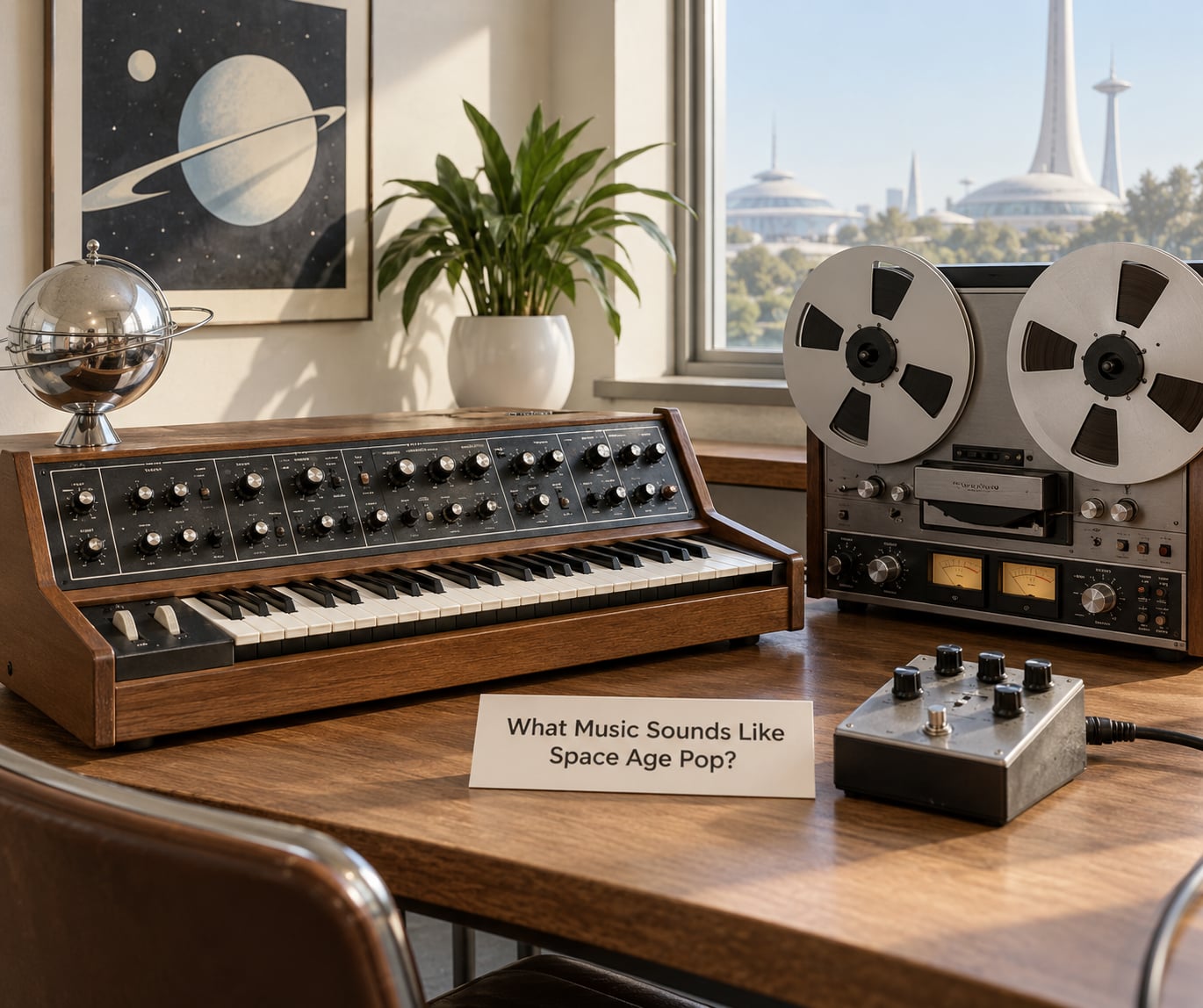
Ignore the cover art for a moment and listen for these six things instead.
- Vocals used as texture. A voice gets treated as an instrument, buried in reverb, chopped into nonsense syllables or run through a vocoder until the words stop carrying meaning.
- Drums that swing from organic to robotic. Real drummers on one track, sequenced machine patterns on the next, sometimes both fighting inside the same bar.
- Meters that refuse to settle. Odd groupings such as 5/4 or 7/8, a bar of triple time dropped into a song that was otherwise straight.
- Harmony leaning outward. Ninths, elevenths and thirteenths stacked over open fifths, with a melody that floats above the changes rather than sitting inside them.
- Room between the notes. Long reverbs, tape echo and delay that smear the edges so a two-minute song occupies far more air than it should.
- Titles that set a scene. Track names and record titles naming rockets, laboratories, alien worlds or appliances, usually paired with abstract atomic-age cover art.
Not every record hits all six. Joe Meek’s Telstar from 1962 gets the first four without trying, and most Japanese and Brazilian records from the early 1970s land the last two.
How Did Space Age Pop Develop?
The electronics came first. The theremin arrived in the 1920s, and by the middle of the century it was the standard sound of the future in film scoring and radio drama. Tape manipulation followed, and studios discovered they could bounce a sound between two channels and put a note anywhere they liked.
The stereo era turned that into a marketing category. Labels in the early 1960s sold records as tests for new hi-fi equipment, and the sleeves advertised speaker placement while the music proved it. RCA ran a Stereo Action series, Command issued Persuasive Percussion and Provocative Percussion, Mercury pushed Perfect Presence Sound and London Phase Four, and each series treated the record itself as the demonstration.
Psychedelia then pushed arrangements outward, and by the end of the 1960s the Moog had arrived in studio sessions at a price most bands could absorb. Joe Meek’s homemade studio in London anticipated the whole direction years early. In the 1970s, records built on sequencers and synthesizers crossed into the mainstream in West Germany, Brazil and Japan, and by the 1980s the same techniques were sitting under pop vocals on both sides of the Atlantic.
Every one of those scenes made records that now get described as space age pop, which is why the label covers so much ground.
How Is Space Age Pop Different From Prog Rock?
The overlap is substantial, and anyone who separates them too rigidly will miss good records. Both favour unusual meters, extended harmony, studio experimentation and artwork that asks you to look twice. Plenty of albums sit in both camps at once.
The practical difference is song shape. Progressive rock usually builds long forms, often as a side of an album, and shows its technique. Space age pop tends toward shorter pieces with a hook you can sing, where the electronic colour is decoration rather than display.
Look at the imagery and it separates cleanly. Prog leans on myth, fantasy and medieval illustration, or on abstraction with no story attached. Space age pop leans on rockets, telemetry, laboratory glassware and mid-century modern furniture.
A rough working rule I use on the turntable: if the band is showing off the drummer, expect prog. If the producer is showing off the studio, expect something closer to this genre.
What Are the Key Space Age Pop Records?
There is no agreed canon, so treat the following as landmarks rather than a definitive list. I have grouped them by scene so you can follow one thread at a time.
United States. The Beach Boys’ Pet Sounds from 1966 is the root of the whole idea, with tape loops, session musicians and a whole band chasing a sound nobody had written down. The Residents worked the same seam decades later, treating the studio as the subject of the record.
United Kingdom. Joe Meek and the Tornados reached number one in America with Telstar in 1962, the moment the genre’s central image became a fact rather than a fantasy. XTC built White Music in 1978 around tape, keyboards and blipping electronics. The Alan Parsons Project’s I Robot the following year brought the Fairlight CMI into a rock album. A Flock of Seagulls in 1982 borrowed the name and made it a new wave hit, which is worth knowing before someone tells you the song is an example of anything.
Germany and France. Kraftwerk’s Autobahn in 1974 and the albums that followed turned sequencers and synthesizers into a band identity rather than a studio trick. Jean-Michel Jarre’s Oxygène and Cerrone’s Cosmic Ark brought the sequencer into French disco and sci-fi soundtrack territory.
Brazil. Os Mutantes recorded their self-titled debut in 1968 with a two-bass lineup, prepared piano and effects borrowed from the rock circuit. Tom Zé pushed it further. The Tropicália scene supplied a decade of strange, humid, very melodic Brazilian pop that collectors now mine for exactly this material.
Japan. Yellow Magic Orchestra in 1978 mixed exotica, electronics and a wry pop sensibility, and it shaped the Shibuya-kei movement two decades later, where Pizzicato Five, Fantastic Plastic Machine and the label Barnesville put the sound into 1990s indie-pop records.
How Do Collectors Recognize Space Age Pop on Vinyl?
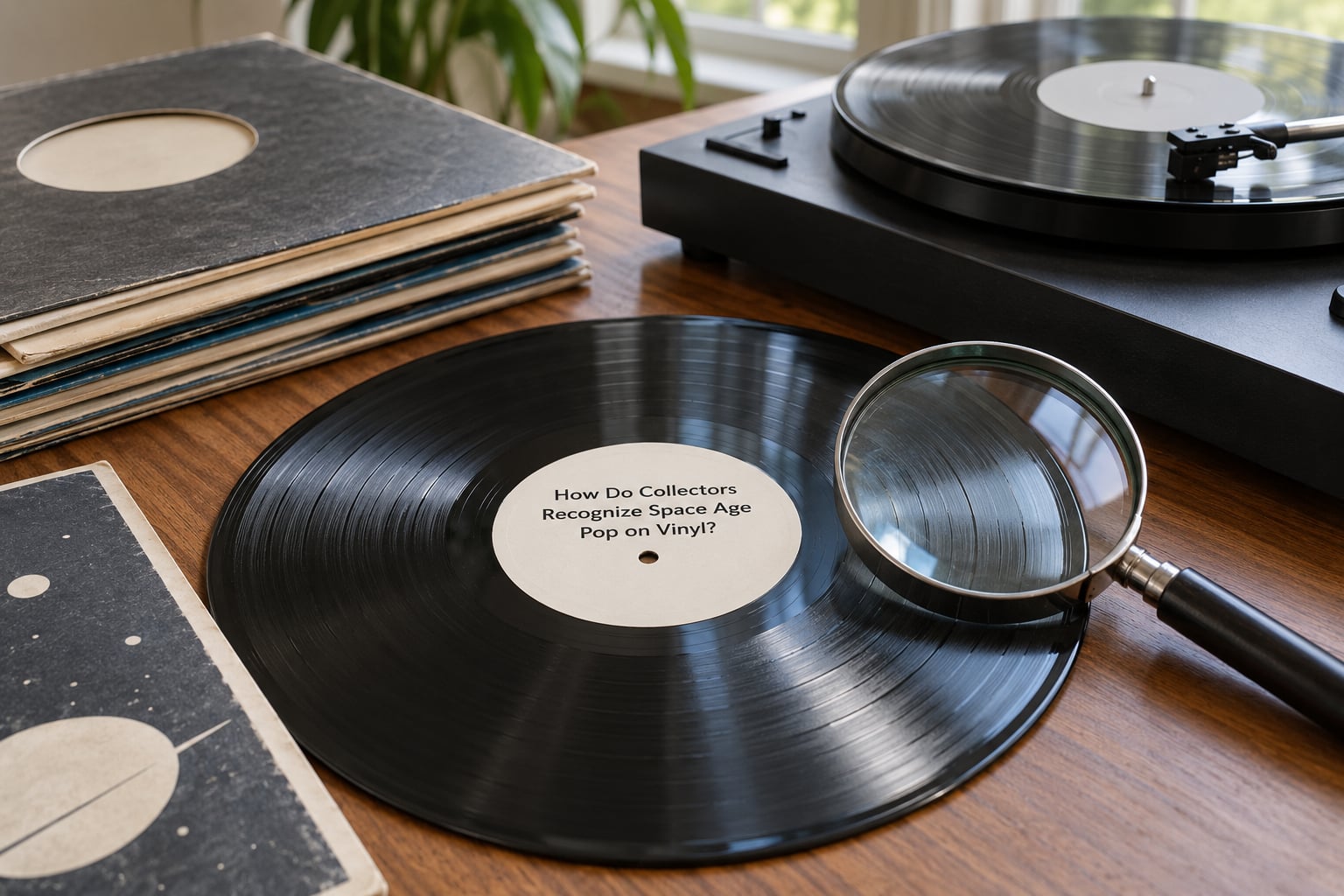
Genre reissues are messy, so check the physical details before you buy.
- Check for mono and stereo versions. Much of this material was cut in mono first, and the stereo version of a record is not a copy with two channels, it is a different mix with instruments repositioned. Where a true stereo mix exists, it is the one worth owning.
- Look for label and series information on the sleeve. Stereo demonstration series such as RCA’s Stereo Action, Command’s percussion sets, London’s Phase Four or Mercury’s Perfect Presence Sound printed their format claims on the cover. That tells you the pressing was made to sell hi-fi equipment.
- Read the runout etching. Matrix numbers on the disc tell you which plant and pressing you are holding, and reissues often carry different numbers from the original run.
- Read the sleeve before the record. Gatefolds, die-cut windows and printed essays about subwoofers are part of what this genre was selling. A readable gatefold is worth real money to a collector.
- Expect budget compilations. Library and production music from the 1950s and 1960s was reissued heavily on cheap compilations in the 1980s and 1990s. They play fine but sound thin, so listen for level differences between tracks.
- Mind the noise floor. This is heavily reverberant music recorded in sessions that were not built for it. A copy with surface hiss is more distracting here than on a dense rock record, so check it in a quiet room.
Condition aside, the genre rewards the hunt. Original gatefolds from the stereo demonstration series turn up less often than the records themselves, which is why sleeves matter so much in this corner of the market.
Frequently Asked Questions
Is space age pop the same as progressive rock?
No, though they overlap heavily. Progressive rock usually builds long forms, often a full album side, and displays technique. Space age pop leans on synthesizers, sequencers and stereo effects, usually in shorter songs with a pop hook. Imagery separates them too: prog leans on myth and fantasy, space age pop on rockets, laboratories and mid-century modern design. Plenty of records sit between the two.
What is the first space age pop record I should hear?
Telstar by the Tornados, produced by Joe Meek, is the usual answer because it captured the whole idea in a single three-minute piece and reached number one in America in 1962. If you want something stranger and less familiar, start with Pet Sounds from 1966 instead, then come back to Telstar and hear how much of the blueprint was already there.
Is space age pop only music from the 1960s?
No. The genre’s core sits between 1954 and 1963, but its sound kept developing. The 1970s brought sequencers and synthesizers into rock records in Germany, Brazil and Japan, and the 1980s carried those textures into mainstream pop. Later records get tagged space age pop through Shibuya-kei, hauntology and lounge revival scenes, so a 1990s release is not automatically wrong.
What instruments are commonly used in space age pop?
The list starts with the theremin and the ondes Martenot, then widens to vibraphone, celeste, electric sitar, electric piano, Mellotron and Moog-style synthesizers. Latin percussion is constant, especially bongos, congas and maracas. Producers used tape echo, spring reverb and ping-pong delay to throw sounds from one channel to the other, and sequencers or drum machines to hold the pulse.
Are space age pop records worth collecting on vinyl?
Worth it, with caveats. Original pressings from the stereo demonstration series are the most interesting, because the stereo mix is genuinely different from the mono version and the packaging was designed as part of the sales pitch. Later budget compilations of library music are common and sound thin. Judge condition carefully, since the heavily reverberant recordings show surface noise easily.
Conclusion
Space age pop rewards listening for mood and production rather than genre borders. Pick one landmark record, play it properly, and listen for melody and electronic texture rather than waiting for a chorus. Then trace outward: the 1960s Hollywood material sets the scene, the British and German records push the technology, Brazil and Japan take it somewhere stranger, and the 1990s scenes tie it back together. That route teaches you faster than any shelf of reference books, and it is still 2026‘s best argument for chasing down original pressings.