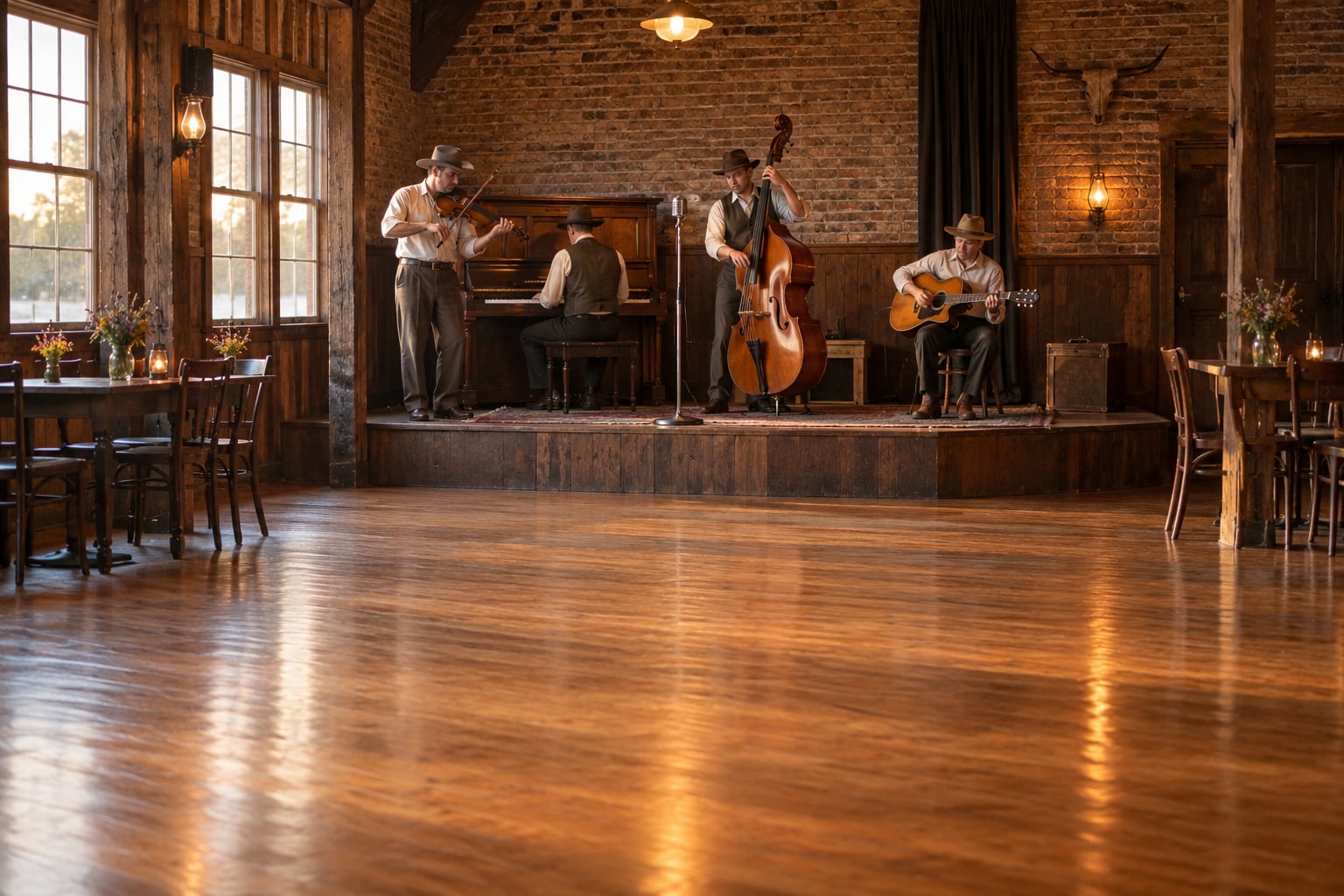
Western swing music is upbeat Texas dance music that puts big band swing rhythms and jazz improvisation onto country instruments — multiple fiddles, steel guitar, electric and acoustic guitars, upright bass, piano and drums, often joined by saxophone, trumpet and trombone. It is also called country jazz, and it grew out of Texas and Oklahoma dance halls in the late 1920s and 1930s.
Ray Benson, who has led Asleep at the Wheel since 1970, has the phrase most people remember: jazz with a cowboy hat. That is the whole idea in six words, and it is more accurate than calling it a subgenre of country music at all.
Table of Contents
- What Is Western Swing Music?
- How Did Western Swing Music Develop?
- The bands that fixed the sound
- Why Is Western Swing Music Different From Traditional Country?
- Western swing versus everything else called swing
- What Makes the Western Swing Sound Distinctive?
- The instruments and what each one does
- The two feels
- How Does Western Swing Music Influence Rockabilly?
- Who Are the Essential Western Swing Artists?
- What Are the Best Western Swing Albums for New Listeners?
- 1. Bob Wills, Take Me Back to Tulsa
- 2. Milton Brown, Maiden Blues
- 3. Bob Wills and His Texas Playboys, San Antonio Rose
- 4. The Light Crust Doughboys, the 1932 Victor sessions
- 5. Spade Cooley, Blue Bonnet Lady
- 6. The Maddox Brothers and Rose, Cootie Blues
- 7. Bob Wills, Idaho
- 8. Jimmy Bryant and Speedy West, Stratosphere Boogie
- 9. Asleep at the Wheel, Roly Poly
- 10. Hank Thompson, Wildwood Rose
- How Can You Recognize Western Swing on Vinyl?
- Frequently Asked Questions
- Is western swing the same thing as honky-tonk music?
- Why is Bob Wills so important to western swing?
- Is western swing music related to swing jazz?
- What makes an original western swing record collectible?
- Is western swing still performed today?
- Where to Start with Western Swing Music
What Is Western Swing Music?
Western swing music is a style of playing and an approach to arranging as much as it is a song list. A band takes a country melody, runs it at a swinging shuffle instead of a straight backbeat, and then lets its players solo the way jazz players do. Nobody plays the same break twice.
The quick version:
- It is swing-era jazz arranged for a string band rather than a horn section, with the lead fiddle holding the melody the way a big band saxophone or trumpet would.
- It is built to be danced to, which is why almost every recording sits in either a two-step or a shuffle, not a ballad tempo.
- It fused blues, jazz, polka, old-time folk, honky tonk and Dixieland into something with no direct parent, which is why it sounds faster and rougher than the country most people picture.
If you enjoy honky tonk, rockabilly or the Bakersfield sound, western swing is the branch of the family tree those genres grew out of rather than something separate from them.
How Did Western Swing Music Develop?
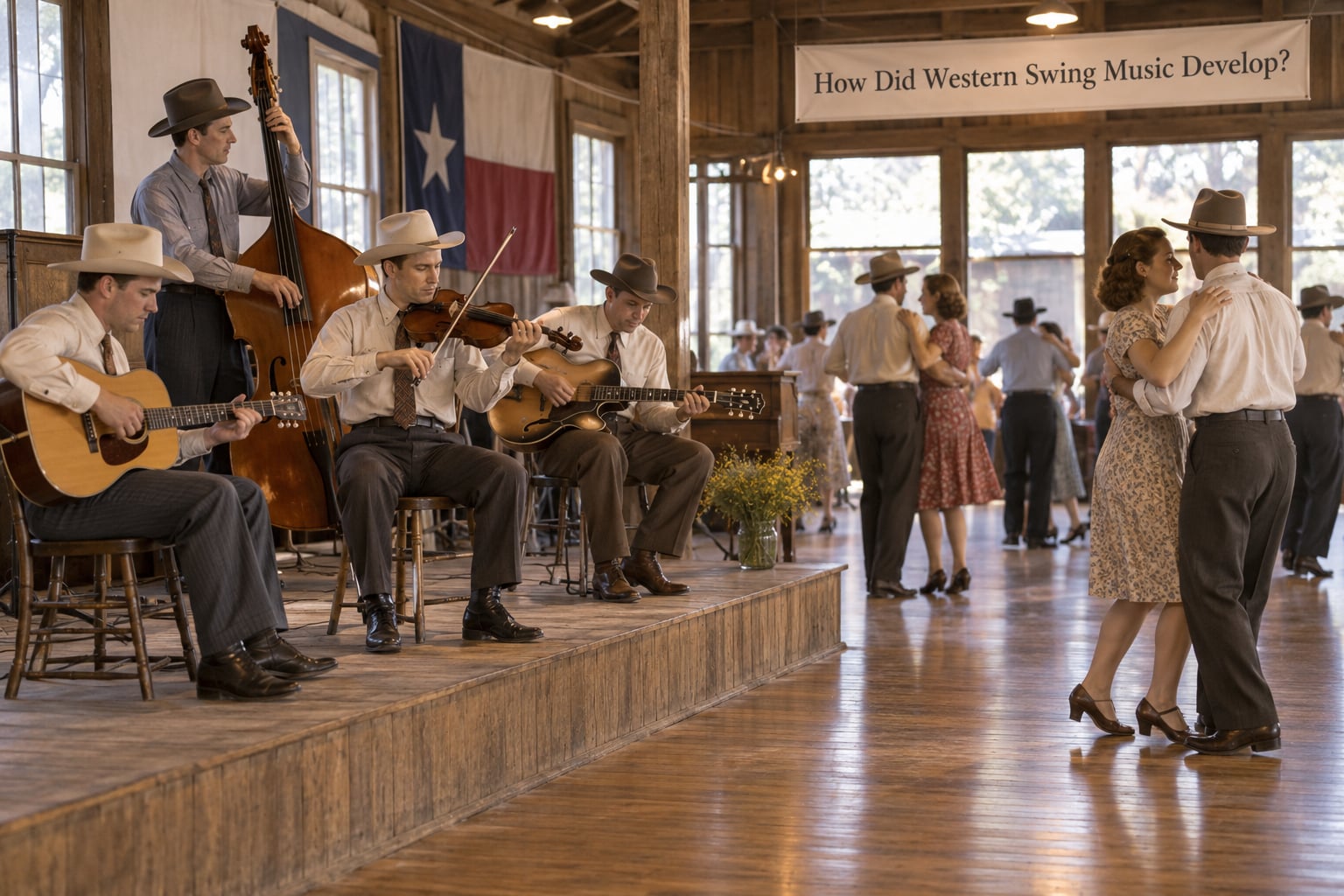
Western swing starts with fiddles. In the late 1920s, Texas fiddlers played reels, jigs and cowboy breakdown tunes at house parties and porch gatherings, where the whole family danced. That tradition ran on melody and rhythm alone, no singing, no sets, no amplification.
Radio changed the scale. When fiddlers began broadcasting through KVOO in Tulsa, the music had to fill an evening of programming rather than twenty minutes of dancing, and it had to be heard in rooms full of people talking.
The bands that fixed the sound
Bob Wills and Milton Brown put together the Light Crust Doughboys in Fort Worth around 1931, and their Victor session of February 9, 1932 is usually treated as the first professional western swing record. They broke in 1933, each taking a band and each pushing the music in a different direction.
Brown ran a cleaner, jazzier shuffle. Wills went for volume, kept the traditional fiddle tunes and built the Texas Playboys into a full dance orchestra. The Playboys spent the late 1930s and 1940s playing for packed halls such as Cain’s Ballroom in Tulsa and Crystal Springs outside San Antonio.
Spade Cooley’s Texas Cowboys gave the music its name. Los Angeles disc jockey Al Jarvis ran a radio contest in 1942 and crowned Cooley King of Western Swing, beating out Benny Goodman and Harry James. Billboard was using the phrase routinely by 1944.
Two things cut the momentum. The federal government hit nightclub dancing with a 30 percent excise tax in 1944, which quietly emptied many halls, and changing radio economics pushed the biggest bands off the air. When the Texas Legislature designated western swing the official State Music of Texas in 2011, the golden age was long over.
Why Is Western Swing Music Different From Traditional Country?
Traditional country music is built on the guitar and the singer. Western swing is built on the ensemble, and it treats the band the way a big band treats itself: a lead voice, arranged backgrounds and then improvised breaks. That is where the improvised jazz solos and looser chord progressions come from, and they are the exact opposite of a strict two-step country beat.
You will also hear the honky tonk connection. Both genres grew in Texas dance halls, both lean on blues, and both were shaped by the same fiddlers and venues. The difference is that honky tonk keeps its pulse low and bluesy, while western swing lifts the same blues and accelerates it into a swing.
Western swing versus everything else called swing
The word causes more confusion than any other in this genre, so here is the disambiguation in one place.
| Style | What it actually is | Lead voice | Typical tempo |
|---|---|---|---|
| Western swing | A recorded music genre from Texas and Oklahoma dance halls, built on fiddle-led string bands | Fiddle | Shuffle roughly 130 to 160 BPM; two-step roughly 90 to 110 BPM |
| Big band swing | The 1930s jazz dance music it borrows rhythm and arrangement ideas from | Saxophone, trumpet or trombone | Similar swing feel, horn-led |
| Honky tonk | A Texas bar room style, bluesy and low, usually guitar-driven | Guitar and vocal | Slow to mid, steady blues pulse |
| Rockabilly | A 1950s hybrid of country rhythm and rock and roll, built on slap bass and vocal | Vocal | Fast, driving backbeat |
| Country swing (dance) | A partner dance, not a genre of music | Not applicable | Follows the record, commonly a two-step |
| West Coast swing (dance) | A different partner dance with a slower count and its own footwork | Not applicable | Slower triple or double rhythm |
Plenty of dancers arrive at a western swing band night and ask about country swing or West Coast swing. Those are dance names. The music being played over the floor is western swing, and the two-step you learn there is the western version, which has a longer, smoother glide than the West Coast style.
What Makes the Western Swing Sound Distinctive?
Put on any Wills or Milton Brown record and the first thirty seconds tell you what you are listening to. Listen for a shuffle that pushes forward, a lead fiddle carrying the tune above everything else, and a steel guitar sliding in underneath. If the guitar is strumming a steady boom-chick and a singer is front and center, that is country, not western swing.
The instruments and what each one does
| Instrument | Role in the band | What to listen for |
|---|---|---|
| Lead fiddle | Carries the melody, takes the solos, sets the tempo feel | Long instrumental breaks, ornaments, double stops |
| Harmonized fiddles | Two or three fiddles trading and echoing phrases | Call-and-response passages between players |
| Steel or lap guitar | Runs underneath, answers the fiddle | Sustained slides and a sweet, crying tone |
| Electric and acoustic guitar | Rhythm anchor, sometimes takes solo turns | Driving strum locked to the shuffle |
| Upright bass | Walks the harmony with the piano | Moving quarter notes rather than roots and fifths |
| Piano | Horns of the band in the early Texas style | Comping, fills, boogie woogie left hand |
| Drums | Keeps the shuffle honest | Ride pattern and brushes on the two-step |
| Accordion | Adds polka and Mexican influence in Texas bands | Played in octaves behind the fiddle |
| Sax, trumpet, trombone | Big band color, more common after Wills went electric | Riffs, stacked brass, shout sections |
The two feels
Almost every western swing record is in one of two grooves. A shuffle runs about 130 to 160 BPM and gives the feet permission to move constantly, and it is the sound people mistake for old timey fiddling at first listen. A two-step runs about 90 to 110 BPM, sits in two four time, and is what most couples actually danced to in the halls.
Merle Travis, who came out of the same Texas scene, put the character of the music better than most critics: western swing was nothing more than a group of talented country boys playing the kind of music they liked. The Texas Playboys and the Playboys of later decades kept his instrumentation and added electric amplification, which is how a regional dance style became national radio music.
How Does Western Swing Music Influence Rockabilly?
Western swing is the missing link in the story of rock and roll. It introduced amplified string bands, drums and blues-based soloing to country music, and every honky tonk act that followed was working inside vocabulary Wills and Milton Brown created.
The line runs through the honky tonk sound of the 1950s and 60s into the Bakersfield sound of Buck Owens and the pedal steel of Speedy West and Jimmy Bryant. Jimmy Bryant and Speedy West were western swing players first, and Stratosphere Boogie is the track where the two paths cross: a honky tonk vocal over a steel guitar that plays jazz lines.
Then came rockabilly. The amplified string band, the blues shuffle, the up-tempo western swing shuffle of Bill Haley and His Comets, and Jimmy Dean all came straight out of this world. The vocal format shifted to a single singer with a band behind him, and the audience for Texas dance music and the audience for rock and roll started overlapping.
Who Are the Essential Western Swing Artists?
Bob Wills is the leading figure, and most histories settle on him. Milton Brown is the other half of the origin story and the more purely jazz-influenced of the two. Spade Cooley holds the literal title. Here is who else matters.
| Artist | Era | Role | Where to start |
|---|---|---|---|
| Bob Wills and His Texas Playboys | 1930s to 1970s | The best known band; drove the amplified sound | Take Me Back to Tulsa, San Antonio Rose |
| Milton Brown and His Musical Brownies | 1933 to 1950s | Clean shuffle and jazz solos; the modern sound of the genre | Maiden Blues, Big Bad John |
| Spade Cooley and His Texas Cowboys | 1940s | Crowned King of Western Swing in 1942; rival of Wills | Spade’s rhythm, fiddle-led 1940s sides |
| The Light Crust Doughboys | 1931 to 1950s | First professional western swing band, Wills and Brown’s shared start | The 1932 Victor sessions |
| Johnny Gimble | 1940s to 1960s | Fiddle player who made western swing fiddling a craft | His fiddle solos on Brown and Wills dates |
| Grady Martin | 1940s to 1950s | Guitarist who introduced a striking electric sound to Wills | The Crystal Springs era with the Playboys |
| The Maddox Brothers and Rose | 1940s | Oklahoma rivals to the Playboys, looser and rowdier | Cootie Blues, Roly Poly |
| Bob Luman | 1950s | Singer who carried the sound into honky tonk | His Decca sides |
| Hank Thompson | 1950s onward | Singer and bandleader who kept the shuffle into the Nashville era | Wildwood Rose |
| Jimmy Bryant and Speedy West | 1950s | The bridge act into the Bakersfield sound | Stratosphere Boogie |
Asleep at the Wheel has been running since 1970, mostly around Ray Benson, and is generally called the longest running western swing band in history. Hot Club of Cowtown, the Western Flyers and the Carolyn Sills Combo keep playing the style as a working dance band rather than a tribute act.
What Are the Best Western Swing Albums for New Listeners?
Start with one Wills recording, then one Milton Brown, then go hunting in the bins. Work through this list in order and you will hear the genre form.
1. Bob Wills, Take Me Back to Tulsa
The record people mean when they say king of western swing. Listen for the steel guitar answering the fiddle on the title track and the way the band never sits still.
2. Milton Brown, Maiden Blues
The other side of the 1933 split. Brown plays a looser, more bluesy shuffle and his solos sound like jazz players rather than dance band fiddlers.
3. Bob Wills and His Texas Playboys, San Antonio Rose
A swing adaptation of an old fiddle tune, which shows the tradition the band was stretching without abandoning.
4. The Light Crust Doughboys, the 1932 Victor sessions
Early, close-mic acoustic recordings of Wills and Brown together. Plain, small, and historically the place where the sound starts.
5. Spade Cooley, Blue Bonnet Lady
Cooley’s band at its most rhythmic, and the reason he beat Harry James in a radio contest in 1942.
6. The Maddox Brothers and Rose, Cootie Blues
Oklahoma swing that leans harder on blues than Wills ever did. A useful corrective if the Wills records sound too neat.
7. Bob Wills, Idaho
A pure two-step example, useful for hearing the slower feel next to the shuffles.
8. Jimmy Bryant and Speedy West, Stratosphere Boogie
The bridge track to honky tonk and the Bakersfield sound. Steel guitar lines that a rockabilly player would recognize immediately.
9. Asleep at the Wheel, Roly Poly
The revival at full volume, and a good test of whether you actually like the style or just tolerate it for historical reasons.
10. Hank Thompson, Wildwood Rose
A 1950s country bandleader who kept the shuffle alive as western swing faded out of the mainstream.
For a quick honest check on a modern act, listener forums single out Brennen Leigh, Josh Hedley, Sweet Megg and Melissa Carper as the ones doing more than a costume. Ray Benson has been blunt about it himself, saying he does not want to be a museum piece.
How Can You Recognize Western Swing on Vinyl?
Western swing records are not in a bin of their own, and that is the first problem. Most sit inside general country, honky tonk or Texas sections, sometimes under an artist name you would not think to look for. A few catalog habits make hunting them much faster.
- Look for the Western Swing Society of Texas and the Texas Western Swing Hall of Fame imprint names on compilations, which tend to be accurately sequenced.
- Know the labels. Columbia, Victor and Decca carry most of the 1930s to 1950s masters, and Decca ran a 1955 country dance music series that is essentially a curated western swing catalog.
- Chase the Tiffany Transcriptions. These were issued on vinyl by the San Francisco label from tape masters of 1930s radio broadcasts, with full band lineups and original broadcast commercials in the run time. Around 150 tracks, and the most reliable document of Wills at full force.
- Read the back cover for a fiddler or a steel player before anything else. Western swing bills are built around the players, not only the singer.
The trap is that broad country reissue series mix western swing with honky tonk, Bakersfield and traditional country recordings without much distinction. A compilation that promises country from the 1940s may hand you four tracks that are not western swing in any meaningful sense, so track down individual sessions by band and year rather than buying by series alone.
One useful habit for beginners: play a side of a Bob Wills record and one of a plain country record from the same year, back to back, at the same volume. The difference is obvious within a bar, and once your ear has it you will never confuse the genres again.
Frequently Asked Questions
Is western swing the same thing as honky-tonk music?
No, though they grew up in the same Texas dance halls and share plenty of material. Honky tonk stays low and bluesy, usually guitar-led, and is designed for a bar rather than a dance floor. Western swing lifts those same blues into a faster shuffle and adds jazz solos, multiple fiddles, piano and drums. Wills and the Playboys were a dance band, not a bar band.
Why is Bob Wills so important to western swing?
Bob Wills took the string band format that he and Milton Brown built in the early 1930s, amplified it, and turned it into national radio music with the Texas Playboys. He kept the traditional fiddle tunes while adding drums, electric steel guitar and, later, horns. More than anyone, he made western swing a sound people outside Texas recognized.
Is western swing music related to swing jazz?
It borrows heavily but is not the same thing. Western swing takes swing era rhythm sections, backbeat discipline and jazz improvisation, then swaps the horn section for fiddles, steel guitar and bass. Because the lead fiddle carries the melody, the band can break from written charts and solo the way jazz players do, which is where the genre gets its looseness.
What makes an original western swing record collectible?
Original 78 rpm pressings from Columbia, Victor, Decca and the Tiffany Transcriptions are what collectors chase, since the Tiffany issues preserve full 1930s radio broadcasts with complete band lineups. Condition matters more than label. Early radio transcriptions are harder to find than commercial 78s, so a clean playable copy in original sleeve beats a mint reissue.
Is western swing still performed today?
Yes, and it is a working tradition rather than a revival costume. Asleep at the Wheel has been running since 1970 under Ray Benson, and Hot Club of Cowtown, the Western Flyers and the Carolyn Sills Combo still play for dancers weekly. Texas and Oklahoma dance halls book western swing bands regularly, and society calendars list monthly dances. The Texas Legislature named it the State Music of Texas in 2011.
Where to Start with Western Swing Music
Start with Bob Wills and His Texas Playboys on Take Me Back to Tulsa, then follow it with Milton Brown’s Maiden Blues so you hear the two halves of the 1933 split back to back. After that, dig into the used bins for individual sessions by band and year rather than general country compilations.
Western swing music is big band swing logic played by a Texas string band, and once that clicks the rest is easy. Keep going forward into honky tonk, the Bakersfield sound and rockabilly, all of which are downstream of the same dance halls and the same amplified fiddles.