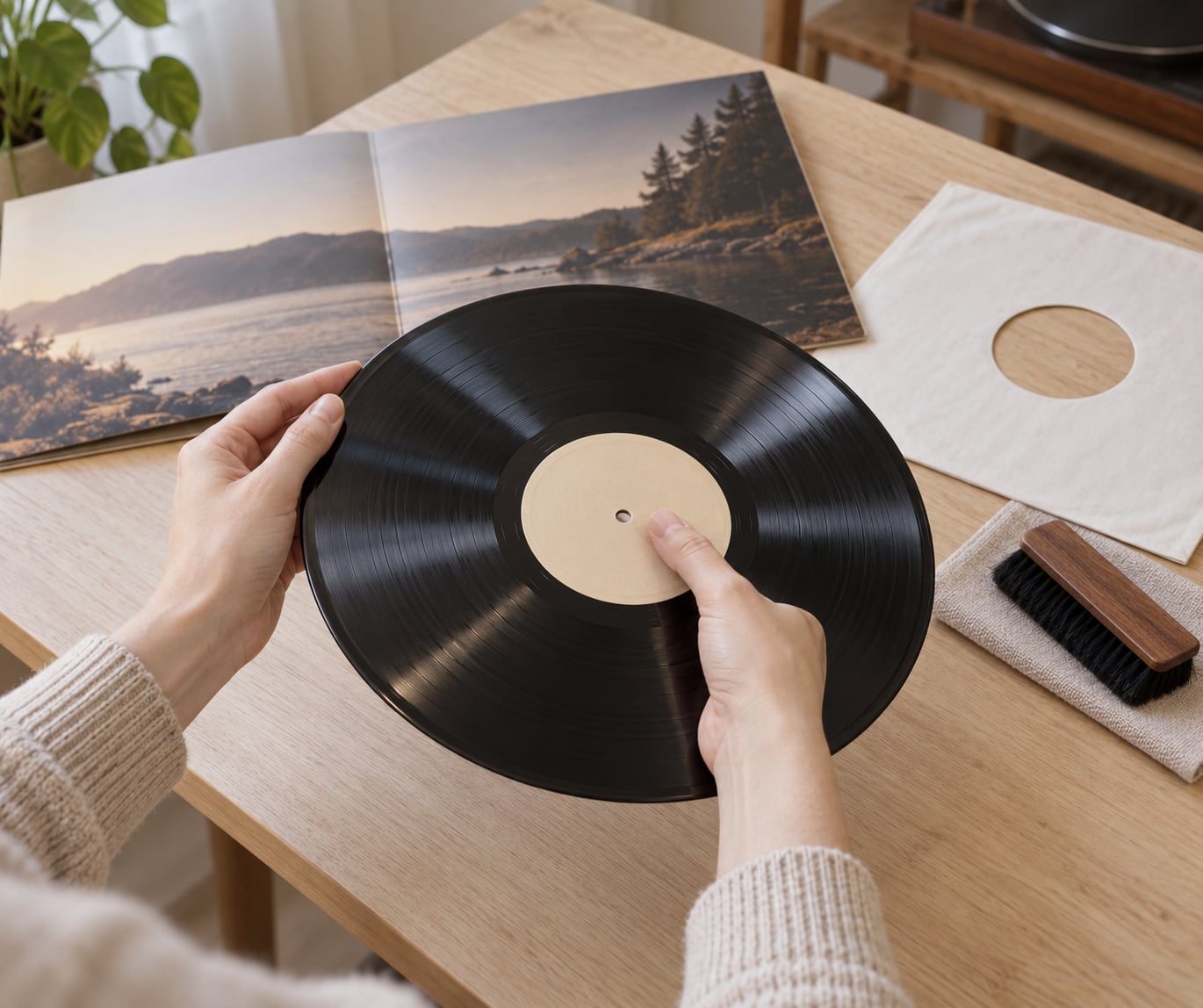
To handle a record by the edges, grip it at two points only: pinch the outer rim between thumb and fingers with one hand, and rest the thumb of your other hand on the center label near the spindle hole. Keep every finger off the grooved playing surface, lift the disc level so it never flexes, and you will not leave a single fingerprint on it.
The grip takes about five seconds to learn, and it is the whole difference between a clean record and one that pops every time the stylus crosses a smear. No gloves, no gadget, no cleaning fluid required for the handling itself.
What follows is the routine in order: prepare, pull the disc out of its sleeve without dragging it sideways, hold it at the rim and the label, check the grooves under angled light, then slide it back and store it upright.
Table of Contents
- What You Need to Handle a Record by the Edges
- Step-by-Step
- 1. Prepare the record and your hands
- 2. Remove the record from the sleeve carefully
- 3. Hold the record only by its edges
- 4. Inspect and clean the playing surface
- 5. Return the record to its sleeve and store it upright
- Common Mistakes
- Frequently Asked Questions
- Why should I handle a record by the edges?
- Is it safe to touch the smooth outer rim of a vinyl record?
- How do I remove a record that is stuck inside its sleeve?
- What is the safest way to clean fingerprints or dirt from vinyl?
- Does holding a record by the edges prevent all scratches?
- Should vinyl records be stored flat or upright?
- Conclusion
What You Need to Handle a Record by the Edges
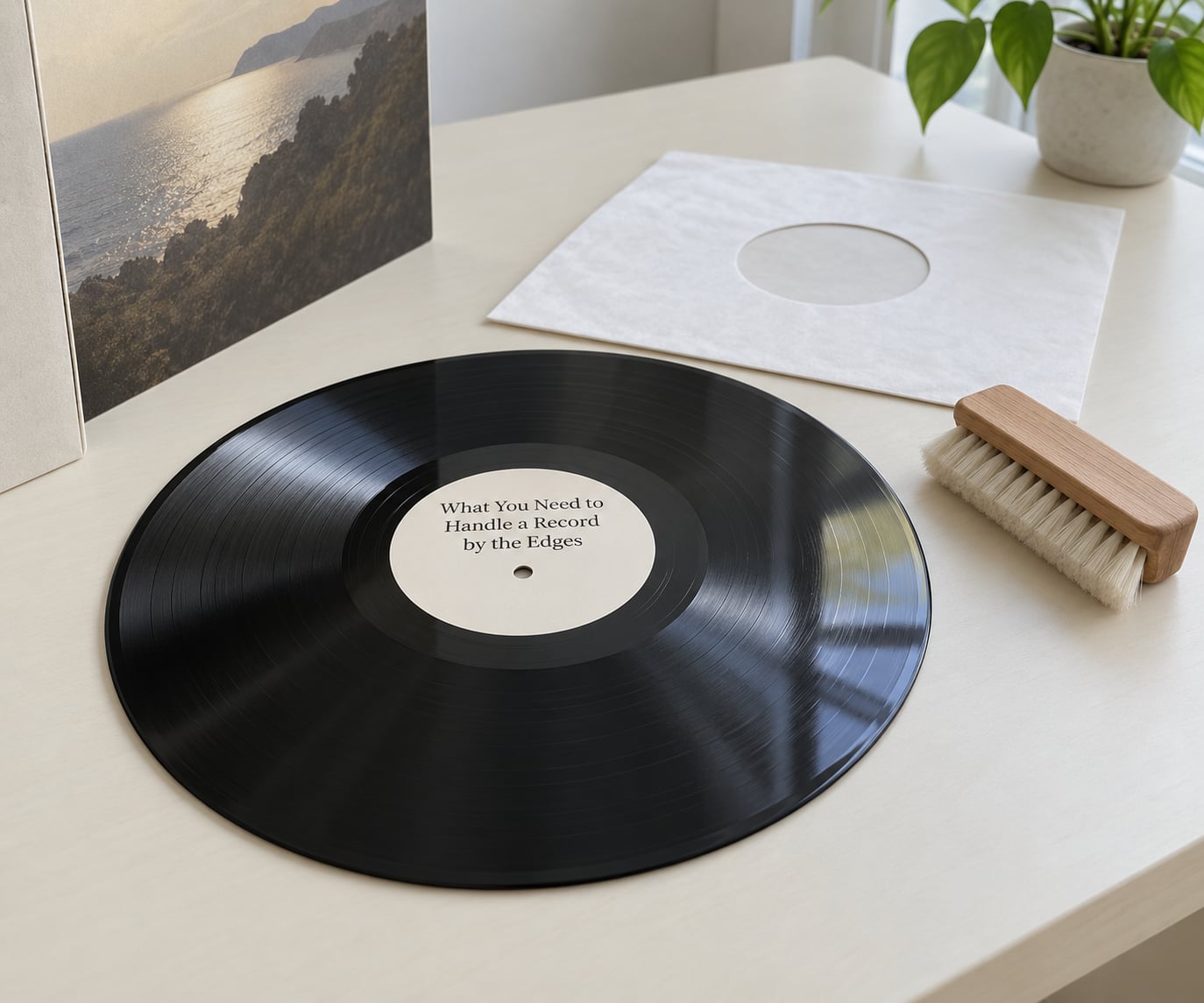
You need very little, and that is the point. Each item below exists to stop one specific failure, so buying more gear does not make a record safer.
- Clean, dry hands. Warm water and soap, then dry fully on a lint-free towel or under a hand dryer. Skin oils transfer from hands that merely look clean, and that is where every mark starts.
- A supported surface. A table, a mat, or a turntable platter. A disc held only by one hand edge sags under its own weight, and 12-inch LPs can crack from that flex.
- A soft anti-static brush. A carbon fiber or microfiber brush lifts the lint and dust that end up on a record no matter how careful you are.
- A clean anti-static inner sleeve. Polyethylene sleeves cut static cling and stop the disc rubbing against the jacket on the shelf.
- Angled light. A desk lamp off to one side, or daylight from a window. Fingerprints and fine dust hide completely under flat overhead light.
- A nitrile glove, if you insist. Useful for exactly one situation: a record that is still damp from a wet clean. Used routinely, gloves add static, and collectors on r/vinyl generally treat washed bare hands as the better option.
One more habit helps more than any tool: clear a spot on the table before you start. Most handling damage happens during the first half second, when the disc is already moving and your attention is still on the sleeve.
Step-by-Step
1. Prepare the record and your hands
Wash with soap, rinse, and dry completely. A damp hand leaves water spots and can carry grit across the grooves, which is worse than a fingerprint.
Push rings off your fingers where you can. A ring on a gripping finger changes your grip in the middle of a lift, and that is how records end up on the floor.
Then open the jacket and look before you touch anything. Check the inner sleeve for grit, torn corners, and a disc that has molded to the plastic or slumped against the jacket. If you see none of those, you are ready.
2. Remove the record from the sleeve carefully
Open the jacket at the hinge so the opening faces up and toward you, then lay it flat with the spine along the table. Peel the inner sleeve back a few inches and hold the sleeve itself, not the disc.
Slide the record out along the direction the grooves run, which means toward the top edge of the sleeve, rather than dragging it sideways across the plastic. Sideways dragging is what scuffs a record against the sleeve opening, and it is the most common complaint I see from r/vinyl posters who pull records from packed shelves.
If the neighbours in the crate are pressed tight, brace them with one hand and ease your record out at a slight angle by its top edge. Do not yank. A jammed disc comes free with a slow tilt far more often than with force, and a forced pull is what tears sleeves and marks edges.
When a disc sticks to its inner sleeve, work at the sleeve’s edge rather than the record. Hold the sleeve flat on the table, press gently near the stuck area so air gets behind it, and peel slowly. Warming the sleeve with your palms first helps.
3. Hold the record only by its edges
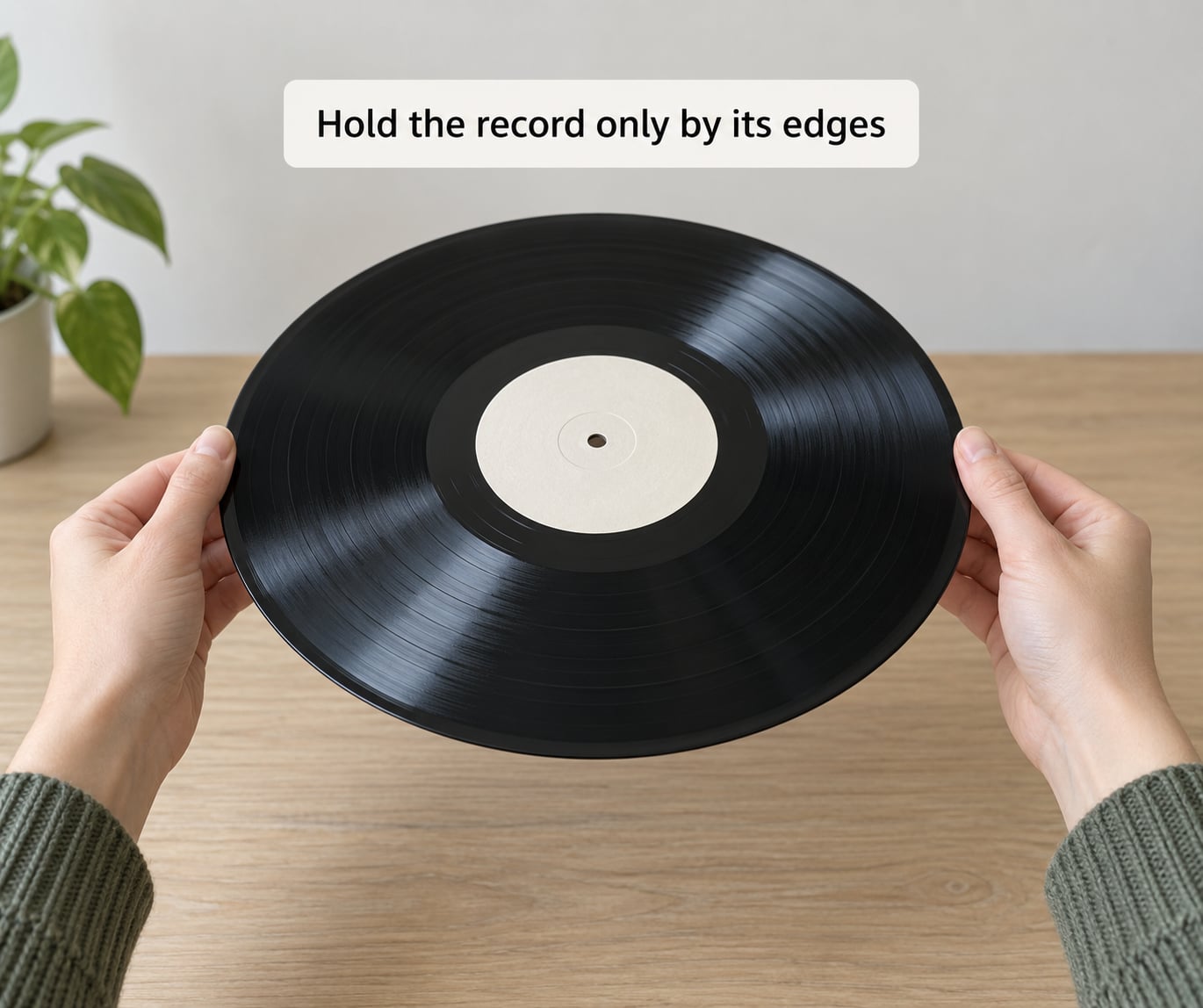
The default grip is two-point. One hand takes the rim, thumb on the top outer edge with the fingers curled under the opposite side. The other hand rests its thumb flat on the center label near the spindle hole, with its fingers supporting the back edge from underneath. The disc is held like a plate, not pinched like a coin.
Keep the label thumb flat rather than hooked into the spindle hole. Hooking it tears the label and can crack the hub area on old pressings, and the tear usually happens on the way up, not the way down.
Three variants cover most situations:
- One-hand rim grip. Works well for 7-inch 45s, for pulling a record to read its label, and for quick flips. Thumb outside on the rim, fingers spread underneath, still nothing on the grooves.
- Small-hand two-point grip. Collectors with smaller hands report the thumb lands naturally on the label close to the spindle hole while the fingers take the far rim. You do not need to span the whole 12 inches; the second contact point does most of the work.
- Two opposite rim points. For picture discs and label-less bootlegs where there is no label to hold, grip two opposite points on the outer rim with thumb and fingers. Handle those more gently, since unsupported hubs flex more.
Lift level, every time. Tilt the disc and gravity does the rest, and a 12-inch LP held by one edge under its own weight can develop a crack you will hear on every play.
When you hand a record to someone at a shop, a swap or a flea market, support the bottom edge and offer it flat and horizontal. Do not pass it over by the top edge, do not slide it across a table toward them, and do not release it until their fingers have closed on the rim. Plenty of second-hand records arrive with fingerprints already on them, so clean before the first play rather than blaming the seller.
4. Inspect and clean the playing surface
Tilt the record under angled light and rotate it slowly. Look for dust and lint first, then fingerprints, then anything that catches the light like a scratch.
Dust comes off with a soft anti-static brush used along the groove direction, on a flat surface, with almost no downward pressure. Hold the disc by the rim with one hand while you brush, or rest it flat and use two hands for the brush. Never hold a record by the edge in midair and scrub it.
Fingerprints need more than a brush. The usual beginner method is a clean microfiber cloth lightly dampened with distilled water, wiped along the grooves in a single direction, then dried with a second clean cloth. Nothing household belongs on a record: window sprays, alcohol, vinegar and undiluted dish soap haze or attack the vinyl.
Two rules cover most of the rest. Never wipe across the grooves, because side motion turns a non-event into a swirl scratch. Never press hard, because pressure grinds dirt into the grooves instead of lifting it out.
Worth knowing before you panic: fingerprints are annoying and often audible as a crackle or a pop, but they sit on the surface and clean up. A scratch that makes the stylus skip is in the vinyl itself and stays there. And in the damage hierarchy collectors argue about on r/vinyl, heat warping and a worn stylus do far more harm than any fingerprint ever will. A record handled by the edges, cleaned with a brush and stored away from sun and heat will outlast one played daily on a cartridge with thousands of hours on it.
5. Return the record to its sleeve and store it upright
Slide the record back into the inner sleeve along the same direction you took it out, holding the sleeve edge and letting the disc travel. Square the sleeve corners with the jacket so the disc does not sit crooked in its pocket.
Store records upright in a shelf or crate, spines out, leaning only very slightly and never stacked flat. Flat stacks put pressure on the discs in the middle of the pile, and the ones at the bottom take the weight longest. They also put ring wear on the jackets above them.
Keep them out of direct sunlight and away from heat sources. Around 65 to 70 degrees Fahrenheit with 35 to 45 percent relative humidity is the range collectors aim for if you want the collection to last decades.
On the turntable, let the record finish rotating before you touch it and lift it with the same two-point grip. To flip to side B, stop the platter first, then turn the disc over like a plate with two hands on the rim. Balancing a record on the edge of a platter or flipping one while it spins is how discs get dropped.
Cue with the lever rather than dropping the needle into the run-out area by hand. Dropping it mid-record concentrates the stylus force at one point in the groove, and the damage is not limited to where the needle landed.
Common Mistakes
- Touching the grooves with a fingertip. Fix: treat the playing surface as off limits every time, even for a quick look at the label on the other side.
- Sliding a record out sideways. Fix: pull it toward the sleeve opening in line with the grooves, holding the sleeve rather than the disc.
- A fingernail catching the rim mid-slide. Fix: keep nails short, or press with the pads of your fingers so a nail cannot find an edge.
- Gripping the label hard with thumb and forefinger. Fix: lay the thumb flat near the spindle hole and support from underneath instead of pinching.
- Forcing a jammed record out. Fix: brace the neighbours, tilt the record slightly, and slide. If it will not move, peel the sleeve back further and try from a different angle.
- Cleaning with household products. Fix: distilled water and a clean microfiber cloth, or a fluid made for records. Nothing from under the sink.
- Wiping across the grooves. Fix: always follow the groove direction, in long even strokes.
- Stacking records flat or leaning them. Fix: upright in a shelf or crate, spines facing out.
- Carrying a loose stack balanced in one arm. Fix: carry a few at a time, held upright against your body by the rim.
- Lifting a record off a spinning platter. Fix: cue or stop first, then lift level with both hands.
- Treating gloves as the fix. Fix: wash and dry your hands instead. Gloves generate static, and static is what pulls dust onto a clean record.
Frequently Asked Questions
Why should I handle a record by the edges?
Every bit of music on a record is cut into microgrooves on one side, and that side is the only part of the disc you should never touch. Fingers leave skin oils in the grooves, oils attract dust, and dust under a stylus sounds as pops and clicks. A fingernail dragged across the grooves leaves a permanent scratch. The outer rim and the center label carry no audio information, so contact there costs you nothing.
Is it safe to touch the smooth outer rim of a vinyl record?
Yes. The rim and the raised label are the two intended contact points, and the r/vinyl consensus is that clean dry hands on those two areas are fine, no exceptions. Keep fingertips off the grooved side and off the smooth labelless areas of picture discs, since a print or coating there scratches easily. Wipe a record you have handled correctly and it should look untouched.
How do I remove a record that is stuck inside its sleeve?
Hold the inner sleeve rather than the record, lay it on a flat table, press gently near the stuck area so air works behind the disc, then peel the sleeve back slowly. Warming the sleeve with your palms first helps a lot. Never lever the disc out at an angle, because that is what bends rims and marks edges. If it still will not release, the record and sleeve are telling you they need a wet clean anyway.
What is the safest way to clean fingerprints or dirt from vinyl?
For dust, a soft anti-static brush along the groove direction on a flat surface, with almost no pressure. For fingerprints, a clean microfiber cloth lightly dampened with distilled water, wiped along the grooves in one direction, then dried with a second cloth. Skip window sprays, alcohol, vinegar and undiluted dish soap, and never wipe across the grooves. Household products haze vinyl and side-to-side motion turns light marks into swirls.
Does holding a record by the edges prevent all scratches?
No. Edge handling prevents the scratches you cause while holding a record, not the ones a sleeve, a crowded shelf, a tumble or a bad cleaning cloth causes. It also does not stop warping from heat, which is usually more damaging than any scratch. But it removes the single most common avoidable source of marks, and it costs nothing beyond paying attention for the five seconds the record is in your hands.
Should vinyl records be stored flat or upright?
Upright, spines out, in a shelf or crate. Flat stacking puts long-term pressure on discs in the middle of the pile and puts ring wear on the jackets above them, and records left leaning at a steep angle can warp toward the wall. Keep them out of direct sunlight and away from heat, and aim for roughly 65 to 70 degrees Fahrenheit with 35 to 45 percent humidity if the collection is meant to last.
Conclusion
Start with the boring part, because it does most of the work: wash and dry your hands, clear a flat surface, and slide the record out of its sleeve in line with the grooves. Then grip it at the outer rim with one hand and flat on the label with the other, lift it level, and keep the grooved side away from everything.
That is how to handle a record by the edges, and once it becomes automatic, your records stop collecting fingerprints and your sleeves stop collecting sleeve marks.