Promoting a local show works in three moves: decide who the show is for, publish one complete event page they can buy from, and then push it through every local channel that already holds that audience. Most small shows fail because the announcement arrives late, the artwork changes halfway through, or nobody on the bill actually posts anything. Fix those three things and a room fills on its own momentum. This whole plan takes two to three focused hours a week for about six weeks.
It is not unusual to watch a band with 400 followers sell out a 60-capacity room while a band with 3,000 followers plays to nine people. The follower count was never the difference. What mattered was whether the show had a specific reason to exist on that specific night, and whether the people who cared were told clearly and early enough to plan around it.
Table of Contents
- What You Need
- Step-by-Step: How to Promote a Local Show
- 1. Define the Show’s Core Hook
- 2. Set a Realistic Attendance Goal
- 3. Build an Event Page and Ticketing Path
- 4. Create a Visual Campaign That Fits Every Platform
- 5. Promote a Local Show to the Right Local Audience
- 6. Give Partners Everything They Need
- 7. Publish on a Two-Week Promotion Schedule
- 8. Follow Up, Show Up, and Learn
- Common Mistakes
- Frequently Asked Questions
- How far in advance should I promote a local show?
- What is the best way to promote a show with little money?
- Which social media platforms should a local musician use?
- How do I get a local music blog or radio show to cover my show?
- How can I tell which local promotion methods are selling tickets?
- Conclusion
What You Need
Before you make a single flyer, four things need to be locked. If any of them is still fuzzy, promotion turns into guesswork and you end up rewriting your artwork three times.
- Confirmed details: date, doors time, start time, exact venue name and street address, billing order, and whether the show is all-ages or restricted.
- Capacity and a ticket plan: the room’s realistic capacity, how many advance tickets you need to break even, and whether you are selling in advance or taking money at the door.
- A working ticket link: one permanent URL that goes to the ticket page, not a chat thread, not a DMs request.
- Artwork: one master image plus a square crop, or a photo of the band that you have permission to use.
- Partners: the venue, every other act on the bill, one or two record stores or radio shows, and a handful of people willing to post on show night.
- A way to track: a simple tally of sales against a weekly target, and a question at the door asking how people heard about the show.
If you have those, you can start. My rule is that no announcement goes out until tickets are buyable and the date is on the venue’s own calendar.
Step-by-Step: How to Promote a Local Show
The campaign below moves from defining the audience and the offer, through publishing and outreach, into local promotion, partner collaboration, and finally the last two weeks and the follow-up after the room clears. Each step has a check you can run before moving on.
1. Define the Show’s Core Hook
Start with the clearest reason someone within driving distance should leave the house on a weeknight. Write that reason in one sentence before you open a design tool. If the sentence needs two “and”s, the show is not defined yet.
Build it from six pieces: the genre, the lineup, the room itself, the audience you already have nearby, the geographic radius you can realistically draw, and the date and time. A specific detail does more work than a mood board. “First show in this room in two years” beats “an unforgettable night.” A support slot from a band with actual fans beats “special guests.”
Turn that sentence into a repeatable message you use in the same order everywhere: who it’s for, what it is, where and when, and the ticket link. Once you write it, you can paste it into a post, an email subject line, a text to a partner, and a zine listing without rewriting anything. That consistency is what makes the promotion legible.
2. Set a Realistic Attendance Goal
Write down how many people you actually need, not how many you hope for. The math is simple: capacity minus the number of people you personally know will come, minus a realistic drop-off for a weeknight. That last number is the hard one, and for a small DIY room it is usually steeper than you want to admit.
Separate three numbers that promoters constantly blur. Reach is how many people saw the post. Responses are the questions, saves, and messages that came back. Sales are the tickets. Reach is the biggest number and the least useful one; judge a channel by sales, and use reach only to spot a channel that is delivering nothing at all.
Then set a weekly ticket target. If you need 80 tickets across eight weeks, aim for 15 in week one, 20 in week two, and let the last three weeks carry the heaviest load. If you are behind at the halfway point, you have time to change something: more outreach, a different offer, or a feature post from someone whose audience overlaps yours.
3. Build an Event Page and Ticketing Path
One complete event page beats five partial ones. It needs the date, doors time, start time, venue name, street address, the full lineup in billing order, ticket price, what fees are included, age restriction, accessibility notes, parking or transit guidance, and a contact for questions.
Remove every step between a person’s interest and the purchase. A direct link to the ticket page in the post body works better than “link in bio.” Test the link from your phone on mobile data, not office wifi, because that is where most of your audience will be standing at the bus stop.
Before you share it anywhere, open it three ways: as a desktop, as a phone, and from a link you have never clicked. Check that the date reads correctly, that the price matches what you posted, and that the buy button works without a login you do not control. A dead checkout link on show day is the one failure you cannot recover from.
4. Create a Visual Campaign That Fits Every Platform
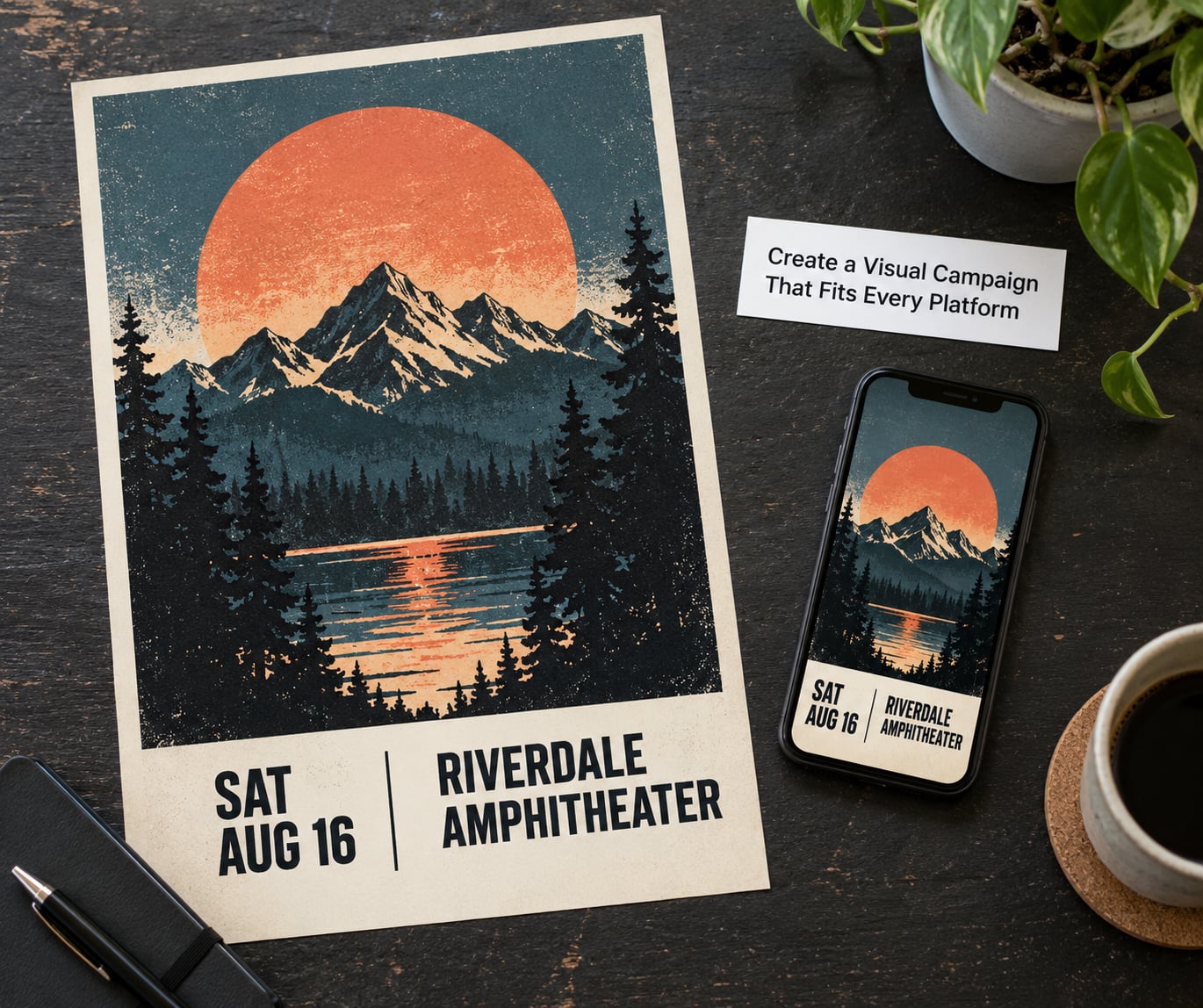
Design one master image and cut the rest from it. A vertical square for social, a wide horizontal for listings and newsletters, and a plain-text version for anyone posting without an image. Redesigning from scratch for each channel is where consistency dies.
Establish a simple hierarchy: the band or event name largest, the date next, the venue next, the ticket link visible last. Nothing else earns top billing. On a phone preview the whole thing has to make sense at thumbnail size, so cut anything that is not readable.
Keep one typeface and two colours across everything. Make sure anyone using a band photo has agreed to it, and give partners the approved file rather than letting them screenshot a compressed version.
5. Promote a Local Show to the Right Local Audience
Choose communities by genre overlap, not by size. A 2,000-person group where everyone listens to the same scene as your lineup is worth more than a general local page with 40,000 followers and no interest in what you are playing.
The channels that reliably move tickets in a small town: local music newsletters, scene-specific fan groups, college radio and local radio shows that take show announcements, independent record stores that hang posters, other venues who will list a friend show, cafés and laundromats on the board, campuses with student-run music societies, and the local paper’s calendar or arts page.
Reach out to each with the same three-line message: one line on the show, one line on why that audience fits, one line asking them to post or hang it. Keep it short. Nobody promotes a show from a 400-word pitch, and the ones who do are rare.
Give every outreach channel its own link or code where the platform allows it. A distinct ticket link for a newsletter, or a code word a partner can hand out, is the cheapest way to find out which channel is producing sales. Without that, you are guessing, and you will keep guessing in the wrong direction next time.
6. Give Partners Everything They Need
Most partner posts fail because they are impossible. The partner is busy, the show is three weeks away, and your materials require them to invent copy, resize an image, and find a link. Remove that work.
Build a one-page media sheet with the date, doors, start time, venue name, address, lineup, price, ticket link, a 30-word short blurb, a 100-word long blurb, the approved artwork file, image credits, your contact details, and the date by which you need their post up. Put it in a link they can open in ten seconds.
Then confirm receipt. Send one message asking whether the artwork loaded correctly and whether the link works, and be specific about what you want posted and when. Follow up once, gently, a week before the show. Partners are doing you a favour; make it easy to be a good partner back.
7. Publish on a Two-Week Promotion Schedule
Each post in the final two weeks does a different job. The announcement invites. The lineup feature gives a reason for a specific fanbase to care. The logistics post removes friction. The countdown creates urgency without nagging.
- Day 14: full announcement with the ticket link and the hook sentence.
- Day 12: feature the support act, aimed at their followers specifically.
- Day 10: practical details, doors time, address, parking, age restriction, and where the entry queue forms.
- Day 7: a short vertical clip or photo, plus a reminder to anyone who said they would come.
- Day 5 and Day 3: countdown posts, each with the link in the same place as the first one.
- Day 2: the last call, stating the real number of tickets remaining if you know it.
- Day 1: tomorrow’s show, time, address, and nothing else.
After each post, check sales against your weekly target. Behind at day 10 means escalate outreach, not post more often to the same audience. On track means keep the schedule and stop adding noise.
8. Follow Up, Show Up, and Learn
The last push is direct. Message everyone who asked about the show and never bought, and everyone who came to your last one. Personal messages convert better than any post in the final week, and you only need to write them once.
On the day, coordinate whoever is helping at the door, keep one person on replies, and post the practical details early so people are not guessing at the door. After the show, thank everyone who came and ask two questions on the way out: how did you hear about us, and what should we have announced differently?
Then run the debrief within a day. Total tickets, tickets by source, cost divided by tickets sold, and one thing to repeat and one thing to change. That note becomes the starting point for the next show, and it is worth more than any marketing advice you can read.
Common Mistakes
Almost every stalled show comes down to one of a handful of fixable errors. Here is what goes wrong and what to do instead.
- Vague descriptions: “a night of great music” tells nobody anything. Name the genre, the lineup, and one specific reason to be there.
- Announcing too late: a two-week window is not enough for a weeknight. Give people time to see it twice and find a ride.
- Announcing before tickets exist: if there is no buy link, you collect interest you cannot convert and the follow-up feels like an announcement.
- Inconsistent artwork: a new design for every post reads as a different event. One master, cut for each platform.
- Generic mass posting: pasting the same blurb into every local group burns goodwill in the exact scene you depend on. Personalise each one.
- Missing or buried links: “DM me for tickets” adds a step and loses people. One link, same place, every time.
- Untracked partnerships: if you cannot tell which partner moved tickets, you repeat the same weak channel for years. Use distinct links or codes.
- Relying on one platform: a single feed can vanish with a reach change. Keep one email list and one physical channel running alongside it.
- Skipping the final week: most tickets sell late. If you go quiet after the announcement, you leave the room half empty.
Make the campaign specific to your show, repeatable from one date to the next, and local in a way a citywide campaign never can be.
Frequently Asked Questions
How far in advance should I promote a local show?
Six to eight weeks for a weeknight show, three to four weeks for a weekend date. Announce only when tickets are buyable and the date is on the venue calendar, then keep a steady cadence: a lineup feature, a logistics post, and two countdowns in the final two weeks. Short-lead shows do not fail for lack of promotion, they fail because the announcement and the show land in the same week.
What is the best way to promote a show with little money?
Borrowed reach beats paid reach at small-room scale. Start with every act on the bill and everyone who came to the last show, then hit record stores, local radio shows, scene newsletters, campus radio, and free community event listings. Flyers at record stores and the one or two venues that would rather have a packed room than a quiet one cost print money only. Paid ads rarely move enough tickets to justify themselves for a room under a hundred people.
Which social media platforms should a local musician use?
Pick two and post to them properly rather than spreading thin across five. For most local shows that means one visual platform for the artwork and one where the actual conversation happens, plus an email list you own. Keep one permanent link that always points at tickets, and repeat the same date and venue text in the same order every time. Platform choice matters far less than consistency and a working link.
How do I get a local music blog or radio show to cover my show?
Send one short email to a named person with the date, venue, lineup, price, a 100-word blurb, the ticket link, an approved image, and one specific angle, such as a first show in that room or a support act with a story. Radio usually wants to record something, so offer two songs in the two weeks before the show. Follow up once after a week, and accept that a listing is a realistic outcome.
How can I tell which local promotion methods are selling tickets?
Give each channel its own ticket link or partner code, then tally sales per source at the door and ask arriving guests how they heard about the show. Compare total spend against tickets sold to get a cost per ticket for each channel. Repeat this after every show and your next campaign is smaller, cheaper, and aimed at the two or three channels that actually fill rooms.
Conclusion
Start with the hook sentence, then the number of tickets you need, then one complete event page with a link that works. From there the promotion is repetition: local outreach week by week, partner materials handed over early, a two-week schedule with a different job for each post, and a debrief the morning after.
Write down where each sale came from while it is fresh. The next time you promote a local show, you will be running a smaller, sharper campaign aimed at the channels that already fill your room.