Are CDs making a comeback? Partly, but the word oversells it. US CD sales grew in the first half of 2026 on every measurement that matters, and collector demand for out-of-print editions is genuinely strong — yet streaming grew faster in the same period, and vinyl still earns more per album. What is coming back is a niche built on ownership, affordability and shelf presence, not a return to 1999.
Last updated October 2026. Sales figures come from Luminate’s midyear report and Recording Industry Association of America revenue data.
Table of Contents
- Are CDs Making a Comeback? What the Evidence Says
- What Is Driving Renewed Interest in CDs?
- Are CDs making a comeback among collectors?
- Why Do Some Listeners Prefer CDs to Streaming and Vinyl?
- What CD Collecting Looks Different From Vinyl Collecting
- Is the CD Revival Here to Stay?
- What Should You Know Before Buying More CDs?
- Frequently Asked Questions
- Are CD sales actually increasing?
- Will CDs replace vinyl records?
- Why are some newly pressed CDs more expensive than used copies?
- Is buying used CDs better than buying new pressings?
- How can I tell whether a used CD is a valuable pressing?
- What Should Collectors Do First?
Are CDs Making a Comeback? What the Evidence Says
The honest answer is yes for units, muted for revenue, and no for anything close to a format takeover. Both the unit numbers and the revenue numbers are correct — they just measure different things, which is where most of the arguing online comes from.
- Units: Luminate’s 2026 midyear report puts US CD shipments at roughly 16.3 million units, up about 16% year over year.
- Revenue: The RIAA recorded first-half CD revenue up approximately 58.6%.
- Without K-pop: Strip out K-pop album variants and unit growth is still positive at about 6.7%.
- Vinyl in the same window: up roughly 2.4%.
- Streaming: global on-demand audio streams rose 9.8% to about 2.8 trillion. Physical growth is additive, not subtractive.
Units measure how many discs moved. Revenue measures what those discs sold for. When a market shifts from cheap used imports toward box sets, deluxe editions and limited variants, average selling price climbs much faster than unit count, which is exactly what the 58.6% against 16% gap describes. One trade body counting CDs sold, the other counting dollars taken, both landing in the same news cycle, and headlines picking whichever number is bigger.
There is a second filter worth applying: how much of the unit growth is fandom merchandise that gets listed, traded and resold rather than kept. K-pop variants are bought in multiples by people who already own the music and want a physical object, and those copies often re-enter the secondhand market. That inflates unit counts without adding listeners. The 6.7% figure with K-pop removed is the more honest read on the general market.
| Signal | What it shows | How much weight it carries |
|---|---|---|
| Unit growth | About 16% more discs moved in the US than a year earlier | Strong — the core measure of demand |
| Revenue growth | Roughly 58.6% first-half increase | Real, but inflated by deluxe and box-set pricing |
| Used-market activity | Thrift stores and charity shops are full of cheap discs because owners are selling down | Confirms supply, not necessarily new appetite |
| New pressing availability | Most mainstream catalogue is still in print; deluxe box sets rotate through pressing runs | Strong for mainstream titles, patchy for catalogue |
| Entry price | A secondhand disc costs a fraction of a new vinyl LP of the same album | Strong — this is the main reason collectors switch formats |
| Format share | CD remains a small share of recorded-music revenue | Limits the size of any “comeback” |
What Is Driving Renewed Interest in CDs?
Five things are doing the work, and only two of them are about sound quality.
1. Ownership instead of a licence. Streaming means access, and access can be withdrawn when a catalogue moves labels or a service shuts. Buyers on collector forums put it bluntly: a stream is a rental. A disc is an object that still plays when the platform does not.
2. Price. The same album usually costs noticeably less as a CD than as a vinyl LP, and a secondhand copy costs a fraction of both. For anyone building a library on a normal income, that maths decides it.
3. A real secondhand supply. People leaving the format, downsizing after a move, or clearing a shelf are selling into thrift stores and online marketplaces in volume. Record store regulars describe buying in bulk precisely because divestiture keeps supply high.
4. Content that exists only on the disc. Demos, live cuts, B-sides, alternate artwork and regional bonus tracks are the reasons collectors describe most purchases. The 2011 iTunes-era shift stripped these out of the standard digital album, and no streaming reissue has put many of them back.
5. Nostalgia and shelf presence. The format is now thirty-odd years old enough to be a period object rather than a default. Teens are buying it the way their parents bought records, often alongside their parents.
Are CDs making a comeback among collectors?
Collectors are where the activity is most visible, and it looks very different from streaming-era consumption. The typical target is a title that has been out of print for years: a regional edition with a different track list, a first pressing, a bonus-track edition that was discontinued after six months, or an album by a band that never got signed in the first place.
A good example of the difference: an artist whose digital release is the plain stereo album, while the CD edition adds a live track and a two-page booklet of photos. The streamer never finds that version because it is not part of the digital catalogue. The collector knows to look for it.
Used market listings reward patience and knowledge. A disc sold as generic stock can be a specific edition if the matrix numbers, catalogue number and booklet art are checked. That is normal collector practice on every format, but on CDs the checks are quicker and the errors more common.
Why Do Some Listeners Prefer CDs to Streaming and Vinyl?
The honest answer is that it depends on what you value, and the arguments on both sides are usually about different things.
Against streaming: lossless audio, no buffering on a bad connection, no dependence on a catalogue licence, artwork and booklet included, and a copy that cannot vanish.
Against vinyl: surface noise, pops and skips, a higher price per album, real storage weight, and the fact that a scratched record is damaged while a marked CD usually still plays.
For vinyl instead: the ritual, the sleeve, the sheer size of the object, and a sound that many listeners prefer even when they cannot articulate why.
Album length matters more than people expect. A 70-minute album on a 74-minute CD leaves real headroom; the same album on a 22-minute vinyl side gets split or compressed. Car listening also favours the format, because a car stereo still plays discs and a phone in the same socket can.
What CD Collecting Looks Different From Vinyl Collecting
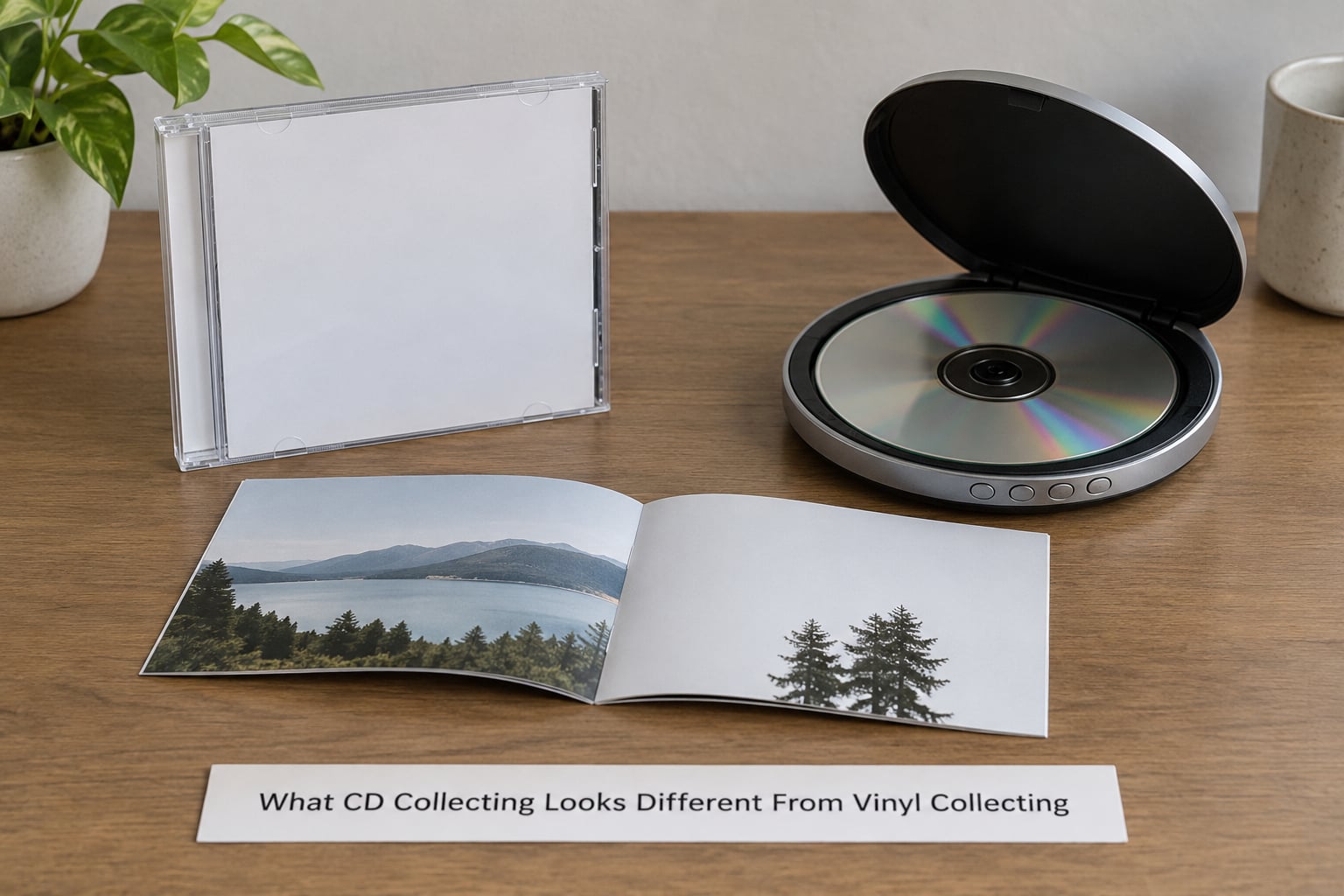
Collecting CDs is a quieter, cheaper hobby with a shorter learning curve, and the physical differences from vinyl explain most of that.
| Characteristic | CD | Vinyl |
|---|---|---|
| Physical size | Small, stackable, shelf-efficient | Large, heavy, needs real shelf space |
| Artwork | Limited by jewel case or digipak; booklet is small | Full album-sized sleeve with room for extensive liner notes |
| Condition risk | Scratches on the data surface cause read errors; disc rot is slow and rare | Warping, sleeve wear, deep groove damage |
| Sound | Clean, consistent, no surface noise | Warmer, with surface and motor noise included |
| Equipment needed | CD player, still manufactured, often cheap | Turntable plus cartridge, and a used deck needs inspection |
| Pressing variations | Matrix numbers and catalogue numbers identify the edition | Runout etchings, label variations, stamper codes |
| Collector editions | Digipaks, booklets, limited box sets, bonus tracks | Coloured vinyl, gatefolds, numbered pressings, picture discs |
| Typical entry cost | Low, especially used | Moderate to high, rising on popular titles |
The digipak is the one CD edition that competes with vinyl on presentation. A well-made CD digipak with a full booklet looks and opens like a small record sleeve, and those editions are where most of the collector attention now sits.
Is the CD Revival Here to Stay?
The likely answer is a stable niche, not a return to the top. CD sales have recovered from a long trough, but the recovery is measured in percentage points from a small base rather than in lost ground being retaken.
Three factors keep it in that lane. First, pressing runs need minimum orders, so labels commit to titles that reliably sell — current artists, deluxe editions and catalogue reissues — rather than speculative deep releases. That caps variety. Second, retail has a small but steady shelf presence; you can still find new CDs in most record shops and online, unlike a decade ago, but they are not being promoted the way new vinyl is.
Third, streaming behaviour has not changed. Roughly 2.8 trillion on-demand streams and growing means the format never lost its core market, and physical buying sits alongside it. The sub-trend most likely to keep growing is car listening, since a working in-car disc drive is still an easy way to play an hour of music without a data connection.
The bearish case is not that CD shrinks back to nothing. It is that the growth keeps coming from editions priced like vinyl, deluxe sets and fan variants, so the average buyer pays more for fewer discs and the unit numbers stay modest.
What Should You Know Before Buying More CDs?
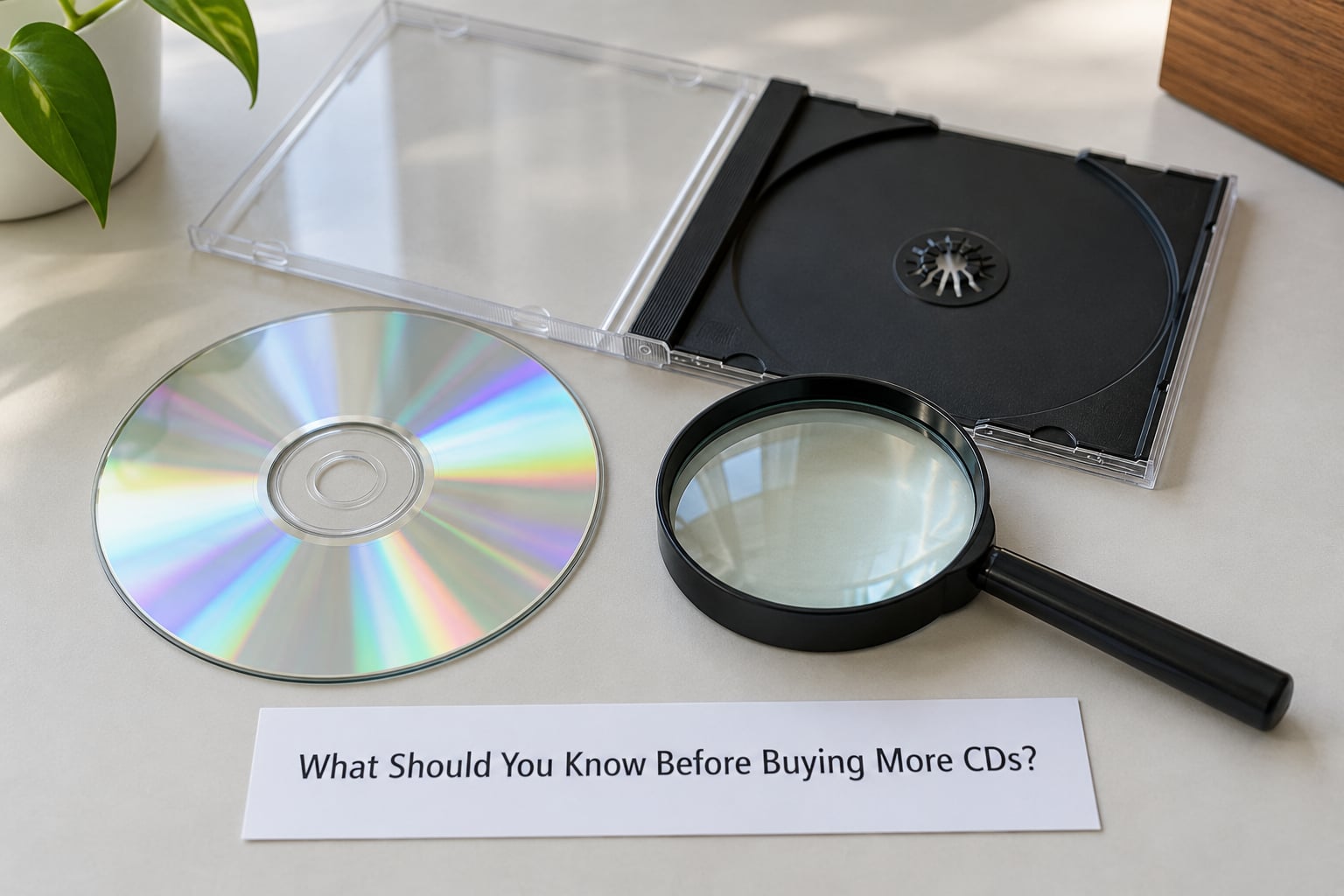
Most beginner mistakes come from buying on the cover alone. A few habits fix that.
Know which edition you are buying. The catalogue number printed on the disc or the back of the booklet identifies the release, and the matrix numbers etched near the inner rim identify the pressing. Two discs with the same album art can be different editions entirely.
Check what is actually in the package. Bonus tracks, booklet pages and obi strips are the reason to choose one version over another, so read the listing before buying rather than after.
Treat mastering claims carefully. Labels advertise bit depth and sample rate on the packaging, but they describe the mastering process, not what your equipment or the player can extract. A stated high-resolution master is not automatically a better listen.
Inspect used discs in person where you can. Scratches across the shiny data surface cause dropouts; radial scratches on the label side are usually harmless. Hold it to the light and turn it.
Check the case. A jewel case with a cracked hinge protects nothing, and a missing booklet is a permanent loss for collector editions.
Use return windows on sellers that offer them, and check graded listings against the stated condition rather than the seller’s confidence.
A short pre-purchase checklist:
- Does the catalogue number match the edition you want?
- Are the matrix numbers readable and consistent across the set?
- Is the disc surface free of scratches that catch a fingernail?
- Does the playback side wipe clean, or is it visibly hazed?
- Is every booklet, obi and insert present?
- Is the case intact enough for storage?
On hardware, a working player is still easy and inexpensive to find, and durability is a genuine advantage of the format — one collector described a thirty-year-old six-disc changer that still runs without issue. For a new or secondhand player, the specs worth caring about are optical versus digital output, whether it can read burned discs if you plan to rip, headphone output quality if you will not run it through an amplifier, and whether the tray loads reliably. Many buyers simply rip to a personal library and play from there, which combines the ownership argument with streaming convenience.
Frequently Asked Questions
Are CD sales actually increasing?
Yes, by unit count. Luminate’s midyear report for 2026 showed US CD shipments at roughly 16.3 million units, about 16% more than the same period a year earlier. The RIAA put first-half CD revenue up around 58.6%, a much larger jump because deluxe editions and box sets lift the average price. Excluding K-pop variants, unit growth is about 6.7%. CD remains a small share of total recorded-music revenue.
Will CDs replace vinyl records?
No, and the numbers point the other way. Vinyl grew about 2.4% in the same period and earns far more per album because collectors will pay for limited pressings, coloured vinyl and deluxe box sets. A CD is cheaper, smaller and easier to shelf, but that works against the ritual and presentation that make vinyl valuable. Expect the two formats to grow side by side, with CD holding the affordable and collector-catalogue end of the market.
Why are some newly pressed CDs more expensive than used copies?
A new pressing can be a box set, a limited edition with a bonus disc and booklet, or part of an album cycle that labels price at a premium. Used copies of ordinary editions cost a fraction of that because they are just standard discs in jewel cases. Comparing a deluxe new edition with a used standard edition is like comparing a poster with a catalogue entry. Decide which edition you actually want before judging the price.
Is buying used CDs better than buying new pressings?
Used is better value for ordinary listening copies. Most standard editions sound identical and play without issue if the disc is undamaged, and secondhand discs cost far less. Buy new when the edition is discontinued, when the booklet or obi is missing from used copies, when you want a guaranteed clean disc, or when the release is genuinely limited and may not be pressed again. Check the matrix and catalogue numbers on anything you buy used.
How can I tell whether a used CD is a valuable pressing?
Look for three things: the catalogue number on the disc and booklet, the matrix numbers etched around the inner rim, and the packaging itself. A digipak, obi strip or thick booklet points to a deluxe edition, and a different catalogue number from the standard release means a different pressing. First pressings often have distinguishing marks in the disc coating or the runout area. Value comes mostly from scarcity and condition, so confirm the details before paying a collector price.
What Should Collectors Do First?
Start by deciding what you are collecting for. Listening copies and collection pieces are bought differently, and mixing them wastes money.
Then look at what you already own before buying anything new. Sorting a shelf by disc, checking condition and throwing out duplicates recovers more playable music than any single new purchase will. From there, target editions that streaming will not give you — bonus tracks, regional releases, discontinued catalogue — because that is where the format still wins outright.
Buy selectively. There is no investment case here: most discs depreciate the moment you open them, and speculation only works for rare, correctly graded, correctly catalogued pressings. Buying because the format is trending is the one motivation that reliably leads to a shelf you regret.