
Short answer: What does produced by actually mean? It names the person who oversaw and shaped the making of a recording. They steer the artist and the musicians, call the studio sessions, make the creative and technical calls, and sign off on the finished record. The exact job changes with era, genre and studio, which is why the same line means different things on different records.
Updated for 2026. If you have ever turned a record over and read the small print on the back cover, that block of names is a map of who did what. Most people understand “written by.” Almost nobody can say what the line above it actually tells them.
What I notice when people ask about this: they are not trying to become producers. They are holding a record, and they want to know whether the name next to “produced by” explains the sound they like. The short version is yes, usually. The longer version needs the rest of the sleeve decoded too, which is where the interesting part starts.
Table of Contents
- What Does Produced By Actually Mean?
- Why the producer credit is worth reading closely
- What Does a Record Producer Do?
- Producer vs. Engineer: What Is the Difference?
- What Does Produced By Mean on a Record Label?
- Is the Producer the Same as the Artist or Songwriter?
- Produced, arranged, composed: where the lines blur
- What Does a Producer Credit Tell You About a Record?
- Why Do Producer Credits Differ Between Record Versions?
- How Producers Collaborate with Artists and Engineers
- Frequently Asked Questions
- Is the producer the person who paid for the recording?
- Can one person be both the producer and recording engineer?
- Why do some artists receive a produced by credit on their own albums?
- Does a famous producer guarantee a record will sound a certain way?
- What is the difference between a producer and a mixer?
- How can I find producer credits for a specific vinyl release?
- Conclusion
What Does Produced By Actually Mean?

A producer is the person with overall responsibility for the recording: the one who gathers the songs, the players, the studio and the budget, guides them toward a finished record, and decides when it is done. On a credit block, that is the name or names printed after “produced by.”
It is worth being precise about what that does and does not claim. The credit is a contractual designation, not a courtesy thanks. In the industry-standard producer agreement, the producer can expect credit in what is legally called label copy, which simply means the liner notes on the physical record. A producer who was not named on the sleeve generally has a strong argument that they were not paid for the work either.
What changes everything is scope. On a 1960s pop record, the producer might have written the arrangement, chosen the studio, hired the players, conducted the sessions and paid everyone. On a 1990s indie record, the producer might be the band’s guitarist working from a home studio after hours. On a modern self-released track, the producer and the artist are usually the same person with two credits on the same release.
Why the producer credit is worth reading closely
Two records with similar sounds can have completely different production setups, and the credit tells you which kind of record you are holding. A credit naming one person on a full band record usually means that person shaped the whole thing. A credit listing five names across an album usually means different records, different rooms, different intentions.
It also tells you where to look next. Collectors who understand the producer credit tend to read the mastering line that follows it, because mastering is the last hand on the record and the one most often changed between editions.
What Does a Record Producer Do?
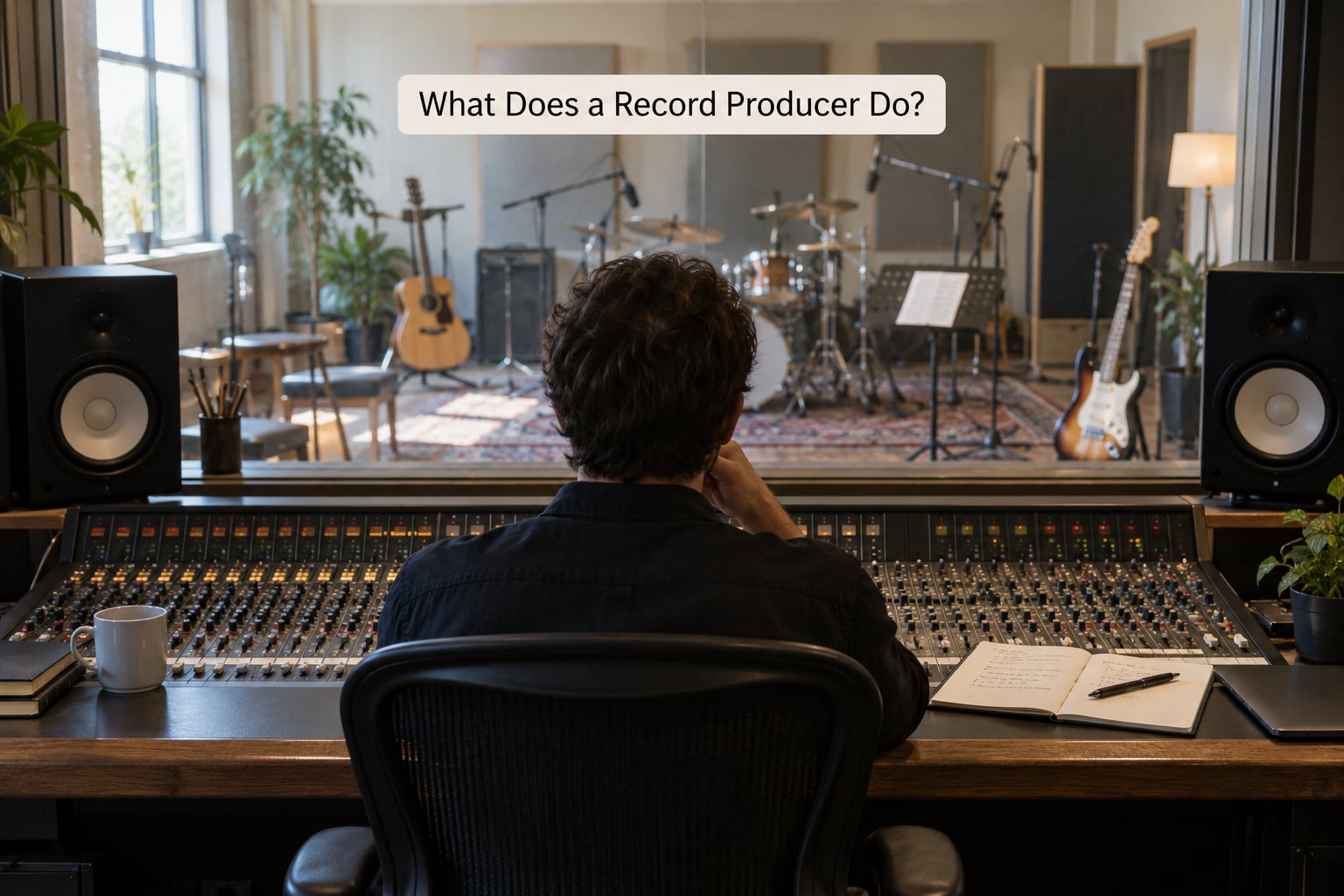
Eight things, roughly in the order they happen. On a small indie record some of these are thirty-second decisions. On a big studio record they are months of work.
- Sets the direction. Before a note is recorded, the producer has usually decided what the record should sound like, and often what it should not sound like.
- Picks or helps pick the songs. Producers routinely pass on tracks, and the ones that survive become the album.
- Hires and directs the players. Session musicians, a rhythm section, a string arranger, sometimes a guest vocalist for one track.
- Books and runs the studio. The room, the hours, the engineer, the schedule, the gear list.
- Guides performances. Telling a singer to try it again a third lower, or a drummer to play less, is a large part of the job.
- Decides what stays. Takes get chosen and takes get left on the floor. A good producer knows the difference between a mistake and a character.
- Manages money and time. The traditional producer was often measured on two things only: on time and on budget. The abbreviation OTOB comes from that era and still gets used.
- Oversees the mix and approves the master. Mixing engineers make the mix; mastering engineers prepare the master for release. The producer signs off on both.
The role has shifted more than the credit line suggests. The studio supervisor who hired the band, paid the engineer and delivered a finished master has largely given way to someone who makes the record themselves on a laptop. Both are producer credits. Both mean the person carried responsibility for the finished thing.
Producer vs. Engineer: What Is the Difference?
The producer decides what the record should be. The engineer figures out how to capture or rebuild it. That split is clean in theory and messy in practice, because on most records the same person does both.
| Credit | What they decide | Where it sits on the sleeve |
|---|---|---|
| Producer | Songs, arrangements, players, sessions, budget, and whether the record is finished | “Produced by” |
| Recording engineer | Microphone choice, placement, levels, takes, signal flow, room setup | “Engineered by” |
| Mixing engineer | Balance, EQ, compression, effects, how everything sits together | “Mixed by” |
| Mastering engineer | Final EQ, level, and the transfer to the release format, vinyl or digital | “Mastered by” |
One sentence to carry away: the producer owns the decision, the engineer owns the execution, and mastering is the last set of ears before the record ships.
Doubles are normal and not suspicious. A producer who works alone in a home studio is almost always also the recording and mixing engineer. A band producing its own record in a professional studio often has an outside engineer handling the technical side while a member of the band produces. Both lines then appear on the sleeve, and neither is a demotion.
What Does Produced By Mean on a Record Label?
Nothing automatic. A label employing someone means they signed them, paid their fee and released the record. It does not tell you who produced the sessions.
Inside a label there are three common arrangements. An in-house producer is a staff member who makes records for that label. An independent producer is contracted per album, sometimes with the label as a partner, sometimes with the band. And plenty of artists produce their own records with an outside engineer handling the technical side.
That last case is where the executive producer credit usually shows up. An executive producer is the budget owner above the creative team, often a label president, an artist manager or the band itself. On the sleeve it reads “executively produced by”, and it means money and oversight rather than studio decisions. It is a different credit entirely, and confusing it with the producer line is the single most common misreading.
There is a legal wrinkle worth knowing. The person who funds a commissioned recording does not automatically own it. Many labels commission recordings as work for hire, meaning the label owns the finished master; in other deals the producer keeps publishing and points. Either way, the sleeve tells you who was responsible for the making, not who owns it. Ownership shows up in the publishing and copyright lines.
Is the Producer the Same as the Artist or Songwriter?
No, and the confusion is worth unpacking because it comes up constantly in music forums. Someone makes a beat, and listeners assume that person wrote the song. A producer can be credited on a record and have written none of the words or melody.
Three jobs sit next to each other. The songwriter or composer writes the words and the music. The performer plays them. The producer makes the recording happen and decides how it comes out. Sometimes one person does all three, and sometimes every job belongs to a different person.
So the belief that a producer credit means a songwriting percentage is wrong by default. Composition credit comes from the split sheet, which is a separate agreement negotiated between the writers. Producing does not automatically buy a share of the song.
There is an exception, and it is where producer credits start to look like authorship. A producer who contributes to the composition can be a co-writer, but they are then credited as a writer. The famous historical cases are the ones where the producer wrote and produced, which is why those records tend to credit the same name twice.
Produced, arranged, composed: where the lines blur
Listeners argue about this on forums constantly, because the credits themselves are inconsistent. A long-running thread on the GearSpace forum on the difference between produced, arranged and composed lands on the producer as the person in charge of the whole recording, and warns specifically against confusing that with beatmaker or executive producer. Arrangement is the internal structure of a piece: who chose the parts, who played what, how the sections stack. Composition is writing the music itself. The overlap happens constantly in practice, and sleeves are written by humans, not by a standard.
What Does a Producer Credit Tell You About a Record?
More than most listeners assume, and less than the internet suggests. A producer name is a genuine signal about continuity of taste, because the same person tends to make the same set of decisions.
Reasonable things to read from it: a likely stylistic family, since a producer usually works within a set of references; probable collaborators, since producers keep working with the same engineers and players; and continuity between releases, because a band keeping its producer is making a deliberate choice about sound.
Things it does not tell you: who made every individual decision, who actually played the parts, or what the record will sound like on your system. A credit also carries no quality signal on its own. A famous name has never guaranteed anything, and a first-time producer has produced records people still argue about decades later.
Then there is the refusal case. Steve Albini recorded a great many records and consistently declined the producer credit, arguing that the engineer should not be able to impose an aesthetic on a band. His records carry his name in the engineering position instead. When a famous producer declines the credit, that tells you something real about how they read the line.
Why Do Producer Credits Differ Between Record Versions?
Because the record is not always the same record, and the credit block sometimes gets updated to match. This is where collector knowledge pays off, because two pressings of the same album can carry different names.
| Release type | What commonly changes in the credits |
|---|---|
| Original pressing | The authoritative credit block as released |
| Remaster | Mastering engineer and the transfer note; producer credit usually unchanged |
| Expanded or deluxe edition | Producer credits added for previously unreleased tracks, sometimes with session details |
| Remix or rerecord | An entirely new producer credit, and sometimes a new writing or engineering credit |
| Compilation or box set | Per-track production credits restored from each original session |
| Streaming credits panel | Often partial, drawn from metadata rather than the physical sleeve |
Where the authoritative information usually lives: the back cover or inner sleeve of the physical release for production credits, the label or runout etching for mastering and transfer details on vinyl, and the liner booklet of a box set for anything that never appeared on the original. Discogs entries help but are user-submitted, so check the sleeve when you can.
Streaming panels are the newest problem. They pull from a database rather than from artwork, so a listener can see a “produced by” credit for the first time without ever buying the record. Convenient, but they are frequently partial, and occasionally wrong. Treat the physical sleeve as the record.
How Producers Collaborate with Artists and Engineers
Most records are made by committee wearing two hats. The producer and the artist argue about arrangements, the engineer explains what the room will actually do with a drum kit, and the mix gets rebuilt because the vocal needs another take.
The producer usually holds the final call on the record as a whole, but not always. On records where the artist is also the producer, the artist decides. When an executive producer is involved, the money side can override a creative decision late in the process, which is one reason that credit matters.
What stays fixed is the order of the pipeline: songs, arrangements, players, recording, editing, mixing, mastering, release. Knowing which stage a credit belongs to is most of what you need to read a sleeve accurately.
Frequently Asked Questions
Is the producer the person who paid for the recording?
Usually not, and this trips people up. Payment and responsibility are separate lines. The producer oversees and shapes the recording, is paid a fee or points, and is contractually entitled to the produced-by credit. Paying for the record is the label or artist’s job, and the executive producer credit usually sits closest to that. When a record lists an executive producer, that person is closer to the budget than the studio.
Can one person be both the producer and recording engineer?
Very often, yes. A producer working alone in a home studio will record, edit and mix their own tracks, so both names can be the same person. Professional sessions also allow it when a band member produces and an engineer records. The sleeve prints each credit separately, so a doubled name is not redundancy, it is two jobs held by one person.
Why do some artists receive a produced by credit on their own albums?
Because producing and performing are different skills, and owning a band does not automatically include running a recording. Many artists decide they want full control of the sessions rather than handing the record to someone else, then hire an engineer to handle the technical side. Others simply take the credit by agreement with their partners. Either way, an artist credited as producer has taken responsibility for the record beyond performing it.
Does a famous producer guarantee a record will sound a certain way?
No. A name on the sleeve predicts a stylistic family, not an outcome. Producers work in different rooms with different players and different budgets, and a famous name can attach to a rushed record just as easily as a landmark. Plenty of records people still argue about were made by producers nobody had heard of at the time.
What is the difference between a producer and a mixer?
The producer decides what the record should contain and what it should sound like, then signs off on the finished work. The mixing engineer takes the recorded parts and balances them, adds EQ, compression and effects, and builds a single balanced listening experience from many separate recordings. Producers sit in on the mix and give notes, but the mixing engineer makes the technical decisions in the room.
How can I find producer credits for a specific vinyl release?
Start with the record itself. The production credit sits in the back cover or inner sleeve credits, and the mastering engineer and studio are usually nearby. For vinyl specifically, the runout etching can identify the mastering engineer and sometimes the cutting engineer. Discogs is useful for cross-checking, though its entries are user-submitted. If the sleeve is unreadable, a clear photo or the label copy settles it.
Conclusion
Read the producer credit as a signal of broad responsibility, not a complete history of the record. It tells you who oversaw the making, and that is genuinely useful: it predicts the sound, points at the collaborators and tells you where to look next.
So what does produced by actually mean, in the end? One person carried the decisions. Everything you still want to know is printed next to it, on the same sleeve. Read the engineer, the mixer, the mastering credit and the studio line, and you will have the whole picture.