An underground music venue is a small room that books unknown and niche bands on purpose: a dive bar with a house PA, an all-ages volunteer hall, a record store back room, an artist-run series or a DIY space. Learning how to find live music venues for underground bands comes down to venue calendars, scene directories, direct outreach and the local band network, not city listicles. Most first shows come from relationships, so the process below is about finding the right rooms and the people who book them.
It takes a couple of weeks of actual work, and it feels awkward for about the first month. Then it becomes routine, and 2026 will be the year you stop chasing rooms and start picking them.
Table of Contents
- What You Need
- A defined local area
- A clear idea of scene and format
- A way to track what you find
- Realistic expectations
- How to Find Live Music Venues for Underground Bands: Step-by-Step
- 1. Define the scene, format and area
- 2. Search local calendars and niche directories
- 3. Look beyond conventional music venues
- 4. Ask promoters, bookers and venue staff directly
- 5. Trace recent performances and recurring series
- 6. Use the scene network to discover hidden rooms
- 7. Confirm details before traveling or promoting a show
- Common Mistakes
- Frequently Asked Questions
- How can I find underground shows in a city that has few listings?
- Are record stores still good places to find live music shows?
- How do I contact a small music venue or promoter?
- What should I ask before promoting an underground band at a venue?
- How can I tell whether a DIY space is a legitimate live music venue?
- What are the best ways to find last-minute underground gigs?
- Conclusion
What You Need
Before you start knocking on doors, get four things straight. Skipping this prep is why most cold emails get ignored.
A defined local area
Pick a realistic radius. A night drive of forty-five minutes each way is fine if you are certain of the date, and miserable if you are hoping to get booked. Start with your own city, then widen to one neighbouring town once you have played a few rooms at home.
A clear idea of scene and format
Punk, hardcore, garage, rockabilly, noise, experimental, singer-songwriter. These book into completely different rooms. Write one sentence describing what you sound like and one describing who shows up to hear it. Talent buyers read that sentence dozens of times a week.
A way to track what you find
A spreadsheet or a dedicated notes file with columns for venue name, room type, booking contact, genre fit, capacity, last show date and outcome. Underground scenes move fast, and a room that was active in 2026 may be gone by next season.
Realistic expectations
Small rooms only need a handful of dedicated people, not a following. Bands regularly report playing a tiny room with ten friends who came specifically for them, and that feels better than a bigger room with an empty floor. Expect your first few dates to be support slots or co-bills rather than headlining.
How to Find Live Music Venues for Underground Bands: Step-by-Step
Seven steps, roughly in the order that works best. Skipping ahead to the emailing part is the most common mistake, and it is the reason inboxes stay quiet.
1. Define the scene, format and area
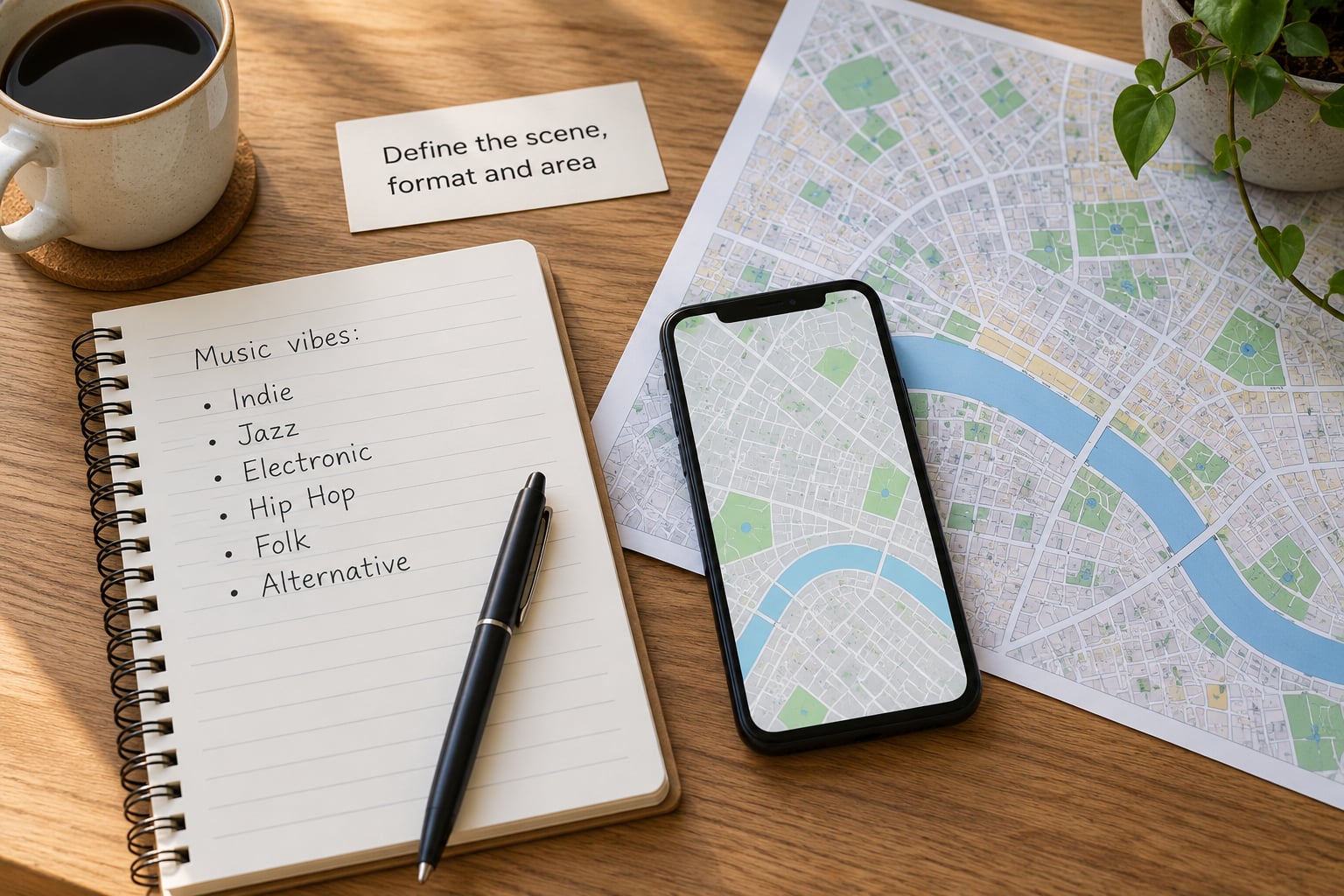
Everything downstream depends on this. If you cannot describe your sound in a sentence, a talent buyer cannot either, and you will get filed under “maybe later”.
Distinguish the kinds of rooms clearly, because they work completely differently. A club books through staff. A bar with a stage often has a promoter who owns the whole night. A record store or rehearsal room runs in-store or private events. A DIY space depends on one or two volunteers. A festival and a nonprofit hall each have their own application process. Know which one you are walking into before you send anything.
2. Search local calendars and niche directories
Start with the platforms that skew underground rather than mainstream: Resident Advisor for electronic and experimental nights, Dice.fm for club and promoter listings, Songkick and Bandsintown for show archives, and city arts guides for anything volunteer-run. Regional arts council sites often list small nonprofit rooms that never run their own website.
Then run the boring searches that actually surface results. Try your genre plus “in-store”, your city plus “all ages”, your neighbourhood plus “basement show”, or a genre-adjacent style like “noise” or “hardcore” in quotes. Band and label websites often list upcoming shows, and label pages are an underrated way to see who else in your scene is playing where.
3. Look beyond conventional music venues
Some of the best rooms for a first or second show are not venues at all. Record stores host in-store sets, rehearsal studios rent the room by the hour, art galleries and framing shops have back rooms, independent cafes run acoustic or jazz-friendly nights, and community centres and church basements rent cheaply to groups with a purpose.
Verify them before you pitch. Look for a real physical address, a consistent event history spanning several months, an insurance or licensing requirement for live sound, and someone who answers email. Nonprofit rooms often ask for a small fee or expect you to run the door yourself, which is normal and worth confirming in writing.
4. Ask promoters, bookers and venue staff directly
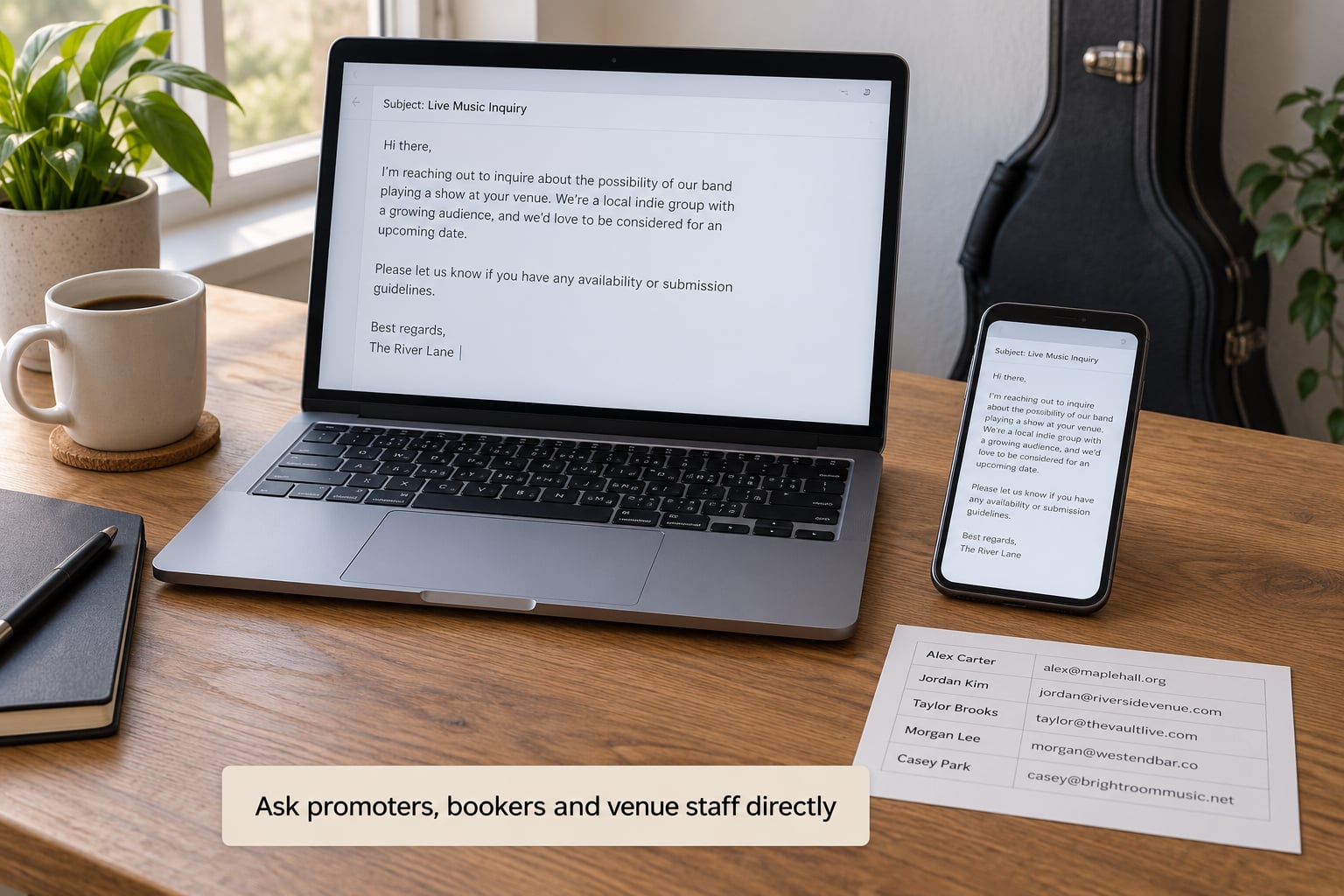
Finding the right human is half the job. A venue has an in-house talent buyer, a freelance promoter, or both. Some rooms have nobody in charge of booking, which is why asking a bartender on a slow Tuesday afternoon works better than email.
Keep the message short: who you are in one sentence, one streaming link, one link to a live clip, the date range you can play, and what you are offering (opening a bill, trading a co-op show, taking a door split). Attach nothing heavy. One short message reads:
Subject: Wednesday show, [genre] band from [city]

Hi [name] - I'm [band], a three-piece [genre] band from [city].
Here's a live clip: [link]. Streaming: [link].

We're in town [dates] and can open for a bill, trade a co-op show,
or take a door split. Two support slots or one headline date both work.

Thanks for your time,
[name, phone, link]
Follow up once, maybe a week later, then move on. Repeat contact reads as pressure, and a venue that wants you will reply.
5. Trace recent performances and recurring series
Instead of guessing whether a room fits, look at its recent calendar. Event archives and tagged pages on social accounts tell you what a venue booked in the last three months and how often. Weekly or monthly series matter most, because the person running the night is actively assembling a bill and needs bodies to fill it.
Promoter-run nights are the practical entry route for an unknown band. The promoter has already decided the date and the headliner; they just need a support act, which is exactly the opening you want. Rooms with one-off events and gaps of six months between shows are harder and tell you something about reliability.
6. Use the scene network to discover hidden rooms
The rooms that never appear on a calendar get found through people: sound engineers who work several venues, touring musicians routing through your town, DJs, fanzine writers, record store employees, and the local bands who play constantly. Ask them one question, which is “who should I talk to around here?”
Forum threads on r/musicians and r/WeAreTheMusicMakers keep repeating the same finding: bands that show up at other bands’ shows, swap favours and open for each other get offered the next date before anyone sends a formal pitch. Respect private groups and event organizers. Ask permission, offer to help at a load-in, and never post someone’s contact details without their okay.
7. Confirm details before traveling or promoting a show
Get these answers in writing before you announce anything: date and exact address, load-in time, soundcheck length and stage time, set length, curfew, age restriction, ticket or donation policy, what the house provides (backline, PA, DI boxes, engineer), door split or guarantee, merch split, cancellation terms, and accessibility.
Curfew and volume limits decide whether your set is possible at all. A hard 11pm stop in a residential building means a short, tight set, and finding that out at soundcheck is too late. Cancellations burn relationships permanently in small scenes, so agree on notice in advance and honour it.
Common Mistakes
Relying on one directory. Each platform skews to a different pocket of the scene, and none of them is complete. Cross-check at least three before you conclude a city has no rooms.
Assuming every small space is a venue. A basement with a guitar amp is a house show, not a business. House shows are worth playing, but they carry none of the infrastructure you would get from a room with a PA, a curfew and an audience.
Overlooking legitimate nonprofit hosts. All-ages halls, feminist and LGBTQ+ spaces, and community centres run real shows for real audiences, often with volunteer-run programming. They are among the best first-show options and are chronically under-pitched.
Contacting without researching. An email that ignores the room’s actual calendar reads instantly as mass mail. Name the promoter-run night you saw, or the specific date you can play.
Ignoring money terms until the night of the show. Door split, flat guarantee, guarantee plus door, and merch split mean different things. Pay to play, where the band pays to appear, is the red flag. Clarify the deal before you accept, not after you load in.
Promoting a show before it is confirmed. Announcing early and getting cancelled costs you the room’s trust and your followers’ patience. Wait for the signed date, then post everything the same week.
Treating one rejection as the whole scene. A single talent buyer saying no usually means the bill was full, not that the city does not want your band. Keep going down the list.
Frequently Asked Questions
How can I find underground shows in a city that has few listings?
Start with people instead of websites. Ask sound engineers, touring bands routing through town, record store staff and fanzine writers who they would contact. Check label pages for acts like yours and see where they have played. Look for one-off shows in arts spaces, rehearsal rooms and community centres, which rarely get listed. A Tuesday visit to a plausible room and a question for the bartender often beats a week of searching online.
Are record stores still good places to find live music shows?
Yes, and they are one of the best starting points for a new band. In-store sets are low cost, low pressure and usually short, often 20 to 30 minutes, which suits a band playing its first show. The staff are gatekeepers for that scene, so a friendly conversation and a demo or link matters more than a formal pitch. Ask whether they run in-store nights or rent the space after hours.
How do I contact a small music venue or promoter?
Find out whether the room has an in-house talent buyer, a freelance promoter, or neither. If the website lists a booking email or form, use it and keep your message short. If it lists nothing, show up during a quiet shift and ask the bartender who handles bookings. Follow up once, about a week later. Bring a streaming link, one live clip, your available dates and what you are willing to offer.
What should I ask before promoting an underground band at a venue?
Ask for the exact address, load-in and soundcheck times, set length, hard curfew, age restriction, what the house provides including backline and engineer, the money arrangement, merch split, and cancellation terms. Get the answers in writing before you post anything. If a small room promises a door split, ask what happens if the draw is thin, since that is where inexperienced bands get hurt.
How can I tell whether a DIY space is a legitimate live music venue?
Look for a real address, a consistent history of events over several months, and a named organizer who answers messages. Check whether they require some form of event insurance or a signed agreement, which is a good sign rather than a red flag. Small DIY rooms usually expect you to handle the door or bar and to bring your own cables. If money changes hands, agree the amount before you promote the show.
What are the best ways to find last-minute underground gigs?
Keep a current spreadsheet of rooms and contacts so you can act in hours, not weeks. Watch scene groups and forums where call-outs and last-minute covers get posted, and tell the bands you share bills with that you are available. Ask venues about filling a cancelled support slot or an opening spot on a promoter-run night. Having a short setlist and a stage plot ready is what lets you say yes on short notice.
Conclusion
Pick one neighbourhood and one scene tonight, then check three specialist calendars and one scene group. Write down five rooms with a contact route for each, and confirm the most promising one in writing before you tell anyone the date is on.