Album credits are the block of names printed in a record’s liner notes or stored in its metadata, listing everyone who made the release: songwriters, players, producer, engineers, the label, and the designers of the artwork. Learning how to read album credits takes about ten minutes on your first record, and about a lifetime to get good at.
Start with these ten phrasings, because they cover most of what appears on any record:
- Written by / Composed by / Lyrics by
- Produced by
- Recorded by / Engineered by
- Mixed by
- Mastered by
- Featuring / Backing vocals by
- Recorded at
- Released by / Distributed by
- ℗ and ©
- Special thanks
The order they appear in is usually deliberate. Credits tend to run from who wrote it, to who performed it, to who shaped the recording, to who legally owns it, and the physical record adds its own clues underneath all of that.
What follows is the sequence I use. It takes a single LP from front sleeve to runout and turns a wall of small type into a catalog note you can actually file.
Table of Contents
- What You Need
- Step-by-Step: Reading a Credit Block in Order
- Step 1: Identify the release and performers
- Step 2: Read the production and engineering credits
- Step 3: Decode labels, catalog numbers, and rights information
- Step 4: Check the physical pressing and runout clues
- Step 5: Check album credits against reference sources
- Step 6: Record what makes the copy collectible
- Common Mistakes: How to Read Album Credits the Right Way
- Frequently Asked Questions
- Where do I find album credits?
- How do I compare two editions of the same album?
- What do matrix numbers mean on a vinyl record?
- Do album credits affect the value of a record?
- What is the difference between a producer and an executive producer?
- How do you credit AI-written tracks?
- Conclusion
What You Need

You need very little. The record itself, a good light, and about twenty minutes.
Physically, work through everything the release shipped with: the front and back sleeve, the inner sleeve or lyric sheet, any booklet, and the labels on both sides of the disc. On a CD, that means the booklet and the back of the jewel case. On a cassette, the insert and the shell itself.
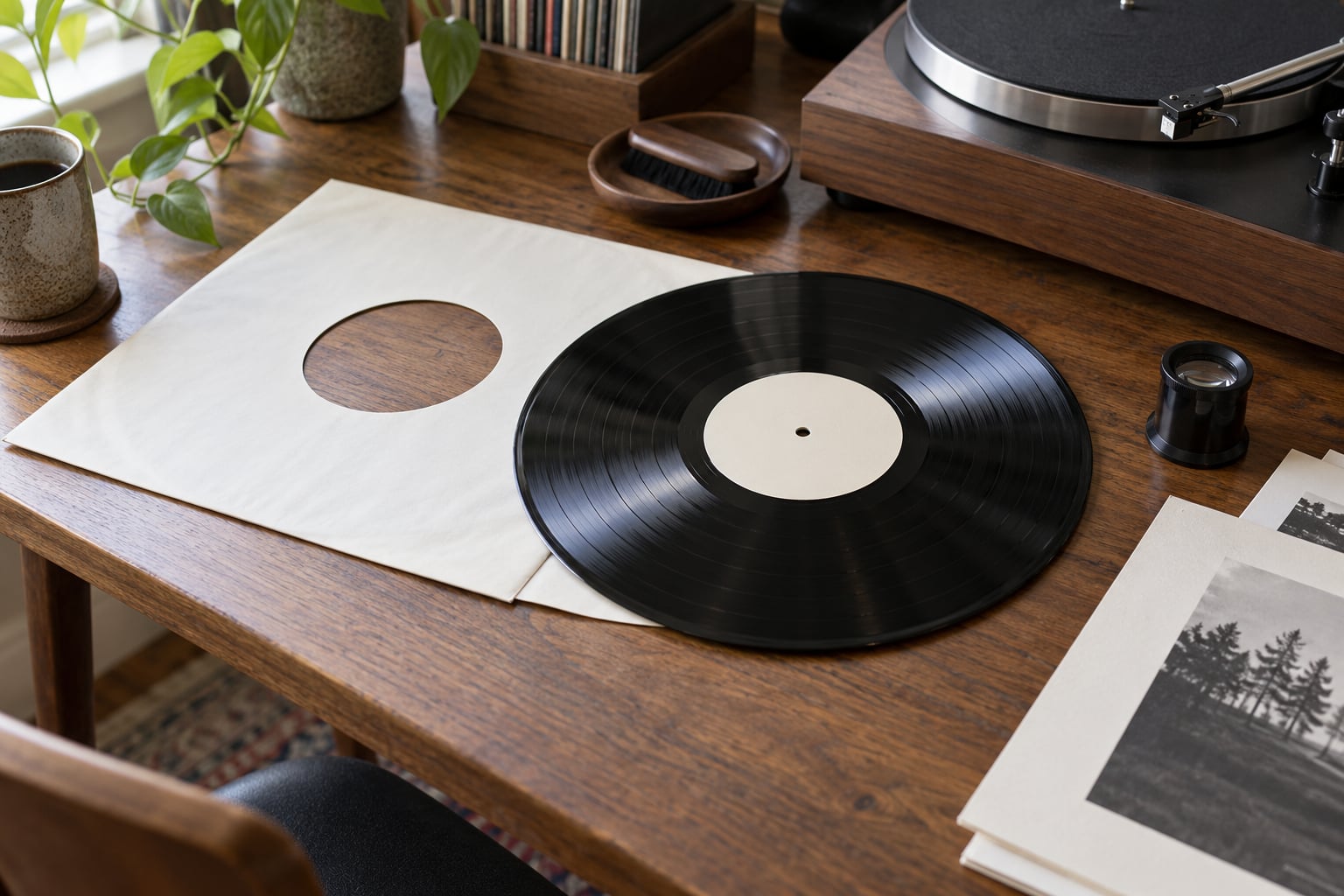
For reading the pressed markings, a loupe and a raking light source help. Etched matrix numbers are shallow and sit in the runout groove, usually just above or below the label, and they are nearly invisible under a ceiling bulb.
For reference, have somewhere to look things up. Discogs is the most useful for physical pressings, MusicBrainz for structured release data, and The Liner Notes Project for searching liner-note credits across a large catalogue. Keep the printed copy in front of you while you do it, and type in what the sleeve actually says before you check what the database claims.
Step-by-Step: Reading a Credit Block in Order
Step 1: Identify the release and performers
Start at the top of the credit block and separate out who wrote the material and who played it. The wording matters more than people expect: Written by usually covers a specific song or group of songs, while All songs written by across a whole record is a broader claim.
Then look at the performance lines. A credit of Featuring means a guest appeared on at least one track, listed either in the block or in the track’s own title. Backing vocals by or Additional musicians tells you session players were hired for the record rather than being full band members.
Watch for pseudonyms and initials. Artists with side projects, or bands that record under a different legal name, often print both. A credit that reads as an initial plus a surname may belong to someone who appears in full elsewhere on the sleeve.
Write down the exact wording rather than what you assume it means. Half of collector arguments come from paraphrasing instead of transcribing.
Step 2: Read the production and engineering credits
This is the section collectors spend the most time on, because it describes how the record was actually made. The roles run in a rough order of creation.
- Produced by names the person who gathered the songs, shaped the arrangements, and made the final calls on what stayed and what got cut.
- Recorded by / Engineered by names whoever ran the session and captured the audio, often at a named studio.
- Edited by covers assembly, comping and corrections, which on dense records can be several people.
- Mixed by is the balance and sound stage, where the individual tracks are combined into the finished song.
- Mastered by is the final transfer for the release format, sequenced last in the chain.
One credit block can contain several mixers or several mastering engineers. That usually means only some tracks were handled by each name, and the sleeve will say so with phrasing like mixed by X except track 4 by Y.
Compare the same credit block across two pressings of one album and you will often find the mastering engineer changed. A remaster is a new transfer, so the mastering credit legitimately differs from the original. Many collectors consider the original master run more desirable for that reason alone.
A useful collector habit is to note the studio name and the recording format when the sleeve provides it. Knowing whether a record was tracked to tape or captured digitally, and in which room, tells you more about the sound than any review.
Step 3: Decode labels, catalog numbers, and rights information
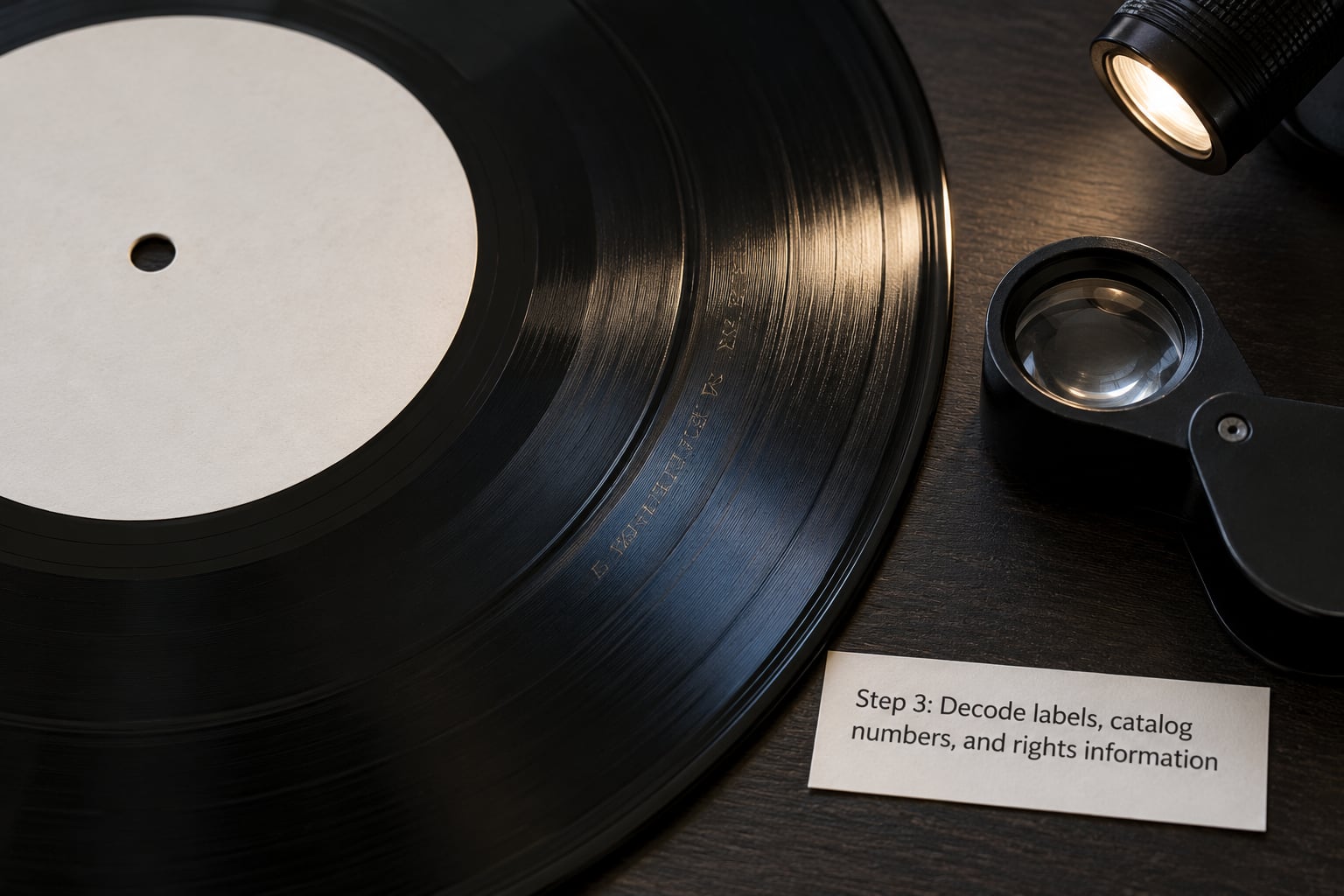
Near the bottom of the block, the credits turn legal. Two symbols do most of the work, and they cover different rights entirely.
| Symbol | What it covers | Who typically holds it |
|---|---|---|
| ℗ phonogram copyright | The master recording itself, the sound as fixed | The record label, often through an acquired catalogue |
| © copyright | The underlying composition, the words and melody | A publisher, or the songwriter’s own company |
That split is why two different parties can hold claims on the same song, and it is the reason a reissue can carry a new ℗ line while leaving the © line untouched. The year on each line is the year of first publication of that particular version, not the year you are holding.
Label and catalog information sits nearby. A label logo or trade name tells you who distributed the release, and a catalog number identifies the release within that label’s numbering scheme. Catalog numbers are label-specific, so the same number can mean different records at different companies.
Regional identifiers such as a country code or a stereo versus mono marking narrow the pressing further. None of these clues is proof on its own. People reissue other people’s records, and rights move, so treat them as indicators that you confirm rather than verdicts.
Step 4: Check the physical pressing and runout clues
Not every credit is printed. The disc itself carries a second set of information that identifies where and by whom it was pressed.
The runout groove is the smooth unrecorded area between the last track and the label. In that band you’ll find one or more matrix numbers: a letter or code for the mastering engineer, a letter for the processing or cutting engineer, a number for the side, and an asterisk or other mark when the stamper was told to kill the previous message rather than let it show through. The same sequence can be etched, stamped in silver, or embossed into the plastic, and it repeats between tracks and in the lead-out.
A single letter pair at the start of a matrix number usually identifies the pressing plant, and that plant is a strong regional clue. Along with it, the label text itself, the sleeve’s small print about manufacture, and any barcode format can each point to a country of manufacture. Different plants used different mark formats across different years, so two copies of the same album can carry completely different runouts.
This is where counterfeit copies often fall apart. Copying the artwork is easy, but reproducing an etched matrix number, a correct stamper mark, and consistent label details on every side of a record is a different problem. The runout is the first place I look, and the second place is the weight and the seam.
Step 5: Check album credits against reference sources
Once you have transcribed the printed credits, check them. Search the artist and album on Discogs and read the Credits tab, which lists each role and links the people involved where their profiles exist. MusicBrainz gives structured release data with its own relationship credits, and The Liner Notes Project lets you search liner-note text across releases.
Expect disagreement rather than assuming one side is wrong. Database entries are contributed by collectors and can be incomplete, and a pressing that genuinely differs from another will be logged differently depending on which copy whoever submitted it happened to own.
Where a sleeve and a database conflict, the printed copy in your hand wins for describing that physical object, and the database wins for finding out what other variants exist. Note the difference instead of picking a winner.
To trace one person, open their artist page and look at their full credit list. On Discogs that appears under the credits associated with the artist and links out to each release they worked on, which turns a single credit into a discography you can work backwards through.
Step 6: Record what makes the copy collectible
Finish by writing a catalog note while the record is still in your hands. Nine fields cover almost everything that matters later.
- The release, artist, and format, transcribed exactly as printed.
- Label, catalog number, and any country or stereo markings.
- The full matrix numbers from both sides.
- The producer, engineer, mixer, and mastering credits.
- The recording studio and format, if the sleeve names them.
- Condition of the sleeve, the disc, and any inserts.
- Any variant notes, such as a mispress, a bonus track, or a corrected credit.
- Provenance, meaning where the copy came from and any paperwork that came with it.
- Rarity indicators: pressing plant, known production quantity, and whether the variant is confirmed.
Collectors search for this key material over and over. A runout that matches a known early pressing or a producer credit that later turned out to belong to a different person is the kind of detail you cannot reconstruct from memory a year later.
Common Mistakes: How to Read Album Credits the Right Way
Mistaking the mixer for the producer. These are separate jobs and on many records different people did them. The producer decides what the song is; the mixer balances the tracks into it. Read both lines rather than assuming one name covers the whole record.
Treating a catalog number as proof of a pressing. A catalog number tells you what the label intended the release to be, not what was actually manufactured that year. Combine it with matrix numbers and label details before drawing a conclusion.
Assuming any discrepancy means a fake. Reissues, remastered editions, regional variants and misprints all produce credit differences that are entirely legitimate. Look for several independent inconsistencies before you call anything counterfeit.
Ignoring the runout entirely. The etched area carries the only pressing information that cannot be copied from another record easily, and collectors will expect you to have read it.
Reading online credits as if they were the booklet. Streaming and database metadata routinely drop assistants, mixers and lesser musicians, and engineers themselves complain about this. When you care about who actually played on a record, the printed copy is the stronger source.
Confusing special thanks with a real credit. Special thanks is a personal acknowledgement. A dedication is aimed at one person or group. A line reading courtesy of usually means materials or a person were loaned or provided free. None of the three carries the same weight as a paying session credit, though all three can be the most interesting part of the sleeve.
Frequently Asked Questions
Where do I find album credits?
On vinyl, look at the inner sleeve, the back sleeve, the album booklet, and the labels on both sides of the disc. On a CD, check the booklet. Online, open the release page on Discogs or MusicBrainz for physical releases, or the track’s credits panel on Spotify, Apple Music, Tidal, or Bandcamp. Menu paths change, so look for a credits or song information link rather than a fixed menu name.
How do I compare two editions of the same album?
Line up both credit blocks and the physical markings before listening. The mastering engineer, the mixing credits, and the studio line are the fields most likely to change between pressings, because a reissue involves a new transfer. Then compare matrix numbers on both sides of each disc, plus the catalog number and any country markings. A runout difference tells you the copies came from different plants or different years.
What do matrix numbers mean on a vinyl record?
Matrix numbers are etched, stamped, or embossed in the runout groove, the blank band between the last track and the label. The characters usually identify the mastering engineer, the cutting or processing engineer, the side, and sometimes the pressing plant. The same code may repeat between tracks and in the lead-out. They are the most reliable physical clue for telling one pressing from another.
Do album credits affect the value of a record?
They can, though indirectly. Credits do not set a price directly, but they help identify a pressing, confirm that a copy is a later reissue rather than an original, and reveal a genuine variant such as a mispress or a corrected credit. For most collectors the decisive factors remain condition, completeness of the inserts, and how rare the variant is.
What is the difference between a producer and an executive producer?
The producer works on the record itself, choosing songs, shaping arrangements, and overseeing the sessions. The executive producer usually does not attend them and handles the budget, financing, or oversight on behalf of the label or the artist’s management. A record can carry both names, and the executive producer credit is often the sign of a label-funded project.
How do you credit AI-written tracks?
Practice is still shifting and no settled convention exists yet. The most common approach so far is to name the human writers who directed or edited the work, note the tool used, and separate any generated material from the human composition credit in the writing line. Streaming metadata often has no field for this, so expect credit pages to be inconsistent for the next few years.
Conclusion
Start with the record in front of you. Read the credit block top to bottom in the order it was printed, transcribe the wording exactly as it appears, and only then open a database to check it. Finish at the runout groove with a loupe, record the matrix numbers, and write the whole thing down while the details are still in front of you. Get those three habits right and how to read album credits stops being guesswork and becomes routine, whether the record in your hands is a first pressing or the tenth pressing of an album you already own.