To start a band with no experience, you need four things and nothing else: a musical direction you actually like, one or two people who want the same thing, enough of an instrument to hold your own part, and a fixed slot in the calendar to rehearse. Everything else — lessons, expensive gear, perfect songs, an LLC — can wait. Most working bands you admire were once two people in a spare room trying to play one song well.
Here is the part nobody tells beginners. Learning how to start a band with no experience is not really about music skill, because the skill gap closes itself the moment you start playing with other people. What breaks projects is commitment mismatch, unclear expectations, and the quiet assumption that you are not ready yet.
And if age is the thing holding you back: 30 is not too old. Neither is 40, 50, or 65. The band that rehearses near you right now has members who picked up an instrument as adults. Your audience is mostly people your age, and your playing improves inside a band faster than it does in a bedroom.
Below is the whole process in seven stages, from the first honest conversation about genre to the first time you play in front of anyone. Each stage has a checkpoint, because “does this feel right?” is not a test you can fail. Learn three songs with one other person and you are officially a band.
Table of Contents
- What You Need to Start a Band With No Experience
- Step-by-Step: From First Idea to First Performance
- Starting a Band With No Experience: Define Your Goals and Genre
- Find People With Compatible Goals
- Choose a Simple First Repertoire
- Learn the Parts and Rehearse Progressively
- Record a Rough Demo
- Build a Minimal Rehearsal and Performance Setup
- Play a Small First Gig
- Common Mistakes and How to Fix Them
- Frequently Asked Questions
- Can I start a band without any musical experience?
- How long does it take to start a band?
- Should I start a band alone or find other musicians?
- Do I need to know how to play an instrument before joining a band?
- Is 30 too old to start a band?
- How much does it cost to start a band?
- Conclusion: Start With One Song and One Rehearsal
What You Need to Start a Band With No Experience
Let us clear up the prerequisites first, because the list is much shorter than the internet implies. None of these require formal training, and none of them require you to own a guitar worth more than your rent.
A shared musical direction is the real prerequisite. If you want to play slow country ballads and the person you have in mind only wants to play fast garage punk, you will spend your first six rehearsals negotiating instead of playing. Agree on a genre and two or three reference tracks before you agree on anything else.
Here is the honest checklist of what you need and what you can skip:
| Prerequisite | Minimum viable version | What you can skip for now |
|---|---|---|
| Musical direction | A genre and two reference songs | A written manifesto or a mood board |
| Collaborators | One other person who shows up | A full four or five-piece lineup |
| Instrument ability | Enough of your part to practise alone | Knowing theory, reading sheet music |
| Amplification | Borrowed or second-hand amp, or a practice amp | A new backline or pedalboard |
| Rehearsal location | A room with a door, some hours booked | A permanent rehearsal studio |
| Calendar slot | Two fixed hours a week that never move | Availability every day of the week |
| Realistic expectations | Six months of beginner-level playing | A debut album, a following, a genre |
Notice what is missing. There is no formal training requirement, no minimum skill floor, and no gear list that must be bought in advance. Music stores make money on the belief that you are under-equipped; you are not.
A few terms will show up repeatedly, so here is what they mean in plain language. A jam is informal playing with whoever turns up, no set list, no pressure. A setlist is the running order of songs for a performance. A soundcheck is the short window before a show when you set levels and check the equipment. A promoter is the person or venue booking acts and deciding who plays. An EPK, or electronic press kit, is a one-page summary a promoter can read in thirty seconds. A gig is just a live performance.
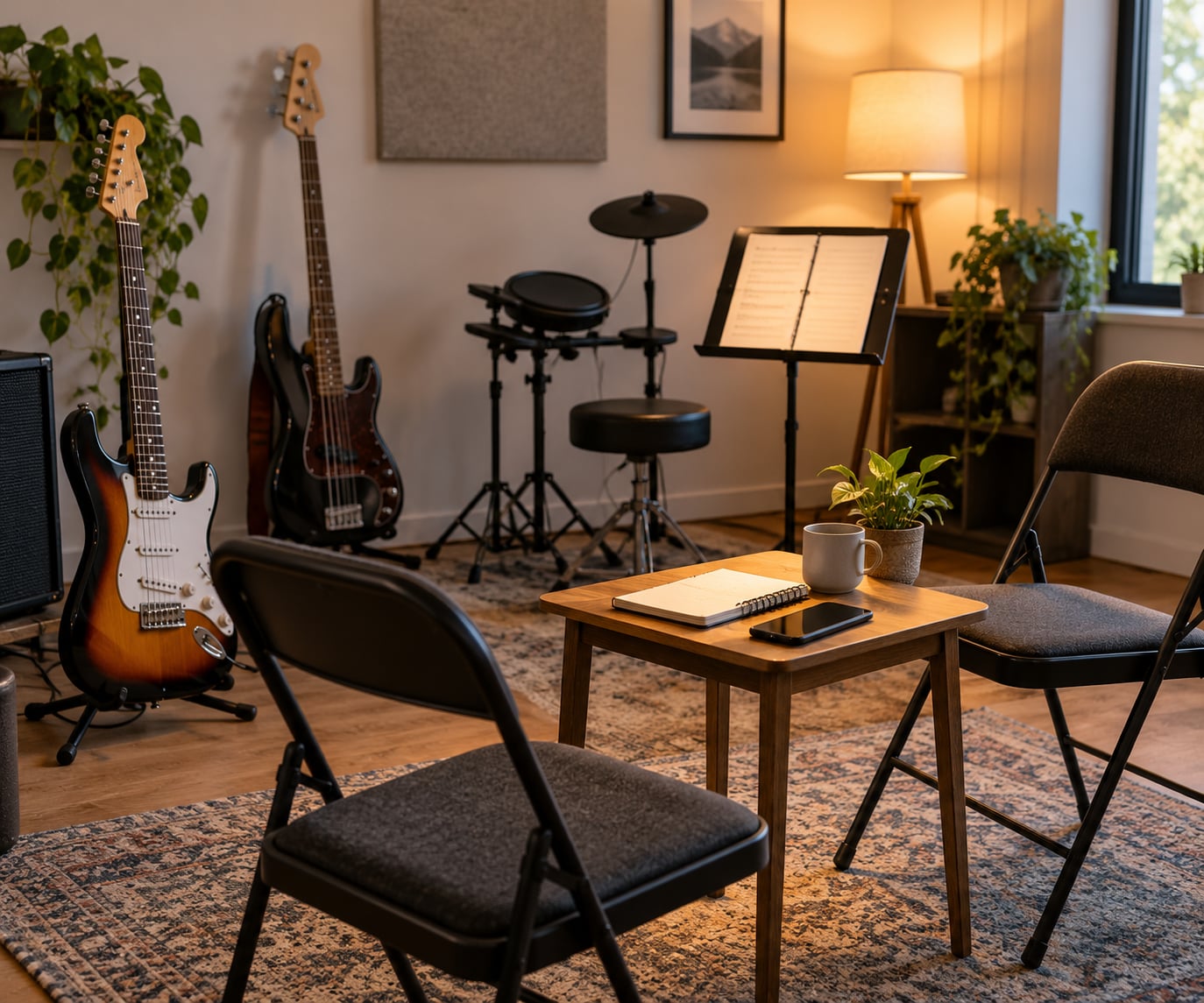
One more thing belongs on the prerequisites list even though it is not gear: a rehearsal space with a door that closes. Sound travels through walls and floors, and you cannot concentrate over a landlady’s objection. Basements, garages, spare bedrooms, community halls rented by the hour, and back rooms of pubs that book acts all work.
Our team’s advice is blunt: rent the room before you buy the guitar. Space and time are the hard resources. Equipment is the cheap one.
Step-by-Step: From First Idea to First Performance
Seven stages, in order. Skipping ahead does not save time, it just moves the frustration later. Skipping stage four is the one everybody does and nobody regrets.
Starting a Band With No Experience: Define Your Goals and Genre
Write down five things before you contact anyone: the genre you want to play, two or three bands you want to sound adjacent to, how many hours a week you can genuinely commit to, your realistic budget, and the role you want to fill. That last one deserves thought, because beginners routinely aim at the hardest position in the band.
Some roles hide a mountain of practice underneath them. Lead guitar in a rock band often needs fast chord changes, clean bends, and the ability to play through a drummer who is not slowing down. Bass, in contrast, is often the most forgiving entry point: root notes, a steady pulse, and plenty of rehearsal time to find the groove. Drumming requires the most physical practice because coordination has to be built from scratch. Vocals require the least technical ability and the most stamina and confidence.
That is the honest answer to what is the hardest position in a band. For most beginners it is the one that demands the most raw technique under pressure, which in most lineups is lead guitar. If you are unsure, start on bass, on rhythm guitar, or on vocals, and be the person who also keeps the setlist and the calendar. Managing duties are a real contribution, not a consolation prize, and in a new band they are often the difference between a rehearsal that happens and one that does not.
Now set a first milestone you can actually hit. Not “play a gig in a year” but “learn three songs well enough to play them all the way through with one other person by the end of this month.” That milestone takes a few weeks, costs almost nothing, and it tells you whether you want the next one.
It also settles the budget question honestly. Rent instruments, borrow amplifiers, use a free tuner and a free metronome app, and spend money only where something blocks progress — usually strings, a decent instrument cable, and eventually hearing protection.
Checkpoint: you can name the genre, the two reference songs, your weekly hour count, and the person you will invite to play with you.
Find People With Compatible Goals
This is the stage that stops people, because the honest version of the question is “where do I find musicians when I know none?” It is easier than it looks, and the order you try things in matters.
Start with places where people already play in public. Open jams, community music groups, local concert venues’ social pages, and adult beginner workshops all put you in a room with players at your level. Post it in a couple of local music Facebook groups or community classifieds, and say what you play, what you are looking for, and what kind of music you want to make. A post that says “beginner guitarist, into garage rock and power pop, looking for a drummer and a bassist, rehearsals Tuesdays, no pressure” gets replies.
Next, go to shows. Local bands need a fill-in, a person to carry amps, someone to watch the door. Turning up early and being useful is how you meet musicians, and it works far better than announcing yourself. Forums like r/bandmembers and r/musicians fill up with people asking the same question, and the advice there is worth reading: most regular posters suggest joining an existing project or jamming first rather than demanding everyone assemble from scratch.
For the first meeting, keep it low pressure and short. An hour and a half, one song each, somewhere with an instrument in the room. Bring a spare cable. Talk about goals, taste, and how many nights a week each person can realistically commit. Leave while it is still pleasant.
Consider a two-person project rather than a full band. A guitarist and a singer, or a bass and a vocalist, is a complete act and it halves the number of people you have to find. Forum veterans keep pointing this out, and it works.
Handle the skill gap early and out loud. Somebody in the room will be more experienced than the rest of you, and one person will be the weakest. Say it plainly in the first two weeks: we are all beginners at different speeds, and nobody gets to skip material just because it is easy for them.
Two other honest options: join someone else’s band first and learn the pressure that way, or play a cover-only project with a group of friends who already know each other socially, which is far more forgiving when nobody shows up. Long-time regulars on musician forums keep giving the same advice: emphasise what you are good at, find a workaround for what you are not, and commit to turning up prepared.
Checkpoint: one person has shown up, played a song with you, and agreed a recurring rehearsal time.
Choose a Simple First Repertoire
Pick three to five songs, not twelve. Beginners make this mistake constantly, and it is the reason so many first bands quit in month three. Twelve songs at beginner level means twelve mediocre performances.
Choose material that fits the instruments you actually have, not the ones you wish you had. If nobody plays bass, the arrangement drops the bass part rather than adding a new member. Pick songs in a comfortable key so the singer does not strain. Pick songs with simple, repeating riffs, steady tempos, and structures you can hear without a chart.
Simplify without shame. Halve a guitar solo. Take a bridge out. Play a whole verse as one sustained chord if that is what you can make sound good. A tight simple arrangement beats an ambitious broken one every single time, and nobody in a small room will notice what you removed.
Play covers first and write originals later. Covers give you a shared reference so nobody has to argue about what a song should look like, and they teach arrangement and dynamics fast. Once three covers are solid, one original is a good next move.
Keep a shared list — a group playlist, a phone note, whatever everyone actually checks — with one agreed key per song and a rough running time. Beginners waste entire rehearsals on “who has the key?”
Checkpoint: you can get from the first note of the set to the last without a long stop.
Learn the Parts and Rehearse Progressively
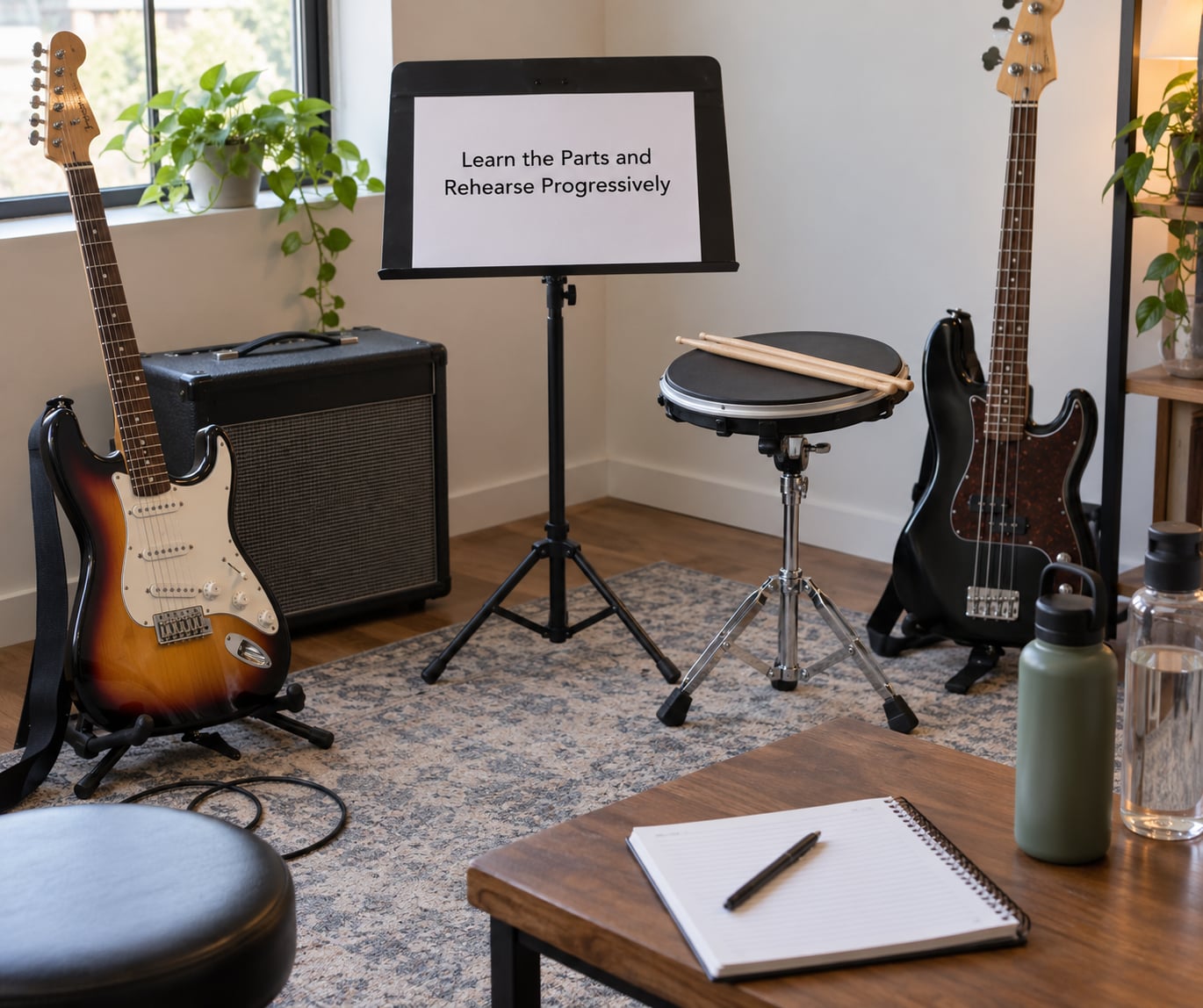
Learning a part is easier when you break it into five separate moves, and skipping the first two is why people conclude they have no talent.
First, listen. Play the reference recording three or four times, ideally the whole song, and try to sing the vocal line. Musicians who sing a part back correctly can usually find it on their instrument. Second, isolate your part on your own. Slow it down, work in four or eight-bar chunks, and drill the awkward bar alone rather than the whole song.
Third, play together at half tempo with a metronome. Tempo is the fastest route to tightness; an app with a tap function is enough for years. Fourth, run the song straight through at full speed, then again. Fifth, do cleanup drills on whatever fell apart — the count-in, the ending, the transition into the second song.
Length and frequency beat length alone. Two solid hours twice a week wins over one long session, because the skill is in the hands and in the counting, not in endurance. Many beginners sit on a four-hour jam and leave with four hours of playing and no progress, because there is no feedback loop.
Add feedback loops cheaply. Record the rehearsal on a phone and listen back the next day — it exposes timing problems instantly. Keep a rehearsal notebook with one note per session. Use a tuner, tune at the start of every rehearsal, and keep tuners and metronomes on everyone’s phone.
Checkpoint: you can play two songs back to back without stopping, and both recordings show the same mistakes, which means you are actually hearing the band.
Record a Rough Demo
A demo is a listening tool, not a product. New bands waste months on production and then wonder why they never booked anything. Record early and record rough, whether on a phone in the middle of the room or in a small professional studio if your budget allows.
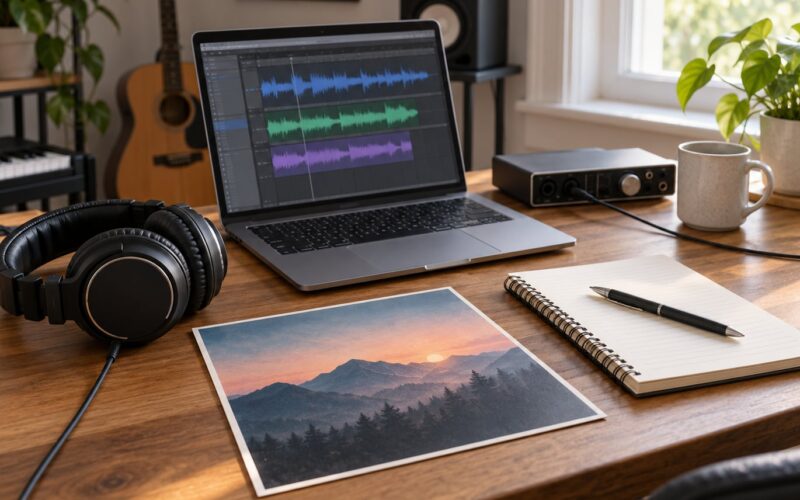
A phone in the middle of the room with a free recording app captures enough to hear what you sound like. Place it near the drummer rather than the vocalist, set it so nobody touches it, and do one warm-up run before you hit record. If you want more control without spending much, a laptop audio interface with a couple of condenser mics will do it, but the phone first is genuinely fine for a first pass.
Do three things with the recording. Get feedback from people who play, not only people who love you — they will hear timing and tuning problems you cannot hear while you are inside the song. Fix the three worst issues rather than all of them. Then cut a short clip, roughly the most listenable thirty to forty seconds, and keep it ready for when someone asks what you sound like.
On rights, keep it simple at the start. Covers you perform are not yours to release commercially without permission, so a demo of covers is fine for private use and for asking promoters about a show. When you write your own material, register the split of songwriting and publishing with your bandmates in writing so nobody has to guess later. Your collecting society will want correct splits, and a band that cannot produce them looks unprofessional.
Checkpoint: a recording exists, someone outside the band has heard it, and three specific fixes are written down.
Build a Minimal Rehearsal and Performance Setup
Buy in priority order, not in excitement order. The order below is roughly the order in which each item stops you from rehearsing.
A playable instrument with strings that are not old, a fresh pack of strings, and one good instrument cable. A practice amplifier you can carry yourself. Reusable hearing protection. A stand and a tuner. Then, only if you play live regularly, a small mixer or powered speakers, a vocal microphone, and a sturdy microphone stand.
Rent before you buy, and borrow before either. Instruments, amplifiers, drum kits, and PA systems are rentable by the hour or the month from local music shops and rehearsal facilities, and borrowing for a month tells you what you actually need rather than what looked good on a display stand.
Think about transport and storage as part of the setup. Gear that is hard to carry does not leave the house, and gear that lives in a damp garage stops working. A folding guitar stand, a padded case, and a plan for the walk from the car are worth more than a pedalboard.
Watch the volume. Rehearsal at a level that rings your ears is too loud, and hearing damage is the one irreversible cost in this hobby. Cheap foam plugs are worse than nothing at high volume; proper reusable ear defenders are the sensible entry purchase.
Build a portable routine instead of a long equipment wishlist. Fifteen minutes of focused practice with a metronome and a notebook travels anywhere and produces more than a two-hour session of noodling.
Checkpoint: you can get the full kit into the rehearsal room and back without help, and the session volume is comfortable in the room.
Play a Small First Gig
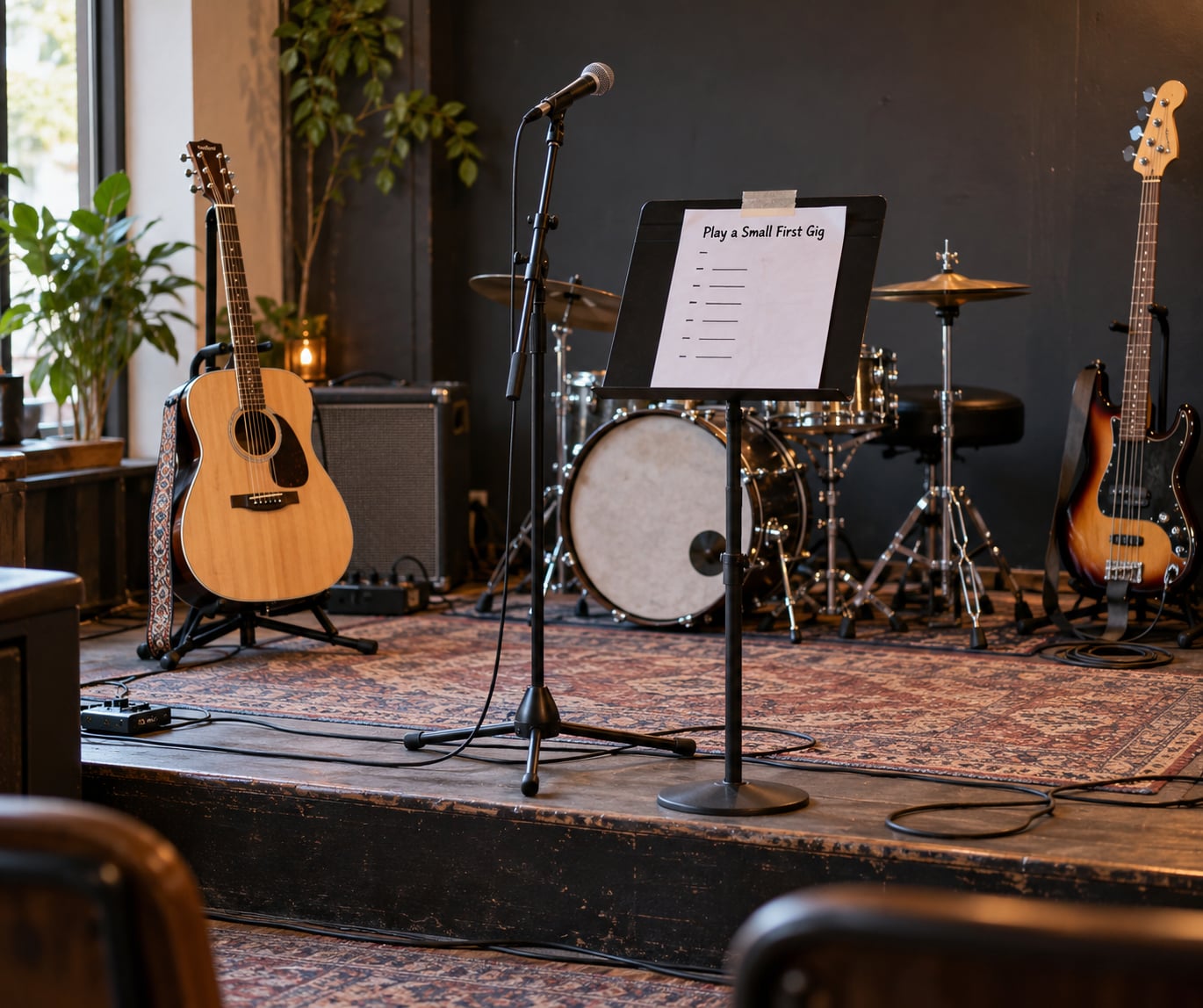
The first performance should be as low-stakes as you can make it while still being in front of people. Play a rehearsal for friends. Play a house concert. Take a slot at an open mic. Offer to play a community centre event, a wedding reception, a fundraiser, a local fair. All of these count, and the bar-and-stage version can wait until you have a set worth its length.
Ask your rehearsal room whether they run open mic nights, and ask local venues what they offer new acts — many have a quieter room, a weekday slot, or a house night aimed at developing bands.
Promotion is one honest message. Tell people who, what you sound like, when and where, and what it costs to get in. Post it where your actual people are, and bring enough friends that the room is not mostly strangers.
Bring a one-page EPK: three photos, three song titles with lengths, one paragraph about the band, one track or clip, and what you need from a venue. It turns “we are beginners” from an apology into information.
Keep the set short. Twenty to twenty-five minutes, four or five songs, one song everyone in the band is sure of at the end. Learn the stage etiquette basics: arrive early for soundcheck, tune before you start, put the set list where you can see it, watch the crowd instead of the floor, thank the venue and the staff afterwards.
Plan for the boring things. Who drives, where the cables run, what happens if someone’s amp dies, what happens if someone is late and the set must drop a song, and where everyone stands between songs. Bands remember breakdowns much longer than they remember good notes.
Checkpoint: you played the whole set, it did not fall apart, and you know one concrete thing to improve next time.
Common Mistakes and How to Fix Them
These are the errors that show up in nearly every beginner story. Each has a correction you can apply this week.
Recruiting members for image instead of reliability. Beginners pick the flashiest player in the room. Fix it by asking everyone the boring question first: how many nights a week can you commit, honestly, for the next six months. Commitment beats skill, because the missing rehearsal is what ends bands.
Trying to learn twelve songs at once. Fix it by dropping to three. Finish them, feel the difference, then add two at a time. A finished set of four songs is worth more than a half-learned set of twelve.
Rehearsing without a milestone. A rehearsal with no target is a hangout. Fix it by naming one thing per session: count-ins, the second song’s entry, the ending of song three.
Buying a large backline up front. Fix it by borrowing everything for a month and writing down what you actually reached for. That list is far shorter and more accurate than a shop list.
Recording too early and polishing too long. Fix it by recording immediately and fixing three problems, then stopping. Excess production hides rather than fixes playing.
Rushing straight to a big stage. A bad first show can end the habit. Play for friends, at a rehearsal, or at a small community event first. Forum regulars nearly always describe the same pattern: nobody remembers a first show of twenty people, but everyone remembers the first one that went badly.
Writing an agreement that sounds like a contract. A band agreement does help, and mismatched commitment is the most common killer of new bands. Keep it to one page and four topics: how often you rehearse, who turns up and prepared, how costs are shared, and who wrote which songs. Leave out legal language, penalties, and anything about leaving the band — it frightens people off at exactly the moment you are trying to recruit them.
Comparing yourself to the best player in the room. The weakest member feeling like a liability is almost universal and almost always unfounded; their own worry is the loud one. Fix it by picking parts that suit your level, and by choosing a role where you contribute something else. Managing the setlist, the calendar, and the promotion is real work, and doing it well earns you a place in the band faster than trying to play someone else’s solos.
Waiting until you are ready. There is no ready. Fix it by booking the smallest possible date now and working backwards from it.
One last practice tip: record every rehearsal from the same spot on every single time. Fixed position, fixed level, same songs. Nothing accelerates learning faster than hearing your own progress in twenty-minute increments, and it also tells you the truth about the days the band did not improve.
Frequently Asked Questions
Can I start a band without any musical experience?
Yes. Most bands start with people who know a few chords or a basic beat. Choose simple songs, share recordings of the parts so everyone hears the same target, rehearse patiently, and be willing to switch instruments or simplify arrangements. Learning a part by singing it first, then playing it slowly with a metronome, gets beginners surprisingly far in a few weeks.
How long does it take to start a band?
You can be rehearsing within a few weeks if you find compatible people and pick accessible material. Playing consistently in public usually takes several months, because songs, arrangements, and chemistry all need time. A fair benchmark: learn three songs with one other person within your first month, and work toward a small low-stakes performance over the following three to six.
Should I start a band alone or find other musicians?
Working alone is genuinely useful for learning an instrument, writing songs, and testing ideas, and it costs nothing. Performing publicly usually needs other people, though a two-person project counts as a complete act. If you cannot find a full group quickly, perform solo at an open mic or join an existing band first so you learn the pressure of playing for people with less experience.
Do I need to know how to play an instrument before joining a band?
No, but you need enough ability to practise your intended part on your own. Beginners learn fast through songs, recorded lessons, or help from bandmates who are further along. Avoid choosing a technically difficult role on day one, such as lead guitar in a fast band, and start on bass, rhythm guitar, or vocals where progress is visible quickly.
Is 30 too old to start a band?
No. Age affects recovery and how quickly some skills come, not whether you can learn or whether anyone will want to play with you. Bands in local rehearsal rooms are full of adults who started in their thirties and forties, and their audiences skew the same way. The only real limit is whether you keep showing up, and most thirty-year-olds practise more consistently than teenagers do.
How much does it cost to start a band?
Less than beginners expect, and less than music stores would like. Many people begin with borrowed instruments and amps, free tuner and metronome apps, and a rehearsal room rented by the hour. The costs that genuinely bite later are rehearsal time, strings and cables, hearing protection, and instrument upgrades once you know what you want. Sponsors, grants, and bar revenue can offset venue costs later.
Conclusion: Start With One Song and One Rehearsal
Forget the lineup, the name, the logo, and the social media accounts. Learning how to start a band with no experience begins with four small actions you can finish this week: choose one genre and two reference songs, invite one person with compatible taste, pick one song simple enough to learn in an afternoon, and book two hours in a room with a door.
That rehearsal is the whole project. It will be rougher than you expect and more fun than you expected, and if it goes well you already have the hardest thing, which is a second person who shows up next week.
As 2026 keeps bringing new bands online, the ones that last are still the ones that practice early, play small rooms first, and stay honest about how much they can actually commit. Start small, play often, and the rest takes care of itself.