Rockabilly is an early form of rock and roll that began in the American South in the mid-1950s, blending country styles such as western swing, hillbilly boogie and bluegrass with Black rhythm and blues. It was defined by a slapped upright bass, hollow-body electric guitars and heavy slap-back echo, led by Elvis Presley, and it came back in a big way from the late 1970s onward.
This is the history of rockabilly explained, from the country pickers and race records it grew out of all the way to the punk scenes that took its rhythm and ran with it. I have pulled the story apart into the parts that usually get skipped, including why the word itself started out as an insult.
Table of Contents
- What Is Rockabilly?
- The History of Rockabilly Explained: Origins in the 1940s
- How Did Rockabilly Get Its Name?
- Early Rockabilly Records and Artists
- The 1950s: Rockabilly Reaches Its Peak
- The peak, honestly measured
- What Made Rockabilly’s Sound Different?
- Rockabilly, Country, and the Birth of Early Rock ‘n’ Roll
- How Rockabilly Influenced Punk and Garage Rock
- The Rockabilly Revival and Its Main Scenes
- Key Rockabilly Eras and Milestones
- How to Collect Early and Modern Rockabilly Records
- Five things to check on a 1950s rockabilly 45
- Where to Begin Listening to Rockabilly
- Frequently Asked Questions
- What does rockabilly mean?
- How did rockabilly start?
- Is rockabilly the same as rock ‘n’ roll?
- Who are the most important early rockabilly artists?
- How did rockabilly influence punk and garage rock?
- What records should a new rockabilly collector buy first?
- Conclusion: Start with the Records That Built the Sound
What Is Rockabilly?
Rockabilly is a fusion style: country on one side of the record, rhythm and blues on the other, usually at the same tempo and with the same band behind both voices. Songs ran fast, loud and short, built on a bass line you feel in your chest before your brain catches up.
The confusion starts with rock and roll, because the two are harder to separate than people expect. Rockabilly was the first complete fusion of Black American music and white country music, and early rock and roll is what happened after that fusion spread and got bigger. Rockabilly is the sharp, small, weird early version.
Here is how the neighbors relate:
- Rockabilly is the mid-1950s Memphis and Nashville sound itself, with a standing bass and a twanged lead guitar.
- Early rock and roll is the wider 1955-1959 explosion that rockabilly fed, including the styles that added horns, harmony singers and bigger drum kits.
- Country shares the instrumentation and much of the audience, but country in 1954 was not doing slap bass and echo.
- Roots rock and alt-country came later, in the 1970s and 1980s, usually with electric bass and a different idea of who was allowed to be angry.
- Neo-rockabilly is the post-1980 revival sound: rockabilly structures with modern amps, drum machines and fuller arrangements.
- Psychobilly is rockabilly’s rhythm with punk attitude, darker lyrics and usually no guitar at all.
The History of Rockabilly Explained: Origins in the 1940s
Rockabilly did not appear out of nowhere in 1954. It came out of a chain of country recordings that had been speeding up, electrifying and absorbing Black music for twenty years before anybody put the two genres in the same sentence.
The oldest strand is commercial country itself. Jimmie Rodgers’ 1923 yodel recordings put a man with a guitar singing the daily life of a drifting worker into millions of American homes, and his yodel became the first genuinely national country vocal style. Bob Wills brought western swing to Texas radio in the 1930s with big horn sections, a driving rhythm and a rhythm section built to make people move.
Then the tempo started climbing. Louis Jordan’s jump blues records in the early 1940s put a small combo in a groove that no one had left, and in 1938 the boogie-woogie craze swept the country, with piano players left-handed and everybody tapping out the same eight notes. Bill Monroe’s bluegrass added high, close harmony and a fast, hard shuffle, and honky-tonk records kept the bar-room volume where country records had never really been.
By the late 1940s, country acts were covering Black rhythm and blues songs and dressing them as country, and Black musicians were recording the same twelve-bar structures. Junior Parker’s 1953 records for Sun in Memphis, including “Love My Baby” and “Mystery Train,” were country in feel and rhythm and blues in everything else, and they were the last thing before the new genre.
Everything else about rockabilly’s arrival had to do with the postwar world. Service men came back, teenagers got disposable money, car culture gave them somewhere to go, and dance halls became hangout places. Then in 1953, a twenty-one-year-old Memphis DJ named Sam Phillips started Sun Records from the back of a radio station at 706 Union Avenue, and a radio show he put on for his brother Judy’s station, KWEM, let him record whoever walked through the door.
How Did Rockabilly Get Its Name?
The word is a portmanteau, a word welded from two halves: rock and roll plus hillbilly. Reviewers and publicists started using it in the mid-1950s as a way of saying that a record was country music played by young guys in an offensive rhythm, and at first it was a put-down rather than a compliment.
The first press-release use is generally credited to a 1956 release about a raucous single, and the term really started circulating through the trade press in 1956, including a Billboard review of Ruckus Tyler’s “Rock Town Rock” in June of that year. That year is the pivot: 1956 is when the word stopped being an insult and started being a category.
The reason it stuck is that nothing else described the thing. “Country and western rhythm and blues” was the polite industry phrasing, and plenty of people preferred it, which tells you how uncomfortable the cultural material underneath was. Rockabilly became the honest label because it named the collision without pretending one side was the real one.
Elvis’s nickname “the Hillbilly Cat” has the same DNA. It was built from the same word that white audiences used to keep Black American music at a distance.
Early Rockabilly Records and Artists
The earliest widely recognised rock and roll record is Bill Haley and His Comets’ “Rocket 88,” recorded in 1951 and released the following year. It was country in content and rhythm and blues in drive, and it tells you how close the two genres already were before anybody named the mixture.
The sound itself arrives in Memphis in July 1954. Elvis Presley, then twenty-one, walked into Sam Phillips’s studio and recorded Arthur Crudup’s “That’s All Right” followed by Bill Monroe’s “Blue Moon of Kentucky,” which Phillips sped up from a relaxed crooning tempo into something hopped-up and grinning. Phillips fed the singing voice and the guitar into a second tape machine a fraction behind the first, and that delay is where the sound comes from.
That July session is the moment the genre exists, because everything else follows the template: a country song and a blues song on the same record, a thin band of a standing bass, a hollow-body guitar and drums, and a voice that moves from a low mumble into something close to a cry.
The next wave came out of the same building. Jerry Lee Lewis arrived that year, playing upright piano with a bass drum pattern nobody had heard, and Carl Perkins turned his own bitterness into the first great rockabilly song, rewriting an Arthur Crudup lyric to change “blue-eyed boy” to “blue suede shoes.” Johnny Burnette and the Rock and Roll Trio had been cutting nervous, up-tempo country for Memphis audiences since 1952, and Roy Orbison cut “Ooby Dooby” in 1956 and wore black for the rest of his life.
The four of them recorded together at Sam Phillips’s studio in March 1956, all of them together in the room, and a photographer happened to walk in. The image from that session is why they are called the Million Dollar Quartet, and none of them knew it at the time.
The 1950s: Rockabilly Reaches Its Peak
The most famous rockabilly song is Carl Perkins’s “Blue Suede Shoes.” He wrote it, recorded it at Sun in December 1955, and released it in March 1956. Elvis covered it within days and that is the version most people know, which is the genre’s whole story in miniature: Perkins wrote it, Elvis made it a hit, and every collector since has wanted the copy that came out first.
Gene Vincent’s “Be-Bop-A-Lula,” recorded in May 1956, became rockabilly’s first million-seller. Gene’s sound came from his broken leg and a rebuilt boot with a metal toe, which forced him to hop on his good leg, and Cliff Gallup played lead guitar that sound like a wire being pulled taut.
Outside Memphis, the genre had its own infrastructure. KWEM in West Memphis and the Louisiana Hayride and Saturday Night Jamboree in Nashville fed the same impatient teenage audience, and those broadcasts turned regional performers into national ones. Eddie Cochran made “Summertime Blues” into a howl from Texas, and Janis Martin was seventeen when “Drugstore Rock ‘n’ Roll” came out in 1956.
Wanda Jackson recorded “I Gotta Know” for Capitol in July 1956 and became the Queen of Rockabilly, writing most of her own material and singing it with a bite that a lot of the men did not have.
The peak, honestly measured
Rockabilly’s national peak was 1956 and 1957, but it never took over pop. Most of the thousands of singles cut in the style never charted at all, and the ones that did usually crossed over from country rather than from rock and roll. It was a big scene with a small ceiling, which is exactly why it stayed intense.
The 45 was part of that. A single had two minutes a side, so the record company put a blues number on one side and a country number on the other, and a kid with fifty cents got the whole fusion in one purchase.
What Made Rockabilly’s Sound Different?
The sound is defined by five things, and you can hear all five within the first ten seconds of most 1950s rockabilly. Once you know what to listen for, you can tell a real 1956 Sun record from a 1970s imitation in about a minute.
| Element | What it is | Who defined it |
|---|---|---|
| Slap bass | An upright bass plucked hard so the strings strike the body, instead of fingerstyle or a walking bass line. | Bill Black, and before him every western swing and hillbilly boogie band. |
| Slap-back echo, called the Sun echo | The vocal or guitar fed into a second tape machine a fraction behind the first, so you hear the performance doubled and smeared. | Sam Phillips at Sun. Earlier studios used big rooms instead, including Decca’s ballroom-sized recording dome in London. |
| Hollow-body electric guitar | A guitar with a hollow chamber, a small amplifier and enough twang to cut through the band at full volume. | Scotty Moore on Elvis’s early records, Cliff Gallup on Gene Vincent’s. |
| Pared-down drum kit | No big band, no horns. Two bass drums in the fort, one or 2 snares, a bare cymbal, and a shuffle nobody could ignore. | D.J. Fontana, who had played drums only a few months before that first Sun session. |
| Vocal technique | A low mumble on the verse that climbs into a falsetto on the chorus, plus close harmony from a second singer. Johnny Cash would keep the mumble and never climb. | Elvis’s phrasing, the Maddox Brothers and Rose for the harmony, Bill Flagg for the shuffle. |
The strange part is how much of this was recording technology rather than musicianship. Phillips was cheap and out in the sticks against RCA, so he used his one studio as creatively as he could, and the slap-back echo was a studio in that sense. It sounds like a bigger room and a louder band than the musicians were.
Listen for the contrast between verses and choruses. Rockabilly verses are often deadpan and nearly spoken, then the chorus arrives at full shout with the whole band hitting on the same beat. That restraint is what makes the explosion sound like an explosion.
Rockabilly, Country, and the Birth of Early Rock ‘n’ Roll
The honest part of this history is that rockabilly was white working-class musicians commercialising Black blues and rhythm and blues, and doing it during Jim Crow in the American South, which is why the industry dressed it up as “country and western rhythm and blues” in the first place. Junior Parker’s Memphis records, the song structures, the twelve-bar blues and the entire rhythmic push came out of Black American music, and the labels and money from the country business were what turned it into an industry.
Anyone giving you rockabilly history who skips that sentence is selling you a costume.
There is also a dimension that usually gets left out of American accounts entirely. Southern California had its own rockabilly scene with a large Latino and Latina following, built around clubs, dances and touring circuits where the music crossed over constantly, and Mexican and Mexican American players were part of that scene from the start. If you want a live example of rockabilly’s cultural reach, a festival stage in that tradition is the place.
Musicians crossed boundaries constantly in both directions. Elvis was a truck driver who had been listening to country. Johnny Cash recorded “Hey, Porter” and “Cry! Cry! Cry!” for Sun, which is rockabilly in structure and country in everything else, so if you ask whether Cash is country or rockabilly the fair answer is that he did both and the categories had not settled yet. George Jones learned from the same Memphis records out of Dallas, and Bill Monroe’s bluegrass influenced more rockabilly than rockabilly ever admitted.
How Rockabilly Influenced Punk and Garage Rock
Rockabilly reached Britain in 1956 and did not let go. Cliff Richard and the Drifters’ “Move It” that same year was the first genuine British rock and roll hit, and the Teddy Boys who bought those records became the first British rock and roll subculture, dressed in Edwardian suits, drainpipe trousers, quiffs and brothel creepers.
The British Invasion bands then handed rockabilly back to America in a cleaned-up version. The Beatles recorded Carl Perkins covers three times, the Rolling Stones covered Buddy Holly and Eddie Cochran, and the Who built early material out of rock and roll and R&B without ever giving it the country half. That dilution is part of why the original sound faded and part of why it spread.
Garage rock is the other branch. American bands playing stripped-down rock and roll in 1963 and 1964 were doing rockabilly without much of the country, and when punk arrived it took the same instinct further: two chords, a fast backbeat, no ornament, played live and badly on purpose.
The Cramps are the bridge everyone asks about, and the answer is only partly. They formed at CBGB in New York in the mid-1970s, played primitive early rock and roll and rockabilly, and put horror-film imagery and B-movie violence into songs like “Human Fly” and “I Was a Teenage Werewolf.” They are usually filed under punk and psychobilly rather than classic rockabilly, and their influence on everything dark and fast that came after them is foundational.
The Rockabilly Revival and Its Main Scenes
The revival started because Elvis died in 1977, and that is the detail most accounts leave out. It was not nostalgia for the 1950s so much as a shock that stopped a generation of British and American teenagers mid-stride.
In Britain the response was fast and mostly rock and roll rather than pure country. Dave Edmunds recorded both, Rockpile put the two together, and the Polecats from Newcastle took it back toward its 1950s shape. Joe Stray and Lee Rocker were still kids when they started playing, and they brought the music back to America on their own terms in 1980.
The Stray Cats closed their first American shows by refusing to do a single 1950s number, which tells you the generation gap was real. Rock and roll magazine sent them on a bill with the Beach Boys to be the token good-time act, and the whole American rock press treated them as a joke.
Several strands have run since then:
- British rockabilly and the festival circuit, which is where most people still meet the genre live.
- American neo-rockabilly, led by Robert Gordon, whose songcraft brought the 1950s structures into contact with punk, country and soul records.
- Psychobilly, which emerged in Britain around 1978 to 1980 around The Meteors and took the swung rhythm, dropped the guitar, and added darker lyrics.
- Gothabilly, the pop-facing corner where bands such as Tiger Army took the look and the horror imagery in a different direction.
- The European scene, from Sweden and Germany to Spain and Italy, plus a small but obsessive rockabilly community in Japan.
Reverend Horton Heat and the Delta Bombers sit somewhere between psychobilly and straight rockabilly, and Imelda May is the act who most directly answers people who assume the genre is a closed male club. The live scene is geographically clustered, which surprises people: the r/rockabilly crowd is small and friendly, and shows are easier to find in Europe than in most of the United States.
Key Rockabilly Eras and Milestones
Here is the whole arc in one table, from the recordings rockabilly inherited to the scenes running it now.
| Era | Approximate dates | What defined it | Artists to know |
|---|---|---|---|
| The roots | 1920s to 1948 | Commercial country, western swing, the boogie-woogie craze, bluegrass, jump blues and honky-tonk speeding up and electrifying. | Jimmie Rodgers, Bob Wills, Moon Mullican, Bill Monroe, Louis Jordan, Arthur Crudup, Junior Parker |
| Memphis | 1951 to 1954 | Sun Records opens, KWEM radio and the regional jamboree circuits feed the same audience, and the first sessions fix the template. | Elvis Presley, Carl Perkins, Jerry Lee Lewis, Johnny Burnette, Johnny Cash, Roy Orbison |
| National peak | 1955 to 1957 | Singles sell in pairs with a blues side and a country side, crossover charts finally work, and the first rockabilly million-seller appears. | Gene Vincent, Eddie Cochran, Janis Martin, Wanda Jackson, Roy Orbison, the Maddox Brothers and Rose |
| Decline | 1958 to 1976 | Buddy Holly dies in 1959, Presley and Lewis leave for the army, the sound gets piano and horns added, and American radio moves on. | Buddy Holly, Jerry Lee Lewis, Elvis’s army years, the drift toward country-pop and pop-soul |
| Revival | 1977 to 1990 | Presley’s death triggers the British response, Teddy Boy and rockers culture reappears, and American rock press discovers the Stray Cats. | Dave Edmunds, Rockpile, The Polecats, The Stray Cats, Shakin’ Stevens, Robert Gordon, The Cramps |
| Today | 1990 to now | Neo-rockabilly, psychobilly, gothabilly, festival circuits and a vinyl collecting audience that hunts original Sun 45s. | Reverend Horton Heat, Imelda May, Tiger Army, The Hillbilly Moon Explosion, The Delta Bombers |
How to Collect Early and Modern Rockabilly Records
The collecting version of this history is mostly about telling genuine 1950s pressings from reissues, because rockabilly 45s were pressed hard, played hard and came back around for decades. Here is what actually decides value.
Five things to check on a 1950s rockabilly 45
- The label and its design. Sun issued several label styles and colours over the years, and a scarce variant of a common record can be worth more than a common record on a rarer artist’s label.
- The matrix number. Every pressing has one stamped in the run-out groove, usually on both sides. Matching a matrix to a known original is the single most reliable check there is, and Discogs entries list them.
- Whether it is mono or stereo. Rockabilly was a mono format. Stereo copies are later experiments, not originals, and they do not carry the same collector weight.
- Whether it is a first press or a repress. Represses from the 1970s and 1980s are plentiful and well-documented, so a 1956 press and a 1981 Sun reissue of the same single are different objects.
- The sleeve and the condition. Some Sun singles shipped in plain paper or printed sleeves, many in none at all. Heavy ring wear, seam splits and writing on the label are worth more in condition terms than a first press alone.
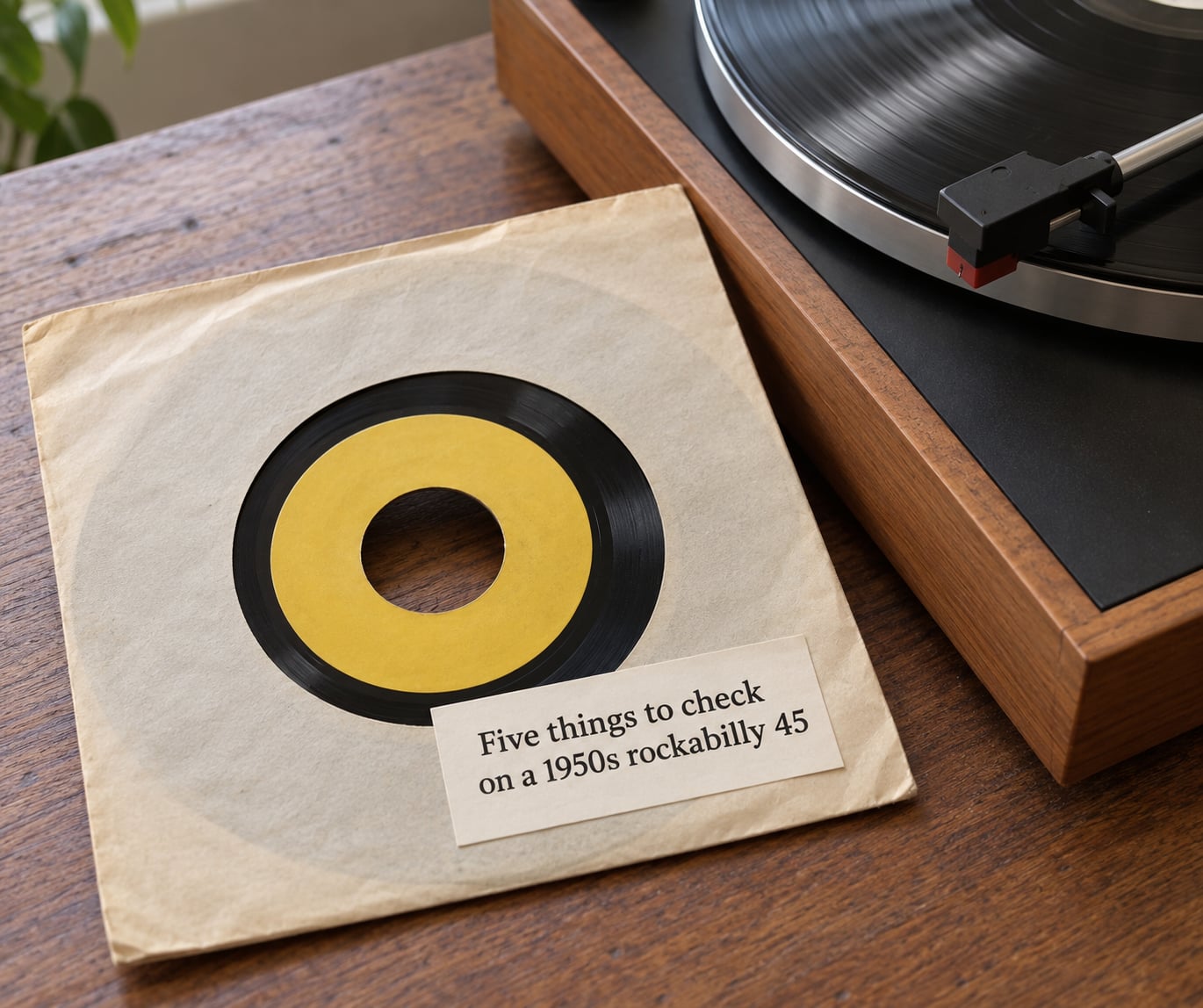
One more thing worth knowing: the Sun name on the label is not the value driver. Artist, song, matrix number and condition drive it, and that is why the r/vinyl crowd cross-references Discogs entries and Bear Family box sets rather than going by the logo in the middle of the disc.
On modern pressings, neo-rockabilly and psychobilly vinyl is easier to find and cheaper to enter, though labels vary in quality. New waves of retro reissues reproduce 1950s Sun-style sleeves on new records, so check the matrix and the country of manufacture before you assume you are holding something old.
Two mistakes cost beginners the most money. Buying a reissue in sleeve and record condition without checking the run-out first, and buying a Sun record signed by someone who was in the building rather than by the artist. If a seller cannot show you the run-out groove, price accordingly.
Where to Begin Listening to Rockabilly
The most common question in the genre’s forums is simply where to start, and the honest answer is that the back catalogue is enormous and badly signposted. Here is a twelve-record path in chronological order. Each one teaches you something the others cannot.
- Bill Haley and His Comets, “Rocket 88” (1951) – country words over rhythm and blues drive, one full generation before Memphis.
- Elvis Presley, “That’s All Right” (1954) – the template, including the slap-back echo on the voice.
- Elvis Presley, “Blue Moon of Kentucky” (1954) – hear a bluegrass standard turned into something hopped-up.
- Carl Perkins, “Blue Suede Shoes” (1955) – the songwriting, and the best rockabilly vocal ever recorded.
- Carl Perkins, “Honey Don’t” (1956) – a country shuffle that barely touches country.
- Gene Vincent with Cliff Gallup, “Be-Bop-A-Lula” (1956) – the guitar tone that made other guitarists sound thin for a decade.
- Eddie Cochran, “Summertime Blues” (1956) – the teenager’s-eye view, rawer than anything from Memphis.
- Janis Martin, “Drugstore Rock ‘n’ Roll” (1956) – seventeen years old, and one of the sharpest performances of the era.
- Wanda Jackson, “I Gotta Know” (1956) – a woman writing and singing her own rockabilly.
- Johnny Burnette and the Rock and Roll Trio, “Rock Billy Boogie” (1956) – the nervous, up-tempo style Memphis loved before the rest of the country did.
- Dave Edmunds and Rockpile, “I Hear You Knocking” (1977) – the first revival record, and the moment the sound comes back.
- The Stray Cats, “Runaway Boys” (1980) – rockabilly rebuilt for a generation that had been born after it.
If you want to go further after those twelve, the community consensus points to the same places: compilations of Sun material, Bear Family box sets for anyone who wants the whole Sun catalogue in order, and then the less famous names. Sleepy LaBeef, Slim Kimbrough, Charlie Feathers, Sonny Burgess and Warren Smith all came out of the same world as the names above and cost far less to find.
Frequently Asked Questions
What does rockabilly mean?
Rockabilly is a portmanteau of rock and roll and hillbilly, coined in the mid-1950s to describe country-influenced songs played with rhythm and blues energy. It started as a mild insult about young Southern performers, then became the name of a genre. Musically it means standing bass, hollow-body guitar, fast tempos and slap-back echo.
How did rockabilly start?
Rockabilly began in the American South in the early 1950s, with Memphis at its centre. Young white working-class musicians fused country styles such as western swing, hillbilly boogie and bluegrass with Black rhythm and blues. The sound crystallised at Sam Phillips’s Sun Records studio in July 1954, when Elvis Presley recorded That’s All Right.
Is rockabilly the same as rock ‘n’ roll?
Not quite. Rockabilly is the narrow, early fusion of country and rhythm and blues, usually with standing bass, twangy guitar and slap-back echo. Early rock and roll is the wider 1955-1959 explosion that rockabilly helped create, and it added horns, harmony singers and bigger arrangements. Rockabilly is the first sharp edge of what came after.
Who are the most important early rockabilly artists?
Elvis Presley, Carl Perkins, Jerry Lee Lewis and Johnny Cash are the core, with Gene Vincent, Eddie Cochran, Johnny Burnette, Roy Orbison, Wanda Jackson and Janis Martin alongside them. Sam Phillips built the studio and the label, while Bill Black on bass, Cliff Gallup and Scotty Moore on guitar and D.J. Fontana on drums defined the sound.
How did rockabilly influence punk and garage rock?
British bands took rockabilly home in 1956, where Cliff Richard and the Teddy Boys turned it into a youth culture. The Beatles, Rolling Stones and Who then stripped the country half away and returned it to America as British Invasion rock and garage rock. Punk inherited that same stripped-down instinct, and The Cramps carried the sound into psychobilly.
What records should a new rockabilly collector buy first?
Start with Elvis’s That’s All Right, Carl Perkins’s Blue Suede Shoes, Gene Vincent’s Be-Bop-A-Lula and Eddie Cochran’s Summertime Blues from the 1950s, then add the Stray Cats and a Bear Family or Sun compilation. Check the matrix number in the run-out groove and confirm it is a 1950s press rather than a later Sun reissue.
Conclusion: Start with the Records That Built the Sound
Rockabilly lasted about five years as a commercial genre and has been alive continuously for seventy. In short, the history of rockabilly explained is the first time Black American music and white country music were deliberately fused, and nearly everything after it – rock and roll, garage, punk, roots rock, psychobilly – runs back to that fusion rather than around it.
So start with four records rather than a hundred: Elvis’s “That’s All Right” from July 1954, Carl Perkins’s original “Blue Suede Shoes,” Gene Vincent’s “Be-Bop-A-Lula” and Eddie Cochran’s “Summertime Blues.” Those cover the echo, the singing, the guitar tone and the teenage anger. Everything after them is downstream.
Put a record on and move. The genre does not need an essay, it needs your feet.