Bandcamp Friday is a recurring 24-hour promotion, usually on the first Friday of a month, running from midnight to midnight Pacific Time. On that day the platform drops its own revenue share to zero, so independent artists and labels keep nearly the whole value of every purchase. Payment processing fees still apply, which is the detail most write-ups skip.
That is the short version, and it explains why collectors plan purchases around it. If you have ever wondered where a vinyl pressing comes from before it hits a shop, this is the day that matters most. Below is how the money actually moves, what you can buy, and where the program disappoints.
Table of Contents
- What Is Bandcamp Friday?
- What is Bandcamp Friday in one sentence?
- How Does Bandcamp Friday Work?
- What the waiver does not cover
- Why Do Artists and Labels Participate?
- Why the fan audience matters more than the fee waiver
- Is Bandcamp Friday still effective?
- What Is Bandcamp Friday’s Connection to Vinyl Collecting?
- How Can Vinyl Collectors Find Good Bandcamp Friday Releases?
- What Should You Know Before Buying on Bandcamp Friday?
- Frequently Asked Questions
- Is Bandcamp Friday still on?
- How does Bandcamp Friday work?
- How much revenue share does Bandcamp take?
- Do artists make money on Bandcamp?
- Is it free to listen on Bandcamp?
- Why don’t big artists use Bandcamp?
- Conclusion: Start With the Release Page
What Is Bandcamp Friday?
Bandcamp is a direct-to-fan storefront. Artists and small labels upload a release once, set a price, and fans buy from that page rather than from a streaming service. Bandcamp normally takes a cut of roughly 10 to 15 percent and routes the rest to the artist, with an average payout of about 82 percent of the money a fan spends.
Bandcamp Friday removes that platform cut for one day only. The event started in March 2020, when venue closures and cancelled tours wiped out the income of most working musicians almost overnight. Bandcamp waived its share for a day and then made it a habit.
What is Bandcamp Friday in one sentence?
Bandcamp Friday is the day, usually the first Friday of the month, when Bandcamp waives its revenue share from midnight to midnight Pacific Time so that independent artists and labels keep essentially all of each sale, minus payment processing fees.
More than 120 million in artist payouts have flowed through the program since it began, and a recent 24-hour event generated around 3.8 million on its own. Fans have quietly turned it into a ritual: spend the day, support the underground, buy the record you have been circling.
How Does Bandcamp Friday Work?
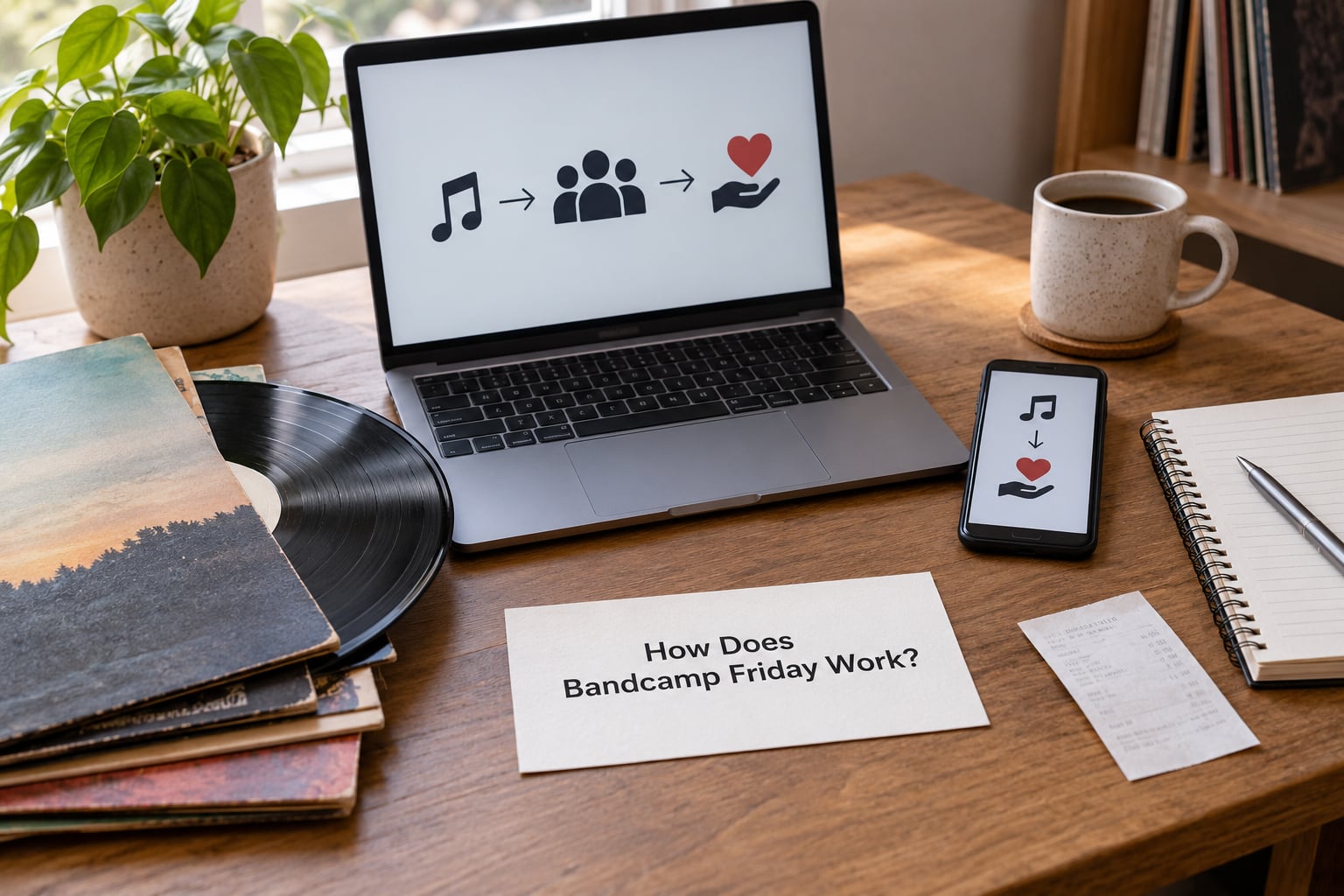
There is no membership, no code to enter and nothing to sign up for. Any purchase on a Bandcamp page during the window counts automatically.
- Find a participating page. Every artist page is eligible by default. Bandcamp also runs a tagged storefront where artists and labels volunteer a specific release for the day.
- Buy anything on the page. Digital albums, vinyl, cassettes, CDs, apparel and bundles all qualify.
- Bandcamp takes zero platform share. Its revenue share drops from the usual 10 to 15 percent to nothing for 24 hours.
- The artist or label is paid out. On an ordinary day the payout arrives within about 24 to 48 hours. It is routed out on the same timeline, only larger.
What the waiver does not cover
Payment processing fees are not waived. They sit outside the revenue share, so a card purchase still loses a few percent to the processor before anything reaches the artist. Shipping and delivery charges are separate again, and they are the part of a physical order that usually moves the least money to the musician.
Some artists have reported confusing lines in their payout reports, particularly around tapes and other physical items. If you are an artist checking your own numbers, compare a normal day against an event day line by line before you conclude anything.
| What changes | Normal day | Bandcamp Friday |
|---|---|---|
| Bandcamp revenue share | Roughly 10 to 15 percent | Zero |
| Average artist share | About 82 percent | Effectively all of it |
| Payment processing fees | Apply | Still apply |
| Window | 24 hours a day | Midnight to midnight Pacific Time |
| Payout timing | Within 24 to 48 hours | Same timeline, larger amount |
| Physical formats | Eligible | Eligible |
Why Do Artists and Labels Participate?
The short answer is that Bandcamp Friday concentrates a known, attentive audience into a single 24-hour window. Artists who depend on album sales rather than streams already live on this page. They arrive with a mailing list of followers and a habit of checking in weekly, and that habit spikes on the day.
Labels use it the same way, with two extras: a new release gets its loudest possible launch, and a charity date turns a sales push into something they can point at afterwards. MusiCares, the charity founded by the recording industry for musicians in financial hardship, has been a recurring recipient on certain dates.
The event has been repurposed for causes more than once. Alongside the pandemic relief dates, Bandcamp has run days where a share went to racial justice organisations during the 2020 protests, and its own revenue has on occasion been donated rather than merely waived. Treat any figure you read about a specific charity date as belonging to that date alone.
For working musicians the money has a direct use. Community pages around the platform report outsized one-day jumps on event days, and musicians routinely describe that income going toward rent, session fees and tour costs. When touring vanished in 2020, this was the patch over the hole.
Why the fan audience matters more than the fee waiver
A 15 percent saving is real but not transformative on a single album. The bigger effect is concentration. An artist who normally sees a modest week can see a sharp spike on an event day, which is the difference between funding a session and not funding it. That spike only happens because the people who already follow that artist made a habit of checking the page on Fridays.
The flip side is how narrow the effect is. Bandcamp does not have a discovery engine feeding it strangers. A new release launched cold on a Friday competes against everything else released that day for an audience that has not heard of it, which is why mailing lists and pre-saves matter more on this platform than on almost any other.
Is Bandcamp Friday still effective?
It still moves money, but fans and artists argue about what kind of money. The complaint is crowding: thousands of records release on the same day, all of them appearing in the same feed, all of them asking for the same hour of attention. An artist without a mailing list, a plan and pre-saves set up in advance gets buried.
There is a second thread worth naming honestly. Long-time listeners say few people outside the community know the event exists at all, which is why artists and promoters keep posting shout-out threads and why it never becomes mainstream news. Both things can be true: the payouts are real, and the discovery problem has not been solved.
It is also worth separating the day from the platform. Several musicians describe promoting on Bandcamp as strange regardless of the event, and that is a feeling about the storefront, not about the waiver.
What Is Bandcamp Friday’s Connection to Vinyl Collecting?
This is where the program matters most for anyone with shelves. On a normal day, a vinyl release competes with every other new record in the world. On Bandcamp Friday it competes with a crowd that has already decided to spend money on music that week.
Collectors find things here that never reach a shop:
- Test pressings from small runs that were never intended for retail.
- Numbered editions of limited pressings, sometimes signed.
- Exclusive variants that exist only on the artist’s own page.
- Bundles pairing a digital download, a physical copy and a shirt at a combined rate.
- Cassettes and CDs from artists who never pressed a mainstream format.
The trade-off is that pressings are small. An edition of 300 does not get reprinted, and when it is gone it is gone from the source that made it. That scarcity is the point for collectors, and it is also why Friday can feel frantic.
How Can Vinyl Collectors Find Good Bandcamp Friday Releases?
Run the same routine every cycle and you will build a decent shelf out of one day of browsing.
- Read the edition details before the audio. Look for the pressing quantity, whether it is hand-numbered, the colour of the vinyl, the mastering engineer and whether it is a reissue or a first press.
- Check the run length against the demand. A pressing of 100 will vanish. A run of 1000 usually will not, so there is no reason to rush the second one.
- Read the artist’s notes. This is where the real context sits: which studio, who mastered it, why this pressing exists at all.
- Do the bundle arithmetic. Compare the combined price against buying the items separately. The artist sets the discount, not Bandcamp, so bundles are often worth it only when you already wanted everything in them.
- Decide before you click. Friday pages move fast. Set a budget in advance and stick to it, because the spending high comes from other people’s releases, not from yours.
What Should You Know Before Buying on Bandcamp Friday?
Dates shift year to year and are announced in pieces, so check a live source rather than trusting a post from last year. As of October 2026, the announced dates ahead are November 6 and December 4. The countdown at isitbandcampfriday.com and the running list at daily.bandcamp.com are the two worth bookmarking.
Then check these details:
- Postage and delivery. Physical items are dispatched separately from downloads, and postage is charged by the seller. It is the largest single leak in a record purchase.
- Regional limits. Some digital releases are not licensed in every country, and a small number of physical editions are made for one territory only.
- What is actually signed. Signed editions are signed by hand and dispatched in batches, so the item turns up well after the event ends.
- Digital versus physical. A download never runs out. A pressing does, and Bandcamp generally does not reprint or restock.
- Popular editions sell out. Well-known artists on limited runs can go during the first hours. If a specific pressing matters, buy early in the window.
One more fan complaint deserves a mention: people regularly feel misled by the phrase 100 percent to the artist, because the processing fee is still deducted. It is a small number, but the sentence is not quite true, and it is worth keeping straight when you compare platforms.
Frequently Asked Questions
Is Bandcamp Friday still on?
Yes. It has run several times a year since March 2020, when it was created during the Covid-19 pandemic after venues closed and touring income disappeared. Most months have one date, and Bandcamp announces them gradually rather than in one annual calendar. The live countdown at isitbandcampfriday.com and the running list on Bandcamp Daily are the reliable places to check.
How does Bandcamp Friday work?
For 24 hours, from midnight to midnight Pacific Time, Bandcamp sets its own revenue share to zero on every eligible page. Digital albums, vinyl, cassettes, CDs, apparel and bundles all count. Nothing needs to be activated and no code is entered, so a purchase made during the window is treated as an event purchase automatically, and the larger payout reaches the artist on the usual timeline.
How much revenue share does Bandcamp take?
On a normal day Bandcamp keeps roughly 10 to 15 percent and sends about 82 percent on average to the artist or label, usually within 24 to 48 hours. During Bandcamp Friday that platform share drops to zero, so the artist keeps essentially the entire purchase price. Payment processing fees still apply because they are charged separately from the revenue share, and delivery costs are also deducted from physical orders.
Do artists make money on Bandcamp?
They do, and Bandcamp Friday makes the sums larger. More than 120 million has been paid out through the program since 2020, with a recent single day generating around 3.8 million. Musicians describe that income covering rent, session costs and tour expenses. The limits are equally real: the audience is self-selected and comparatively small, and processing fees still apply.
Is it free to listen on Bandcamp?
Yes, streaming through the Bandcamp player is free, including on Bandcamp Friday. The waiver affects what happens when money changes hands. Artists set the price of a download or a physical item themselves, and on the event day none of that amount is taken as platform revenue share.
Why don’t big artists use Bandcamp?
Some do release there, but mainstream acts rarely rely on it. Bandcamp has no streaming-equality payouts, limited playlist placement and no major marketing reach, so a superstar earns less from it than from other routes to fans. Its strength is the opposite: direct-to-fan sales, physical editions and mailing lists, which is exactly where independent artists and small labels are strongest.
Conclusion: Start With the Release Page
What is Bandcamp Friday? A 24-hour window on which the platform gives up its cut so independent artists and labels keep nearly everything, minus processing fees that nobody waives. Everything else worth knowing sits on the release page itself.
Open a participating artist’s Bandcamp page before you spend anything. Check whether vinyl is offered and how many were pressed, read the notes on the pressing, look at whether a bundle is genuinely cheaper than the parts, and confirm the postage. Then buy. That page tells you more about a release than any roundup will.