A record deal advance is an upfront, non-returnable payment a label hands an artist in exchange for the right to recover that money out of the artist’s future royalty earnings first, which means you get paid now for income that has not happened yet and may never happen at all.
That second half is the part people miss. An advance is the only guaranteed money in most record deals, and it is also the least revealing number in them. It tells you very little about what you will earn in five years.
Here is how the money actually moves, how recoupment works, and which clauses decide whether a deal is worth signing. Figures below are approximate market ranges as of October 2026, not entitlements.
Table of Contents
- What Is a Record Deal Advance?
- How Record Deal Advances Are Paid
- One payment at signing
- Installments tied to milestones
- Advance plus separate fees
- How Advances Are Recouped
- What is a record deal advance worth once the costs are added
- Why an artist may see nothing for years
- Why vinyl and manufacturing costs matter here
- What Is the Difference Between an Advance and Royalties?
- What Should an Artist Look for in an Advance Clause?
- Is this all-in or a recording fund plus an artist advance?
- What is the royalty rate, and what is it a percentage of?
- Which costs count as recoupable?
- How often will you get statements, and can you audit them?
- Are albums cross-collateralized, and what happens at the end of the term?
- Frequently Asked Questions
- Do record labels have to recoup the advance from an artist’s royalties?
- Is a record advance the same as a signing bonus?
- Can a record label take the advance back after an album is released?
- How much of an advance should an artist accept?
- When does an artist receive accounting statements after signing a record deal?
- Conclusion
What Is a Record Deal Advance?
The label pays you. The money usually lands after you sign, sometimes in one payment and sometimes in stages tied to finishing your record, delivering the masters, and hitting a release date. In exchange, the label gets a slice of your income stream until it is made whole.
It is not a loan in the normal sense. Nobody sends you a bill, there is no interest rate, and there is no schedule for repayment. It is also not a signing bonus, and it is definitely not a salary. The closest analogy is an advance against a future paycheck, except the paycheck comes from records you may never sell.
The label’s risk is real, though. It has committed cash before it knows how a record performs, and recoupment is how it manages that risk. The advance is also the artist-facing face of a much bigger trade: ownership of your master recordings, your term, and your rights in territories you may have wanted to keep.
How Record Deal Advances Are Paid
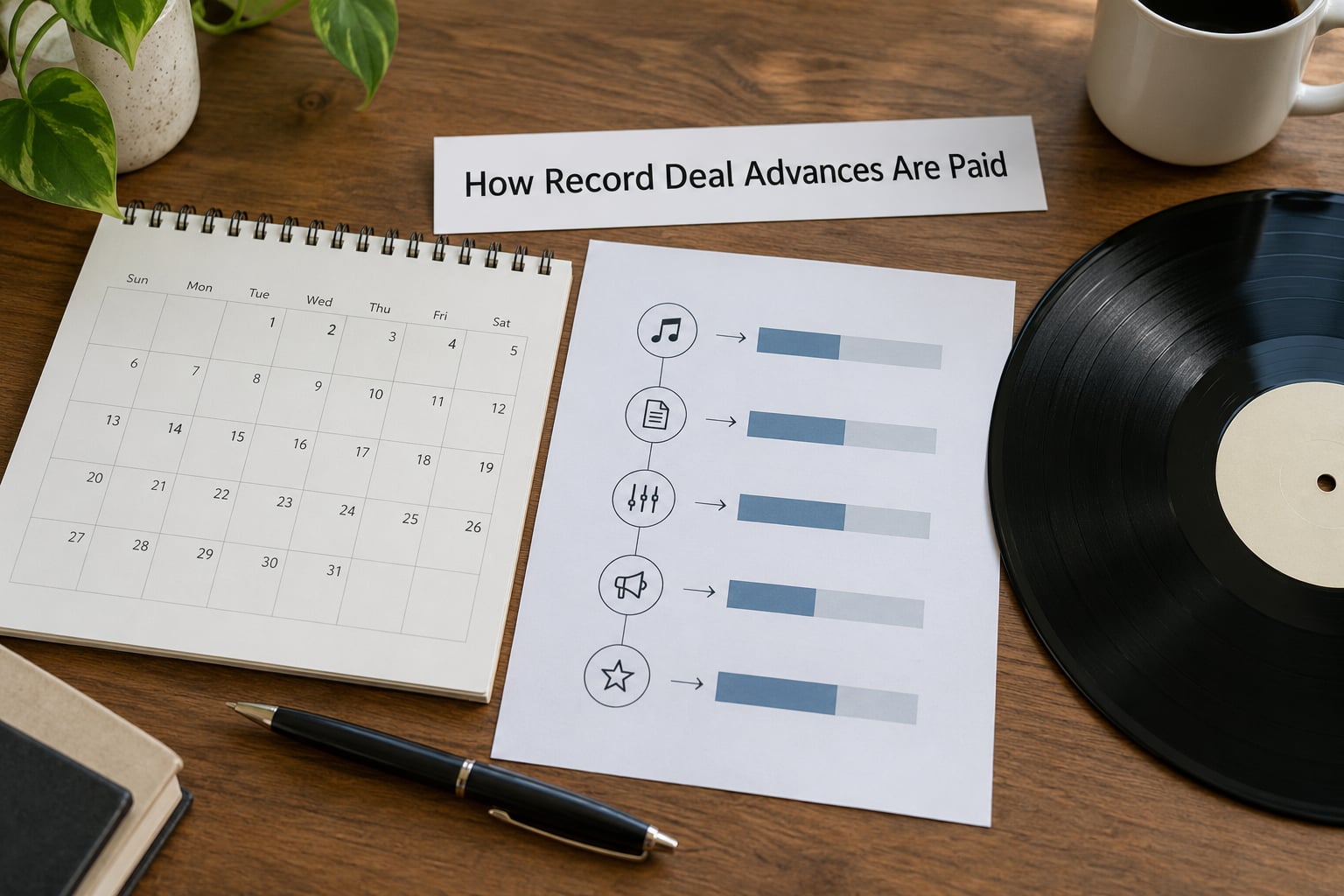
Payment schedules vary from contract to contract, and the shape of the schedule tells you a lot about who negotiated the deal. Three patterns cover most offers.
One payment at signing
The full amount arrives once the paperwork is done. Simple to read, and it means the label is betting the whole figure on your record without hedging. Independent labels do this most often, because their budgets cannot stretch across months.
Installments tied to milestones
Part of the money is released when you finish recording, another part when you deliver finished masters, another at release. A major-style deal often splits an advance this way, so you are paid in stages as you deliver. It also means a missed deadline can stall a payment you were counting on.
Advance plus separate fees
Some deals stack an advance with a signing bonus, a touring support fund, or a video budget. These are different pools of money with different rules, and treating them as one number is the most common misreading artists make.
One practical point applies to almost every US advance: it is taxable income in the year you receive it, not spread across the life of the recordings. Setting aside roughly a quarter to a third before spending anything is the habit that keeps a release from turning into a tax bill next spring.
How Advances Are Recouped
Recoupment is the mechanism, and it is simpler than the vocabulary around it suggests. Every dollar your record earns, the label takes its percentage first, then applies what is left of your share against the outstanding balance. Only when the balance reaches zero do on-going royalty payments start.
The important detail is that recoupment happens out of your royalty share, not out of total revenue. At a 20% royalty rate, 20% of every sale goes to recoupment until the balance clears, and the other 80% is the label’s. That is why the revenue needed to clear an advance is always a multiple of the advance itself.
What is a record deal advance worth once the costs are added
The headline figure is rarely the whole balance. Recording costs, video production, artwork and photography, and marketing spend are commonly added to the advance and recovered the same way. Ask for the full list, because what the label calls a recoupable cost becomes your money before it becomes theirs. So what is a record deal advance in practice? Not the number you were handed, but what is still owed after the cost sheet is finished.
Here is the arithmetic that decides whether a release feels successful to the artist and successful to the label at the same time.
| Deal line | Amount |
|---|---|
| Artist advance | $50,000 |
| Recording costs added to the balance | $50,000 |
| Marketing spend added to the balance | $25,000 |
| Total recoupable balance | $125,000 |
| Revenue needed to clear it at a 20% royalty rate | $625,000 |
| Revenue needed to clear it at a 15% royalty rate | $833,333 |
That table is the whole argument in six rows. A record that earns $125,000 feels like a success to the artist and has cleared nothing at all.
Why an artist may see nothing for years
Royalties are paid on what the record earns, and a modest release earns slowly. An artist can sign, watch the advance disappear into costs, and go three years without a royalty check while the contract is technically performing perfectly. Community discussion among unsigned and signed artists repeats the same confusion constantly: nobody can see the balance, so nobody knows how close it is to clearing.
Cross-collateralization is the clause that extends this. Where a label cross-collateralizes albums, an unrecouped balance from record one carries into record two, and both releases have to clear the combined debt before a single royalty check arrives. A band can have two records that both do well and still be paid nothing.
Why vinyl and manufacturing costs matter here
Physical manufacturing is often a recoupable cost, and in punk, hardcore, garage, and rockabilly scenes it is frequently a large one. Pressing runs are paid for up front and recovered from unit sales, so a label that fronts your vinyl order may fold that cost into your balance alongside the recording. Ask directly whether manufacturing is recoupable, and at what point units are counted as sold.
What happens to the balance when a deal ends is worth understanding too. If the term expires or the contract is bought out, the outstanding recoupable balance generally does not follow you as a personal debt. It does, however, disappear as a claim against future records in many structures, which is a large part of what you give up by signing away the option period.
What Is the Difference Between an Advance and Royalties?
The four payments people call money in a record deal behave differently, and the confusion between them costs artists real money. This table separates them.
| Payment | Who pays it | What it depends on | When you get it |
|---|---|---|---|
| Advance | The label | The deal you sign | At signing or in stages against milestones |
| On-going royalties | Whoever exploits the recording | Revenue actually earned, after the balance clears | Only after recoupment is finished |
| Signing bonus | The label | Simply signing, no strings | At signing, never recouped |
| Accounting statement | The label | The reporting period covered | Quarterly or semi-annually, usually lagging behind |
An advance is the only one of the four that is certain, and the only one that is not profit. Royalties are the only payment that grows if the record works, which is why experienced artists and managers often negotiate the advance down in exchange for a better royalty rate or a shorter list of recoupable costs.
Rates differ sharply by deal type. Traditional major and independent label deals commonly sit around 10 to 20% of net receipts. Profit split deals divide net profit rather than gross revenue, often on a 50/50 basis. Licensing and distribution deals can reach 50% or higher once distribution fees come out. The headline rate matters less than what the contract says it is a percentage of.
What Should an Artist Look for in an Advance Clause?
Work down this list before you sign anything, and take the answers in writing.
Is this all-in or a recording fund plus an artist advance?
This is the distinction that most changes what you actually receive. An all-in advance of $100,000 where $80,000 goes straight into recording is functionally a $20,000 cash payment with a production budget attached. A separate recording fund means the money is spent on your record and the advance is yours to keep. Confirm which structure you have before you negotiate anything else.
What is the royalty rate, and what is it a percentage of?
Net receipts, retail, gross, or net profit are not the same number. A percentage of net profit after label overhead can be a fraction of a percentage of retail, and the difference compounds over a whole album cycle.
Which costs count as recoupable?
Get the full list. Recording, video, artwork, photography, mastering, and marketing can all sit on it, and some deals even fold in legal and administrative costs. Every item on that list delays your first royalty dollar.
How often will you get statements, and can you audit them?
Reporting is usually quarterly or semi-annually and lags the period it covers. Ask specifically how the statement shows the outstanding recoupable balance, and whether you have the right to audit the label’s books. Without that visibility, recoupment becomes something you have to take on trust.
Are albums cross-collateralized, and what happens at the end of the term?
Cross-collateralization carries debt forward across releases. The term and option structure decides how many albums you owe and for how long, and whether masters come back to you. Master ownership and reversion matter more to a career than the advance figure ever will, and the strongest reversion position is a deal that ends with the masters returning to you.
Two things worth saying plainly. Rules on master ownership and statutory termination rights vary by jurisdiction, so what holds in one country may not hold in another. And this is general information, not legal or financial advice: before you sign, take the contract to an entertainment attorney. For a deal involving real money and years of your rights, that fee is small next to the cost of the terms you did not understand.
If no label is offering you anything, self-releasing is the honest alternative. There is no advance, no recoupable balance, and no one else owning your masters, and in exchange you fund recording, manufacturing, and distribution yourself and take every dollar. For a lot of artists in DIY scenes that trade is a good one.
Frequently Asked Questions
Do record labels have to recoup the advance from an artist’s royalties?
Usually, yes. A typical clause lets the label recover the advance plus listed costs out of your royalty share before you receive anything. Labels have strong incentive to recoup quickly, so assume every dollar you earn goes to the balance first, at your royalty percentage, until it clears. Read the clause for what counts as recoupable beyond the advance itself, since recording and marketing costs are often added.
Is a record advance the same as a signing bonus?
No. A signing bonus is a flat payment for signing, and you keep it no matter how the record performs. An advance is recovered from your future royalties, so if your record earns nothing, you receive nothing further. Some offers include both, and confusing them leads artists to spend money that was never yours. Ask which pool each payment comes from and whether it is recouped.
Can a record label take the advance back after an album is released?
Not as cash. Advances are described as non-returnable, meaning the label cannot demand the money back from you after a release flops. The real consequence is different and quieter: you keep the money, but you may never earn anything beyond it, and options in later album cycles can be declined while the balance stands. That lost runway is often the actual cost of an advance that never recoups.
How much of an advance should an artist accept?
There is no magic figure, and a larger advance is not automatically the better deal. What matters is the size of the recoupable balance behind the number, the royalty rate applied to it, and whether you can live with the recoupment timeline. Experienced teams often negotiate the advance down in exchange for a better rate, a shorter recoupable cost list, or faster reversion of masters. Judge the whole package, not the headline.
When does an artist receive accounting statements after signing a record deal?
Most statements arrive quarterly or semi-annually, and they usually cover a period that has already closed, so there is a built-in lag of months. Before recoupment finishes, the statement shows what was earned and what was applied to your balance rather than a payment to you. Check that the contract requires the statement to show the outstanding balance, and whether you hold audit rights if the numbers look wrong.
Conclusion
The advance is the only guaranteed money in a record deal and the least informative number in it. Judge the offer by the recoupable balance behind the figure, the royalty rate, the list of recoupable costs, and when your masters come back.
Start with one question: is this all-in, or is it a recording fund plus an advance? Everything else gets clearer once you know that.