A split single is a vinyl release with one artist on each side: one band plays the A-side, a different band plays the B-side, and both names appear on the same record. It lets two acts share one pressing bill and split the manufacturing cost. Quick note before we start: this is the music meaning, not the crochet stitch or the motorcycle engine that share the name.
You will see the term on sleeves, in Discogs listings and in record store bins, usually attached to a 7-inch. Once you know what you are looking at, the phrase stops being confusing and starts being useful, because it tells you the format, the running time per side and how the release was paid for.
Table of Contents
- What is a split single and why did bands use this format?
- How did split singles work on vinyl?
- What are the common split-single formats?
- How can you tell whether a vinyl record is a split single?
- What is a split single on a 7-inch single?
- Which details matter most when collectors identify a split single?
- Why are split singles collectible?
- Frequently Asked Questions
- Are all two-artist vinyl records split singles?
- What is the difference between a split single and an EP?
- Can both bands receive a split single?
- Why do some split singles have different track assignments?
- Are split singles always rare or valuable?
- Conclusion
What is a split single and why did bands use this format?
The short answer is cost. A vinyl disc has two sides whether you fill them or not, so if two bands each have one song finished, giving each one a side halves what each of them pays for the plates, the plastic and the sleeve. Nobody wastes half a record, and nobody has to turn down a finished track to wait for a second one.
That logic made the format natural for small independent labels and self-released bands. A first pressing might be a few hundred copies, which is a number that can be sold through a scene, mailed to a mailing list and played on a tour without a distributor taking a cut. When you look up what is a split single in a collectors database, you are usually looking at that economics made physical.
The social side matters as much as the financial one. A split puts your band’s name next to a band people already trust, and it spreads a scene’s record collection across two audiences at once. Community scenes adopted it early, which is why punk, hardcore, post-punk, garage, rockabilly and indie catalogues are thick with these releases.
How did split singles work on vinyl?
Play one like any other record. The A-side holds one artist’s track, the B-side holds the other’s, and the sleeve tells you which is which. Frequently the two names sit side by side on the front in equal type size, and the back carries the credits, the label logo and whatever the label thought you needed to know.
From a cataloguing angle, a split has one release identity but two artistic identities. The sleeve and labels usually credit both acts and the label, sometimes as a joint billing, sometimes as a straight list. The label’s catalogue number covers the whole record. Older catalogues often appended a suffix for one half of the pairing, a letter or small number that flags which artist the item belongs to, which is why the same split can show up under two entries in a discography.
Matrix numbers in the runout groove settle most disputes. Each side is etched with a code, usually a letter and digits, so the A-side and the B-side of a split carry different identifiers even though they came out of the same stamper. Those codes are how pressing plants and collectors tell one version of a record from another, and they are the single most useful piece of evidence you can read off a disc yourself.
What are the common split-single formats?
Almost every split you will meet fits one of these shapes. The differences are mostly about size, running time and how many tracks each act gets.
| Format | Typical tracks | Running time per side | Label arrangement | Collector consideration |
|---|---|---|---|---|
| Standard split 7-inch | One song per artist | Around 2 to 3 minutes | One label, both acts credited | The commonest form and the easiest to find |
| Two-songs-per-side split | Two songs per artist | Around 4 to 6 minutes | One label, tracklist usually numbered A1 to A4 | Check which artist owns which numbered track |
| Split 10-inch | One or two songs per artist | Around 4 to 8 minutes | One label or a partnership between two | Often sold or catalogued as a split EP |
| Flexi-disc or giveaway split | One song per artist | Short | Usually with a magazine or fanzine | Paper or thin plastic sleeve, often partial |
| Promotional split 12-inch | One track per artist | Around 5 to 10 minutes | Sent to reviewers, shops and radio | White-label promos and hand-numbered editions turn up used |
Two-way splits are the default, but three-way and four-way splits are not unusual and follow the same logic with more names per side. With four acts you may get two tracks per side, and each label or band sometimes presses its own variant of the same design.
How can you tell whether a vinyl record is a split single?
Start at the sleeve, then confirm on the disc. The quickest cues, in the order I check them: both artist names printed on the front or back in similar billing, a tracklist with only one or two tracks per artist, two label logos or a joint credit, a catalogue number that a database lists under both names, and matrix numbers etched into each side’s runout.
Three things trip people up. A two-act release where both acts appear on the same side is a double A-side, not a split. A release where each artist gets several tracks may be catalogued as a split EP rather than a split single, which is a naming convention rather than a real difference. And a various artists compilation puts several tracks per act on a longer record, usually at 33 1/3 RPM.
| Format | Artists per release | Tracks per artist | Typical size and speed | How it reads in the bin |
|---|---|---|---|---|
| Split single | Two or more, one per side | One | 7-inch at 45 RPM | One song per side, both names on the sleeve |
| Split EP | Two or more | Two to four | 7-inch or 10-inch at 33 1/3 or 45 RPM | A longer tracklist, often numbered per artist |
| Double A-side | One | Two on one side, two on the other | 7-inch at 45 RPM | A single artist, both sides marked A |
| Various artists compilation | Several | Several | LP or CD, 33 1/3 RPM | A tracklist of five names or more on a longer record |
Condition tells you something too. Sleeves designed to be split down the middle, or printed on the back for one act and the front for another, were never meant to survive a used bin, so a clean original sleeve tells you the record was handled carefully.
What is a split single on a 7-inch single?
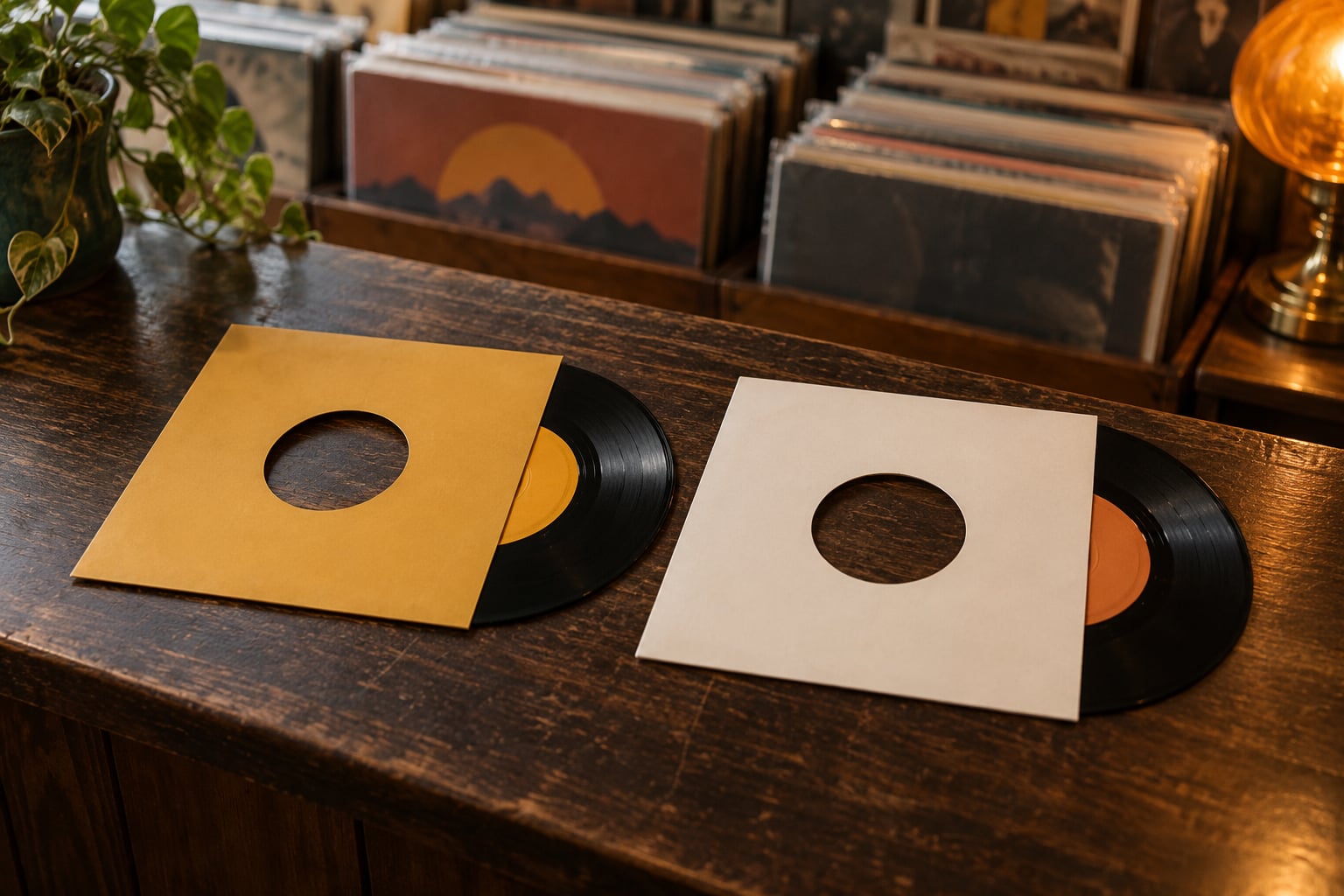
This is the plainest version of the format: two artists, two sides, one track each, pressed at 45 RPM. Whether the names appear in the release title, only on the sleeve, only on the labels or just in the label’s catalogue listing varies release by release, and all four arrangements show up in the wild.
Say you pull a 7-inch from a bargain bin. The front reads Band One / Band Two in one line, the back shows one track each side and a catalogue number, and the labels name a single independent imprint. That is a split single.
Now say the same record turns out to read Band One and Band Two only on the labels, with the sleeve crediting just Band One and a distributor’s sticker across the front. The disc still works as a split, and database entries may file it under either name, but the sleeve alone would have misled you. Labels on the record are the harder evidence.
Which details matter most when collectors identify a split single?
The strongest evidence, in order: artist names printed on both labels, matrix numbers etched into the runouts, the catalogue number matching a known release, the label credit in the sleeve’s small print, and the physical format matching a documented pressing.
Sleeve art alone is the weakest. Designs get copied, reissued and re-used, and the same catalogue number can appear in several countries with different track assignments, different matrix codes and different label names in the runout. That happens because a design and a catalogue slot are cheap to license between pressing plants, and nobody checks that the record inside matches the paperwork outside.
Bootlegs and unofficial repressings are where confusion multiplies. An unlicensed version may keep the catalogue number, drop one artist’s credit from the sleeve and add tracks that were never part of the release. The matrix numbers are usually the giveaway, since they will not match the documented pressing.
Why are split singles collectible?
Most split singles are not scarce. Small runs were common and the format lived on short distribution, so plenty of ordinary copies circulate. What makes a given one interesting is usually its context rather than its rarity.
Early pressings, complete label variants, surviving sleeves in good shape and unusual couplings between bands from different towns or genres all carry weight. So do historically desirable lineups, like a debut pairing or a split that connects two scenes that rarely crossed. Run sizes in the low hundreds show up often in scene catalogues, which is low enough that a surviving original matters once the music itself matters.
Label provenance counts too. A split released by a small independent label with a real catalogue history reads differently from a throwaway licensed reissue, and collectors tend to keep buying from the labels they trust even when the run is tiny. Online databases such as Discogs are the first place to check when a sleeve tells you nothing.
One practical habit pays off more than any other: keep the original sleeve. Half of what makes a split identifiable lives on the cardboard, and a bare disc loses the joint credit, the catalogue number and the run size information.
Frequently Asked Questions
Are all two-artist vinyl records split singles?
No. If one artist plays both sides of a 7-inch, with two tracks per side, that is a double A-side release by a single act. A record only counts as a split single when each artist takes a side. Some databases file split EPs under the same heading, so check how many tracks each name gets before you label it.
What is the difference between a split single and an EP?
It comes down to track count and size. A split single usually gives each artist one song on a 7-inch at 45 RPM. A split EP gives each artist two or more tracks on a 7-inch or 10-inch, often at 33 1/3 RPM. The same idea applies, and collectors disagree about where the line sits, so expect both labels for some records.
Can both bands receive a split single?
Often yes, though it varies by release. The usual model is one shared inventory item under a single catalogue number that both acts sell and split the revenue from. Some labels instead press two versions, one credited to each artist, sometimes with a catalogue suffix. Check the label’s own catalogue listing to see which arrangement a particular release used.
Why do some split singles have different track assignments?
Designs and catalogue numbers get licensed between pressing plants and across territories, so a release can appear in several countries with the songs switched between sides or replaced entirely. Different sides can also be cut from different masters. Comparing the matrix numbers etched into each runout tells you whether two versions came from the same stamper.
Are split singles always rare or valuable?
No. The format was cheap by design, and many small-run splits turn up in used bins at ordinary secondhand prices. Value tends to come from context instead: early or test pressings, complete label variants, an intact original sleeve, an unusual pairing or a band people now look for. Run size and label provenance tell you more than the format label on its own.
Conclusion
Before you call anything a split single, look at the labels for both artist names, check that each act has its own side, then confirm the catalogue number and read the matrix codes in both runout grooves. That takes about a minute and keeps you from filing a double A-side as a split.
Still stuck on what is a split single? It is almost always one of two things: a label printed for only one act, or a sleeve that lists both names without saying who plays what. Sort that out first and the rest of the identification follows from the labels. The format still matters to independent music, where it remains one of the cheapest ways to put out a physical record and to put two scenes in the same collector’s crate. Keep the sleeve with the disc, and the next one you pull from the bin will tell you its own story.