Sun Records sounded different because Sam Phillips recorded almost everything the way it arrived: one take, a small room, microphones close enough to hear a singer’s breath, and a short slapback echo that put a second copy of each phrase just behind the first. That combination — spare arrangements, blues-derived playing, and tape built space where none existed — is why “what made Sun Records sound unique” still gets asked, and why collectors argue about which sessions deserve the label’s name.
The answer sits in five parts: a deliberate echo technique, close microphone placement, musicians who left room in their playing, and a studio in Memphis that mixed country, blues, R&B and gospel into one language. Some of what passes for a Sun technique is folklore, so those pieces get sorted out below too.
Table of Contents
- What Made Sun Records Sound Unique?
- How Did Sam Phillips Create Sun’s Signature Sound?
- What Made Sun Records Sound Unique in the Studio?
- Why Did Echo Matter So Much at Sun?
- How Did Sun’s Music Combine Different Musical Traditions?
- Why Were Sun’s Musicians and Arrangements So Effective?
- Which Sun Records Best Reveal the Label’s Sound?
- Is It Correct to Call Every Famous Sun Recording the “Sun Sound”?
- How Can Collectors Hear the Sun Sound on Vinyl?
- Frequently Asked Questions
- Was the Sun Records echo real or an effect?
- What does the classic Sun Records echo sound like?
- Who invented the sound commonly called the Sun Records sound?
- Did Sam Phillips record everything at Sun Studio?
- What is the difference between the Sun Records and Phillips International sounds?
- Are older mono Sun Records better than stereo reissues?
- Conclusion
What Made Sun Records Sound Unique?
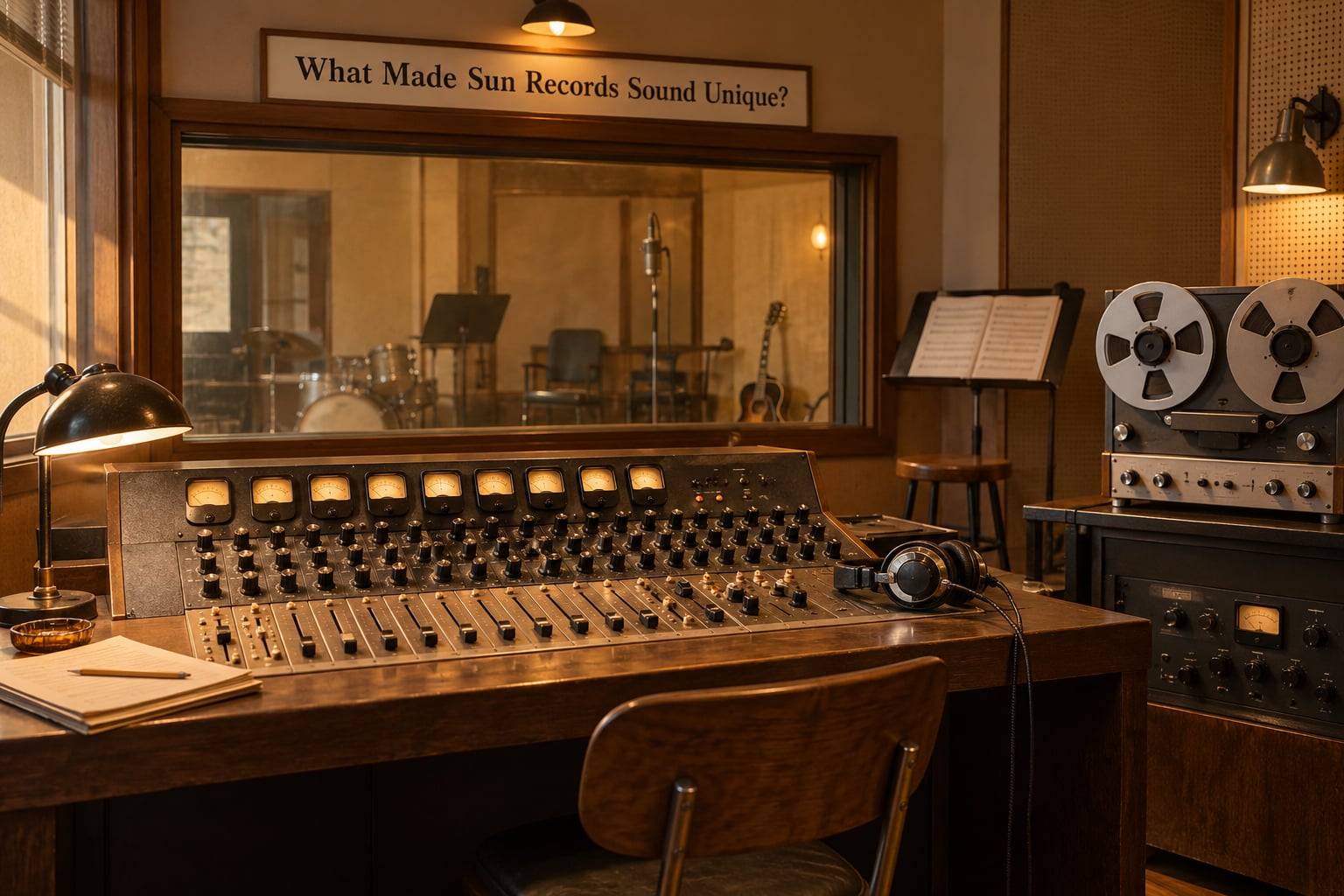
The short version: close-miking, Phillips’s echo, economical arrangements, blues-derived musicianship, and a mix of country, R&B, gospel and early rock and roll compressed into a small Memphis room. No single trick created the sound, and the echo is only the most audible part of it.
The practical reasons Sun recordings still sound alive decades later:
- Short delay repeats. A single audible echo a fraction of a second behind the voice, which pushed the vocal forward and gave the band a sense of depth.
- Close microphones. Detail that reveals grain, breath and pick attack instead of hiding it.
- Live playing. Most tracks were single takes or near-singles, so phrasing wanders in ways polish tends to erase.
- Lean arrangements. Guitar, bass, drums and piano doing the minimum, leaving pockets for the singer to sit in.
- Tape and mono. Saturation on the tape stock and a single channel, which keep the low end solid and the top end slightly soft.
The mythical parts deserve a warning label. The “compressed ceiling” story, in which the studio’s ceiling was so low Phillips had to kneel to operate the board, has never been backed up by a blueprint, and audio engineers who have measured the room doubt it. The torn speaker cone on “Rocket 88” is also contested: Phillips told the story of leaving a microphone in front of an amplifier and driving it into overdrive, while guitarists point to the simpler explanation of a damaged cone. Phillips’s own version is the better source for how he thought it happened, not necessarily for what happened.
What is not mythical is the last three points. Those are things you can hear on any decent pressing, which is why the question keeps coming up.
How Did Sam Phillips Create Sun’s Signature Sound?
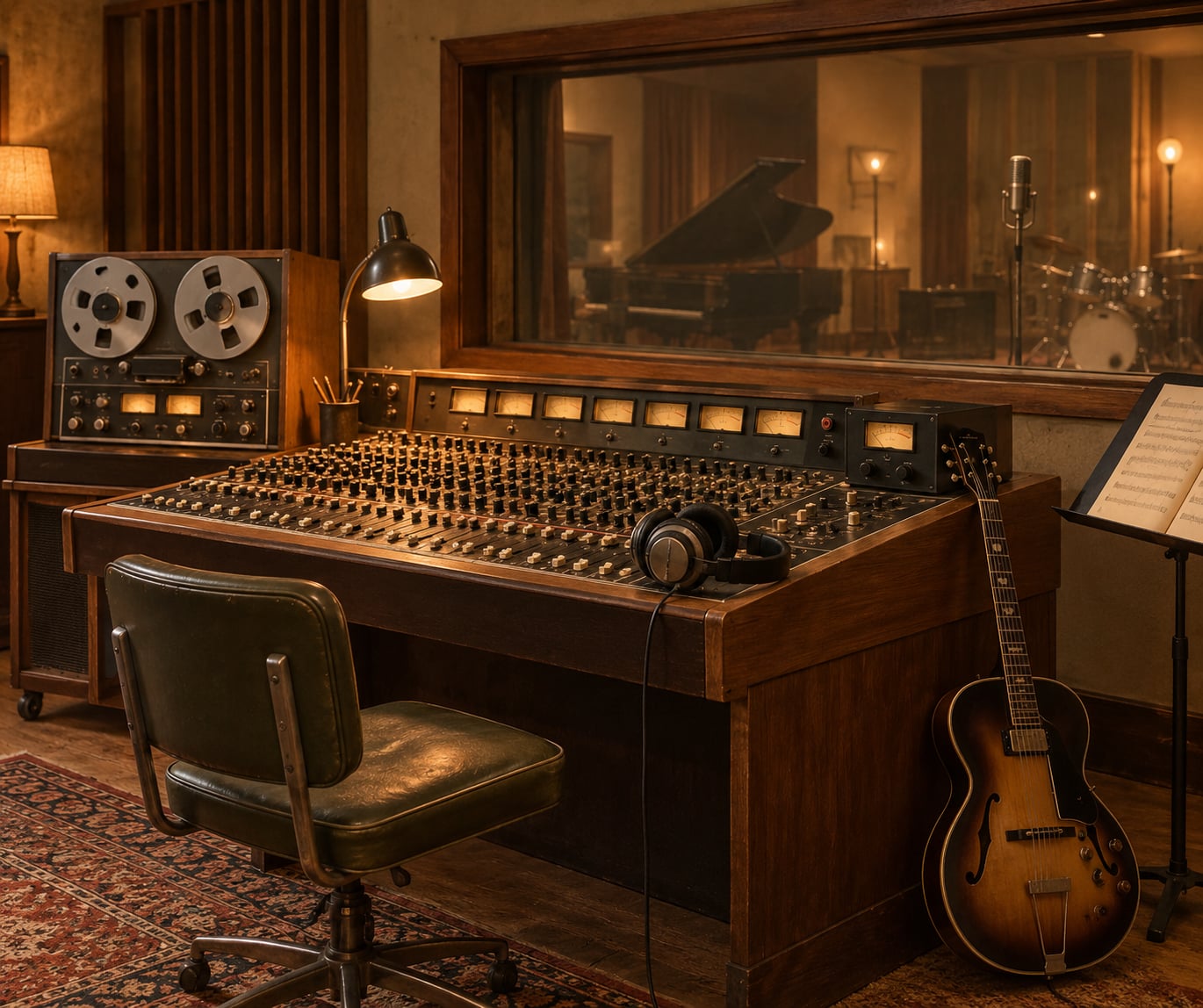
Phillips built his studio around limitations instead of spending his way out of them. He had war-surplus microphones, a couple of tape machines, and a room that was not built for music. He treated all of that as a feature, and the results came from a handful of methods used with real judgement.
What Made Sun Records Sound Unique in the Studio?
Four methods account for most of what you hear. Performance echo, where a musician sang or played the same phrase twice and Phillips let both passes stay on tape, is the oldest and the most human. It is why a Sun vocal often seems to lean forward, then double itself a fraction behind.
Then there is the tape delay, which Phillips built by routing the output of one tape machine into the record input of another and layering the returned signal on top of the dry take. Slide the fader between the two sources and you get anything from a ghost vocal to a thickened rhythm guitar, which is exactly what gives a performance its sense of space.
Microphone placement came third. Close vocal positions brought out the words and the grain in the voice, and widely placed drums sat behind them, so the kit sounded further away than the singer without anyone moving anything. That relationship, not the echo, is the reason a Sun record can feel immediate.
The fourth method was simply recording fast. Minimal overdubs, limited editing, and a willingness to print a take because the emotion was in it. You can hear that on “Bear Cat,” on Elvis’s “Good Rockin’ Tonight,” and on the loose, arguing energy of the December 1956 sessions later billed as the Million Dollar Quartet.
Why Did Echo Matter So Much at Sun?
Echo did something ordinary studios had no reason to bother with: it added space to a room that physically had none. The repeats landed late enough to read as a separate voice rather than a reflection, so a singer sounded bigger without any extra musicians.
Two different techniques hide behind the same word, which is where most confusion starts. Performance echo is musical — the player performs the repeat. Slapback echo is mechanical — the tape machine returns a copy of whatever you just played. Phillips used both, and he also fed specific instruments through the return, so the beat itself could feel wider than the room.
For collectors, the useful rule is to listen rather than assume. On many early sides the slapback is audible on the vocal only. On later ones it opens up, and it sometimes sits on the guitar or the whole kit instead. Sun’s catalogue was a moving target across twelve years and dozens of sessions, so no single delay setting describes the label.
How Did Sun’s Music Combine Different Musical Traditions?
Sun did not invent rock and roll from nothing. It put people in one room who came from different places and let them argue, and the friction is what you hear on the records.
Country came in through the rhythm section and the vocal phrasing. Boogie-woogie piano from Jackie Brenston’s Delta Cats, and slide guitar that came straight out of the Delta, sat under vocals shaped by the emotional directness of blues and gospel. Rufus Thomas’s “Bear Cat” answered Big Mama Thornton’s “Hound Dog,” which told you exactly how closely R&B was being tracked in Memphis.
Howlin’ Wolf brought a harmonica style and a voice that sat in front of the band so convincingly it changed how everyone else sang for the next year. Then the country-and-R&B hybrid came back around as something new: Carl Perkins’s “Blue Suede Shoes” in 1956, with its dropped beat and stabbing guitar, and Elvis’s run of Sun singles from 1954 onward, where gospel phrasing and country lilt shared the same microphone.
By the end of the Sun era the strands had braided into one style, and it is easy to mistake the result for something Sun created alone. It did not, and hearing the ingredients side by side is the fastest way to hear what Phillips actually added.
Why Were Sun’s Musicians and Arrangements So Effective?
Because they played less than you think. Sun lineups were small, and good players left air around the beat instead of filling it. Elvis’s early rhythm section knew when to stop. Jerry Lee Lewis’s band played behind the piano rather than on top of it, and that restraint is the difference between rockabilly and noise.
Blues phrasing did the rest. Singers pushed and pulled against the beat, and the bands left enough slack for that to happen. On an Elvis Sun track the vocal frequently sounds like it is running slightly ahead of where you expect it, which is a blues habit sitting on top of a country backbeat.
There is a caveat worth keeping. Lineups changed constantly, sessions moved between Memphis and other studios, and the catalogue spans everything from early Memphis sides to Phillips’s later stereo-era experiments. So when someone says a record has “the Sun sound,” they may be describing a producer, a studio, an era, or one mic in one session. Treat the phrase as a description rather than a measurement.
Which Sun Records Best Reveal the Label’s Sound?
Start with the sides that separate the techniques. On “Bear Cat” by Rufus Thomas, listen for the accordion line and how the band stays out of the vocal’s way. On “Rocket 88” by Jackie Brenston’s Delta Cats, listen for the attack on the guitar and the piano left bare enough for you to hear the room in it.
Then move to the records where the echo becomes a compositional element. Elvis’s “That’s All Right” and “Good Rockin’ Tonight” show the vocal sitting forward with a repeat behind it, and Jerry Lee Lewis’s “Great Balls of Fire” pushes the same approach harder, with the band leaning into the vocal’s timing. Carl Perkins’s “Blue Suede Shoes” is the one to play when someone claims Sun was just country with effects: the rhythm is its own thing.
Johnny Cash’s Sun work is worth a separate session of listening, since he brought a different weight and a different way of phrasing. Roy Orbison’s brief run on the label is the useful counter-example, because the production sits so far back that the song carries itself. Several of those later recordings came after the label had moved to stereo-capable equipment, so they do not sound like the mono run.
The practical collector’s note: the catalogue has been reissued in waves, from CD-era compilations through to more recent box sets, so the copies circulating in 2026 are rarely all cut from the same source. If a mono side sounds thin rather than solid, that is often the transfer.
Is It Correct to Call Every Famous Sun Recording the “Sun Sound”?
No, and the label’s own history is the reason. Sun Records, run from 706 Union Avenue in Memphis, came first. Phillips sold the label in 1962 and went on to run Phillips International, which had its own roster, its own engineers and its own sonic preferences. Records from that later period get filed under the same name because of the logo, not the room.
Several things have to line up before the phrase means much: who produced the session, which studio it was recorded in, which year it falls in, and what technology was in use. A Sun single cut in another city is not a Memphis recording, and a Phillips International track is not a Sun track.
Being picky about this is not pedantry. Once you start separating Memphis Sun from Phillips International, from the later RCA and Columbia years, and from genuine Sun sessions that simply happened to be recorded elsewhere, the phrase starts describing something real instead of everything anybody likes.
How Can Collectors Hear the Sun Sound on Vinyl?
Play it the way it was mixed. Early Sun sides are mono, and mono means the vocal, the guitar and the kick drum all share one channel, so balance is fixed. Adjusting the balance control on a stereo setup does not reveal a hidden stereo image; it only attenuates one side.
Run a mono source through a good stereo system with the mono switch engaged. If the master is clean, a Sun vocal slapback will sit noticeably behind the dry vocal with the same tone and weight on both copies. A repeat that sounds thin or bright is usually a mastering or playback-speed issue, not an original difference.
Watch your turntable speed. A 45 played a fraction fast sounds thin and slightly out of tune, which is easy to confuse with a bad reissue. On mono pressings, check what the sleeve says about source and speed before blaming the mastering.
Finally, note what matrix numbers can and cannot tell you. They identify the cutting master and pressing, which is useful for dating a copy and spotting a later repress. They say nothing about who played on the session or what the room sounded like in 1954. Trust your ears over the runout etchings when you are judging the sound itself.
Frequently Asked Questions
Was the Sun Records echo real or an effect?
Both, and the distinction matters. The echo you hear on early Sun sides was a real effect, produced by routing one tape machine into another and layering the returned signal under the dry vocal. But Phillips also used performance echo, where a singer or guitarist simply played the phrase twice and both passes were kept. Collectors who ask only about machines miss half of what was happening.
What does the classic Sun Records echo sound like?
One repeat, a fraction of a second behind the voice, with the same tone and weight as the original. It is not a long smear or a rumbling reverb tail. Listen for it sitting just behind the dry vocal on tracks like Bear Cat and Good Rockin’ Tonight, and notice how it widens the phrase without making the voice sound distant. On many sessions it appears on the vocal only.
Who invented the sound commonly called the Sun Records sound?
Sam Phillips, the DJ and engineer who ran the Memphis Recording Service at 706 Union Avenue and launched Sun Records. He developed the echo routing, chose close microphone positions, and insisted on printing performances quickly. He did not do it alone; the players he recorded supplied the phrasing that made the technique work, and the claim of single authorship is mostly a habit of telling the story badly.
Did Sam Phillips record everything at Sun Studio?
No. Most of the famous early sides were cut in the small upstairs room at 706 Union Avenue in Memphis, but sessions moved over the years and Phillips recorded elsewhere when a situation called for it. Some Sun singles were cut at other studios, which is one reason the catalogue does not share one uniform sound. Always check the session location before assuming a record inherits the Memphis room.
What is the difference between the Sun Records and Phillips International sounds?
Sun Records was the Memphis label Phillips ran from the early 1950s until he sold it in 1962, and it is where the close-miked mono rock and roll sound belongs. Phillips International came after, with a different roster and later technology, including stereo work. The two are often filed together because of the name, but the room, the era and much of the production method were different.
Are older mono Sun Records better than stereo reissues?
Neither is automatically better, though mono originals usually capture the intended balance of voice, guitar and drums without a modern mastering decision layered on top. Later reissues can sound thin or oddly bright, but many are handled well and some offer clearer detail. Judge a copy by listening: if the slapback repeat sits behind the dry vocal with the same weight, the transfer is doing its job.
Conclusion
Sun’s achievement was not a secret effect. It was a producer with good ears, a room small enough to keep everybody close, and tape machines he knew how to wire together well enough to make the room bigger. Everything else — the phrasing, the restraint, the willingness to print a take with the emotion still in it — came from the people standing in front of the microphones.
If you want to hear it for yourself, start with a clean mono pressing of “Bear Cat” or “That’s All Right” and listen for the repeat sitting just behind the vocal. Then compare Carl Perkins’s “Blue Suede Shoes” with Jerry Lee Lewis’s “Great Balls of Fire,” and you will hear the range inside one label. Decide for yourself which era sounds most like the Sun sound once you have heard more than one.