If your turntable buzzes louder the moment you touch the plinth, the tonearm or the cueing lever, your hand has completed an electrical path that should not exist. That buzz is almost always 50 or 60 Hz mains hum leaking into the signal, and the phono stage’s enormous gain is what makes it audible. It is nearly always a connection, not a cartridge.
The fix I reach for first is the cheapest one: reseat the ground wire at the amplifier, then push the RCA plugs in properly and give them a quarter turn. Nine times out of ten the hum disappears or drops out of the way. This guide walks through what is actually happening, how to prove which part of your system is at fault, and an ordered fix list you can work through in about ten minutes.
Table of Contents
- Is It Safe to Touch a Buzzing Turntable?
- What Causes a Turntable to Buzz When Touched?
- Why Does My Turntable Buzz When I Touch It?
- How to Tell Which Problem You Have
- How to Fix the Most Common Causes
- How to stop buzzing from turntables: the 10-step order
- Static crackle or ground fault? How to tell them apart
- Do I Need a New Ground, Cartridge, or Power Supply?
- When Should I Stop Troubleshooting and Get Help?
- Frequently Asked Questions
- Why does my turntable hum when I touch the tonearm?
- How do I stop buzzing from my turntable?
- Is this static or a ground fault?
- Should I use a ground loop isolator for my turntable?
- Why does my turntable hum louder at high volume?
- Can a bad RCA cable cause turntable hum?
- Conclusion
Is It Safe to Touch a Buzzing Turntable?
A faint tingle and a touch-dependent hum are the same family of problem, and neither is a reason to keep poking at a powered turntable. Unplug it before you inspect the chassis, look inside, or touch the tonearm wiring. Everything below assumes the deck is off the wall while you work on connections.
What you should never do is defeat the safety earth on a three-prong plug to silence the hum. The third pin is there so a fault in the deck trips the breaker instead of energising the chassis. Reversing the plug in the socket is a legitimate short diagnostic test; clipping off the earth pin is not a repair and it is how people get shocks.
Get a technician rather than continuing if you feel a definite shock rather than a buzz in the speakers, if there is a burning smell, or if you see exposed wiring inside the plinth. A fault that shocks you is a different fault from a fault that hums, and it deserves a proper look.
What Causes a Turntable to Buzz When Touched?
There are more than one, and they need to be told apart before you start buying parts. The usual suspects, in rough order of how often they turn out to be the answer:
- Microphony or body coupling. Your hand completes a low-impedance bridge between floating metal and ground, and the mains hum on that path gets amplified.
- A loose, unconnected or oxidised ground wire. The single most common cause. The post looks connected but the lug has backed off, or the copper has gone green and stopped conducting.
- A ground loop. Two or more grounded paths between turntable and amplifier create a small current loop that radiates 50/60 Hz into the signal.
- Electromagnetic interference. A power transformer, dimmer switch, LED lamp, PC power supply, phone charger or cable box sitting too close to the phono-level RCA cables.
- Dirty or unseated RCA plugs and cartridge pins. Oxidation on the cartridge pins is a classic one-channel-only fault.
- Reversed cartridge leads. Swapped red and green produce loud hum in both channels; a swapped blue and white can silence one channel entirely.
- Motor-borne hum. On belt-drive and vintage decks, a worn motor or degraded isolation can pass hum into the chassis or the signal ground.
- A fault inside the turntable electronics, the phono stage, or downstream of it. Least common, and the last thing to suspect.
Why Does My Turntable Buzz When I Touch It?
Because the metal under your hand was not at the same electrical reference as your phono stage, and you just connected the two. Your body is a conductor with a few hundred picofarads of capacitance to earth, which is enough to couple the mains field into a very high-gain input.
Hum during needle contact points at a floating ground, an open connection, or interference. Hum that appears the instant you touch the metal, and disappears when you let go, is your body acting as an antenna and a bridge at the same time. A metal tonearm that gets louder when you touch it is usually not bonded to the ground post properly, which is the fault to chase.
How to Tell Which Problem You Have
Run the touch ladder in this order, with the record playing, volume up, and the system audible. Use headphones rather than speakers if you can, because you will be moving cables near live cones.
- Touch the plinth or platter edge away from the cartridge. If the buzz jumps when you touch the body but not when you touch anything else, suspect the ground wire or a chassis bond.
- Touch the tonearm tube with a fingertip, no metal. A big jump here means the arm wiring is not shielded or not bonded. Wood and plastic tonearm tubes hum more often than metal ones.
- Touch the RCA cables near the turntable end. A jump means the cable run is unshielded, badly made, or lying alongside something with a transformer in it.
- Touch the metal belly of the cartridge with the arm down. If the hum changes pitch or character when you do, the cartridge shell is part of the circuit. A folded strip of paper held against the shell makes the same test without your skin.
- Touch the receiver chassis. If touching the receiver makes it quieter, the floating side is the turntable. If it makes it worse, the floating side is downstream.
That last step is the one people report finding most useful: touch the table, hum gets louder; touch the receiver, hum gets quieter. It settles the direction of the fault in about five seconds.
| What you hear | When you hear it | What it usually means | First thing to check |
|---|---|---|---|
| Steady low hum | Only when you touch the metal | Floating ground or loose earth path | Ground wire seating at the amplifier |
| Hum in both channels | Only above about half volume | Phono stage picking up an ungrounded signal | RCA plug seating, then ground loop |
| Hum in one channel | Any time, often worse on touch | One broken or miswired cartridge lead | Colour-coded wires under the headshell |
| Hum only with the needle down | During playback | Interference reaching the cartridge, or loose pin | Pin cleanliness, cable routing |
| Hum that rises and falls with the record | Track to track | Motor noise leaking into the signal | Motor isolation, internal wiring |
| Ringing buzz at high volume only | Above a set volume threshold | Unshielded cable or system noise floor | Distance from power transformers |
| Intermittent crackle on touch | Random | Oxidised connector, not hum | Clean contacts with contact cleaner |
Hum that only appears above a certain volume is still hum. It is not the amp distorting, and turning the volume down hides it rather than fixing it. If a CD or a 3.5 mm input on the same amplifier is silent, the fault is on the turntable side of the chain.
How to Fix the Most Common Causes
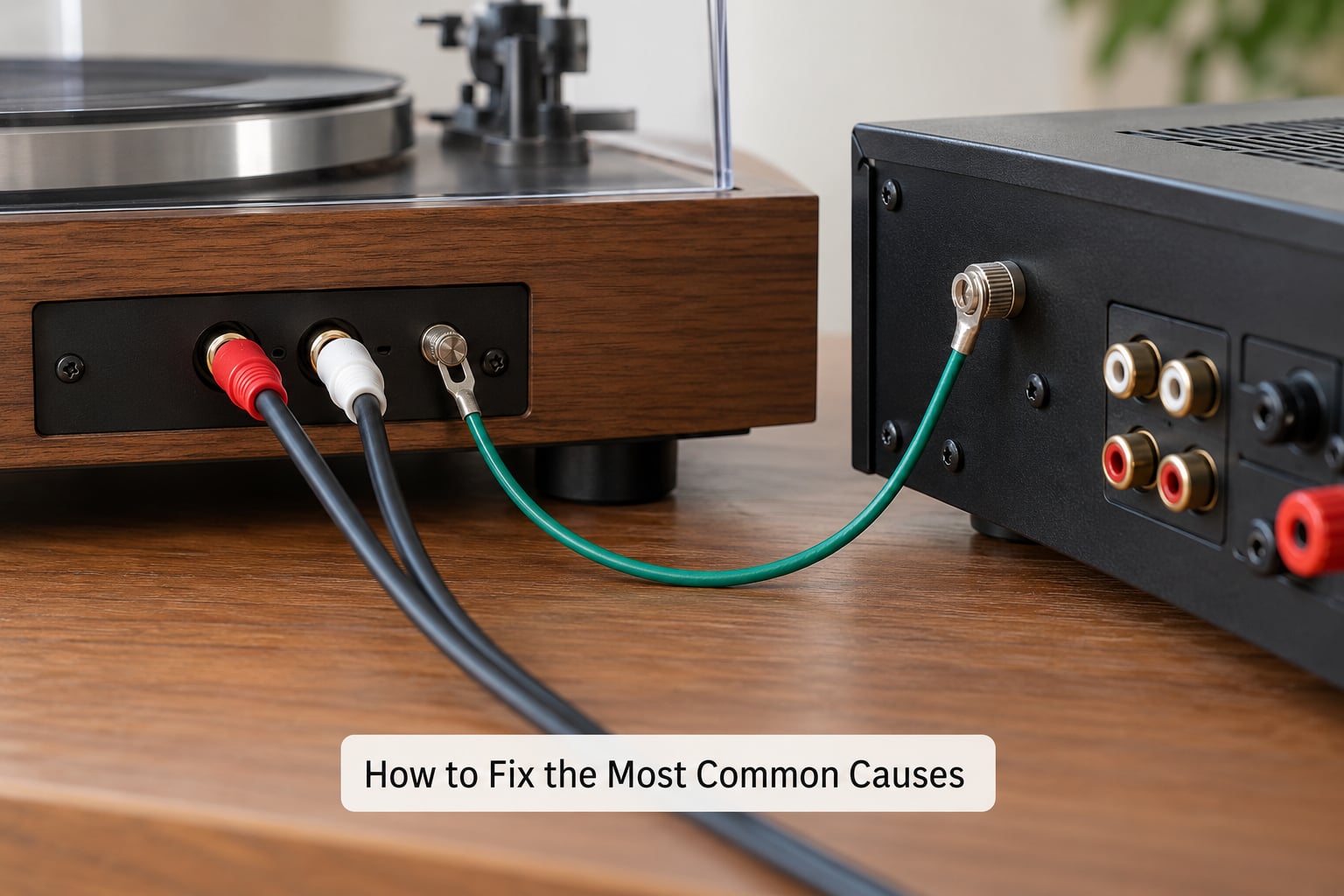
Work in this order. Each step is cheap, and stopping at the first one that changes the symptom saves you the rest.
How to stop buzzing from turntables: the 10-step order
- Turn everything off and unplug the turntable. Do all connection work cold.
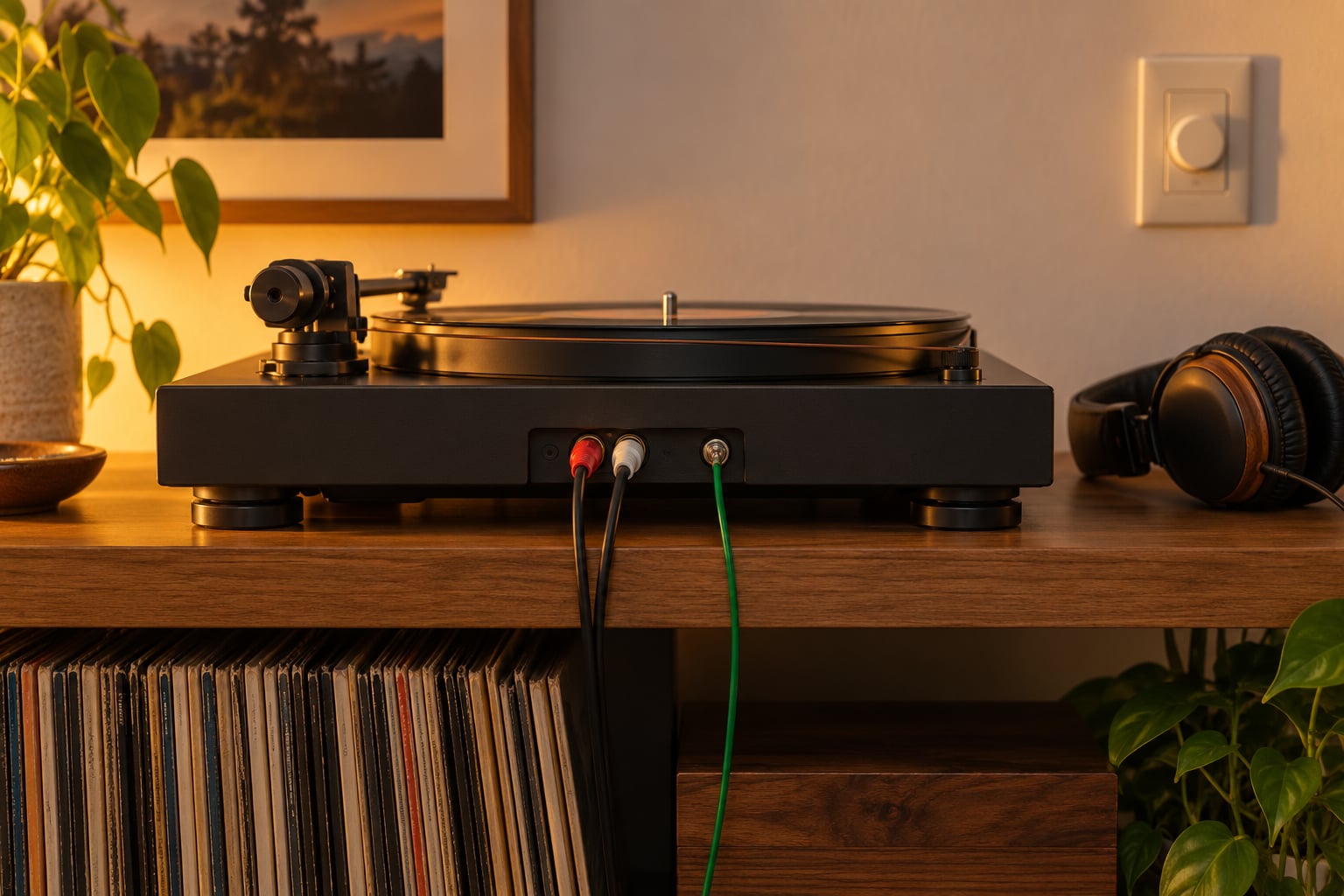
- Reseat the ground wire. Unscrew the ground post on the amplifier, strip a little fresh copper, and refit it bare. No need for a lug crimp at the post end; bare copper under the nut is the normal arrangement.
- Reseat and rotate the RCA plugs. Push each one fully home, then turn it about a quarter turn so the spring contacts bite into the socket plating.
- Check the cartridge lead colours. Red is right, green is left, blue and white are the two grounds. Any other pairing causes hum or a dead channel.
- Clean the contacts. Isopropyl alcohol on a cotton swab for the cartridge pins and the RCA pins, and a shot of contact cleaner on the ground post.
- Reroute the RCA cables. Keep them away from the amplifier’s power transformer, and run them alongside rather than parallel with mains cables.
- Reverse the AC plug in the wall socket. On a non-polarised two-prong cord this flips which side the leakage comes in on. It costs nothing and it fixes a surprising share of cases.
- Swap the RCA cable. If a different cable kills the hum, the old one was unshielded or damaged.
- Connect only the turntable. Unplug every other source, then add them back one at a time. Whatever makes the hum appear is the culprit.
- Isolate the ground last. A ground loop isolator or a deliberate missing ground wire tells you the fault is a loop. Leave it as a diagnostic result, not as the final setup.
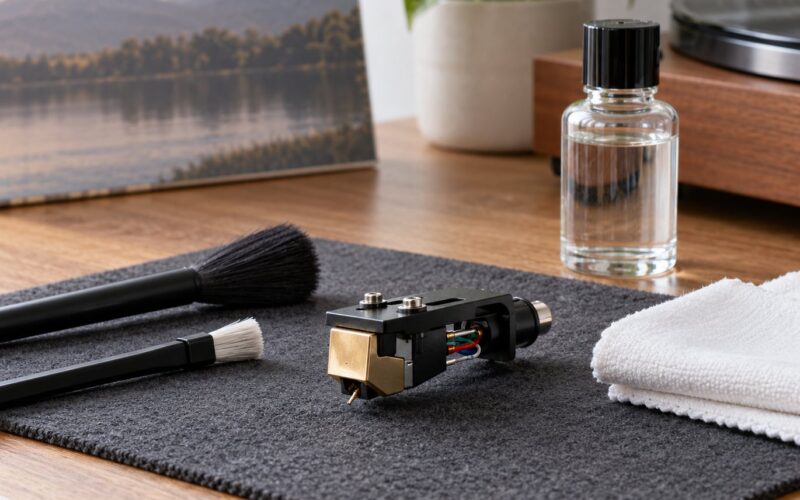
Cleaning cartridge pins and headshell contacts with isopropyl alcohol on a swab, then gently brightening them with a jeweller’s screwdriver, has resolved touch-dependent hum on setups that had already been checked for ground wire seating.
Also rule out the neighbours. Dimmer switches, LED lighting, computer power bricks, phone chargers and cable boxes all inject noise into a phono-level input. If the hum comes and goes with the lights, that is your answer.
Static crackle or ground fault? How to tell them apart
Hum and static get confused constantly, and they are fixed in completely different ways. Hum is a steady tone at the mains frequency. Static is irregular, and it usually means humidity or a dirty contact rather than a grounding problem.
| Sound | Does touching change it? | Volume behaviour | What fixes it |
|---|---|---|---|
| Steady 50/60 Hz tone | Yes, clearly | Grows with volume | Ground wire, RCA seating, isolation |
| Ragged crackle on touch | Yes, intermittently | Unpredictable | Contact cleaning, lower humidity |
| Rumble that changes with the record | No | Constant | Motor isolation, record cleaning |
| Warble or wobble in the music | No | Constant | Finger lift tightness, bearing, stylus |
Hum you can make come and go with your hand is an electrical fault. Hum that ignores you completely and travels with the music is mechanical.
Do I Need a New Ground, Cartridge, or Power Supply?
Almost never, and replacing parts before checking connections is the most expensive mistake owners make here. Work through the ten steps first, because a two-minute reseat solves the majority of cases.
A new ground wire or a fresh set of shielded RCA cables is reasonable if step 8 confirms a bad cable, or if your existing cables are visibly unshielded. A replacement cartridge makes sense only if hum persists with the arm wired down, the RCA pins shorted to ground at the turntable end, and a different phono input still showing the same noise.
A step-up transformer for a low-output moving coil cartridge changes the grounding topology completely, and a faulty one inside it is a common source of hum that gets blamed on the turntable. Vintage belt-drive decks with hum that changes with platter speed point at the motor or its isolation rather than the audio path.
Do not open anything that exposes mains-voltage wiring to find these faults. Test from the sockets outward, and hand anything past the RCA connections to a technician.
When Should I Stop Troubleshooting and Get Help?
Stop and get help when the symptom goes beyond hum you can influence by touching metal. A definite shock sensation, a burning smell, visible scorching or melted insulation, or a power supply that ticks or whines loudly under load all belong to a technician.
Also stop if the hum follows the turntable to a completely different amplifier in a different room. That points at internal wiring or a failing motor rather than the ground path, and it is no longer a connector job. If the deck is out of warranty, a manufacturer service centre is usually cheaper than the parts you would otherwise buy.
One honest possibility worth naming: the turntable may be fine. RCA cables, the phono stage inside the amplifier, and the wall wiring itself all produce identical symptoms, and swapping in a known-good cable costs less than any part you would order for the deck.
Frequently Asked Questions
Why does my turntable hum when I touch the tonearm?
Touching the tonearm couples your body’s capacitance to metal that is not at the same reference as the phono stage, which lets mains hum into a very high-gain input. If the buzz jumps when your finger is on the arm tube and drops away when you let go, the arm wiring is probably unshielded or not bonded to the ground post. Touch the RCA cables too: a jump there means cable shielding or routing instead. A steady tone that ignores your hand entirely is a different fault.
How do I stop buzzing from my turntable?
Start with the ground wire at the amplifier, reseat it bare under the nut, then push the RCA plugs fully home and give each a quarter turn. Check the cartridge lead colours: red right, green left, blue and white both grounds. Clean the pins with isopropyl alcohol and a swab, keep the RCA cables away from power transformers, and reverse the AC plug as a free test. Only after all of that is clean should you consider a ground isolator.
Is this static or a ground fault?
Static is irregular crackle, often linked to humidity or a dirty contact, and it does not respond predictably to your hand. Hum is a steady 50 or 60 Hz tone that grows louder as you turn the volume up and changes the moment you touch the metal. If the sound is a single unchanging pitch, it is hum and the cause is grounding or shielding. If it comes and goes in bursts, clean the contacts first and try lowering humidity.
Should I use a ground loop isolator for my turntable?
Use one as a test, not as a cure. Breaking the ground link tells you immediately that the hum is a ground loop, which narrows the fault to multiple ground paths. Leaving it installed just hides the loop, and the loop keeps circulating. Find the extra ground point instead: usually a second earth on the shelf, a metal furniture bridge, or a component grounded twice in the chain.
Why does my turntable hum louder at high volume?
Because the hum was always there and the volume control only reveals it. The phono stage amplifies very small signals, so a steady interference signal rises with everything else as you turn the knob. If the hum is audible only above roughly half volume and touching the table makes it start earlier, you have a marginal ground path rather than a volume-related fault. Turn the volume down and you are simply hearing less of a signal that never went away.
Can a bad RCA cable cause turntable hum?
Yes, and it is easy to miss. A cable with a broken shield or a poor ground connection behaves exactly like a loose ground post. Swap in a known-good shielded cable for a minute: if the hum vanishes, the cable was the fault. Cheap moulded plugs with thin shields cause this constantly. Never run the phono-level cables parallel to mains wiring or along the base of an amplifier with a large power transformer.
Conclusion
Unplug the turntable, then reseat that ground wire at the amplifier and push the RCA plugs in properly. Run the touch ladder once, note whether the buzz jumps on the plinth, the tonearm or the cables, and that single result usually tells you which subsystem to work on next. Only after the connections are clean should you be weighing a cartridge, a cable or a service visit.