If you want the short version of the cork vs felt vs rubber turntable mat debate: cork is the best all-rounder for most home listeners, rubber wins on grip and survives rough handling, and felt is really a DJ tool that most home setups are better off without. The one thing that overrides all three is your room — a dry winter climate pushes you toward rubber, a humid summer room pushes you toward cork.
That caveat matters more than any brand name. Owners who love their cork mat often bought it in July and discovered the sticking problem come February.
Table of Contents
- Cork vs Felt vs Rubber Turntable Mat at a Glance
- What Is a Turntable Mat, and What Does It Do?
- Cork Turntable Mat: Natural Grip and Practical Protection
- Why cork grips vinyl
- Where cork falls short
- Felt Turntable Mat: Softness, Dust Control, and Minimal Resonance
- Rubber Turntable Mat: Strong Grip and Stable Playback
- Cork vs Felt: Which Is Better for Vinyl Records?
- Cork vs Rubber: Which Offers the Best Record Grip?
- Felt vs Rubber: Which Is Better for Noise and Cleaning?
- How to Choose the Right Turntable Mat for Your Setup
- How to Test and Maintain a Turntable Mat
- Frequently Asked Questions
- What is the best material for a turntable mat?
- Which is better for my turntable, a cork mat or a felt mat?
- Are turntable mats necessary?
- Is cork a good turntable mat?
- Why does my felt mat stick to the record?
- How thick should a turntable mat be?
- Conclusion
Cork vs Felt vs Rubber Turntable Mat at a Glance
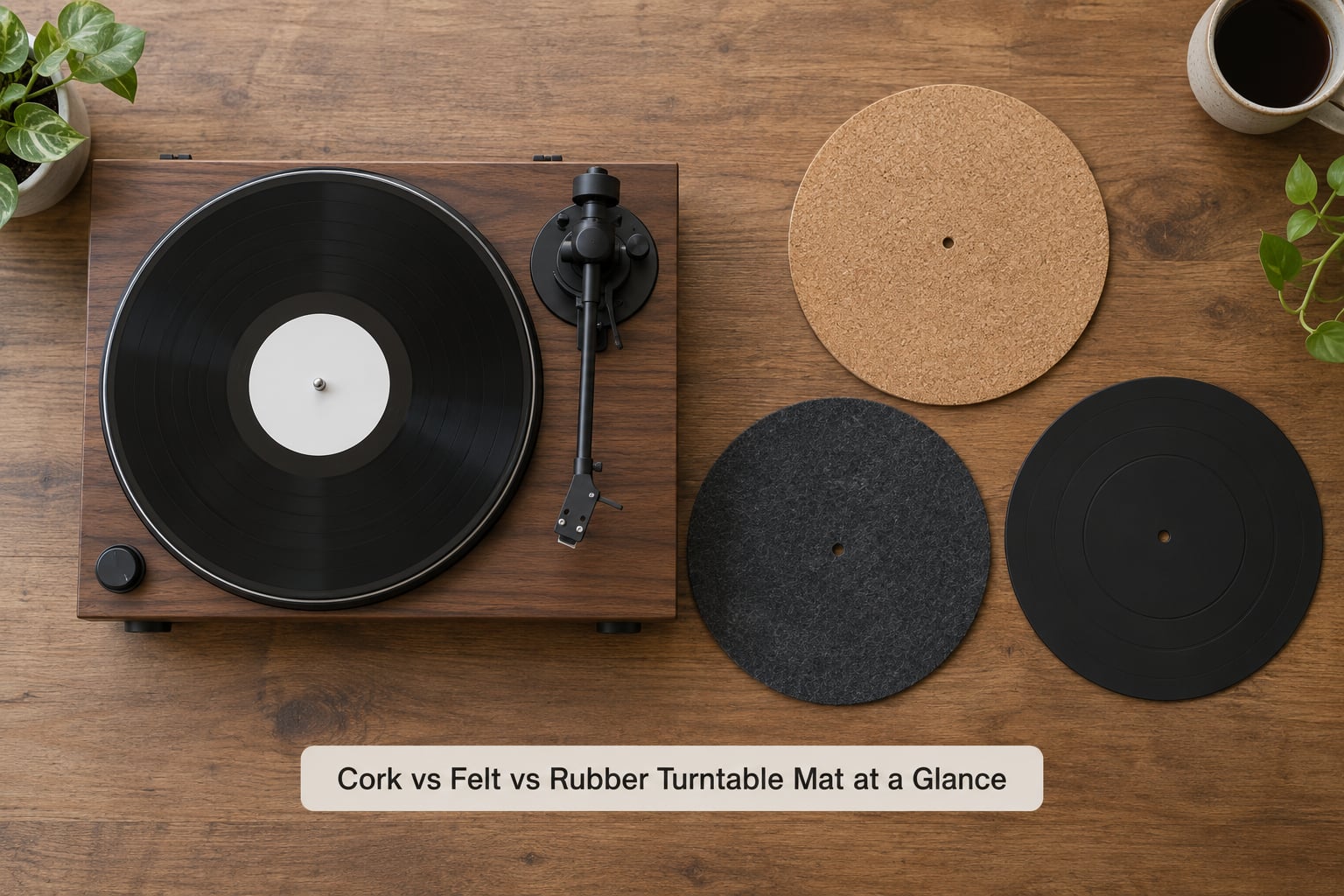
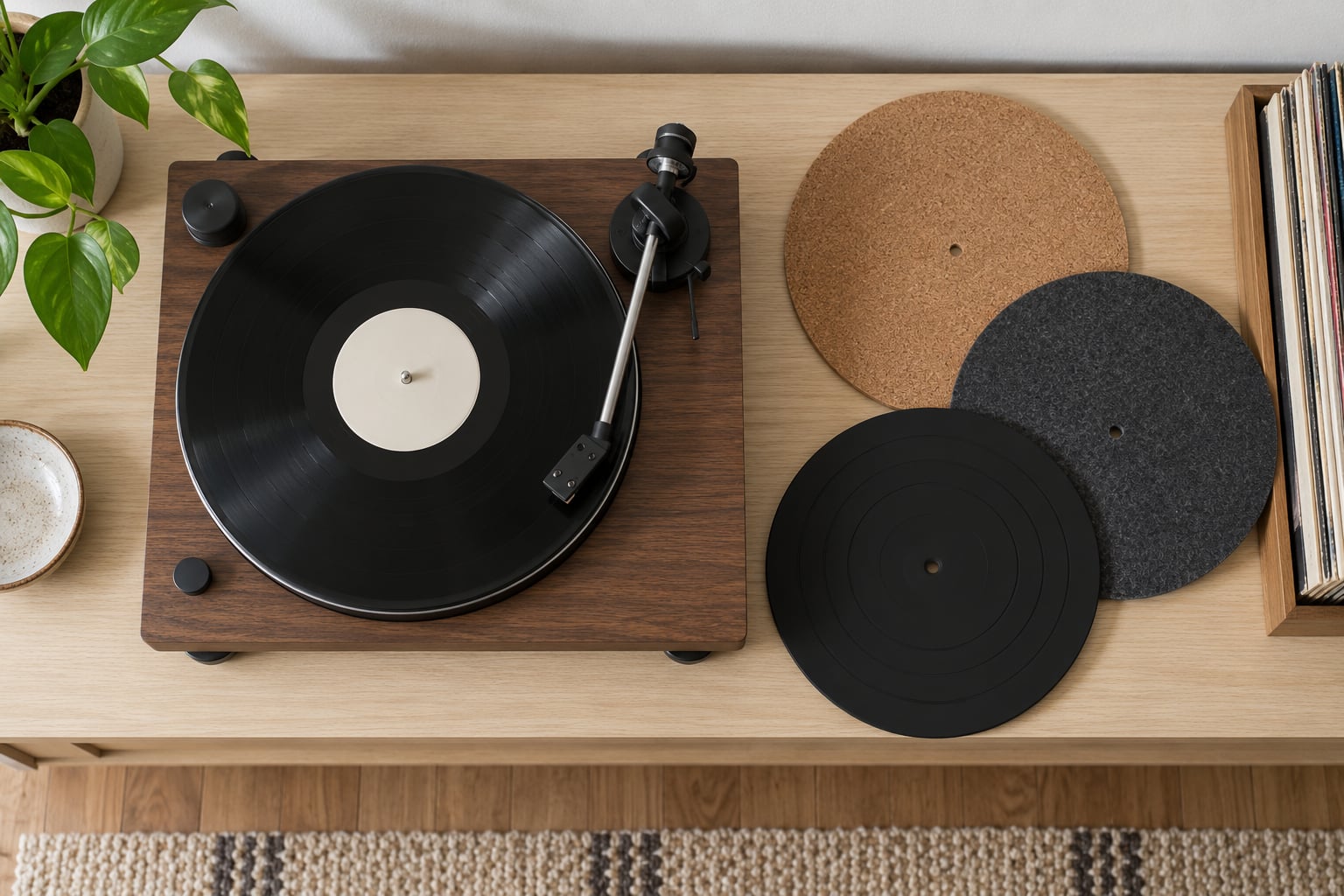
The three materials behave very differently once you look past the surface. Cork is open-pore and grips moderately, felt is soft and quiet but dusty, and rubber is closed-pore with the strongest bite. Here is how they stack up on the things that actually change your listening experience.
| Attribute | Cork | Felt | Rubber |
|---|---|---|---|
| Grip on the record | Moderate | Light, and loosens when dusty | Strongest |
| Anti-static behaviour | Good in humid air, can cling in dry air | Poor in dry air, the classic sticking problem | Plain rubber is poor; carbon-loaded rubber is good |
| Dust handling | Traps dust in open pores | Attracts dust and hair on the surface | Sheds dust, easiest to wipe clean |
| DJ scratching and hand cueing | Too little slip | The standard choice | Holds a record still while the platter spins |
| Long-term durability | Can crumble and flake with age | Wears and thins at the centre | Best, if you buy a decent grade |
| Cleaning | Brush and wipe, never wet | Regular brushing, picks up everything | Damp wipe, dries fast |
| Odour | None | None | Cheap grades can smell of hot rubber |
| Best for | Balanced everyday listening | DJs and hand cueing | Dry rooms and maximum grip |
What Is a Turntable Mat, and What Does It Do?
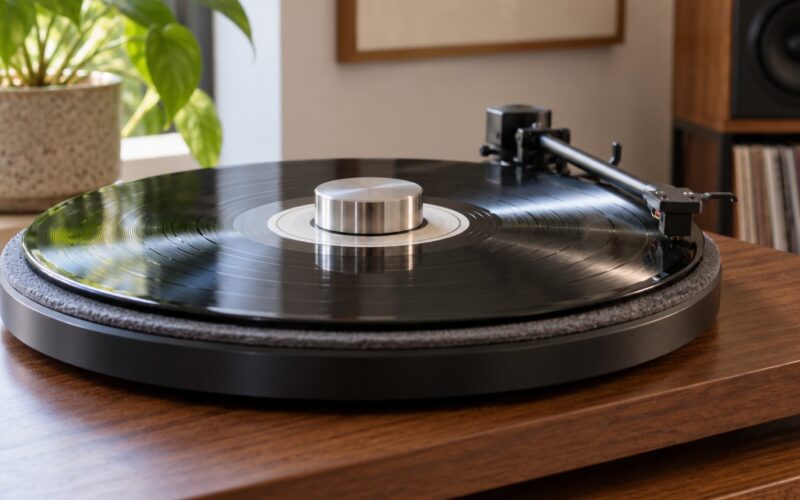
A turntable mat is the thin circular pad between your record and the platter. It grips the record so it spins with the platter instead of sliding, protects the vinyl from a hard metal surface, and changes how the platter’s resonance couples into the record.
It also does two more jobs people rarely notice. It gives the stylus a slightly softer, more forgiving surface, and it catches a certain amount of dust before that dust reaches the grooves.
What it does not do is replace a proper felt slipmat for cueing, or fix tracking problems that come from a worn stylus or a badly aligned cartridge. Nor does it substitute for an isolation platform. If your deck is on a table that thumps, the mat is the least of it.
One honest note before the deep dives: the big sonic claims attached to mats are mostly marketing. The measurable differences between a decent mat and a bad one are small — noise floor and resonance control, mostly. If you have a store credit and something else needs buying, buy the cartridge first. Most owners who have tried several mats say the same thing: the change is real but small, and the mat swap is a cheap experiment rather than an upgrade.
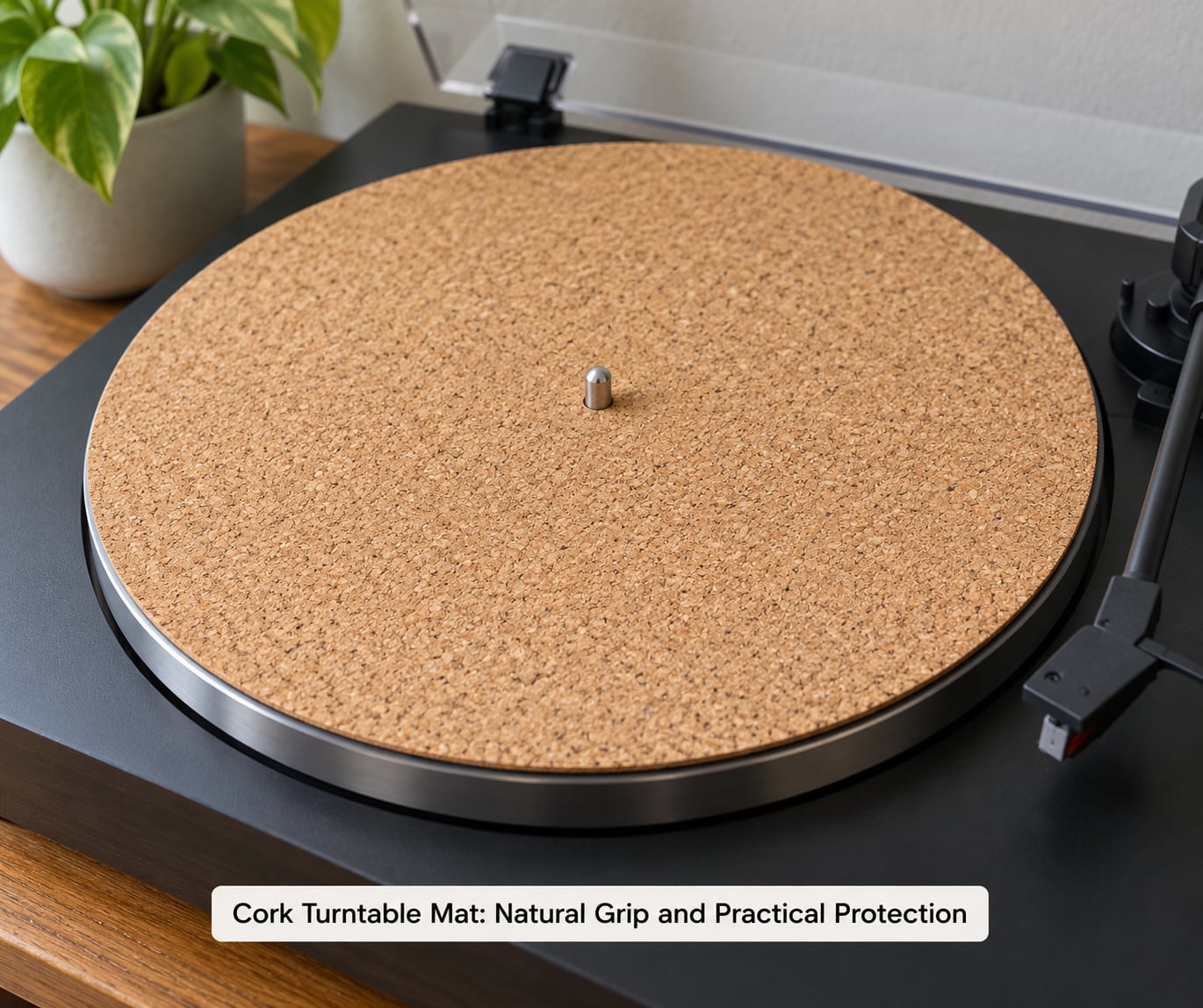
Cork Turntable Mat: Natural Grip and Practical Protection
Why cork grips vinyl
Cork’s surface is made of thousands of tiny open pores, and those pores give it a gentle, all-over grip. You can lift a record off a cork mat with one hand, which is exactly what you want on a home deck. It is a compromise material, and that is its main appeal: more grip than felt, more warmth than rubber, fewer problems than either in most rooms.
Where cork falls short
The open pores are also cork’s weakness. Dust settles into them instead of being wiped away, and an AudioKarma user made the point clearly in a long thread: open-pore mats trap dust that later gets ground into the grooves. Closed-pore rubber does not do that.
Then there is crumbling. Older or cheaper cork mats break down with age and start shedding grit onto the record, which creates crackle that people often blame on the stylus. And in dry winter air, a light cork mat can bond electrostatically to the vinyl. One owner wrote about lifting an album off the turntable and having the mat come with it, then having to work a fingernail between the two to separate them.
So cork is a genuinely good mat in humid air and a debatable one in dry air.
Felt Turntable Mat: Softness, Dust Control, and Minimal Resonance
Felt earns its place on a DJ deck and almost nowhere else. It gives your hand almost nothing to grip on, which lets you hold a record still while the platter keeps spinning underneath — that is the hand-cueing move, and no other material does it as well.
For home listening, most owners skip it. One AudioKarma user put it plainly: two of their turntables came with chintzy felt mats, and they went straight in the garbage. The complaints are consistent — felt attracts dust, hair and pet hair, and the mat plus the record both need cleaning constantly.
The bigger problem is static. Felt is usually wool, which holds a charge in dry air, and a light felt mat sitting on a light platter gives the charge nowhere to go. That is the sticking problem again, and it is worse on felt than on cork. Felt also does very little to damp platter resonance, so a record that rings on your deck keeps ringing.
If you are not cueing by hand, felt is asking for trouble.
Rubber Turntable Mat: Strong Grip and Stable Playback
Rubber is the standard-issue material for a reason. It grips harder than cork, sheds dust instead of holding it, wipes clean with a damp cloth and outlasts almost anything else you can put on a platter.
But there are two very different rubbers, and treating them as one thing is the most common mistake in this whole discussion. Cheap OEM rubber is soft, dull and non-conductive — one r/vinyl owner put it bluntly that rubber is just as bad at static as felt is. Carbon-loaded rubber is a different material: it is filled with conductive carbon, so charge bleeds off rather than building up.
Thicker rubber also changes how the mat sits under the record. Go much thicker than the original and cueing starts to feel forced, which is a complaint people have with heavy rubber and with cork-rubber composites in particular.
One more thing nobody mentions until they hit it: cheap rubber can develop a burnt-rubber smell after a long session. It is harmless but it lingers.
Cork vs Felt: Which Is Better for Vinyl Records?
Cork, for almost every home setup. The two materials only compete when the record has to be held still by hand, and that is a DJ technique rather than a listening one.
In every other respect cork wins on grip and on record protection, and it loses only on cleaning — felt’s dust problem is real enough that many owners end up cleaning both the mat and the record every time they sit down. One AudioKarma reply captures the practical split: rubber or cork for a home deck, and away from felt, because felt will slide on a metal platter.
Cork vs Rubber: Which Offers the Best Record Grip?
Rubber grips better. That is not opinion — it is the reason a rubber mat lets you lift a record with one hand and why DJs can hold one still on a spinning platter, which cork will not reliably allow.
Cork grips well enough for normal playback, though, and it protects your vinyl better in the long run. Rubber is harder, so it puts more wear on the record over years of use, and cheap grades can leave residue. The caveat for rubber is that the grip you feel is a function of the rubber’s hardness and thickness, so a very soft cheap mat may grip less than a decent cork one.
For stable everyday playback, rubber wins. For records you want to keep for a decade, cork is the safer bet.
Felt vs Rubber: Which Is Better for Noise and Cleaning?
Rubber, on both counts. Closed-pore rubber sheds dust and wipes down in seconds; felt needs a brush every time you use it and still looks grubby.
On noise, the answer depends on what you are hearing. Felt is soft and does very little to damp platter resonance, so a resonant deck stays resonant. Rubber adds damping and a little mass, which takes the edge off some of that. The honest caveat is that both changes are subtle compared with a good isolation platform or a properly set-up deck.
Felt does have one edge: it is gentle on the stylus during hand cueing. For playing records, rubber is cleaner and quieter.
How to Choose the Right Turntable Mat for Your Setup
Start with the problem you actually have. If records pop and cling in winter, you need grip and conductivity, which means rubber, ideally carbon-loaded. If dust is the issue, you want a closed-pore surface you can wipe down, which again means rubber. If your room is humid and you want something gentle and quiet, cork is the sensible pick.
Then look at your deck. On a metal-platter belt-drive — a Rega Planar, a Pro-Ject Debut, an Audio-Technica LP-120, a vintage Yamaha — the mat matters, because a bare metal platter is hard and cold to the vinyl. On a DJ deck such as a Technics SL-1200 or SL-1950, use whatever the manual expects and follow it if you play tricks. On an acrylic platter, many owners run matless and rely on a felt slipmat only for cueing.
Finally, be honest about maintenance. Cork needs a dry brush and no moisture. Felt needs frequent attention. Rubber just needs a damp cloth. If you know you will not maintain anything, choose the material that forgives you.
How to Test and Maintain a Turntable Mat
Match the thickness of the mat you are replacing before you buy anything. Two and three millimetre mats are the common sizes, and the single most repeated tip across the turntable forums is to check your original and match it. A noticeably thicker mat changes the feel of cueing and can sit proud enough to interfere with the stylus on some setups.
Install it dry, on a clean platter. Check for a lip or a raised edge — older felt and rubber mats curl and can make the record wobble, which shows up as speed variation rather than a tracking fault. Never glue it down unless the deck genuinely needs it, and never put anything wet on the platter surface.
Cleaning depends entirely on the material. Cork gets a soft brush and a dry wipe, because moisture wrecks it and promotes crumbling. Felt gets a brush and a barely damp cloth, worked in one direction so you do not grind grit in. Rubber can take a damp cloth and dries quickly. Let any of them dry fully before you cue a record.
Replace a mat when it hardens, sheds material, holds a charge no matter what you do, or when it simply will not come clean. Once dust is permanently ground into pores, no amount of cleaning gets it back.
Frequently Asked Questions
What is the best material for a turntable mat?
For most home listeners, cork is the best all-round material because it grips well, feels gentle on vinyl and stays quiet. Rubber grips harder and cleans more easily, which makes it the better pick in dry winter rooms where static is a problem. Felt is the best choice only if you hand-cue and scratch. Your local humidity matters more than any brand.
Which is better for my turntable, a cork mat or a felt mat?
Cork wins for home listening. It holds a record firmly enough to lift with one hand, protects the vinyl better, and dampens platter resonance more than felt. Felt is softer, which is exactly what you want for hand-cueing on a DJ deck, but it attracts dust and hair, cleans badly and does little to control resonance. Choose felt only if you cue by hand.
Are turntable mats necessary?
Not strictly — many decks run fine without one, and acrylic-platter setups often do. A mat does help by giving the record grip, protecting vinyl from a hard metal platter and damping platter resonance. If your turntable already plays records cleanly and does not slip, the mat it came with is probably fine. Swapping one is a cheap experiment, not an upgrade you need.
Is cork a good turntable mat?
Yes, with one caveat. Cork grips nicely, feels gentle on vinyl and works with every platter type, and it handles humid air well. The two problems are that its open pores trap dust and grind it into grooves, and that older cork mats crumble and flake. In dry winter air it can also stick to the record, so check your room humidity before choosing it.
Why does my felt mat stick to the record?
It is static, not glue. Felt is usually wool, which holds a charge, and dry winter air makes it worse because there is no moisture in the air to dissipate the charge. A light felt mat on a light platter gives that charge nowhere to go, so it bonds to the vinyl. Lift by the label edge, and consider a carbon-loaded rubber mat or a Zerostat gun instead.
How thick should a turntable mat be?
Match whatever came with your turntable. Two and three millimetre mats are the common sizes, and the most repeated advice on turntable forums is to check the original before buying. Going thicker changes how cueing feels and can leave the mat sitting proud enough to interfere with the stylus on some setups. Going thinner loses most of the damping benefit.
Conclusion
Pick by priority rather than by reputation. Start with cork for a balanced everyday setup that treats vinyl gently, choose felt if you hand-cue and scratch, and go with rubber — carbon-loaded if you can find it — when you want the strongest grip and the easiest cleaning, especially in a dry room. Match the thickness of the mat you already have, and test one record on each before you commit.
That is really the whole cork vs felt vs rubber turntable mat argument. Try both, keep the one that does not make you peel your records apart in February.