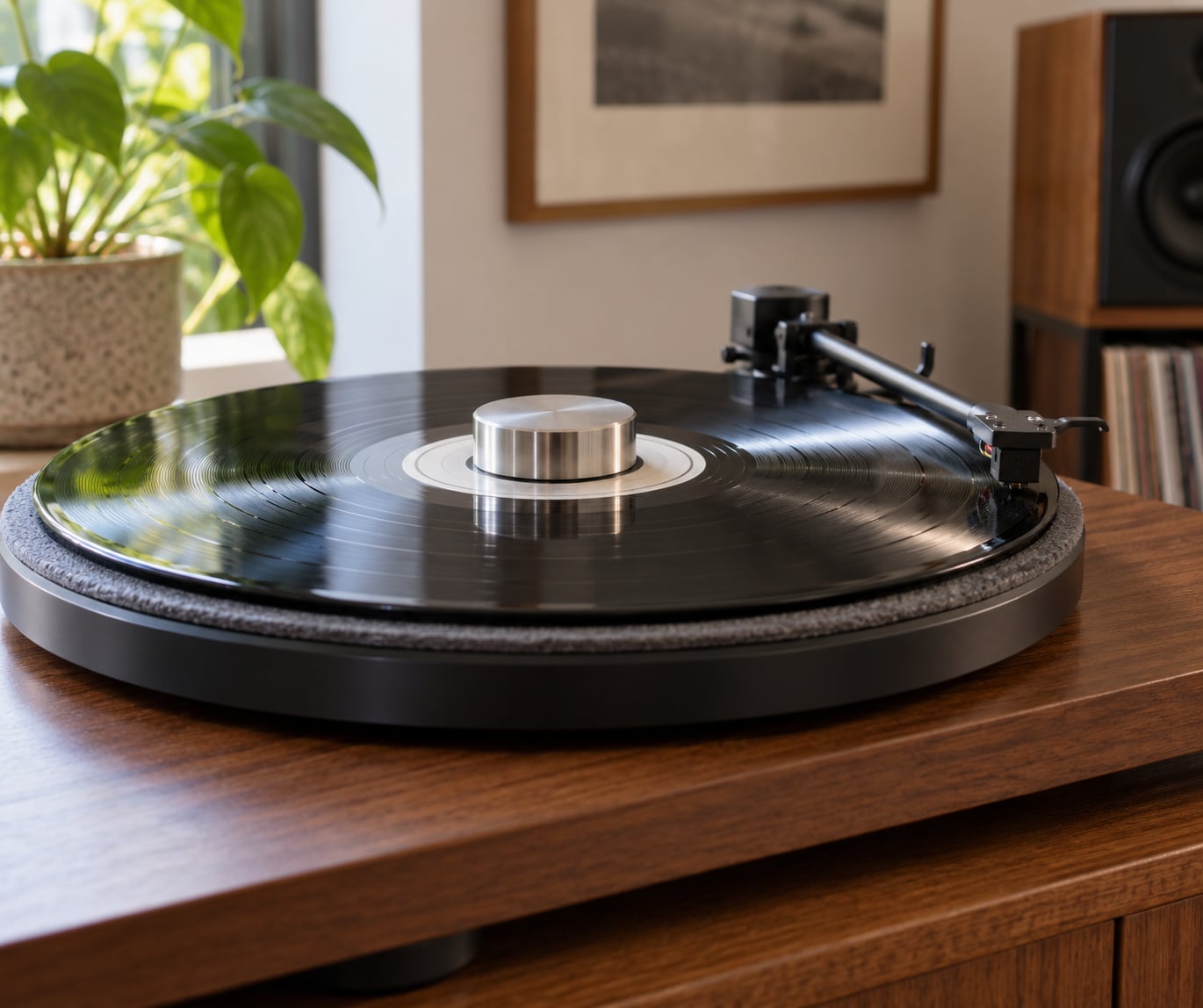
A record weight is a small, heavy puck that drops over the centre spindle of your turntable and rests on the record label, adding downward mass so the disc stays seated against the platter. So what does a record weight do, in plain terms? It presses a gently warped record back into full contact so the stylus stops skipping, and it damps the tiny movements a bare platter allows. It is a handling tool first and a sound upgrade second, if that at all.
Quick answer: A record weight adds downward force at the spindle to keep a spinning record flat and coupled to the platter, reducing movement caused by warp, vibration or an accidental bump. It does not remove scratches, repair a damaged record, or replace correct cartridge setup.
Table of Contents
- What Does a Record Weight Do?
- How Does a Record Weight Affect Vinyl?
- What Is the Purpose of a Record Weight?
- Does a Record Weight Make Records Sound Better?
- What Kind of Record Weight Should You Use?
- How Do You Use a Record Weight Without Damaging Vinyl?
- Do You Need a Record Weight on Every Turntable?
- Record Weight vs. Record Cleaning and Other Setup Tools
- Frequently Asked Questions
- Do record weights damage vinyl?
- Does a record weight reduce crackle or improve sound quality?
- Is a heavier record weight always better?
- Can I use a record weight with 7-inch records?
- What should I do if my record still wobbles or skips?
- Conclusion
What Does a Record Weight Do?
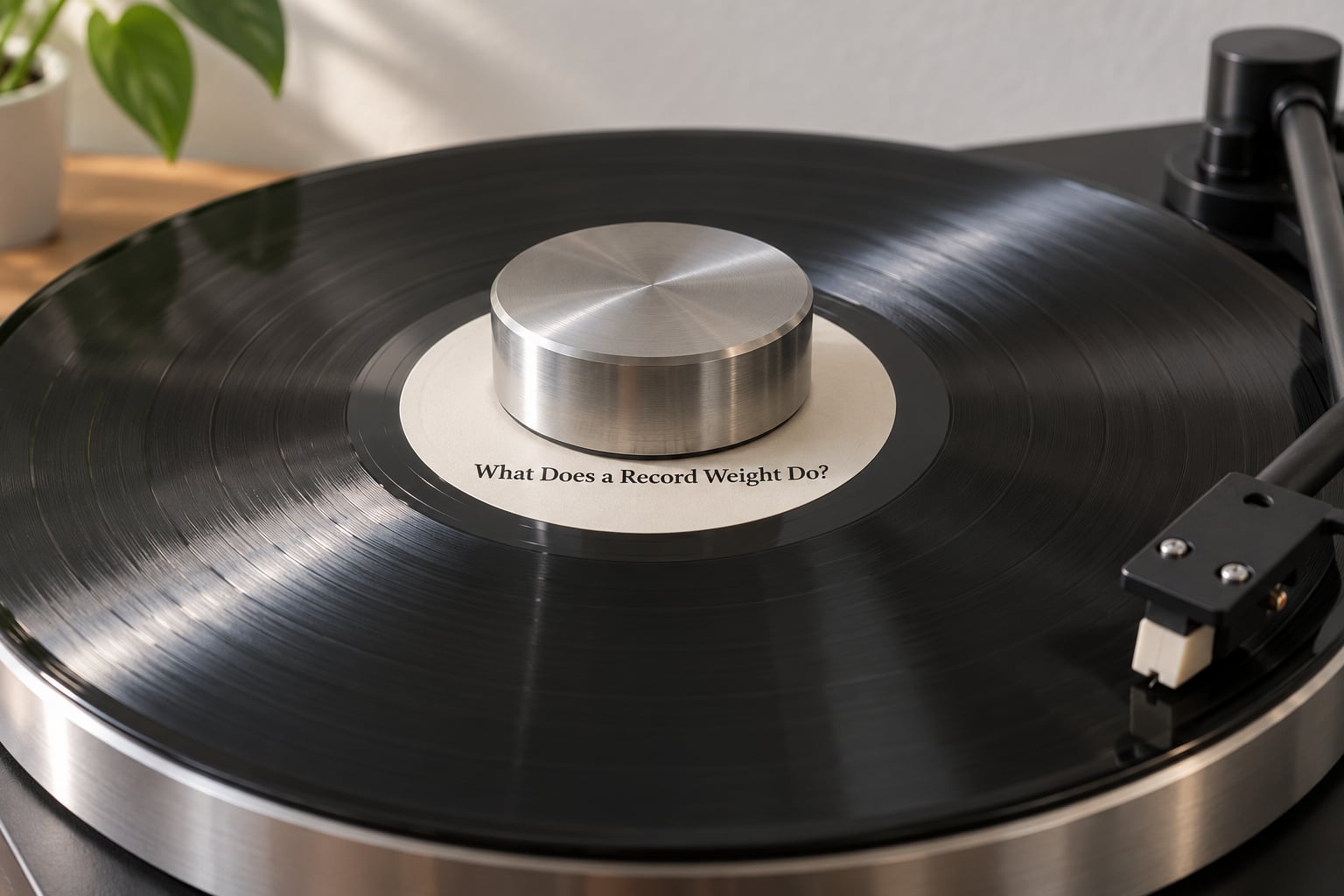
The job is contact. A 12-inch LP is a thin, slightly flexible disc that sits on a mat, and at any moment parts of it may be sitting a fraction of a millimetre above the platter. A weight sitting on the label pushes the centre area down, and that pulls the rest of the disc into contact with the mat.
That contact is what stops the small hop that makes a stylus skip, what keeps a disc from creeping sideways during a long side, and what stops a knock on the cabinet from shifting the record under the stylus.
What it does not do is worth stating plainly. It will not make a scratched record sound unscratched, it will not fix a record with a deep groove crack, and it will not correct a cartridge aligned badly or a tonearm tracking too heavily. Anyone selling it as a cure-all is selling you something.
| Setup | What the record sits on | Typical result on a slightly warped disc | Best for |
|---|---|---|---|
| Bare platter, no weight | Rigid platter or thin mat | Warp shows as a slow float, occasional skip | Flat records, decks with a well-engineered mat |
| Lightweight clamp or puck | Label plus a soft contact pad | Most small dish warps settle; edge-lift barely changes | General use, suspended and light sub-chassis decks |
| Heavier weighted clamp | Label under firm, wide pressure | Centre dish sits flatter; no help for an edge-lifted warp | Mass-loaded decks where the manual permits extra load |
How Does a Record Weight Affect Vinyl?
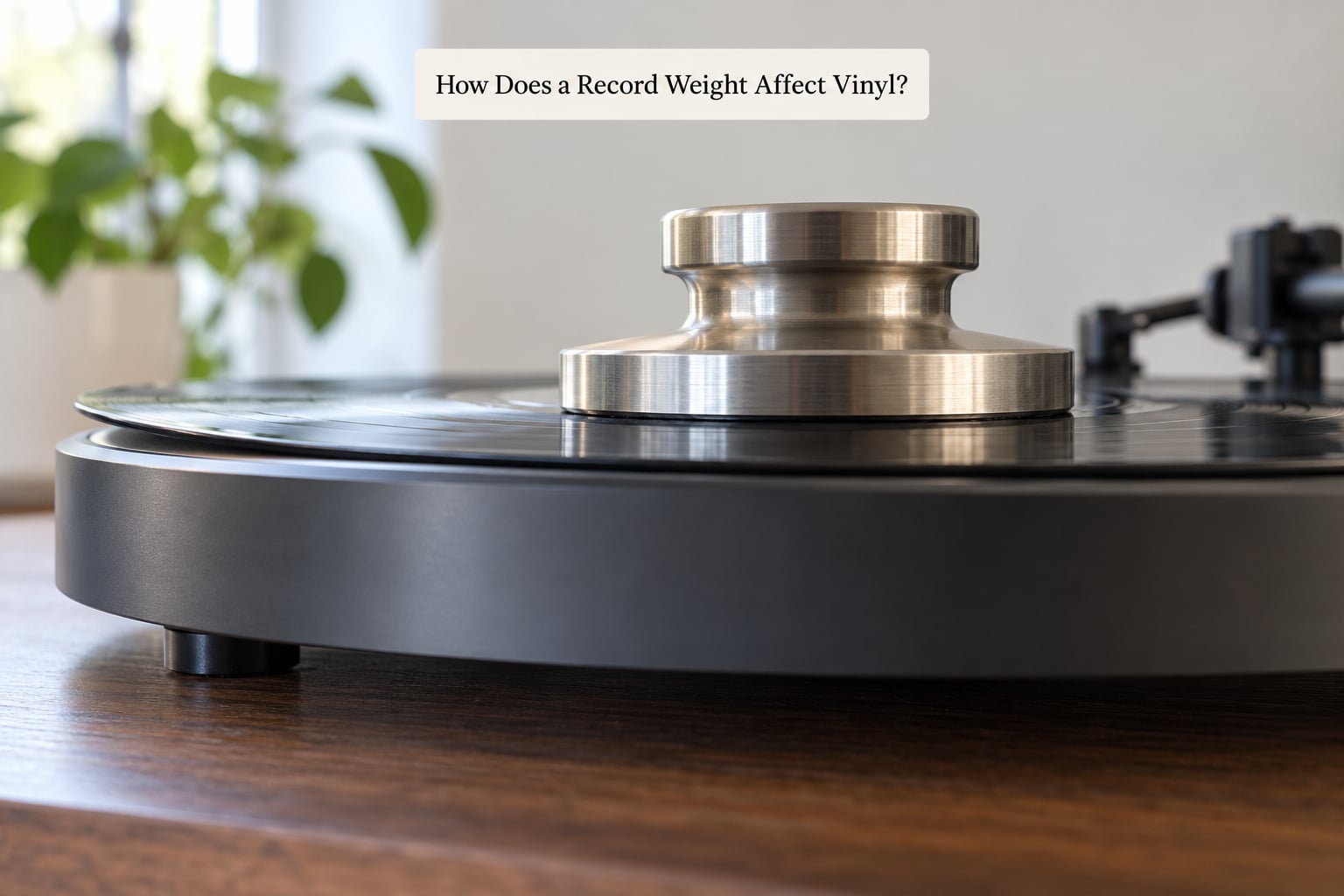
Think about what the weight physically touches. It presses on the label, and the label is bonded to the centre of the disc, so the force travels outward through the vinyl and into the mat. Everything between the label and the outer groove moves together, which is why a centre-dish warp responds and an edge-lift warp does not.
Three things happen, in order:
- The record is located. The spindle hole has about half a millimetre of clearance, so a disc can sit very slightly off-centre. The weight fits over the spindle and takes up that slack, so rotation stays true.
- Contact improves. A bowed section of vinyl is pulled down onto the mat, and the stylus crosses the groove at a consistent height instead of riding up and dropping back.
- Movement is damped. The label area no longer shifts independently of the platter, so energy from footfall, a motor rumble or a bass note has one path into the deck rather than several.
Notice what is missing from that list. The weight does not make the platter heavier in any useful way for the motor, because the load sits above the bearing, not below it, and it does not remove vibration energy. It mostly removes a degree of freedom.
That distinction matters. Reducing wobble is a mechanical result you can see with your fingertip on the outer edge as the record turns. Improving audio is a perceptual claim, and the two are frequently confused.
What Is the Purpose of a Record Weight?
Legitimate uses, roughly in order of how often they matter:
- Rescuing a warped record. The single best case. A disc with a gentle centre dish often plays through cleanly under a weight and skips without one.
- Keeping a record seated. On a shared shelf or in a household with a bass-heavy speaker in the same room, a record that shifts mid-side is a ruined side.
- Consistent 7-inch cueing. Owners on the Test Pressing forum repeatedly describe a weight making the drop on small singles land the same way every time, because the 7-inch centre hole has proportionally more play in it.
- Routine setup and cleaning. Holding the disc steady while you brush or measure runout is genuinely useful, even if you never weight it again.
- Aesthetics and label hiding. A puck also hides an unreadable label. Nobody will pretend that is an audio benefit, but it comes up in almost every forum thread on the subject.
Then there are the misconceptions. One Test Pressing poster described being convinced the sound improved, then realising later that the difference was nothing. Another owner who tried many weights ended up playing without one because he could never hear an improvement, and kept it only for wobbly records. That split is the honest consensus.
Not to be confused: A record weight accessory is not the same as a 180-gram pressing, which describes how thick the vinyl itself is, and it is not the tonearm counterweight at the back of the arm. A thicker pressing does damp micro-movement more than a thin one, but both are pressed with the same groove geometry, so the heavier disc is not inherently better sounding.
Does a Record Weight Make Records Sound Better?
On a flat, undamaged record, almost certainly not in any way you could prove. On a warped one, it can be the difference between playing an album and binning it, which is a far bigger deal than tonal refinement.
Added mass does not inherently reduce vibration. Mass resists acceleration, and a weight on top of a record does not make the record sit more still, it makes it resist being nudged. Real damping needs a soft, lossy material that absorbs energy and turns it into heat, which is why cork and rubber contact pads exist.
If a weight does seem to change the sound, the more likely explanations are that a warp stopped skipping, that a mat is now loading the disc differently, or that you are listening to a different track than you remember. Cartridge alignment, tracking force, mat material, groove condition and correct speed all move the result far more.
You can test it yourself in ten minutes:
- Choose a record you know well, ideally one with a stable, undamaged outer edge.
- Play the same side twice, first bare and then weighted, at the same volume and with the cartridge unchanged.
- Watch the outer edge in good light during both passes and note whether the float changes.
- Reverse the order on a second track so your ear cannot simply remember which came first.
- Only believe a tonal change if you hear it twice, in both orders.
| What you notice | What it actually points to | Try this first |
|---|---|---|
| Random pops and crackle | Dirt in the groove or a worn stylus | Brush, then wet clean; check stylus wear |
| Skips at the same track every time | A local warp or a raised scratch | Try a weight, then check that groove under a loupe |
| Skips in different places each play | Tracking force too low, or an anti-skate problem | Measure tracking force with a gauge |
| Slow drift in pitch | Wow and flutter, often from a heavy or sticky off-centre record | Re-seat the disc and re-check the bearing |
| Warmer or duller sound with the weight on | Different mat loading, or expectation | Swap the mat, keep the weight off, listen again |
What Kind of Record Weight Should You Use?
There are four families, and they are not equally safe on every deck.
- Weighted clamps. A pillar, bar or knurled cylinder that grips the spindle and pulls down on the label. Most hold best and most need a soft base to avoid marking the label.
- Spindle adapters and pucks. Simple rings or discs that slide over the spindle and rest flat on the label. The most common design and the least fiddly.
- Cork or rubber padded pucks. A light ring with a compliant base that grips without sliding. Gentlest on labels and the most useful on a suspended deck.
- Lightweight clips and low-profile designs. Minimal mass, sized to sit well inside the label so nothing overhangs the disc edge.
What to check before buying:
- Spindle fit. Most 7.2mm spindles are standard, but measure yours if you have an odd deck.
- Contact surface. It should sit flat on the label and stay well inside the printed area, with no point that could dig into a paper sleeve.
- Base material. Cork, rubber or felt. Bare metal on a bare label is a scratch waiting to happen.
- Diameter. Under about 10cm suits most 12-inch LPs; smaller rings suit 7-inch singles, where clearance around the label is tight.
- Mass. Heavier is not better. See the ranges below.
| Tier | Mass | Where it makes sense |
|---|---|---|
| Light | 150 to 200g | Suspended sub-chassis decks, 7-inch singles, cautious first purchase |
| Moderate | 250 to 350g | Most belt-drive and mass-loaded turntables; the sensible default |
| Heavy | 400g and above | Only when the manufacturer allows it. Many decks say no |
My own rule is to start at the light end, confirm it does the job, and stop there. Nobody needs a half-kilo brass puck, whatever the packaging implies.
How Do You Use a Record Weight Without Damaging Vinyl?
The routine is short. Inspect the record first: if the label is torn, deeply scratched or lifting at the edges, do not put anything on it.
Clean both surfaces, then place the record on the spindle and let it seat fully. Line the weight up over the spindle with both hands, lower it straight down rather than sliding it, and let it rest without pressing extra force on top. That extra pressure buys you nothing, because the disc is already flat against the mat.
To remove it, lift it straight up. Dragging it across the label is the single most common way people scratch one, and a paper sleeve near the platter edge is the second.
Watch out for: cracked or flaking labels, warped discs with a lifted edge, a loose adapter that can rock and chip the spindle hole, and any design that overhangs the record edge or uses a sharp point. A weight resting on the rim changes the balance of a disc for no benefit at all.
Before and after, judge stability like this:
- Before: fingertip on the outer edge, record turning. Feel the height of the float and note the time in a full rotation at the same spot.
- After: repeat exactly the same test. A steady improvement you can feel with a fingertip is the honest, measurable effect.
- Fail test: if it still floats, the warp is edge-lifted and no weight will change it.
Do You Need a Record Weight on Every Turntable?
No. It depends on the design of the deck, and the manual knows more than any forum post.
Suspended or light sub-chassis decks use a floating platter to keep motor vibration away from the stylus. Adding mass on top of the disc works against that isolation, which is why Rega and Linn have both published guidance against heavy weights on their suspended designs, and why owners of Rega P-series, Linn LP12 and similar models are advised to check the manual first. Forum advice on Soundfountain makes the same point: a very heavy weight on a light sub-chassis model can affect the isolation it was built for.
Medium-mass belt-drive decks with a firm mat are the easiest case. The mat is doing some of the coupling work already, and a moderate puck rarely changes anything except on warped discs.
High-mass, rigid-platter direct drives are where extra loading is least likely to upset the design, though a direct-drive motor still feels the extra inertia at start-up, and that is the concern raised on Audiogon and Reddit r/DJs.
A record weight is never a substitute for correct tracking force, a balanced cartridge, a healthy spindle bearing or a record that plays without skipping. If you are using one to paper over any of those, fix the underlying problem instead.
Record Weight vs. Record Cleaning and Other Setup Tools
Most complaints aimed at record weights are really complaints about a dirty record or a badly set-up cartridge. These tools do different jobs, and none of them replaces another.
| Tool | What it actually does | Replaces a record weight? |
|---|---|---|
| Record weight or clamp | Presses the disc onto the platter to improve contact and tame a mild warp | n/a |
| Carbon fibre brush | Removes surface dust from the groove in one pass | No, and you need it more often |
| Wet cleaning fluid and cloth | Removes embedded dirt and fingerprints that the brush cannot reach | No |
| Anti-static cloth | Neutralises static charge that snaps at the stylus | No |
| Stylus force gauge | Sets tracking force correctly, which prevents skipping and stylus damage | No, and use it first |
| Platter mat | Adds damping and grip, and shapes how the disc is loaded | Partly, depending on the mat |
| Turntable level | Removes the tilt that makes a cartridge track unevenly | No |
Used in the right order, the cheap tools matter far more than the puck: clean record, correct tracking force, level deck, then decide whether a weight earns its place.
Frequently Asked Questions
Do record weights damage vinyl?
A well-made weight with a cork, rubber or felt base will not damage a healthy record. Problems come from a bare metal base on a paper label, sliding the weight across the label instead of lifting it, or a design that overhangs the record edge. Scratched or flaking labels are the real warning sign, and any weight should be left off those. Lift it straight up when you remove it.
Does a record weight reduce crackle or improve sound quality?
Not crackle. Pops and clicks come from dirt in the groove or a worn stylus, and neither is fixed by pressing the record down. What a weight reliably does is stop a mildly warped record from skipping, and that can sound like a huge improvement because whole tracks play instead of repeating. On a flat record, any tonal change is subtle and largely subjective.
Is a heavier record weight always better?
No, and the heavier-is-better claim is mostly marketing. Added mass does not reduce vibration energy, and on a suspended sub-chassis deck extra load works against the isolation the design relies on. A light or moderate puck with a compliant base handles gentle centre warps about as well as a heavy one. Check your turntable manual, and stay under roughly 350g unless the manufacturer says otherwise.
Can I use a record weight with 7-inch records?
Yes, and many collectors use one mainly for 7-inch singles, because the larger clearance in a 7-inch centre hole makes cueing less consistent. Choose a small ring that sits flat on the label without touching the runout area or the raised outer lip, and check that the adapter fits the spindle. A 7-inch is also light, so this is where a lighter weight makes the most sense.
What should I do if my record still wobbles or skips?
If a weight does not change the float, the warp is probably edge-lifted rather than centre-dished, and no weight will help. Clean the record, then check tracking force with a gauge and make sure the deck is level and the anti-skate is set. If it still skips in different places each play, suspect the cartridge setup. Persistent skipping on one track usually means a raised scratch in that groove.
Conclusion
What does a record weight do? It presses a spinning record flat against the platter so a gentle centre warp stops lifting the stylus out of the groove, and it takes up the small amount of play in the spindle hole. That is the whole honest list. It does not clean a record, fix scratches, or substitute for correct cartridge setup.
Start by checking your turntable manual and looking at your records under a light. If one wobbles and skips, buy a light or moderate weight with a compliant base, use it only on good labels, and stop there. Everything else worth hearing comes from a clean record, correct tracking force, a level deck and careful handling.