The difference between surf rock and instrumental rock comes down to scope. Instrumental rock is the parent category: any rock built around instruments instead of vocals, from Link Wray to television theme music. Surf rock is one guitar-centred corner of that category, born in early-1960s California and defined by twangy single-coil tone, spring reverb and tremolo picking. They are not peers, and a surf record is always also an instrumental rock record. The reverse is nowhere near true.
That last point trips up almost everybody at first, including me. I pulled a Bel-Airs 45 off a shelf last year next to a Ventures album and treated them as two different shelves of music. They are not. One is a regional sound inside a much larger form, and once you hear that, the labels stop competing and start nesting.
Table of Contents
- Difference Between Surf Rock and Instrumental Rock at a Glance
- What Is the Difference Between Surf Rock and Instrumental Rock?
- Sound and Arrangement
- Reverb and tremolo as surf rock’s fingerprints
- Rhythm section drive
- Melody and dynamics
- Instruments and Typical Instrumentation
- What surf rock is built on
- Twang-bar guitar versus twister guitar
- History and Cultural Identity
- Vocals and Song Structure
- Examples Artists and Essential Listening
- Four surf rock tracks to know first
- Three instrumental rock tracks that are not surf
- Edge cases worth arguing about
- Where Surf Rock and Instrumental Rock Overlap
- Which Should You Choose?
- Frequently Asked Questions
- Is all surf rock instrumental?
- Is surf rock a genre or a scene?
- What does twister guitar mean in surf rock?
- Can an instrumental rock record also be called surf rock?
- What instruments does surf rock use?
- Is Pipeline surf rock or vocal surf?
- Conclusion
Difference Between Surf Rock and Instrumental Rock at a Glance
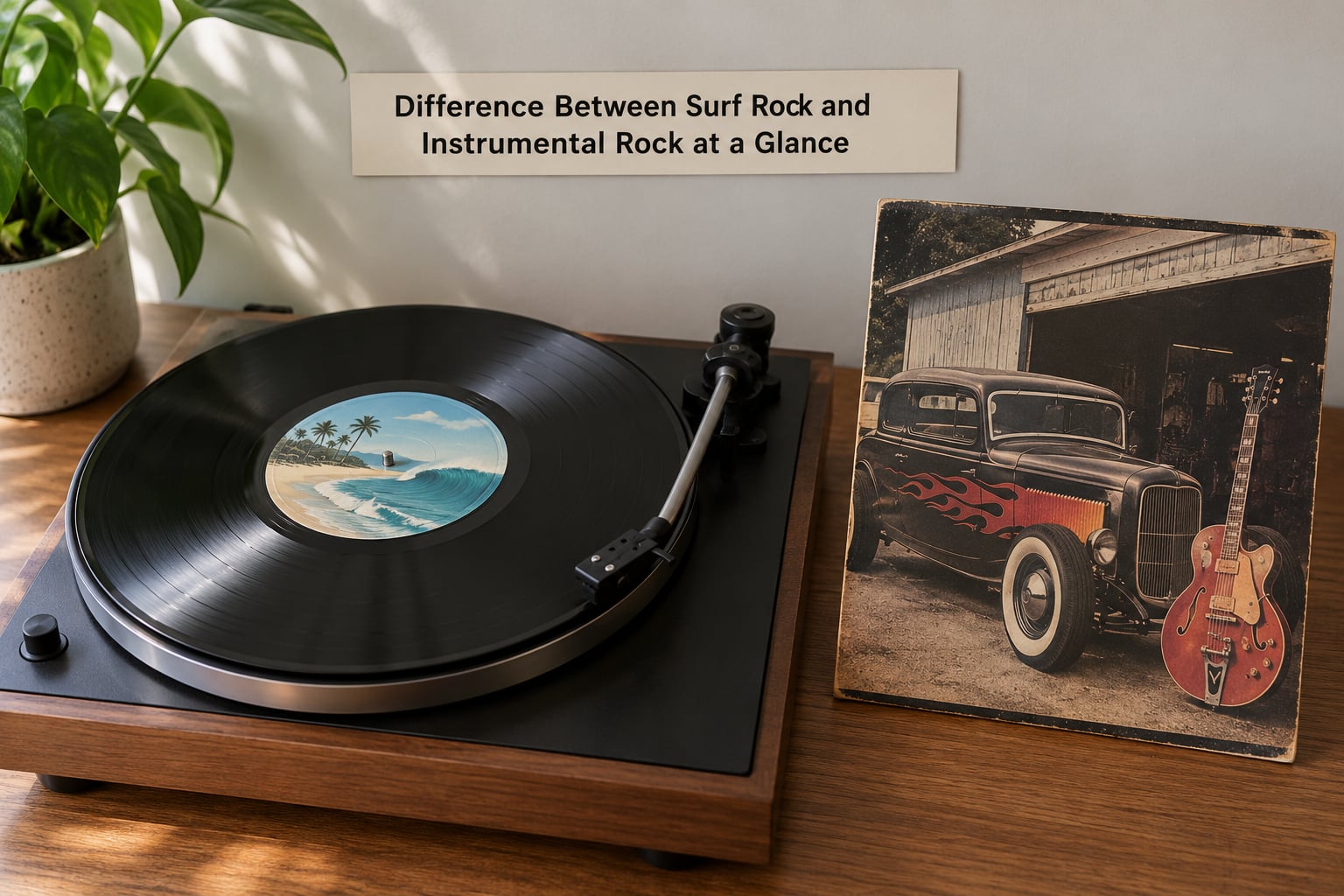
Here is the whole comparison on one screen. Read the instrumental rock column as the broad form and the surf rock column as the corner of it that surf guitar occupies.
| Attribute | Instrumental rock | Surf rock |
|---|---|---|
| What it is | A broad category: rock music built around instruments rather than vocals | A guitar-centred style within that category, associated with surfing and hot-rod culture |
| Origin | Late 1950s, driven by early rock and roll guitarists including Chuck Berry, Duane Eddy and Link Wray | Southern California beaches, roughly 1961 to 1963, centred on Dick Dale and His Del-Tones |
| Vocals | None by definition | Usually none, though vocal surf exists as a separate branch of the style |
| Core sound | Varies enormously, from twang to fuzz to orchestration | Reverb-drenched clean guitar, rapid tremolo picking, big whammy bar bends, driving backbeat |
| Typical instruments | Electric and acoustic guitar, bass, drums, keyboards, brass, strings | Solid-body electric guitar, slap and fingerstyle bass, drums, occasional Hammond organ |
| Defining technique | None universal; each sub-genre has its own | Double picking, staccato runs, glissandi, muted chanks, whammy bar dips, reverb tails |
| Gear signature | No single signal chain | Fender-style single-coil guitars with outboard spring reverb and tremolo circuits |
| Tempo and feel | Anything, slow ballads included | Mid-to-fast, relentless forward push, short side-one singles |
| Cultural imagery | None inherent to the label | Surfboards, hot rods, sunset cruisers, garage rock and punk crossover |
| Reference artists | Link Wray, Duane Eddy, The Ventures, spot themes, soundtrack cues | Dick Dale, The Bel-Airs, The Surfaris, The Chantays, Duane Allman |
| Strongest overlap | The whole style sits inside this category, always | Twangy lead guitar, reverb, tremolo and instrumental form are shared outright |
What Is the Difference Between Surf Rock and Instrumental Rock?
Instrumental rock is a format. It describes rock recorded without a singer, with the melody carried by guitar or another lead instrument. The category is enormous and it swallows things you would never file under rock at all: theme music for detective shows, library music, TV commercial jingles, film cues, and the occasional jazz-funk monster guitar record.
Surf rock is a genre inside that format with a very specific address. It came out of Southern California in the years just before and after the surfing boom of the early 1960s, and it carries cultural freight that the parent category has no interest in: boards, wax, hot rods, a soundtrack built for two minutes of riding rather than a whole evening.
Think of it as a country and a state. Instrumental rock is the country. Surf rock is one state with one coastline, and a record from that state is also, unavoidably, a record from the country.
One useful test: if a record would still make sense if you changed the label on the sleeve from Del-Tone to Del-Fi, you are probably listening to instrumental rock that happens to be very good. If the record only exists because someone was standing near an ocean in 1961, you are in surf rock.
Sound and Arrangement
The parent category has no fixed sound, which is precisely why surf rock’s sonic signature stands out so sharply against it. Here is where the two part ways.
Reverb and tremolo as surf rock’s fingerprints
Surf records sit in a wash of spring reverb, and the guitar often runs through a tremolo circuit that chops the signal into a pulse. Plenty of instrumental rock uses reverb, but almost none of it uses that much of it for that long. When the reverb is the loudest thing in the mix, you are usually close to surf territory.
Duane Eddy’s Rebel Rouser in 1958 had a wet, echo-soaked guitar and no surf behind it at all. Placement matters as much as ingredients.
Rhythm section drive
Surf drumming is busy in a specific way. Snare accents land on the second beat and its upbeat, toms fill short gaps, and the whole thing pushes forward without ever settling into a groove you can relax into. Compare that to a Link Wray instrumental, where the rhythm is deliberately spartan and everything serves the riff.
Melody and dynamics
Surf leads are written like vocal lines, with long ascending and descending bends, vibrato, glissandi and rests that let the reverb ring out. The dynamic push matters as much as the notes. Most surf rock builds rather than sits, and it usually ends abruptly.
This is also why you cannot assign a genre from instrumentation alone. A record with twangy guitar and heavy reverb could be surf, garage rock, a B-movie cue or a Telecaster monster-guitar record. The label comes from context, not from the instruments.
Instruments and Typical Instrumentation
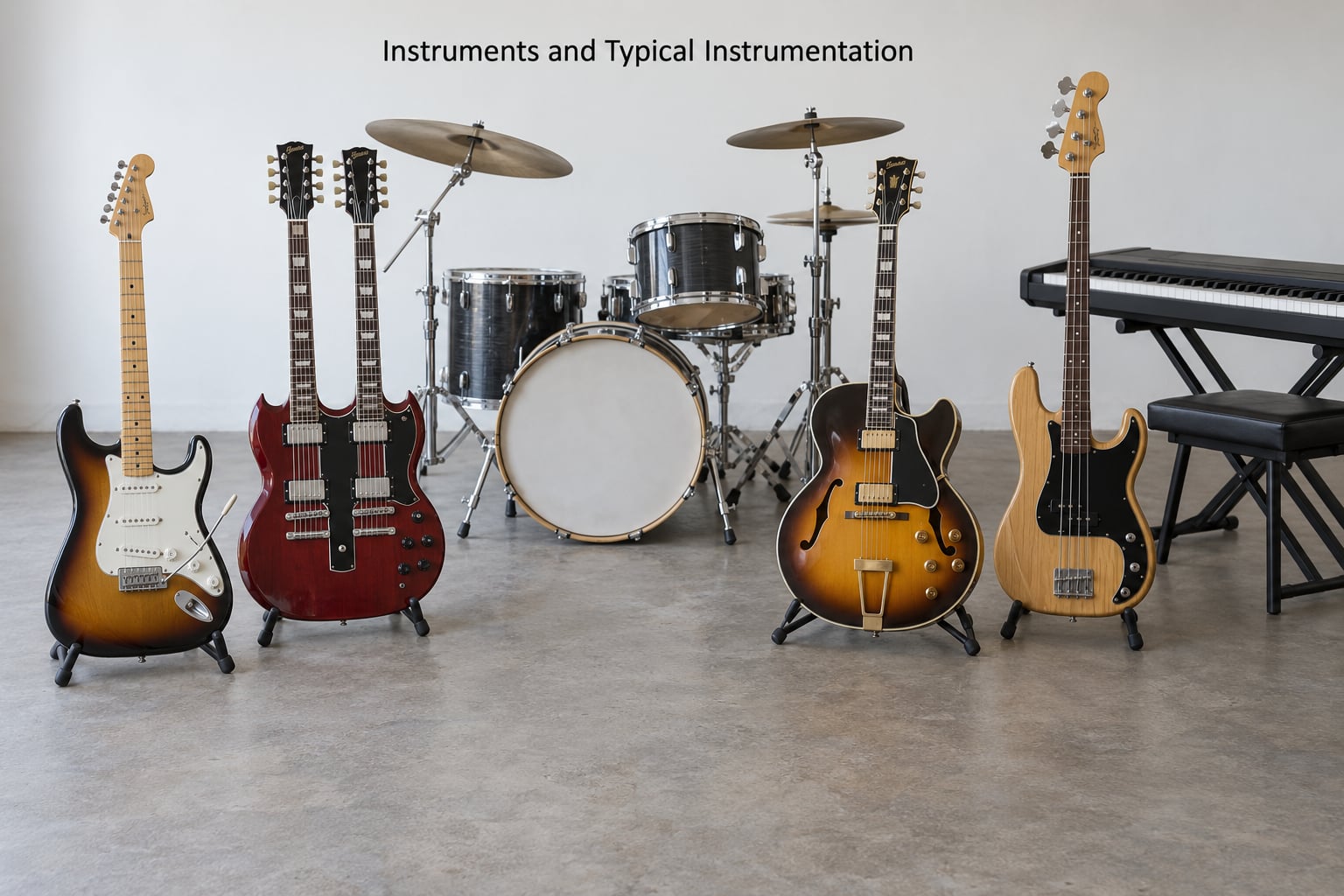
Instrumental rock covers whatever the band brought: fuzz-toned humbuckers, orchestral strings, brass sections, organs, sitars. Surf rock is far more prescriptive, and that narrowness is part of the style’s identity.
What surf rock is built on
- Lead electric guitar, usually a solid-body with single-coil pickups and a tremolo or whammy bar
- Bass, played either slapped, fingerstyle or picked with a heavy amp
- Drums with a splashy surf beat: snare on two, toms moving between phrases, ride or crash accents
- Hammond organ on some tracks, often adding to the wash rather than the melody
- Occasional sax or flute for the Tex-Mex and lounge-adjacent branches
Twang-bar guitar versus twister guitar
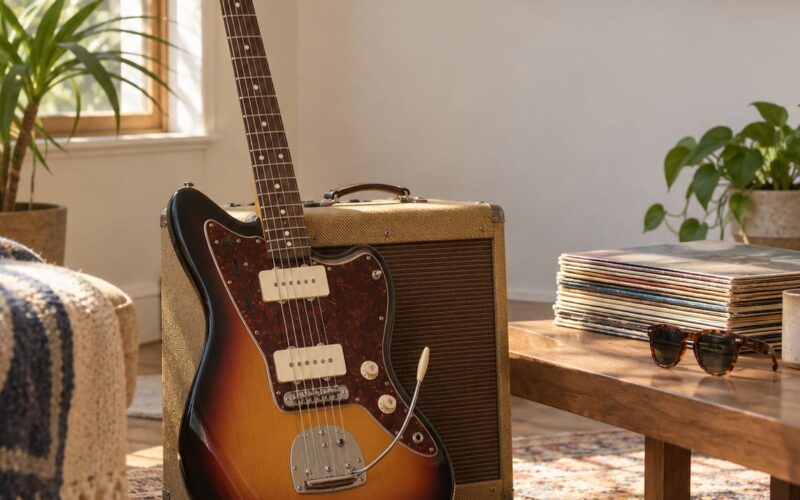
The confusion between these two terms comes up constantly, so it is worth clearing up. A twang bar is a string-thinning device: you push it down and the pitch rises, which is how a Fender Jazzmaster makes those long ascending bends. A twister is a tremolo unit, a rotating fan in the amplifier or a circuit in the guitar that chops the signal into a pulsing roar. The twister is the second half of the surf guitar voice; the twang bar is the expressive half.
Neither one is required by the genre rules. Link Wray played a Gretsch hollow-body with a big steel bar through a plexiglass panel and produced the era’s defining instrumental tone without either device.
Collectors and players argue endlessly about onboard versus outboard reverb. Onboard units sit in the signal after the preamp, which thickens the sound but softens the pick attack. Outboard units sit ahead of the preamp, so the attack survives and the reverb behaves more like a room. Guitarists who chase the 1963 sound mostly land on outboard.
History and Cultural Identity
Surf rock did not appear out of nowhere. It grew out of rockabilly, which grew out of country and rhythm and blues, and it arrived at a moment when guitarists in America had started asking what a rock record could be without a singer holding it together.
The short version runs like this:
- 1958, Duane Eddy’s Rebel Rouser and Link Wray’s Rumble put the twang guitar front and centre on American rock singles
- 1959 to 1960, Chuck Berry’s instrumentals and early television appearances build a national appetite for guitar-led rock
- 1961, Dick Dale and His Del-Tones record Let’s Go Trippin’, and The Bel-Airs cut Mr. Moto, both on Del-Tone records
- 1961 to 1963, surfing goes mainstream and a dense scene of California beach bands forms around the Del-Tone and Liberty labels
- 1963, Pipeline by The Chantays and Wipe Out by The Surfaris put the style on the Billboard Top 10 twice over
- Late 1960s onward, surf gives way to psychedelic rock, while the instrumental format is absorbed into garage rock, TV themes and film scores
- Late 1970s through the 1990s, a revival of mostly instrumental surf bands runs largely undocumented, and later revival scenes in Japan, Indonesia, Europe and Australia extend it further
That last stretch matters for collectors, because the 1980s and early 1990s bands are some of the hardest music to find on original pressings, and nobody wrote the histories down at the time.
The cultural identity also explains the genre’s afterlife. Surf rock fed directly into garage rock, then punk, then skiffle-adjacent new wave, and later into psychobilly and surf punk. Los Straitjackets, the Cramps and the B-52s all carry pieces of it into different decades.
Vocals and Song Structure
Instrumental rock has no vocal question to answer. Surf rock has one, and it is the most argued-about thing in the whole scene.
Early surf singles were almost entirely instrumental, with the rare shouted exclamation or hummed chorus. A surfguitar101 regular put the working definition simply: instrumental music, no singing, while allowing the occasional human noise. Under that definition, a self-described surf band with full vocals and a clean reverbed guitar is not surf, however twangy it sounds. Plenty of players agree. Plenty of listeners shrug and accept it anyway.
The honest summary is that vocal surf exists, and the vocal branch is usually called surf pop. The Beach Boys and Jan and Dean wrote about cars and girls rather than waves, but they shared the era, the imagery and a chunk of the market, so the label got stretched to cover them.
Structure tells you something too. Surf singles tend to be short, built around two or three repeating riffs, and cut abruptly at the end of a side. Instrumental rock generally takes longer forms: extended solos, whole-album movements, or the fifteen-minute suite. If you put a needle down expecting one strong riff and a hard stop, you have probably got surf.
Examples Artists and Essential Listening
Here is a short listening panel that makes the difference obvious. Start with the four surf tracks, then hear what the parent category sounds like on its own terms.
Four surf rock tracks to know first
- Dick Dale and His Del-Tones, Let’s Go Trippin’ (1961) — the origin point, with the whammy bar dives and the biggest room in music.
- The Bel-Airs, Mr. Moto (1961) — a nervous, staccato riff that sounds like a wave standing up before it breaks.
- The Surfaris, Wipe Out (1963) — heavy tremolo picking, a full band sound, and a Top 10 hit.
- The Chantays, Pipeline (1963) — the other famous 1963 surf single, with the voice-organ answering the guitar.
Three instrumental rock tracks that are not surf
- Link Wray, Rumble (1958) — the twang-bar blueprint, played through a hollow-body with a plexiglass panel. No ocean anywhere in it.
- Duane Eddy, Rebel Rouser (1958) — huge echo and reverb years before anybody in California thought about surfboards.
- The Ventures, Walk Don’t Run (1964) — a polished studio sound the band had already established before the surf era peaked.
Edge cases worth arguing about
- The Beach Boys, Surfin’ Bird (1963) — vocal pop riding the same imagery; surf-adjacent, not surf instrumental.
- Duane Allman, early Hour Glass and Allman Joys material — surf was an influence on a player who went somewhere else entirely.
- Russ Mitchell, Night Rider (1961) — issued alongside Dick Dale and frequently paired with him, though often credited to another guitarist on the record.
The Tornados and their Telstar belong on the parent-category side rather than the surf side. So do Booker T. and the M.G.’s, who play organ-led instrumentals with no surf intent at all, and so does almost every library and television theme record ever cut.
Where Surf Rock and Instrumental Rock Overlap
Because surf rock sits inside instrumental rock, the overlap is total in one direction. The interesting question is the other way round: which instrumental rock records deserve the surf label too?
The honest answer is that a record earns both labels when it carries twangy lead guitar, deliberate reverb, tremolo or a fast rhythmic feel, and arrangement with space in it. Wipe Out qualifies. A Ventures record played with full twang and tremolo probably qualifies too, though The Ventures themselves predate the genre and resist being filed inside it.
Surf rock vs surf pop is the comparison that causes the most friction, so here it is stripped to its essentials.
| Attribute | Surf rock | Surf pop |
|---|---|---|
| Vocals | None, or a shouted word or hummed chorus | Full lead vocals throughout |
| Role of guitar | Carries the entire melody and the drama | Sits mostly under the voice |
| Era | 1961 to 1963 at the centre | 1962 to 1966 at the centre |
| Reference acts | Dick Dale, The Bel-Airs, The Surfaris | The Beach Boys, Jan and Dean |
| Purist verdict | The reference point | Contested, and often rejected outright |
Two other things blur the boundary. Licensing and interpolation keep the surf guitar sound alive in mainstream pop, where it arrives stripped of its cultural setting and becomes just a sound effect. And the revival scene has widened the door: bands playing twangy instrumental guitar in 1962 mode get called surf regardless of where they were formed, which means the label now describes a style rather than a place.
Which Should You Choose?
Choose surf rock if what you want is twangy lead guitar, cinematic momentum and guitar effects you can picture someone playing. The whole style is designed to be played loud, in a car, near water. If you are building a shelf, start with Del-Tone and Liberty 45s from 1961 to 1963, where the scene is concentrated and the condition tends to be better than later pressings.
Choose instrumental rock if you want the wider territory: rockabilly-adjacent twang, TV themes, monster guitar records, soundtrack cues, and the long instrumental forms that do not fit on a 45. Link Wray and Duane Eddy are the sensible doors in, and neither requires any interest in surfing.
If you cannot pick, do what I did and put both on the same side of the turntable. The category relationship becomes obvious within about three tracks, and the labels stop feeling like rival genres.
Frequently Asked Questions
Is all surf rock instrumental?
No. Most early surf records from 1961 to 1963 are fully instrumental, but surf rock also includes vocal surf, mixed vocal and instrumental tracks, and later surf punk and surf revival releases built around the sound. Purists on surfguitar101.com insist surf means no singing, which pushes vocal material into the separate category of surf pop. Treat instrumental as the core case and the exceptions as the interesting part.
Is surf rock a genre or a scene?
Both, depending on who you ask. It began as a guitar-centred musical style in the early 1960s, then grew into a scene organised around instrumentals, surfing culture, hot-rod imagery and a tight cluster of California labels. Because the scene carried music, imagery, slang and a lifestyle together, plenty of listeners hear surf as a mode rather than a genre. Wikipedia treats it as a genre; the people who made it treat it as a way of playing.
What does twister guitar mean in surf rock?
Twister usually means a solid-body electric played through a tremolo unit, often an outboard spring reverb paired with a rotating tremolo circuit. The signal gets chopped into a pulsing roar, which is the engine room of the surf sound. It is different from a twang bar, which is the string-thinning device used for big ascending and descending bends. Players often use both in the same solo.
Can an instrumental rock record also be called surf rock?
Yes, when it carries the surf specifics: twangy lead guitar, deliberate reverb, tremolo, fast rhythmic passages and arrangements with air in them. Wipe Out by The Surfaris is the obvious case. A purely atmospheric or jazz-instrumental record may be instrumental rock without qualifying as surf, since reverb alone is not enough. Genre context decides it as much as the gear does.
What instruments does surf rock use?
Lead electric guitar is the centre of it, usually a solid-body with single-coil pickups and a whammy bar. Bass, played slapped or fingerstyle, carries the low end. Drums supply the surf beat with snare accents on two, toms between phrases and ride or crash accents. Hammond organ turns up on some tracks, and saxophone or flute appear in the Tex-Mex and lounge-leaning branches of the style.
Is Pipeline surf rock or vocal surf?
Pipeline by The Chantays is surf rock, and one of its best-known records. The lead is a heavily reverbed, tremolo-picked guitar line with no singer competing for attention. Many listeners remember a vocal version sung over similar material, but the famous Chantays record that reached the Billboard Top 10 in 1963 is instrumental. Vocal surf, surf pop, is the branch where a singer leads and the guitar stays underneath.
Conclusion
Instrumental rock is the category and surf rock is one of its styles, so the difference between surf rock and instrumental rock is a difference of breadth rather than of kind. Listen for genre context and the twang-bar guitar effects first: big reverbed bends, tremolo chop, a snare hitting on two, and a riff that wants to end fast. If those are there, it is surf. If the guitar simply leads because nobody is singing, you are in the wider instrumental rock world, and there is plenty of good music there too.