Before the internet, mail order record catalogs were how most people bought music their local shop did not have. A store or club printed its inventory, mailed it out, and waited for a check. You flipped through the pages, found a listing, filled in the order form, and posted your payment back. Then you waited weeks for a parcel to arrive.
Columbia House — founded in 1955 as the Columbia Record Club, grown to roughly 16 million members by 1996, and wound down effective September 15, 2026 — was the largest operator of that model. BMG Music Service did the same thing with CDs for two decades. Understanding how mail order record catalogs worked before the internet is mostly a story about physical constraint: paper you had to hold, money you had to send, and boxes that had to fit through a mail slot.
Table of Contents
- How Mail Order Record Catalogs Worked Before the Internet
- What Was in a Vinyl Mail-Order Catalog?
- How Did Collectors Find and Order Records?
- Why Printed Inventory Lists Were So Important
- What Payment Methods Did Mail-Order Stores Accept?
- How Were Records Packed, Shipped, and Insured?
- How Did Shipping Costs Affect Record Prices?
- What If an Order Was Wrong, Damaged, or Missing?
- How Did This System Compare With Shopping Online?
- Why Does This History Matter to Vinyl Collectors Today?
- Frequently Asked Questions
- Could you order vinyl records by phone before the internet?
- Did mail-order record stores ship outside the United States?
- Why did mail-order catalogs have minimum order requirements?
- How can I find an old record store mail-order catalog online?
- Can a catalog listing prove that a record was available?
- Conclusion
How Mail Order Record Catalogs Worked Before the Internet
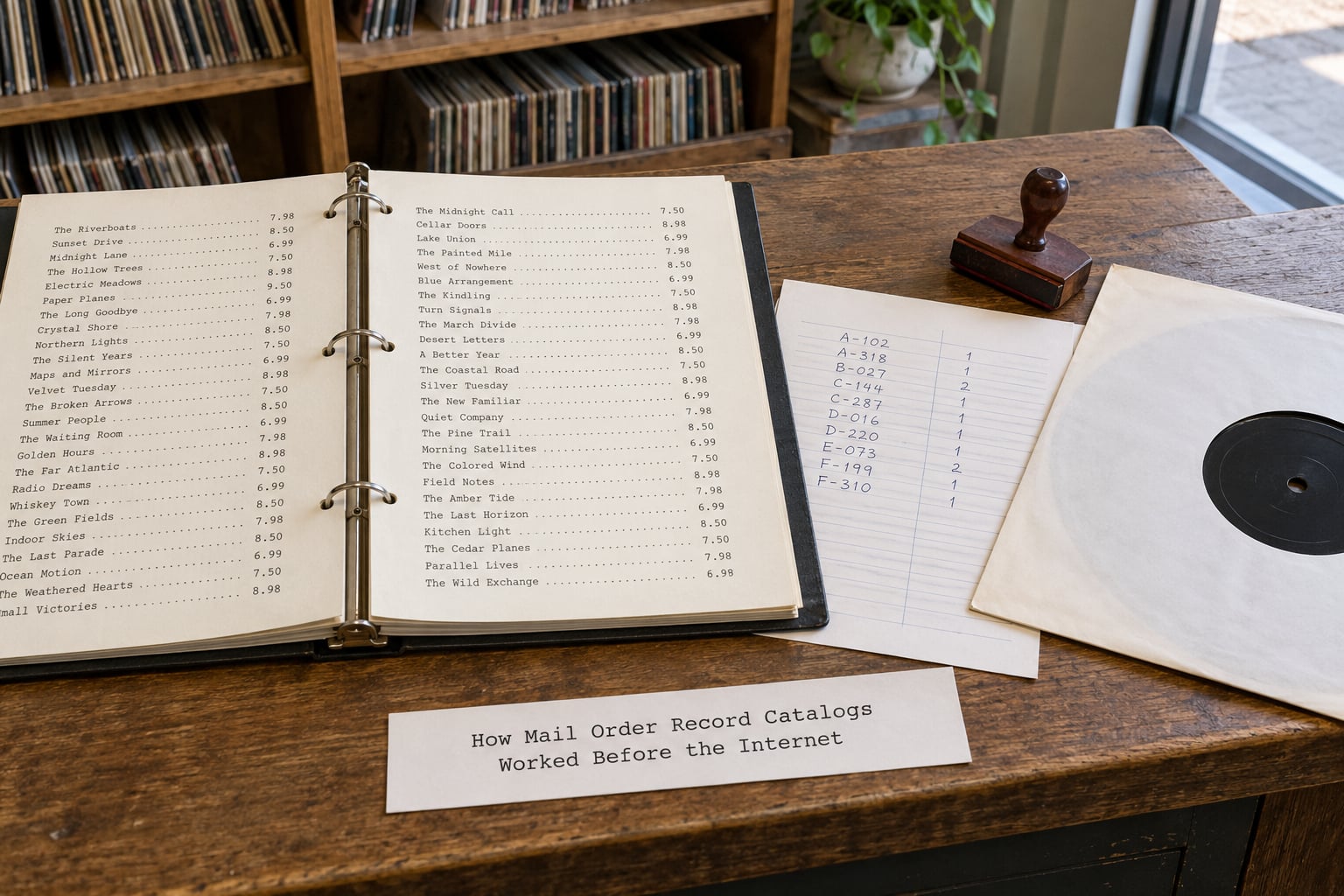
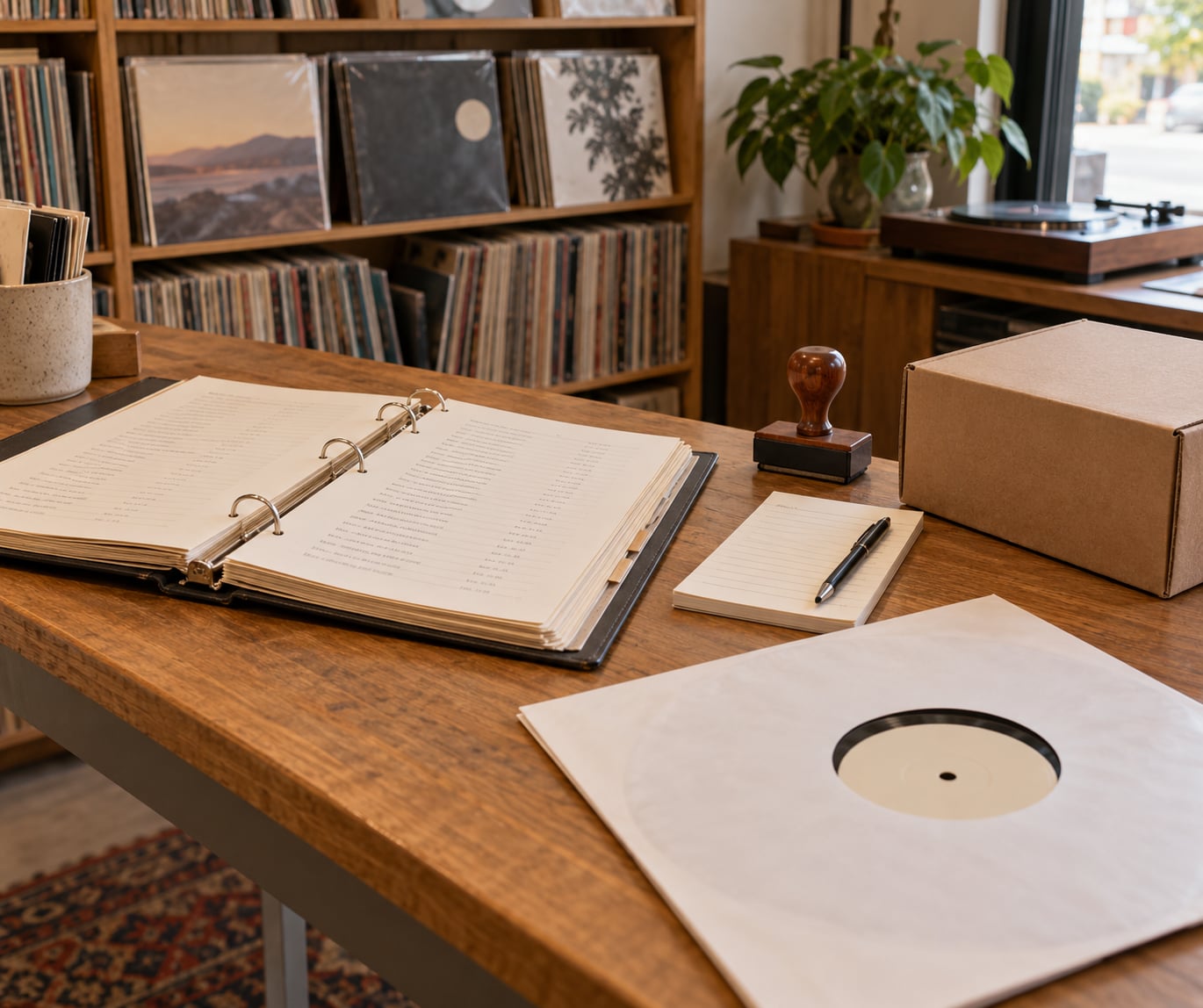
A mail order record catalog was a printed list of records, mailed to you on a schedule, that served as the only storefront the seller had. You read the pages, copied a catalog number onto an enclosed order form, attached a check or money order, and mailed it back. The warehouse then picked your record from a real shelf, packed it, and posted it to your address.
There was no search box, no stock counter refreshing itself, and no photograph of the sleeve unless the seller had access to a scanner. Everything you knew about a record came from a line of type on paper, and everything you owned afterwards came through a postal service.
The loop ran roughly like this:
- You subscribed, or sent a request for a catalog, or clipped an order form out of a magazine.
- A printed catalog arrived, either bundled with mail or on a schedule.
- You located the listing and noted the catalog number printed beside it.
- You filled out the order form, chose a payment method, and added postage and handling.
- You mailed the envelope and waited.
- The warehouse picked, checked, packed, and posted your records.
- If something was unavailable, a backorder notice went out and you waited again or cancelled.
That loop is why collectors describe the era with real specificity. One poster on the Badger & Blade forum remembers the Sears catalog as mostly a wish list that gave people ideas of what existed, with plenty of those purchases then made locally instead. The same poster describes joining a record club as getting a dozen discs for a penny in exchange for agreeing to buy five more at regular price over two years, and says that deal is where most of his collection came from.
What Was in a Vinyl Mail-Order Catalog?
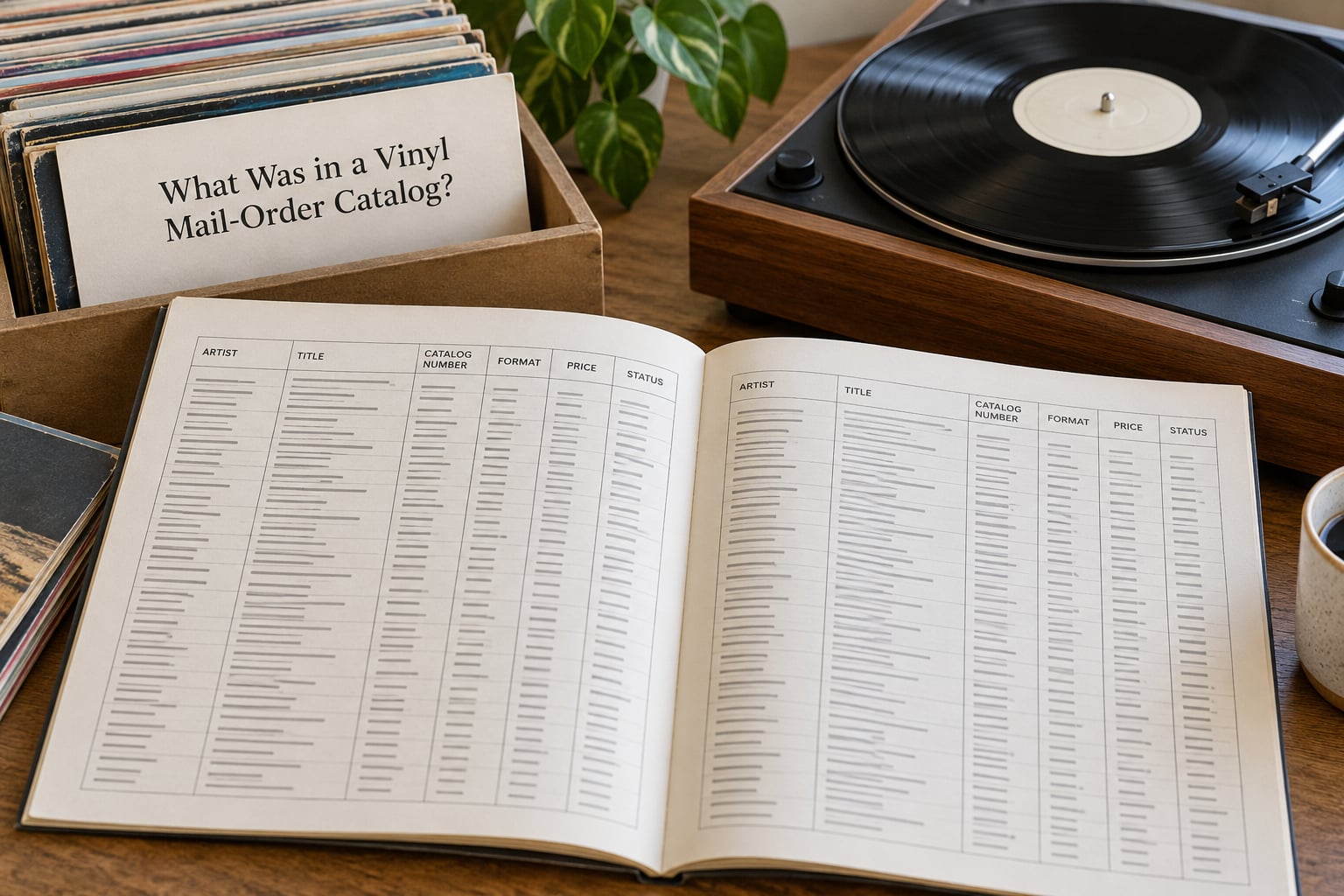
A catalog was the business’s entire storefront, so it had to carry every piece of information a buyer needed to commit. A working entry usually gave you the artist, the title, the label, the catalog number, the format, the price, and a status note telling you whether the item could actually be sent.
Catalog numbers were the spine of the system. A number such as a label prefix plus four digits lets you identify a specific release, which matters enormously when several editions of the same record exist. It also tells you what to write on the order form, since titles repeat, get mistyped, and get abbreviated differently from one catalog to the next.
The listings also told you which kind of object you were buying, and this is where collectors learned to read carefully:
- Commercial editions — the version a record store would have shelved, in its regular sleeve with its regular track list.
- Budget reissues — the same album on a cheaper label with plain packaging. Good for filling holes, bad for anyone chasing a specific pressing.
- Import pressings — releases licensed or manufactured for another country, often listed in their own section with their own catalog numbers.
- Promo, white label, and test pressings — small runs, unlisted or thinly listed, and never treated as ordinary stock.
- Used copies — graded by condition, priced accordingly, and a separate transaction from new inventory.
Take a small independent label’s listings as the model. Suppose a seven-inch single lists under a three-letter prefix and a four-digit number, priced below the major-label version, with a status column reading that copies are available. Another entry uses a different prefix entirely, is marked as a limited run of 500, and is marked sold through. An entry for an LP with a gatefold note and a mono or stereo indication gives you the sleeve type before you spend anything.
That density was the point. The catalog did not merely advertise; it pre-answered the questions a buyer would otherwise have to phone about.
How Did Collectors Find and Order Records?
Collectors of a certain age found records through a short list of channels, and most of them started outside the catalog itself. Magazine advertisements, flyers at shows, and small classified ads were how you first heard a label or distributor existed. A friend passing you a record did more to shape a collection than any advertisement did.
Newsletters were huge. A label’s mailing list, a fanzine, a shop’s printed sheet — these arrived unprompted and told you what was coming before it reached the shelves. Record store visits supplied the impulse half of the purchase: you heard a track, saw a sleeve, and wanted the whole record that week rather than whenever a warehouse got to it.
Once a record was identified, the ordering source mattered. Ordering direct from the issuing label meant factory-fresh copies, the correct catalog number, and often the only route to an import or a small-run pressing. A mail-order specialist carried new and used together, priced used copies by condition, and was the practical choice for filling a gap quickly. A general used dealer sorted by genre and condition, and the useful part of their listing was usually condition grading rather than title detail.
The difference showed up when something went wrong. A label had the original sleeve but nothing if it broke. A specialist had a replacement copy but not the correct matrix. A used dealer had the music and a frankly ugly sleeve. When I started digging through a box of these listings, the thing I kept checking first was the catalog number, because it settles most of that argument on its own.
Why Printed Inventory Lists Were So Important
Printed inventory lists mattered because they were the only honest description of what physically existed, and physical limits were absolute. Every record occupied shelf space in a warehouse bin. A label pressing 3,000 copies of an album had 3,000 records, and when they were gone the item was finished regardless of how many people wanted one.
Status codes carried that reality in a few words. Available meant copies on the shelf. Limited meant the run was small and probably counted down. Sold through meant the warehouse had none but the record still existed on the market elsewhere. Out of print meant the run was ended and nobody was manufacturing more. Reprint pending meant wait. Collectors learned to read these four or five phrases as fluently as a modern shopper reads a delivery estimate.
The system also produced errors that no interface has ever had to apologize for. Listings went stale between printings, so a record marked available could be gone by the time your envelope arrived. Typos in catalog numbers sent back the wrong record. Substitutions happened when a shipment came up short, usually with a note tucked inside explaining the swap. A catalog number for a record that was never manufactured in the US led to a long wait that ended in a refund and a stamped envelope back.
Anyone paying real money for a scarce item learned one rule: confirm before you pay. A phone call to the order desk, made days before mailing the check, could confirm that a specific copy was actually in the bin. This is the era’s equivalent of a live chat transcript, and it saved more money than it cost.
What Payment Methods Did Mail-Order Stores Accept?
Checks were the default. You wrote one payable to the company or its bank, filled in the amount and your account number on the order form, and enclosed both. Postage stamps went on the envelope, and getting that wrong was a common reason an order stalled at the sorting office and came back a week later.
Money orders solved the problem for anyone without a checking account, and cash by mail was accepted by some operations, though it discouraged refunds. Where a catalog advertised it, bank drafts, certified cheques, and personal cheques were all options. Major operations eventually took credit card numbers by phone and later by a toll-free line, which felt like a leap in convenience at the time.
Expensive or rare orders often required a deposit rather than full payment, with the balance due on shipping. That arrangement protected the seller, who had already committed money to acquiring the item, but it also handed over a chunk of cash before anything arrived.
Cash on delivery was uncommon and small operations disliked it, because a refused parcel cost the seller the postage both ways plus the handling. When a merchant did offer it, the risk sat entirely with them.
When an item turned out to be unavailable, the sequence was mechanical. The seller stopped the order, sent back the payment or issued credit, and returned the paperwork. Some stores held the payment on account against a future order instead, which annoyed buyers who wanted their money back immediately but was common enough that experienced shoppers asked about it before sending the cheque.
How Were Records Packed, Shipped, and Insured?
Fulfilment started when a clerk pulled your envelope, read the order form, and walked to the bin holding that catalog number. The record came out, the clerk looked at it, and the condition of that copy was decided right there. A used copy that did not match its grading went back into the pile.
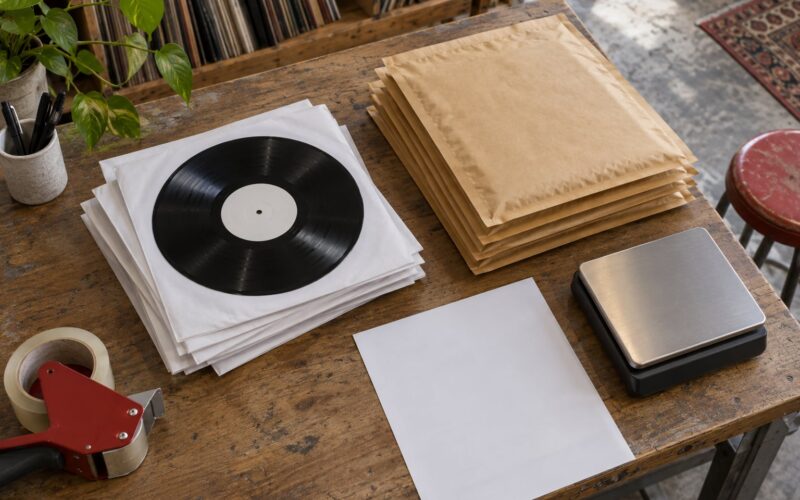
Packing was where a lot of mail order reputations were made or lost. The record was removed from its outer sleeve, slipped into a new inner sleeve to prevent seam splits cutting the jacket, and sandwiched between cardboard stiffeners. LPs often went into a padded mailer; 45s and 7-inch singles went into a bubble mailer or a padded envelope. A heavy or wide order went into a corrugated box.
Insurance was available and, for anything expensive, essential. You asked for it on the order form, paid a small fee, and got a receipt or a signed note from the carrier. Uninsured parcels that went missing were simply gone — the seller had no claim to file and no obligation to replace.
Most parcels went by ordinary postal service because it was cheap and it reached nearly everywhere. Speedier options — registered, express, or air service for international orders — cost several times more and were used when the order was worth it or the deadline was a release date. Express service did not mean tracking; it meant a shorter transit and a better handling chain, and a lot of buyers only learned the difference after a parcel sat in a depot for a week.
The real hazards were heat, bending, and rain. A padded envelope left on a porch in July can warp vinyl; a parcel that gets crushed in a sorting machine arrives with a cracked corner. Mail order buyers learned to open parcels immediately, which is a habit that has never really died.
How Did Shipping Costs Affect Record Prices?
Shipping was the part of the old system that quietly broke the economics. The discount a club offered on records was real, and postage could eat it in one parcel. This is why people who used the clubs still argue that mail order was not always cheaper once you counted the delivery charge.
| Charge | What it added to the order |
|---|---|
| Postage | Roughly scaled with weight and distance; a single 45 in a padded envelope cost less than a box of a dozen LPs. |
| Handling | A flat fee the seller set, usually covering picking, packing materials, and labour. |
| Insurance | An optional percentage of the declared value, charged on top of postage. |
| Split shipment | Charged twice or more when one order left the building in two parcels because a title was unavailable. |
| Domestic versus overseas | Overseas orders cost multiples of a domestic parcel and took weeks longer, which is why most buyers stayed local. |
Two behaviours fell out of those numbers. Buyers stacked multiple items into one order to spread postage across them, and sellers set a minimum spend above which postage came free or heavily reduced. Both practices exist today in ordinary online retail, and both were invented here, out of arithmetic rather than software.
There is a flip side worth knowing about. A single inexpensive record was often a bad mail order purchase, but a single record you could not find anywhere near you was still worth ordering, because the alternative was a long drive or nothing at all.
What If an Order Was Wrong, Damaged, or Missing?
Before email, a complaint was a phone call, a postcard, or a typed letter. Each had a different practical character. The phone call was fastest but required the store to be open and a person to answer, and mail order customer service lines were frequently busy. The postcard was cheap, slow, and easy to lose. The letter was the most formal and the most likely to produce a written record of what was agreed.
An effective claim contained a specific set of details: the order date, the catalog numbers involved, what you received, what you expected, and what you wanted — a replacement, a refund, or credit. Vague letters got vague answers. Catalog numbers did the work that adjectives could not.
The usual problems fell into recognisable types. A wrong item arrived, usually because two similar titles shared a truncated catalog number. A record arrived cracked or warped from heat or pressure, and the buyer had to argue about who packed it. A used copy did not match its grading, which became an argument about condition vocabulary rather than about fault. A parcel never arrived, which without insurance simply ended the story.
Retaining paper turned out to matter more than most people realised. The catalog page you ordered from, the order form, the packing slip, and every piece of correspondence formed a paper trail that resolved disputes years later. That trail is also why catalogs survive in boxes and drawers today, long after the records are long gone.
How Did This System Compare With Shopping Online?
Online ordering fixed the things printed catalogs were worst at and lost a few things the printed system did better. Neither system wins outright, and the honest comparison is more interesting than a verdict.
| Criterion | Mail order catalog | Online store |
|---|---|---|
| Finding a specific record | You read a line of type and noted a number. | You search a live database and filter by format. |
| Accuracy of availability | Frozen at print time; sometimes weeks out of date. | Usually close to real time, though not always. |
| Seeing the record | A typed description, or a shop window if you went in person. | Photographs on every listing. |
| Payment | Cheque, money order, or a card number read over the phone. | Card, wallet, or buy-now-pay-later, in seconds. |
| Communication | Phone call, postcard, or letter. | Live chat and email replies within hours. |
| Delivery | One to several weeks, rarely trackable. | Days, with a tracking number. |
| Handling a problem | A claim you posted, argued, and waited on. | A refund button. |
| The feel of it | A printed object you could keep and write on. | A tab you scroll past. |
The genuine tradeoffs were speed and transparency on one side, and human contact on the other. The printed system was slower and vaguer, but the person who answered the phone often actually knew the stock. Every copy sold was a physical object that existed before it was bought, which put a hard limit on how badly a seller could let you down.
The old model also survived outside the clubs. Independent punk, garage, rockabilly, and rock & roll labels ran mail order operations with photocopied listings and rubber stamps, because for a tiny label with a few hundred copies of a single pressing, mail order was the only distribution that could reach past the local scene.
Why Does This History Matter to Vinyl Collectors Today?
Because the catalogs are primary sources. A catalog page records what a label thought it was selling, at what price, under which number, and in what quantity, at a moment when nobody was revising the page. That is exactly the information collectors need when a pressing has several versions and the disc alone cannot tell them which one they are holding.
The New York Public Library maintains a Record Company Catalogs and Ephemera collection holding exactly this kind of material, and it is one of the places to look when a catalog surfaces with no provenance. Surviving copies also turn up in estate sales and on auction sites, and sellers who once threw them away are learning that a run of club catalogs has value as a set.
What a listing can prove is narrow and worth being precise about. A catalog entry proves the item was offered for sale by that seller during that catalog’s run, and it fixes the price and the stated condition. It does not prove that a copy remained unsold, that your specific copy came from that seller, or that the pressing was still in production when the mail arrived. Catalog listings are evidence of an offer, not of a transaction.
That distinction keeps people honest. A number in a catalog confirms the release existed in the cataloging system of a label. It does not, on its own, settle how many copies were pressed, and it never settles the condition of the copy now sitting in a collection.
Frequently Asked Questions
Could you order vinyl records by phone before the internet?
Yes, though not from most independent sellers. Major record clubs and large mail order operations took credit card numbers by phone during business hours and read your order back to you, then posted the card details with the paperwork. Small labels were different: their published number usually answered to a person who could take a message but rarely took payment. The common practice for an indie label was still paper, and a phone call was mainly for confirming that a rare copy was really in the bin.
Did mail-order record stores ship outside the United States?
They did, though it was a smaller business than most people assume. Overseas parcels cost several times more than domestic ones and took weeks longer to arrive, so the trade was usually worth it only for something unavailable in your own country. Import sections of domestic catalogs gave buyers a way to buy the pressing issued elsewhere without writing abroad. Fans of British punk, garage, and rockabilly records ordered across the Atlantic constantly, accepting long waits for the rarest pressings.
Why did mail-order catalogs have minimum order requirements?
Because postage was the largest cost in the transaction and it did not shrink with order size. A seller filling one small order spends as much on picking, packing materials, and postage as on ten. Setting a threshold above which postage came free or reduced meant the seller could fill a carton for less than the buyer would have paid for three separate parcels. Minimum-order rules exist in ordinary online retail for the same reason, and they are one of the clearest pieces of old mail order logic still running today.
How can I find an old record store mail-order catalog online?
Start with institutional archives rather than auction listings. The New York Public Library holds a Record Company Catalogs and Ephemera collection covering major labels and their mail order arms, and most university libraries keep trade catalogs too. Auction platforms are the second route, where sellers often have no idea what year a run covers and price accordingly. Search by the seller name printed on the cover rather than by year, because catalog runs are catalogued under the company, not the date.
Can a catalog listing prove that a record was available?
It proves that the seller offered the record for sale during the run of that catalog, and it fixes the price and the stated condition at that moment. It does not prove a copy was still in the bin when your envelope arrived, that your specific copy came from that seller, or that the pressing remained in production. Treat a listing as evidence of an offer rather than of a completed transaction. For pressing and quantity questions, you need the label’s own discographic records or the matrix numbers on the disc.
Conclusion
Mail order record catalogs were the whole interface: paper standing in for a website, a cheque standing in for a checkout page, and a warehouse shelf standing in for a database. If you have found a box of them, start by identifying the seller and dating the run, then read the terms page for payment and postage rules before ordering anything from it.
Next, look at the catalog numbers printed beside the titles you recognise. Those numbers still identify pressings, and a catalog page that matches one tells you what the release was called, what it cost, and how it was described at the moment it was new.