
If you run a record label and someone has just sent you a distribution agreement, the short answer is this: a distribution deal is a contract where you hire a company to deliver your releases to streaming platforms, digital stores and physical retail, collect the money those sales generate, and report it back to you. You keep ownership of your masters. You keep running your own release campaign. The distributor gets paid a commission out of what it collects.
Everything below is educational rather than legal advice. Contract language varies between distributors and between countries, so treat the clauses as things to look for rather than things that will always read the same way. Fee and revenue-share figures change often, and every percentage in this guide is illustrative.
Updated for October 2026.
Table of Contents
- What Is a Distribution Deal for a Record Label?
- How Does a Record Label Distribution Deal Work?
- Key Terms in a Distribution Deal for a Record Label
- What Rights Does a Distributor Receive?
- Which Types of Distribution Deals Are Common?
- How Are Royalties, Fees, and Recoupment Calculated?
- What Should You Look for in a Distribution Agreement?
- How Do Labels Choose the Right Distributor?
- What Red Flags Should an Independent Label Watch For?
- Frequently Asked Questions
- Does a distribution deal transfer ownership of a record label?
- Should a small record label sign an exclusive distribution deal?
- What is the difference between distribution revenue and artist royalties?
- Can a distributor recover recording and marketing costs from royalties?
- Is it better to distribute an independent record yourself or hire a distributor?
- Should I hire a lawyer to review a distribution agreement?
- Conclusion
What Is a Distribution Deal for a Record Label?
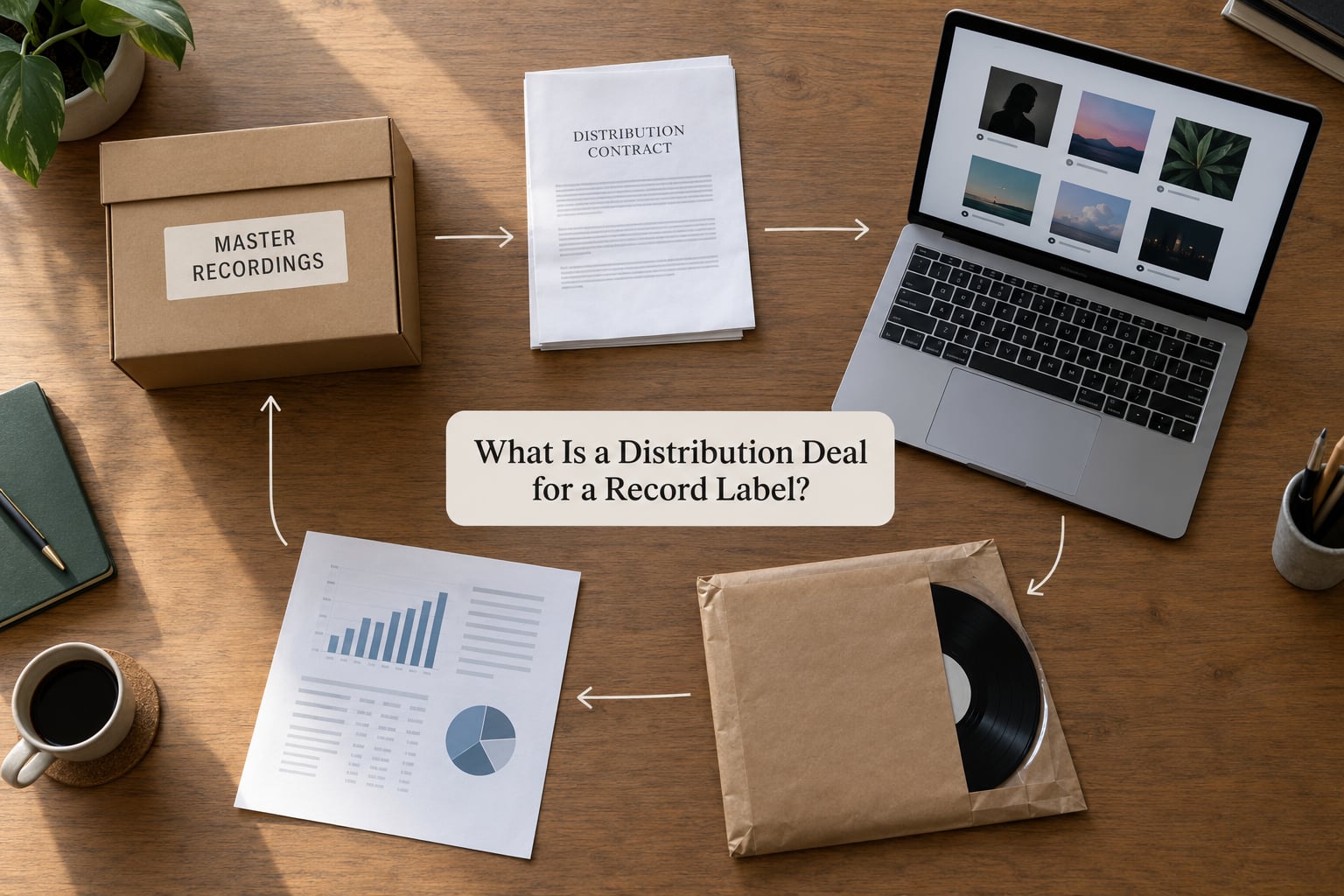
A distribution deal for a record label is an agreement in which the label licenses its finished recordings to a distributor for delivery to digital service providers and physical retail, in exchange for a commission on the revenue collected. Ownership of the masters stays with the label, and the label handles marketing, A&R and artist management itself.
Five things sit inside that agreement, and they are the reason a label signs one at all:
- Delivery. Your masters, artwork and metadata get sent to streaming services, download stores and, if you buy that service, physical retailers and wholesale partners.
- Collection. The distributor invoices platforms and stores and chases the money back, which almost nobody wants to do by hand.
- Reporting. You get a statement showing plays, units sold, territories and what was deducted, usually per track and per release.
- Payment. The balance reaches your account on a set schedule after the commission and any agreed costs come off.
- Commission. The distributor’s fee, commonly a percentage of revenue received or a flat annual or per-release charge.
What a distribution deal is not is equally important. It is not manufacturing: pressing vinyl, CDs or cassettes is a separate supply business, and fulfilment to record shops is often subcontracted again. It is not a licensing deal, where someone else records the artist and owns the masters for a period. And it is not selling your catalogue, which is the one thing that changes everything about your label’s future.
The distinction that trips up most people is between a label hiring a distributor and an artist hiring a distributor. Artists upload singles to aggregators like DistroKid, TuneCore, CD Baby or Ditto for a small fee and keep everything. A record label signing a distribution deal usually negotiates a percentage of revenue instead, with a proper contract, reporting commitments and possibly a term measured in years. Same industry plumbing, very different paper.
How Does a Record Label Distribution Deal Work?
The mechanics are more predictable than the contract language around them. Most distribution agreements run through six stages, and if you can picture where a release sits at any moment, you can tell whether something has gone wrong.
- Delivery of material. The label supplies mastered audio, artwork, liner notes, credits, ISRC codes for each track and a UPC code for the release, plus any required clearances.
- Ingest and quality control. The distributor checks levels, formats, metadata and artwork against each store’s delivery specification. A single wrong credit here follows the release everywhere for years.
- Delivery to platforms. Files go out to streaming services, download stores and physical wholesale partners under the label’s own identifiers, not the distributor’s.
- Revenue collection. Money arrives from platforms and stores on the label’s behalf. The distributor reconciles storefront reporting against its own statements, which is where mismatches usually surface.
- Statement. A period report arrives per release showing plays or units by territory, gross revenue, deductions and the commission.
- Payment. The net balance is paid out, commonly monthly or quarterly, sometimes after a reserve period while returns and chargebacks settle.
Who keeps track of music royalties, in practice? The answer is a chain rather than one party. Platforms report usage to the distributor, the distributor reports and collects from the label’s perspective, and the label then reports to artists and pays them under the artist agreement. Each link is a place where reporting can go soft, which is why independent label owners compare statements rather than brand names.
On a personal site like this one, the practical reality is that a distributor’s job ends at delivery, collection and payment. Pop on streaming services is close to nonexistent without paid promotion, and several label owners in music business forums describe distribution as the price of admission rather than a growth strategy. For a garage rockabilly or punk label releasing vinyl, that distinction matters twice over, because pressing and mailing orders is a separate cost centre the distribution agreement may or may not touch.
Key Terms in a Distribution Deal for a Record Label
Contracts reuse a small vocabulary. Learn these and the rest of the document becomes readable.
- Rights. Exactly what you are licensing: streaming, downloads, physical sales, territories, formats and the length of time.
- Territory. Where the distributor may sell. Worldwide rights are normal; territory carve-outs matter when a partner handles only certain markets.
- Term. How long the deal lasts, and whether it renews automatically.
- Royalty rate. The distributor’s cut, expressed as a share of gross revenue received, of net revenue, or of wholesale value.
- Advance. Money paid upfront against future royalties. Rare in plain distribution deals, common in label services and licensing deals.
- Recoupment. The partner recovers advances and costs from royalties before your share is paid.
- Holdback or reserve. A portion of revenue withheld until returns, chargebacks and platform adjustments clear.
- Audit rights. Your right to examine the distributor’s source data to check what was reported.
- Most-favored-nation clause. A guarantee that no other label receives better terms from the same distributor.
What Rights Does a Distributor Receive?
A distributor receives a licence, not ownership. The precise wording decides whether you can get your catalogue back, and the difference between a licence and an assignment is the single most consequential line in the document.
A licence gives permission. An assignment transfers the right itself. If your agreement says the distributor is granted exclusive rights to exploit the recordings for the term, you have given a permission that ends when the contract ends. If it says the masters are assigned or licensed perpetually, or that rights revert only at the distributor’s discretion, you have given away something you may not get back cheaply.
Ownership and copyright are also two different things, and this is where most confusion starts. The master recording is the sound recording itself, and that is what distribution covers. The composition, meaning the underlying song, is a separate copyright usually held by the songwriter or their publisher. A distribution deal touches the master and leaves the composition alone. Separately, in much of the world performers and producers hold neighboring rights in their performances and productions, which is another layer your agreements need to respect.
On duration: copyright in a recorded sound recording generally runs to the end of the calendar year of its creation plus a long fixed period, and in many jurisdictions the performer or producer can extend protection for another long period after the recording’s release. That is the rule people mean when they call it the 35 year rule. Your distribution term can be shorter than copyright protection, and usually should be.
Sublicensing is normal and not itself a warning sign. The distributor cannot deliver to Spotify without giving Spotify permission to stream the recording, so the contract needs to allow that. What to check is whether sublicensing is limited to platform delivery or whether it also permits bundles, compilations, direct-to-consumer sales and licensing to third parties such as television and advertising.
Which Types of Distribution Deals Are Common?
Four models cover nearly everything an independent label will be offered, and the differences come down to who keeps the masters, who builds the campaign and how long the relationship lasts.
| Deal type | Master ownership | Who builds the campaign | What you keep | Typical length |
|---|---|---|---|---|
| Aggregator or DIY distributor | Label keeps masters outright | Label and artist | Most revenue after a small commission or flat fee | Year to year, cancellable |
| Label services or hybrid deal | Label keeps masters | Shared, with the partner funding some campaigns | A negotiated share of net revenue after costs | One to three years, often with options |
| Traditional label deal | Masters licensed or assigned for the term | The label funds and runs it | A royalty share, often 15 to 25 percent to the artist | Three to seven albums, with option periods |
| 360 deal | Broad rights granted across recording, touring and merch | The partner | Any one of many splits, often with heavy recoupment | Long, frequently five years or more |
The aggregator route suits a label that just needs releases online and can handle its own reporting. Hybrids such as AWAL, Stem, UnitedMasters and Empire sit closer to a label relationship: the partner contributes money, campaigns or team, and takes a larger share in exchange. White-label or sub-label distribution is a variant where the distributor releases under your imprint and takes a percentage rather than charging you to use theirs.
An exclusive label partnership means one distributor handles your whole catalogue in exchange for better terms, marketing support or an advance. The reward is real when it comes with a commitment you can measure. Without one, exclusivity mostly removes your negotiating options.
How Are Royalties, Fees, and Recoupment Calculated?
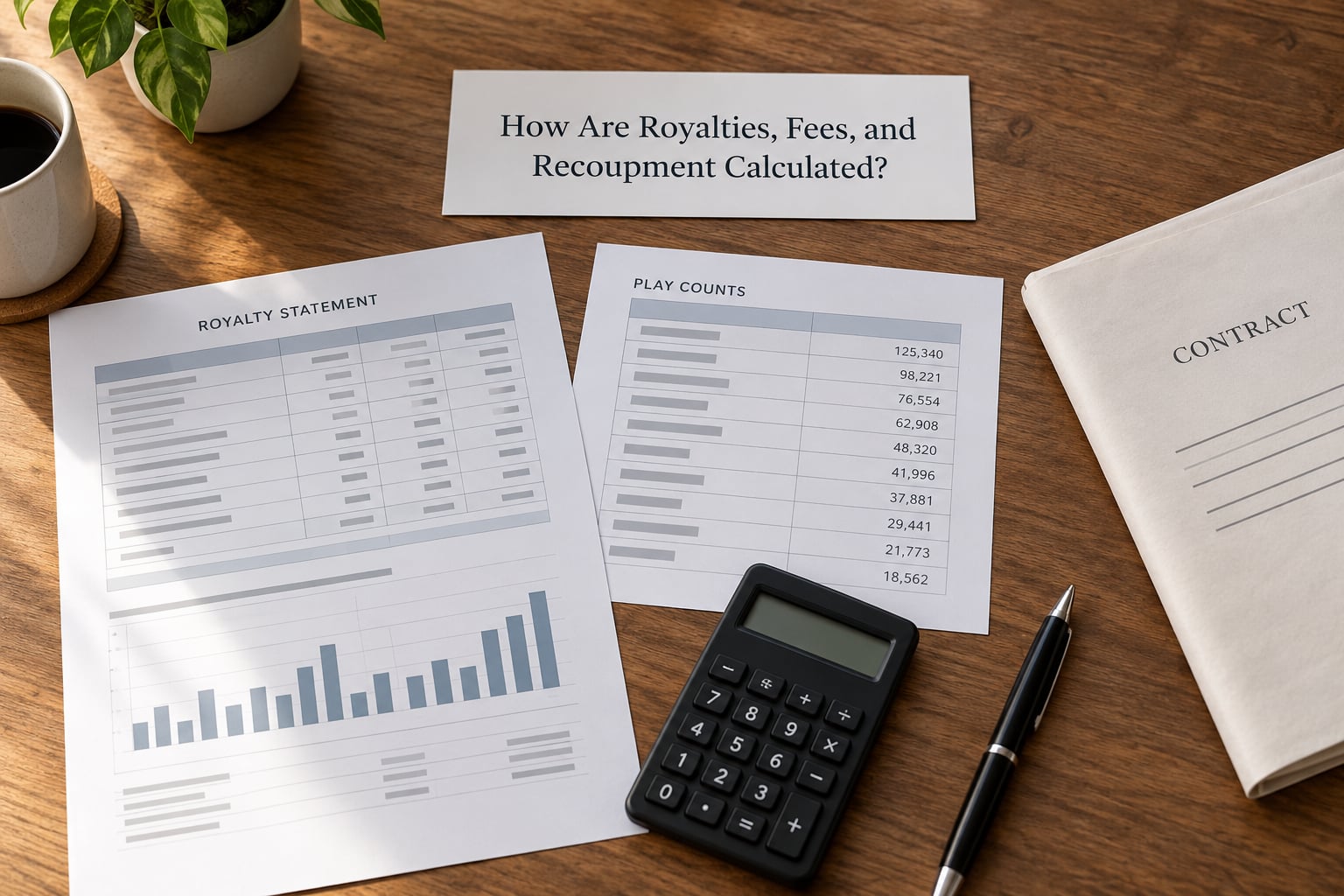
Distribution money is calculated from what the distributor actually receives, which is rarely the number on the retail price sticker. Index the money to 100 arriving at the distributor, and a typical statement period looks like this.
| Step | Amount | Remaining |
|---|---|---|
| Wholesale revenue received from stores and platforms | 100 | 100 |
| Distributor commission | 15 | 85 |
| Store, platform and payment processing deductions | 9 | 76 |
| Reserves and any agreed recoupable costs | 4 | 72 |
| Net paid to the label | 72 | 72 |
So for every 100 of wholesale revenue reaching the distributor, a label on a 15 percent commission structure typically banks around 72 before tax. The deductions in row three are the ones that cause arguments, because platform reporting and distributor reporting can disagree, and the distributor usually follows the platform.
Two definitions decide which number the percentage applies to. Under a gross revenue basis, the commission is charged on what came in before any deductions. Under a net receipts basis, the commission is charged after platform and store costs come off. The same 15 percent can be worth very different money depending on which basis is written, so check the definition of the word before the number.
Recoupment belongs to a different family of deals. In a distribution-only contract, the distributor’s fee is its compensation and costs are usually limited to things it can itemise. In a label services, licensing or 360 deal, the partner may advance recording costs, video budgets or marketing spend and then deduct them from your share until they are repaid. That is how a 70 percent share can still produce a small payment for several years.
Then there is the artist royalty sitting underneath. The label’s agreement with each artist commonly splits the label’s net receipt, often half to the artist and half to the label, after any recoupment at the artist level. That is a second agreement, separate from the distribution contract, and the two splits stack.
What Should You Look for in a Distribution Agreement?
Read these nine clauses before anything else. They decide whether you can leave, how much you keep and whether the numbers can be checked.
- Term and renewal. One year, three years or perpetual? Does it renew automatically, and can you decline renewal or terminate for convenience with reasonable notice?
- Territory. Worldwide, or specific markets? A narrow territory is fine if it is deliberate; an accidental gap means income you were counting on never arrives.
- Exclusivity. Exclusive in what sense: all formats, only streaming, only digital, only certain territories? Exclusivity should be matched by something from the distributor.
- Delivery requirements. Audio specifications, artwork standards, metadata accuracy, ISRC and UPC assignment, and what happens to releases that fail the check.
- Royalty rate and its basis. The percentage, and whether it applies to gross revenue, net receipts or wholesale value.
- Accounting frequency and payment terms. How often you get a statement, how long after period end you get paid, and whether a reserve applies.
- Audit rights. Whether you may examine source data, how far back it goes, how often, and who pays if an error is found. No audit rights with vague accounting is a bad combination.
- Reversion. What happens to rights and to your catalogue profiles at the end of the term. This is the clause that answers the question people ask most often.
- Exit and migration. How long it takes to move to another distributor, what happens to playlist placements, store pages and YouTube channel claims during the move, and whether the distributor assists.
Warranties and indemnity are worth reading too. The label usually warrants it holds the rights it is granting and has cleared samples, covers and remixes, and it indemnifies the distributor if that turns out to be untrue. Cover versions and unlicensed remixes are the most common reason a release gets blocked at ingest.
Should you have a lawyer review it? For a standardised aggregator agreement, most label owners read it and move on. For anything exclusive, long, involving an advance, or with recoupment, an hour of a music attorney’s time is cheap. The clauses above are where the money sits, and that is where mistakes are expensive.
How Do Labels Choose the Right Distributor?
Choose by testing the reporting, not the logo. Distributors with annual unlimited-release plans tend to suit small rosters better than per-release fee structures, and the fastest-growing labels usually start with an aggregator and move up later.
A workable sequence: ask each candidate for a sample statement on a comparable catalogue, then check how the reporting compares per release rather than per label. Confirm the digital platforms you need, especially for catalogue that predates streaming. Ask what physical services exist and whether pressing, manufacturing and fulfilment sit inside the agreement or outside it.
Then look at genre fit and audience. A distributor with genuine listeners in your genre can move a release further than a larger one that does not. Geographic reach matters too, particularly if you sell records in specific markets or to collectors who buy at record fairs.
Finally, look at the operational side: how quickly a support question gets answered, whether there is a real human on the other end for a royalty discrepancy, and how they handle a catalogue migration when you outgrow them. Migration is where relationships are tested, and it is the thing nobody demos before signing.
What Red Flags Should an Independent Label Watch For?
These five patterns come up repeatedly in label-owner complaints, and each one is fixable before you sign rather than after.
- A perpetual or effectively non-terminable term with no written exit. Fear of being locked in is the most cited worry in music business forums, and perpetual language buried in the definitions is the thing to look for.
- Vague accounting. If the agreement does not define the basis of the royalty rate, the accounting frequency, or the deductions, you have no way to check the statements you will receive.
- One-sided termination and takedown rights. A partner who can remove releases instantly while you cannot leave for months leaves you exposed with no leverage.
- Excessive recoupment or hidden fees. Unitemised costs, administration charges or marketing deductions can quietly consume the margin that the headline royalty rate implied.
- Pressure to sign quickly. Being pushed to sign before a release campaign starts, or shown a reduced fee that expires this week, is a technique, not a deadline.
One more red flag deserves naming because it is the source of most forum anxiety: any wording that transfers masters or copyright rather than licensing them. A distribution agreement should never need you to give up ownership of what you spent years paying to record.
Frequently Asked Questions
Does a distribution deal transfer ownership of a record label?
No. A distribution deal grants a licence to deliver recordings and collect revenue on your behalf. The label keeps the master recordings and the composition copyright throughout, and rights return at the end of the term. Ownership only changes if you sign an assignment or sell the catalogue outright, which is a different transaction entirely.
Should a small record label sign an exclusive distribution deal?
Only when the exclusivity is narrow and time-limited, and the distributor commits something measurable in return: a named marketing commitment, a reporting standard, or better terms. Exclusivity without a matching commitment, or combined with a perpetual term, removes your ability to shop elsewhere when reporting disappoints.
What is the difference between distribution revenue and artist royalties?
Distribution revenue is the money the distributor reports and collects from platforms and stores on the label’s behalf, after the distributor’s commission and platform deductions. The artist royalty is the separate share of that revenue the label then passes to an artist under the artist agreement, often half, and often after any artist-level recoupment.
Can a distributor recover recording and marketing costs from royalties?
Usually not in a plain distribution deal. A distributor’s compensation is its commission, and any costs are normally limited to items it can itemise. Recoupable recording and marketing costs appear in label services, licensing and 360 deals, where a partner funds the work and deducts it from your share until repaid.
Is it better to distribute an independent record yourself or hire a distributor?
An aggregator is quicker and cheaper for a single self-released record, and the label keeps everything. A distributor adds real value once you have a roster: consolidated reporting, sync licensing outreach, pitch handling, catalogue tools and often physical fulfilment. The honest test is whether anyone on your team will actually read the monthly statements.
Should I hire a lawyer to review a distribution agreement?
Worth it for anything exclusive, long, or involving an advance or recoupment. Standard aggregator terms are familiar and low-risk, so most owners read those themselves. Bespoke partner agreements are where ownership, term and exit get decided, and an hour of a music attorney’s time is cheap against a multi-year commitment.
Conclusion
A distribution deal is plumbing, not partnership: you keep the masters and the control, and someone else handles delivery, collection and reporting in exchange for a commission. Before you compare two offers, write down five things on paper — which rights you are granting, which territories and formats you will not grant, how long you are willing to commit, the revenue basis you expect, and the conditions under which you want your catalogue and its profiles back.
Put those five answers next to each distributor’s terms and the comparison takes ten minutes instead of ten weeks. If the answers are uncomfortable, that is the deal doing its job in reverse.