A licensing deal in music is a contract where the owner of a song gives a film studio, brand, game, podcast or video creator permission to use that song for a set period of time, in a set territory, for a set purpose, in exchange for money. Ownership of the song stays with the rights holder. Think of it as renting a room: the licensee gets the keys for an agreed stretch, and when the rental ends, the keys come back.
Most people meet this for the first time when they want to put music under their own video, ad or trailer and realize the song is spoken for. That first conversation is where the vocabulary gets confusing fast, and the licensing market in 2026 is not getting simpler. This guide lays out what a licensing deal covers, what the licensee actually receives, how the money works, and what to read before you sign anything.
Table of Contents
- What Is a Licensing Deal in Music?
- How music licensing works, step by step
- What Can a Licensing Deal Cover?
- The other assets and rights that show up
- What Rights Does the Licensee Receive?
- Exclusive versus non-exclusive
- The permission list
- How Does a Licensing Deal Work From Start to Finish?
- What Is a Licensing Deal in Music? Key Terms to Know
- How Are Licensing Payments Calculated?
- What Is the Difference Between a License and a Sale?
- Which Common Music Licensing Deals Should Artists Know?
- Synchronization license
- Master use license
- Mechanical license
- Performance license
- Cover song license
- Sample clearance
- Beat license
- What Should Artists Check Before Signing?
- How Can an Artist Negotiate Better Licensing Terms?
- Set priorities before the call
- Ask precise questions early
- Ask for payment and reporting terms
- Offer alternative language
- Frequently Asked Questions
- Do music licensing deals give up copyright?
- How long does a music licensing deal usually last?
- Who pays the licensing fee for a song used in a video?
- Can an artist license the same song to several licensees?
- Should an artist hire a lawyer to review a music license?
- Conclusion
What Is a Licensing Deal in Music?
A licensing deal is permission to use music that someone else owns, limited by three dials: how long, where, and for what. Ownership is not part of the transaction. A license grants usage rights for a defined window; the copyright stays with the writer, artist, publisher or label.
It helps to separate three things that get blurred together. A license is temporary permission to use. An assignment permanently transfers copyright ownership. A recording contract, on the other hand, is a deal between an artist and a company to make and release records, which is a different animal and often sits upstream of every license anyone signs later.
Why does an artist grant permission at all? Because copyright law is strict. Using a song you did not write, in a video you produced, without permission can trigger a claim, a takedown, lost revenue on the platform, or a legal claim. Fear of that outcome is the single most common reason independent creators end up licensing music they can already legally afford, like public domain recordings and properly cleared stock libraries.
How music licensing works, step by step
- The rights holder grants usage rights for a defined territory, term and medium.
- The licensee pays an upfront fee, and sometimes an ongoing royalty or backend share.
- The licensee uses the music only inside the granted scope, often with a required credit.
- The license expires, renews, or converts, and anything outside the scope needs a fresh deal.
What Can a Licensing Deal Cover?
Every song carries two layers of copyright, and most confusion in licensing starts from treating them as one.
The composition is the song itself: the melody, words and chord structure. Its owner is usually the songwriter or a music publisher, and licensing it grants performance and mechanical rights. The master recording is the specific sound file, owned by the artist or a label. Licensing the master lets someone use that exact recording rather than a re-recorded version.
Because those two layers are often owned by different people, a film placement usually needs two licenses: one from the music publisher for the composition, one from the master owner for the recording. A single signature can clear both when the same company controls both, which is common for major-label catalogue material and rare for a self-released indie track where the artist owns everything.
The other assets and rights that show up
A licensing deal can also cover a performer who owns their performance rights, a producer who controls the underlying beat, a remixer’s contribution, or a label holding rights across a catalogue. Other things that appear in these agreements include merchandise, brand partnerships, games, and neighboring rights, which cover performers and other contributors who do not own the underlying song.
Beat licensing is a good example of the confusion here. A beat sold with a license is a lease on a backing track, and the deal types differ sharply. One artist may buy a non-exclusive license, meaning many artists can use the same beat, while another buys an exclusive license, meaning nobody else gets it. If another artist has already bought the beat exclusively, the exclusive purchaser can generally stop distribution, which is exactly the trap producers on Gearspace and r/synclicensing keep running into.
What Rights Does the Licensee Receive?
The rights a licensee receives are always described by four questions: which rights, where, for how long, and in what media. Get answers to all four and the deal is clear enough to sign. Miss one and you get the kind of ambiguity that ends with a claim three months later.
Exclusive versus non-exclusive
An exclusive license means the licensee is the only party allowed to use the music for the defined scope, so the licensor signs away the ability to place it with a competitor. It usually commands a higher fee. A non-exclusive license lets the licensor grant the same or similar permissions to others, and it is how most catalogue and stock library placements work.
The exclusivity in a sync agreement is often narrower than it sounds. A brand campaign exclusive to one advertiser in one territory for two years does not stop a film placement, a podcast, or another ad in a different country. Read the scope rather than the label.
The permission list
Common scope language includes reproduction rights (copying the recording), distribution, public performance, streaming and downloads, broadcast, adaptation and editing rights (cutting a 30-second cutdown), territory, and term. Some deals add sublicensing, which lets the licensee pass the rights to a distributor, a network, or a broadcaster. Sublicensing matters most to companies whose business model depends on reselling access, and it is worth a lot of money to them, so it is worth challenging.
How Does a Licensing Deal Work From Start to Finish?
The process looks different from the licensor side and the licensee side, but the bones are the same eight steps.
- Identify the asset. Nail down which exact recording and which composition, with title, version, length and writers. Ambiguity here causes disputes years later.
- Find the right licensor. Start with the chain of title. If the master belongs to a label and the composition to a publisher, you need both, and the publisher’s administrator may be a PRO such as ASCAP, BMI or SESAC rather than the writer directly.
- Define the use precisely. Medium, project name, audience, territory, term, exclusivity, whether edits are allowed, and what the credit line must read.
- Negotiate the money. Flat fee, advance against royalties, royalty share, backend points on the project, or a mix. Put the payment schedule in writing.
- Sign. Both rights owners sign where two layers are involved. Get a signed copy and confirm the effective date.
- Deliver and administer. The licensee sends the recording, the cue sheet or the asset metadata, and delivers the fee per the payment schedule.
- Collect the money. The fee is normally paid on execution. Royalties and performance income arrive later, often months afterward, which is a point of friction that comes up constantly in sync discussions on Reddit.
- Renew, convert or end. Some licenses convert to a longer term once a project succeeds or airs. Others expire cleanly, and any use outside the original scope requires a new agreement.
What Is a Licensing Deal in Music? Key Terms to Know
Contract language looks intimidating until you know the dozen words that carry the weight. Here they are in plain English.
- Royalty: a payment calculated as a share of revenue or a set amount per use, rather than a one-off fee.
- Advance: money paid up front against future royalties. If the royalties never catch up, the artist keeps the advance and the licensee has usually paid for nothing more.
- Minimum guarantee: a floor the licensee promises regardless of actual use.
- Term: how long the license lasts. Short for advertising and campaigns, long for a library placement, and perpetual in the worst cases.
- Territory: where the use is permitted. Worldwide rights cost more than a single country.
- Media: what it can be used on, such as online video, paid television, radio, in-store or in-app.
- Synchronization fee: the upfront payment for pairing a recording with picture, which is why these deals are called sync licenses.
- Master use: the right to use the specific sound recording, as opposed to the underlying song.
- Publishing: the rights in the composition, usually administered by a publisher or a PRO.
- Neighboring rights: performance and producer rights that sit alongside copyright, administered separately in many countries.
- Reversion: the point at which rights return to the artist, either by a fixed date or a defined event.
- Audit rights: the right to inspect the licensee’s accounting records to verify what was actually earned.
- Indemnity: a promise to cover the other side’s losses if something goes wrong, including claims that the music infringes someone else’s rights.
- Credit: the required on-screen or written acknowledgement, often with a defined size and duration.
How Are Licensing Payments Calculated?
Licensing payments come in four main shapes. Most real deals blend two of them, and knowing which one you are in tells you where the risk sits.
| Payment model | How it works | Where the risk sits |
|---|---|---|
| Flat fee | A one-time payment for a defined use, paid on execution and treated as the licensee’s cost. | The artist, who receives no further income if the project succeeds. |
| Royalty only | No upfront payment. The artist collects a share of revenue generated by the use. | The licensee, who may earn nothing if the project underperforms. |
| Advance against royalties | A payment up front, recouped from subsequent royalty income. | Shared. If royalties fall short, neither side recoups fully. |
| Hybrid | A modest fee plus a backend share, common in advertising and lower-budget film. | Balanced, but the backend definition needs precise drafting. |
What drives the number is a short list: song length, how well known the artist is, where the music runs, the size and length of the campaign, the size of the audience, how long the rights last, and how much editing the licensee wants. A short, memorable, mid-tempo track with a clean chorus is worth more than a long build because a supervisor can use it without editing.
I would rather readers see honest ranges than a single confident number, because the ranges online are wildly inconsistent and most are years out of date. Two things are stable. Fees for a song used in a small creator video are trivial next to fees for a national advertising campaign. And a fee paid today is money in hand, while performance royalties can arrive a year or more later.
What Is the Difference Between a License and a Sale?
A sale, or assignment, moves copyright ownership. A license keeps it with the artist and hands over only the right to use it, for a defined scope and time. Once the license ends, the music belongs to the artist again and the licensee must stop using it or renegotiate.
The practical differences show up in predictable places. With a license, the artist can license the same song to a competitor tomorrow, keeps earning from other placements, and can re-license the same footage or project later. With a sale, there is no second chance at that money, and if the project outperforms expectations the artist usually shares in none of it.
Ownership also determines who can authorize future use. In a licensed deal, the artist can approve or refuse additional uses and can pull the license when the contract says it ends. After an assignment, the former artist has no say at all.
A separate trap sits in the gap between the two. Some independent creators buy a track once, use it in a video, and assume they own it. They licensed it, and the license covers the scope they signed for. Step outside the scope and the correct move is a new license, not a quiet assumption.
Which Common Music Licensing Deals Should Artists Know?
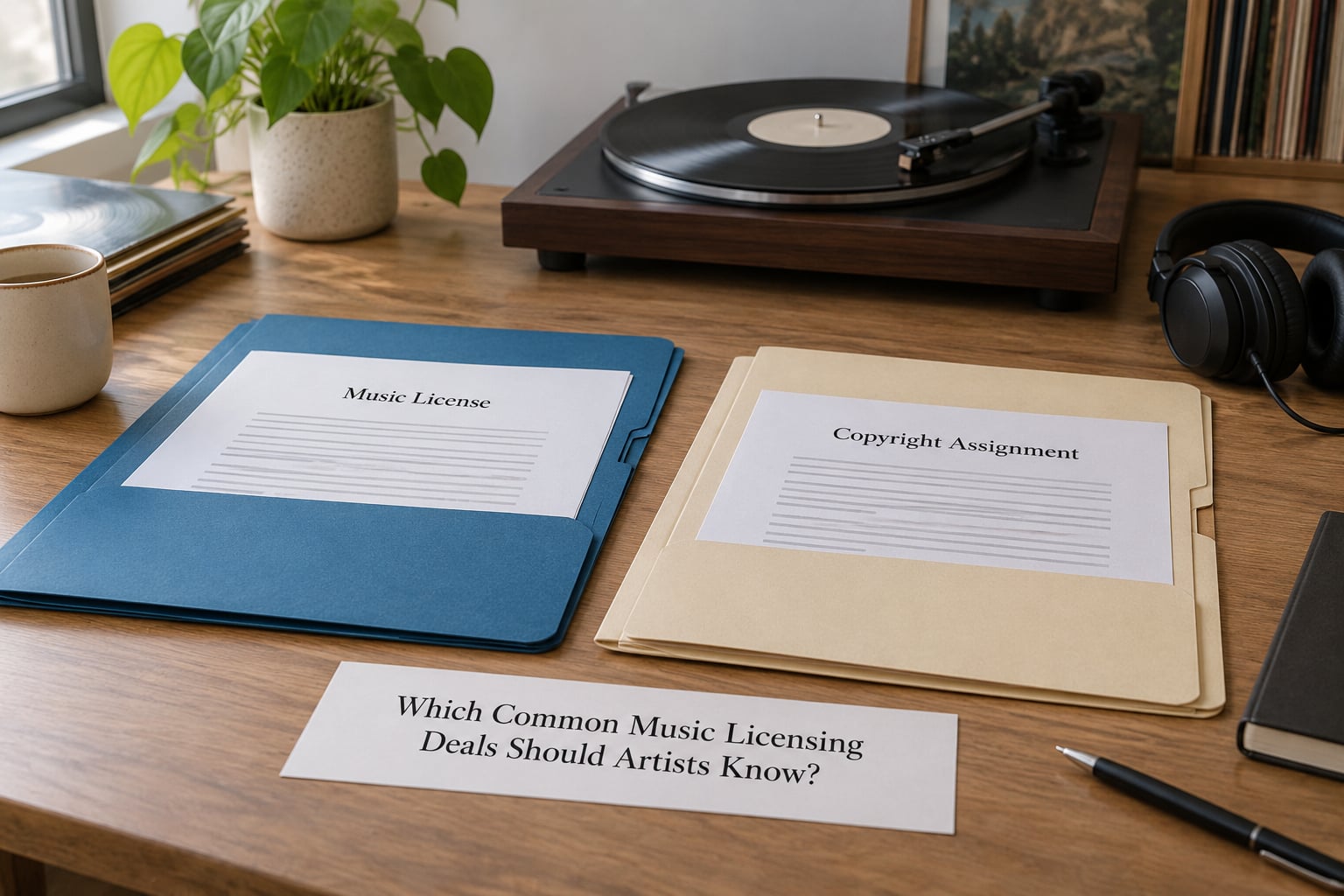
Seven deal types cover almost everything an artist and a licensee run into.
Synchronization license
The most recognizable type: permission to synchronize a song with picture in film, television, an ad, a trailer or a game. It usually requires two clearances, one for the composition and one for the master, and it pays a synchronization fee plus performance royalties for the term of the project.
Master use license
Permission to use a specific recording, usually without picture, in advertising, radio, online video or a podcast. This is the deal behind most brand campaigns, and it is the one where territory and term get negotiated hardest.
Mechanical license
Permission to reproduce a composition, such as covering a song or including it on a physical or downloadable product. Rates for these are generally set by law or by a rate-setting body rather than negotiated per song, though voluntary direct agreements do happen.
Performance license
Permission for music to be played publicly, whether live, on radio, or in a venue that pays a blanket license to a PRO. Venues and businesses usually buy blanket licenses rather than licensing track by track, which is why the payment from a venue is diffuse.
Cover song license
Permission to record a song someone else wrote. The practical obstacle is less legal than administrative, since publishers are slow to answer and the required documents go missing. Where the original writer is deceased, an estate or executor controls the rights and the process takes longer.
Sample clearance
Permission to use an existing recording inside a new one. This is the most fragile deal type on this list, because a clearance must cover both the underlying composition and the sampled master, and sampling recognizable audio invites a claim if it is missing. Threads on r/musicproduction lean heavily toward building original material rather than sampling for exactly this reason.
Beat license
Permission to use a producer’s backing track. Exclusive variants give one artist sole use and higher fees; non-exclusive variants let many artists record against the same beat at a lower price. The three families get confused constantly: a beat license covers the backing track, a master use license covers a finished recording, and a sync license covers placing that recording in a project.
What Should Artists Check Before Signing?
Twelve items deserve a slow read before any signature. Run them in order, because the first four decide whether you should sign at all.
- The exact asset. Title, version, length, writers, master owner, and a clear reference to the recording.
- Permitted use. Medium, project, audience, and whether edits or cutdowns are allowed.
- Exclusivity. What is actually blocked, for how long, and in which markets.
- Term and territory. Watch for perpetual, and for perpetual combined with worldwide.
- Payment. Amount, schedule, invoicing steps, and when the clock starts.
- Accounting and reporting. How revenue is calculated, how often statements arrive, and whether you can audit.
- Credit. Exact wording, placement, and size, and what happens if the licensee misses it.
- Warranties. Especially that the licensor has authority to grant what is being granted.
- Indemnity. Whose losses are covered, and whether a one-sided indemnity puts all the exposure on the artist.
- Sublicensing. Whether the licensee can pass rights on, and to whom.
- Renewal and conversion. Automatic renewals and event-based conversion clauses can extend a deal without anyone noticing.
- Reversion and termination. The date rights return, what triggers early termination, and what happens to uses already in the wild.
Two clauses deserve a lawyer’s eye every time: a perpetual worldwide term with sublicensing, and a waiver of moral rights. Moral rights are personal rights that sit alongside copyright in many countries, and waiving them is a bigger step than most creators realize they are taking.
How Can an Artist Negotiate Better Licensing Terms?
Trade scope rather than arguing only about money. An artist who asks for a narrower territory, a shorter term, or a carve-out for future placements often gets a better deal than one who only pushes on fee, and the licensee usually still gets what they need.
Set priorities before the call
Decide in advance what you cannot give up. Most independent artists can live with a short exclusive window but not with a perpetual worldwide one, or they can accept a modest fee if the credit is prominent and the term is three years. Walking in without a priority list means conceding whatever gets pushed hardest.
Ask precise questions early
Useful opening questions include how long the campaign runs, which territories are covered, how many media are included, whether the project has a theatrical release window and a streaming window, and whether other artists are already licensed for this use. Specific answers prevent vague drafting later.
Ask for payment and reporting terms
Request a clear payment schedule, a defined statement frequency, audit rights, and a late-payment position. On the licensee side, ask for the chain of title in writing before any invoice goes out, which is what prevents a clearance from collapsing after the edit is finished.
Offer alternative language
Counter with drafted language rather than adjectives. Proposing a concrete three-year term in one territory, or a reversion after twelve months, moves a conversation further than asking for a fairer contract.
On exclusivity specifically, the honest trade-off is straightforward. Exclusive deals often carry better per-use rates and broader pitching, and the friction independent artists report on r/synclicensing and r/WeAreTheMusicMakers is consistent: an exclusive library deal can quietly become the only door, while a non-exclusive catalogue keeps options open. One compromise that keeps coming up in those threads is keeping the catalogue non-exclusive while handling production work exclusively.
Frequently Asked Questions
Do music licensing deals give up copyright?
No. A licensing deal grants permission to use music within a defined scope, term and territory, and the copyright stays with the writer, artist, publisher or label. What changes is that the licensee now has a legal right to the specific use described, and the artist has promised not to grant that same use to a direct competitor for the same scope. That exclusivity is often the real consideration behind a higher fee.
How long does a music licensing deal usually last?
It depends entirely on the use. Advertising campaign licenses often run one to three years, sometimes longer if usage is extended. Broadcast and streaming placements are tied to the life of the project, which can be decades for a long-running series or a film library. Catalogue and stock placements can be perpetual. Any term described as perpetual with worldwide territory deserves a second look before you sign.
Who pays the licensing fee for a song used in a video?
The party producing the video pays it, and for most independent creators that means you. Fees rise steeply as the project grows: a personal video carries a small cost, a monetized channel carries more, and a national advertising campaign carries the most. Note that a song normally needs two clearances, one for the composition and one for the master, and each rights holder can charge separately.
Can an artist license the same song to several licensees?
Yes, as long as the licenses do not collide. With non-exclusive deals you can license the same song to many licensees for different projects, markets or media, which is the normal model for stock libraries and much of the sync world. An exclusive license blocks a defined scope only, so check the scope carefully: exclusive to one advertiser in one country for one year leaves plenty of room for other placements.
Should an artist hire a lawyer to review a music license?
For a small non-exclusive placement, a careful read may be enough. For anything exclusive, perpetual, worldwide, involving a sublicensing clause, or worth real money, an hour of a music lawyer’s time is cheap next to the downside. Legal rules differ by country and state, and some jurisdictions add rights such as neighboring rights or moral rights that a generic template will not account for.
Conclusion
A music licensing deal is a permission with edges, and the whole game lives in where those edges are drawn. Start by writing down the exact asset and the exact proposed use, then settle four things before signing: which rights, which territory, how long, and what triggers payment and reversion.
Everything else follows from that. Two clearances instead of one, a term you can live with, and a scope narrow enough that your next opportunity stays open.