Updated for October 2026
A vinyl pressing plant is a factory that turns raw plastic pellets into finished records. It takes an approved audio master, cuts it to lacquer, copies that lacquer into metal stampers, and presses hot vinyl between them on a hydraulic press until it cools into a playable disc. That is the whole job: manufacture physical records from a finished master.
What is a vinyl pressing plant, in practical terms? It is the room where a record actually gets made. Artists, indie labels and major labels own the music and the artwork, but the plant owns the machines, the stampers and the quality control. If you want to understand how vinyl records are made, or why two copies of the same album can behave differently, this is the process that decides it.
Table of Contents
- How a Vinyl Pressing Plant Turns Masters into Records
- The Main Stages of Vinyl Record Production
- What Is a Vinyl Pressing Plant?
- The Role of the Mastering Engineer and the Metal Master
- How Labels Choose a Pressing Plant
- What Matrix Numbers, Runout Etchings, and Plant Identifiers Tell Collectors
- Why the Same Album Can Sound Different on Vinyl
- How Collectors Can Evaluate Pressing Quality
- Frequently Asked Questions
- Do vinyl pressing plants make the music themselves?
- How do I tell which pressing plant made my record?
- What are vinyl test pressings?
- Do first pressings sound better than later ones?
- Can a record be repressed years after its release?
- Is there a vinyl record shortage?
- Conclusion: Start With the Production Details
How a Vinyl Pressing Plant Turns Masters into Records
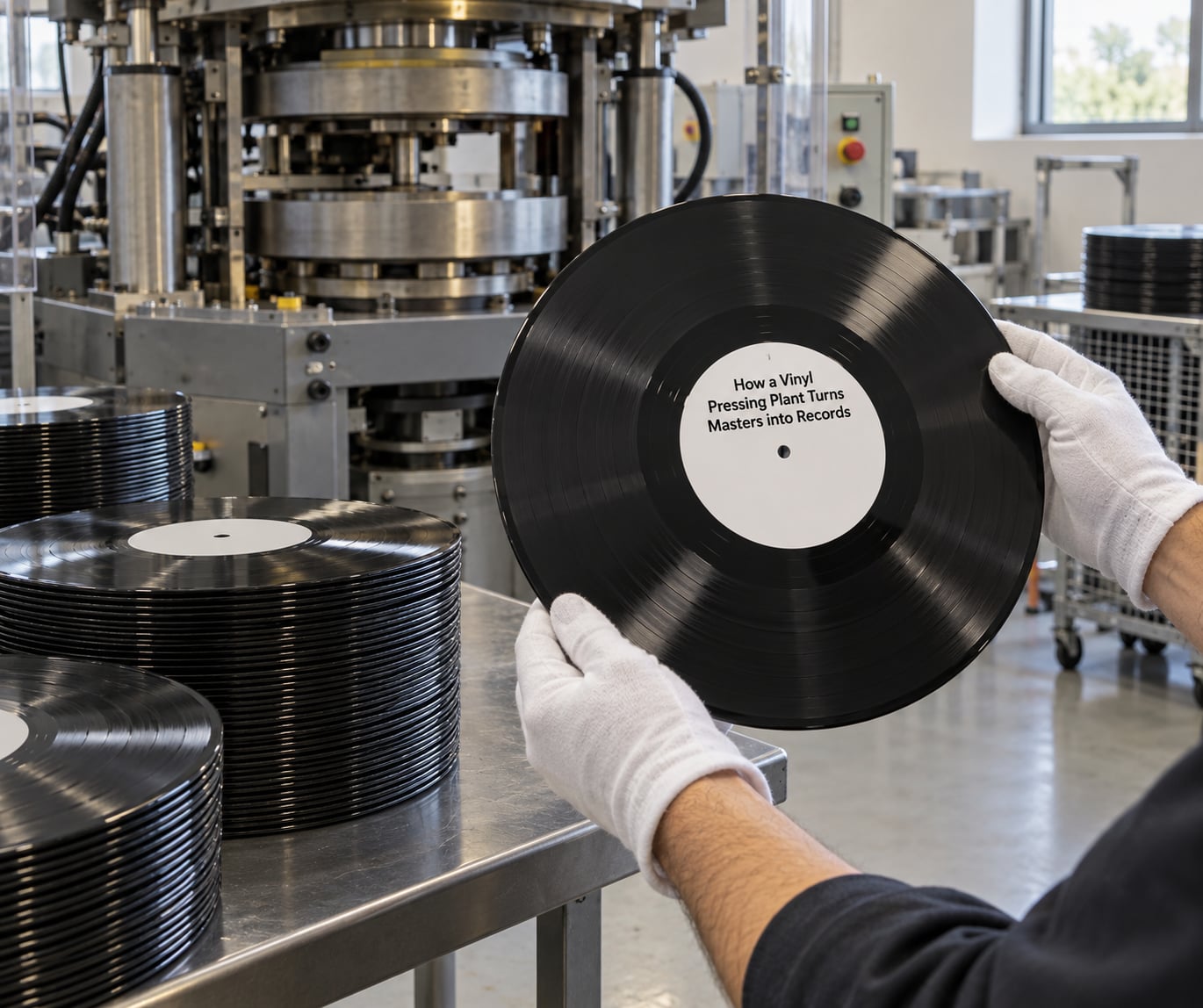
Inside a pressing plant you will find a short list of heavy, hot, noisy machines: an extruder that softens PVC pellets, a row of hydraulic presses, a plating area, a trimming area and a wrapping station. Almost everything else is floor space for moving records on pallets.
Scale varies enormously. A boutique plant might run a couple of presses for small runs of coloured vinyl, while a large European plant advertises 43 presses and output of roughly 40,000 to 60,000 records a day. Both are doing the same thing, just at different speeds.
Plants do not usually decide what gets made or what it should sound like. They take a job from a label, a distributor or a broker and manufacture to the specs supplied. If you have wondered whether the same company cuts your lacquer, presses your record and distributes it to shops, the short answer is usually no.
The Main Stages of Vinyl Record Production
What Is a Vinyl Pressing Plant?
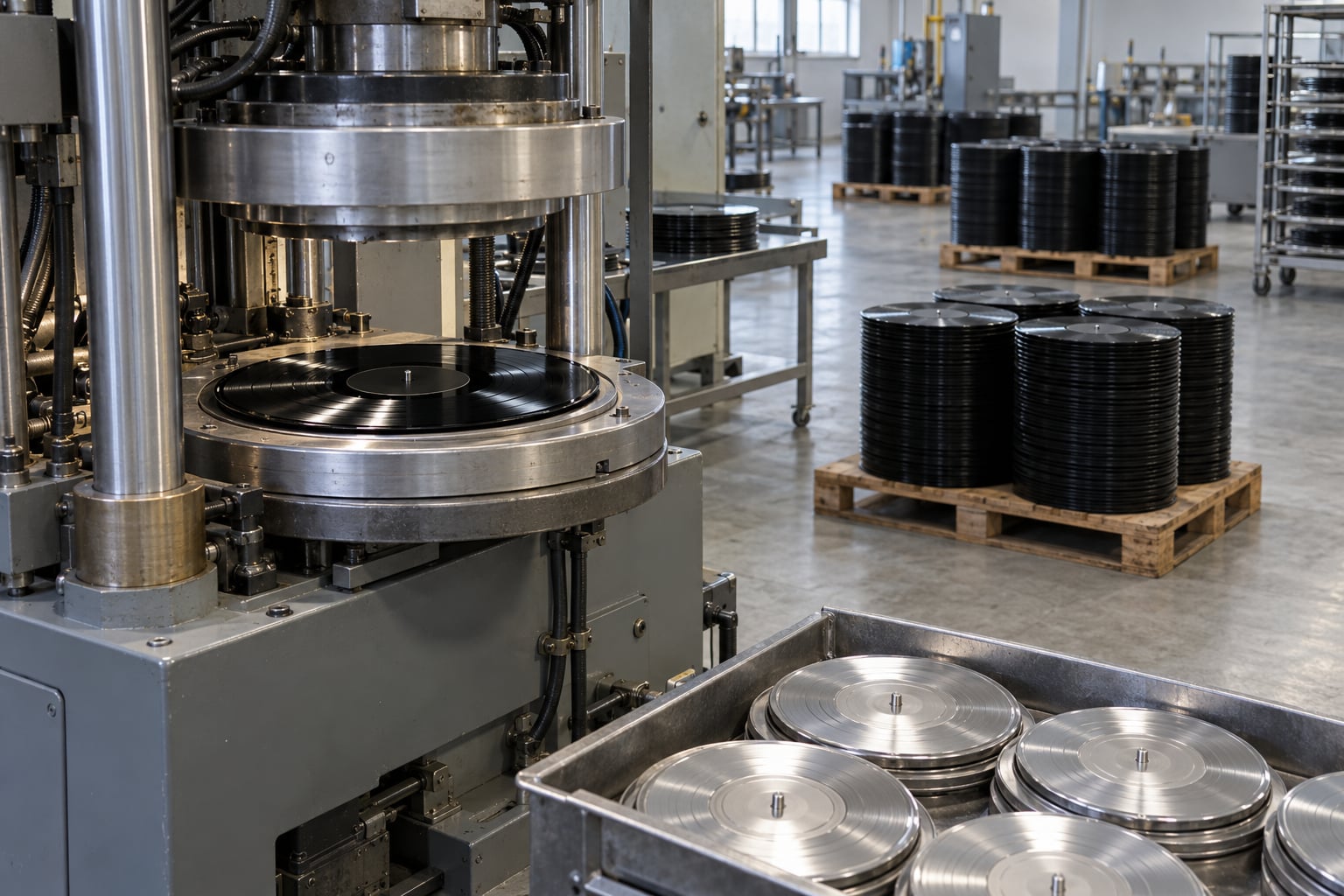
A vinyl pressing plant is a factory where raw plastic material is transformed into physical vinyl records. Pellets are heated and extruded into a soft disc called a biscuit or puck, that puck is stamped between two metal stampers carrying the record’s grooves, and then it is pressed and cooled under roughly 155 tons of hydraulic pressure until it holds its final shape.
That three-beat summary is the whole manufacturing core. Everything else in the plant exists to feed it or to check the result.
- Heating and extruding. PVC pellets are fed into an extruder and heated until they become a dough-like mass. A hydraulic screen pushes it through a round die, and a knife trims the output into a flat disc called a biscuit or puck. The puck is still hot and soft at this point.
- Stamping. The hot puck is placed on the lower half of a press, with the paper centre label positioned by hand or by machine. The upper stamper descends and a ring of hot material is forced out to the edge, forming the rim of the disc.
- Pressing and cooling. Under about 155 tons of hydraulic pressure, the vinyl fills the microscopic grooves cut into the stampers. Water flows through channels in the press plates to cool the record, and after enough cooling cycles the finished disc is ejected, trimmed and inspected.
Before any of that, though, the audio has to travel a long way. The full sequence runs from the source master through audio preparation, lacquer cutting, plating, test pressings, mass pressing, inspection, packaging and finally distribution. Cutting happens at a mastering house or in-house facility. Pressing, plating and packaging happen at the plant.
The Role of the Mastering Engineer and the Metal Master
Before a pressing plant can manufacture anything, an audio master has to exist and be approved. Mastering engineers balance levels, manage dynamics and decide how the record should translate to the format, often producing a high-resolution file or an approved digital master for the label to release.
That master then goes to a cutting lathe, where a fine diamond stylus cuts the grooves into a blank lacquer disc. A lacquer is soft and thin, so it cannot be pressed against directly. Instead it is placed in a plating tank and electroformed: metal is deposited on the lacquer surface until it forms a solid negative, which is then plated to the required thickness and quality. That metal negative is the stamper, and the stamper is the template for every record the plant makes from that master.
This is why two records holding the same musical master can still differ. A different cutting engineer makes a different lacquer. A different lacquer generation, a different stamper plating, or a stamper that has worn after producing a large number of copies all change the result slightly. Once a label approves a test pressing, that approval is tied to a specific set of stampers.
How Labels Choose a Pressing Plant
Labels do not shop on sound alone. They shop on capacity and reliability, because a plant that is fully booked for three months cannot help you.
- Capacity and lead time. How many presses are running, how many orders are queued, and how quickly a test pressing comes back.
- Minimum order quantity. Smaller plants will often quote runs in the low hundreds, which suits independents and one-off projects.
- Equipment type. Manual, semi-automatic and fully automatic presses suit different runs, and colour and specialty formats need compound handling.
- In-house services. Cutting, plating, printing, jacket assembly and shrink-wrapping under one roof reduce the number of handoffs.
- Track record. Labels rely on plant operators to flag problems early, because a defect caught before pressing completes costs far less than a rejected finished run.
- Sustainability. Several plants now advertise records made from fully recycled coloured vinyl, and the PVC supply chain matters to some labels.
For small labels, a broker often sits between label and plant. Brokers pool small orders into one large run and split the shipment, which is why forum threads about vinyl pressing keep circling back to brokers. It also keeps recurring complaints about communication landing on the broker rather than the factory.
What Matrix Numbers, Runout Etchings, and Plant Identifiers Tell Collectors
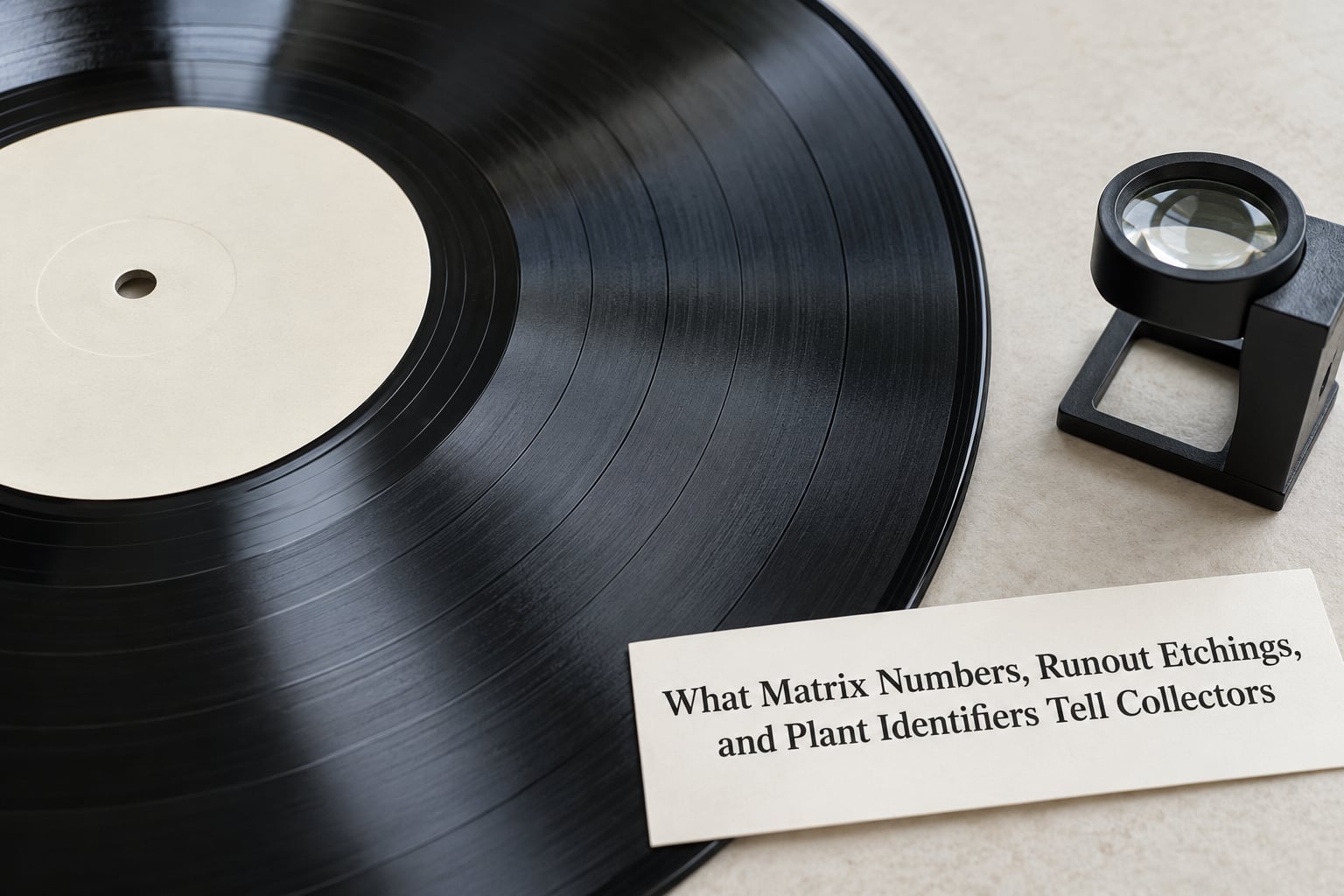
The area between the last music groove and the edge of the record is called the dead wax. On many pressings it carries etched or stamped text, and that text is the closest thing vinyl has to a serial number.
What you are usually looking for:
- Runout etching. Hand-etched text identifying the stamper and often the matrix. Hand etching means a worker inspected the record individually, which used to be a marker for higher-end manufacturing.
- Matrix number. A short code linking the record to a specific master, often beginning with a mastering studio code and ending in letters that indicate the stamper version, such as A1, A2, B1 or B2.
- Plant identifiers. Some plants stamp their name, initials or a symbol into the runout. Where a plant does not stamp, the lettering is often the cut engineer’s mark or the plant’s own code system.
- Side and format marks. Side designations, speed markings and stereo or mono indicators often sit alongside the matrix code.
One caution. Not every runout is legible, and plenty of records have plain dead wax with no markings at all, particularly on later pressings. Etchings wear, get cleaned away or were never stamped in the first place. Treat the dead wax as strong evidence when it is readable, and as no evidence at all when it is blank.
Why the Same Album Can Sound Different on Vinyl
Collectors argue about whether one pressing sounds better than another, and the honest answer is that most of the difference is audible and measurable, but not always the difference people expect.
The audio master is the biggest factor by far. Two editions cut from different masters can differ in loudness, spacing and treble. Next comes the cutting engineer and the stamper generation, since a later stamper revision often sounds tighter than the first cut. The pressing plant matters less than most forums suggest, and much of the reported difference there is expectation rather than measurement.
What genuinely changes playback is physical. Heavier records tend to resist warp, thinner ones can flutter. Surface damage, a dirty groove and a worn stylus all do more harm than any difference between two good plants. Age matters too, because vinyl compound and jackets both move with time and storage conditions.
How Collectors Can Evaluate Pressing Quality
Evaluate a copy before you clean it. Look at the sleeve first for ring wear, seam splits, corner wear and spine cracks, since jacket condition drives price more than any production detail. Then check the disc under good light for scratches, scuffs and any signs of warping.
Next, read the record. Note the label design, the catalogue number, the matrix and runout markings, and whether the dead wax is stamped or plain. Test pressings usually show heavy edge wear from being handled and tried before a release, sometimes with plain white labels and hand-applied centre labels.
After cleaning, play it through properly. Listen for surface noise that repeats in the same spot, a rumble that builds through low frequencies, and any loss of inner-groove resolution. A record that drops out or distorts on inner tracks has tracking problems, and a record that separates, binds or spins slightly unevenly is warped. Collectors on collector forums routinely advise checking these physical signs before debating mastering credits.
Frequently Asked Questions
Do vinyl pressing plants make the music themselves?
No. A plant manufactures; it does not create. The music is recorded, mixed and mastered elsewhere, and the label approves the test pressing before a run begins. The plant’s job is to reproduce that approved master accurately on press, which is why a bad copy is usually a manufacturing problem and not an artistic one.
How do I tell which pressing plant made my record?
Read the dead wax between the last groove and the record edge. Runout etching, a matrix number or a stamped plant code can name the plant or the stamper version. Not every record carries readable markings, so a blank runout tells you nothing definitive. Cross-check any code against a collector database rather than guessing from the label design.
What are vinyl test pressings?
A test pressing is a small run made before the full production order, used to check sound quality, artwork and label accuracy. Labels listen to them and can send them back for corrections. Because they were handled and evaluated by staff before release, surviving copies often show heavy edge wear and become prized by collectors.
Do first pressings sound better than later ones?
Sometimes, but not for the reason people expect. The first cut from a fresh stamper can be marginally more open and detailed than a stamper worn after tens of thousands of copies. The larger difference is usually the master itself, and whether an edition was cut from a better source. Condition and cleaning matter far more than pressing order.
Can a record be repressed years after its release?
Yes. A label can license an album and manufacture a new edition whenever a plant has capacity, which is how catalogue reissues and Record Store Day releases happen. The new edition carries a new matrix and possibly a different plant, so collectors treat it as a separate pressing rather than part of the original run.
Is there a vinyl record shortage?
Capacity is tight because relatively few plants remain, and most were not designed for the volume the revival brought. Plants book orders months ahead and each run takes time on a limited number of presses. That backlog, rather than a shortage of plastic pellets, is what causes long lead times for small labels.
Conclusion: Start With the Production Details
A vinyl pressing plant is a manufacturing factory, and almost everything collectors argue about traces back to decisions made before the press ever ran. When you pick up a record, look at the runout marking and matrix information first, then the mastering credit on the sleeve, then the physical condition of the disc and jacket. Those three checks explain most of what you are seeing, and they cost you nothing.