Self-releasing a single takes eight steps: finish the master, clear the rights, choose a distributor, upload the audio and artwork with complete metadata, claim your artist profiles, pitch to playlists, run the promotion, then publish and follow up. Most first releases cost very little and take four to six weeks from finished track to release day. Nothing about it requires a record label, an industry contact or an existing audience.
Below is how to self release your first single, in the order you should actually work through it.
- Choose one song and decide what it is for.
- Finish the recording and the mix, leaving headroom for mastering.
- Master the track and build your artwork, photos and press shots.
- Clear rights, credits, splits and metadata.
- Pick a distributor and upload the release.
- Set a release date, at least three to four weeks out.
- Plan the promotion before the date is announced.
- Publish, verify the platforms, and support the release for a month.
If you learn only one thing from this page, learn the third one. Most releases that go wrong go wrong in the paperwork, not the music.
Table of Contents
- What You Need
- The four deliverables your distributor asks for
- Step-by-Step: How to Self Release Your First Single
- 1. Choose One Song and Define the Goal
- 2. Finish the Recording and Mix
- 3. Master the Track and Create Release Assets
- 4. Clear Rights, Credits, and Metadata Before You Upload
- 5. Use a Distributor to Self Release Your First Single
- 6. Set the Release Timeline and Budget
- 7. Plan Promotion Before Release Day
- 8. Publish, Check the Platforms, and Follow Up
- Common Mistakes
- Frequently Asked Questions
- What do I need to release my own song on Spotify?
- Can you release a single without an album?
- How long does it take to distribute a single?
- How much does it cost to release your first single?
- How do I release music if I have no audience?
- How many singles should I release before an album?
- Your First Release Checklist
What You Need
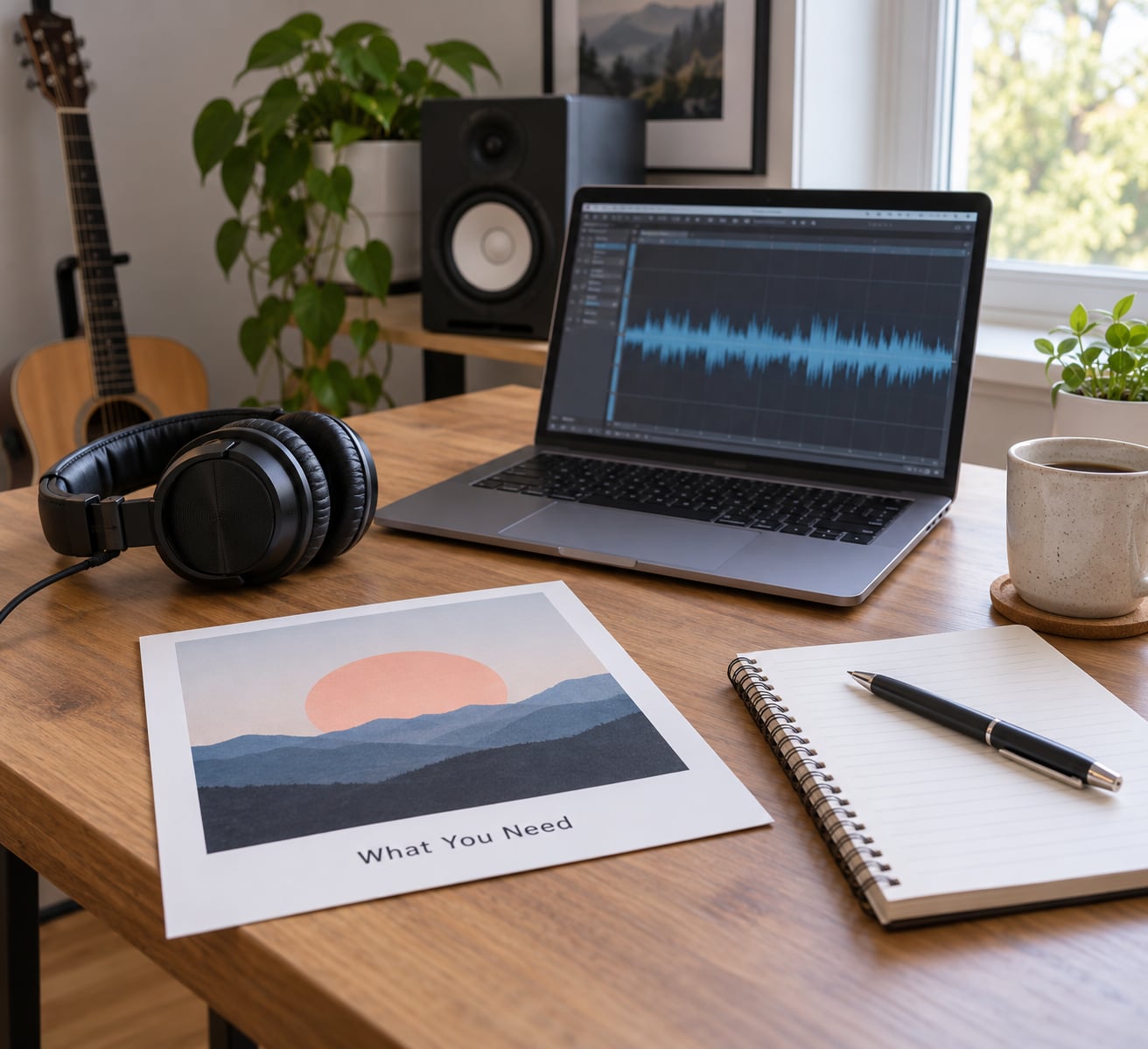
Six things have to be in place before you upload anything: a finished master, cover art, complete metadata, cleared rights, the delivery files in the right format, and a written plan with a budget attached.
Three of those are non-negotiable. A distributor will reject an unfinished mix, a cover that is not square, or a release with missing writing credits. The other three you can sort in stages: rights paperwork can trail by a couple of weeks, and the plan can be tightened as the date firms up.
The four deliverables your distributor asks for
- Audio. A final master, usually 16-bit/44.1kHz WAV, peaking at no more than minus one dB. Some services also accept 24-bit files. Give them the unmastered mix too if you have the bandwidth, because some deliverers prefer to master themselves.
- Artwork. A square JPEG, 3000 by 3000 pixels or larger, with no logos, no URLs, no social handles and no pricing burned into the image. Streaming services crop to different shapes, so keep important elements away from the edges.
- Metadata. Track title, artist name, any featured artists, release type, release date, primary genre, sub-genre, mood tags, language, explicit flag, label name, copyright lines, ISRC and UPC or EAN.
- Paperwork. Split sheets signed by every co-writer, sample clearance for anything you lifted from another record, and permission for anyone appearing on the track.
Two optional extras pay for themselves later. A press photo and a short bio mean you are ready when a blog or a local radio station asks. And if you already know the second single, decide now whether both tracks will share one catalogue number, because changing that later splits your streaming numbers.
Before any of it, do the boring name check. Search your artist name on Spotify, Apple Music, Instagram, TikTok, YouTube and every domain variant you care about. Someone with a near-identical name already holding the exact handle is the single most common reason a first release has to be renamed after delivery.
Step-by-Step: How to Self Release Your First Single
1. Choose One Song and Define the Goal
Your debut single is a statement, not a catalogue dump. Pick the track that best represents what you sound like right now, not the one with the most experimental structure. Listeners who click once need something that makes them press play again, so the chorus should arrive inside a minute.
Then write down what the release is for. Streaming exposure, a specific plug, a first live booking, fan growth, sync licensing and direct sales all produce different campaigns. A song aimed at sync needs different artwork and a different pitching approach than a song aimed at teenagers on short-form video.
2. Finish the Recording and Mix
Most first releases are delayed by revisions nobody scheduled. Set a lock date for the recording, a date for the mix, and a date by which you stop touching it. Give yourself at least two weeks after the mix for revisions, because you will hear things differently a week later.
For the mix itself, keep the vocal clear and the low end controlled, and export at 24-bit so your mastering engineer has room to work. Leave headroom rather than pushing the mix up to full level. A loud, squashed mix is the hardest thing to master well, and it is the most common reason a first release sounds thin.
3. Master the Track and Create Release Assets
Mastering has three jobs: balancing the levels of the mix, keeping every platform from turning the track down on playback, and making the low end behave on a phone speaker. Mastering engineers target an integrated loudness around minus nine to minus fourteen LUFS for streaming, and check that true peak stays under minus one dB.
Whether you pay for it depends on the record. A finished garage rock or punk track that was tracked cleanly and mixed honestly often survives an automated mastering service. Anything with vocal detail you care about, or anything you plan to send to press, is worth a human ear.
Artwork is the other half of the release. Use a square image at 3000 by 3000 pixels or above, shoot or design it for a thumbnail, since most people will only ever see it that small. Take the press photo the same afternoon in the same clothes so the artwork and the photo feel like the same project.
4. Clear Rights, Credits, and Metadata Before You Upload
Every release separates two sets of rights. The sound recording copyright belongs to the performer and producer, shown with the symbol for phonographic copyright. The composition copyright belongs to the songwriters, shown with the copyright symbol. Money moves in both directions, and conflating them causes arguments years later.
Get a split sheet in writing from every co-writer, listing percentage shares and who administers them. Your publisher or administrator is a performing rights organization such as ASCAP, BMI or SESAC in the US, or its equivalent elsewhere. Registering the composition is separate from distribution and is where the songwriter money actually gets collected.
If you sampled or interpolated anything, clear it. Releasing without clearance does not fail automatically, it just means a rights holder can ask for the track to be removed later, and the removal lands on your profile rather than theirs. Also check your artwork and photos: a photo with no usage release, or an image lifted from a museum collection, carries the same risk as an uncleared sample.
Then compile your metadata. The ISRC is a permanent code identifying your recording; the UPC or EAN is the product code for the release. Write both into a spreadsheet and keep it. If your single later appears on an album, matching ISRCs are what merge the stream counts instead of splitting them across two entries.
5. Use a Distributor to Self Release Your First Single
You cannot upload a track straight to Spotify or Apple Music. A digital distributor, also called an aggregator, is the middleman that delivers your release to every streaming service and collects the revenue on your behalf. Almost every one of them requires a lead time of one to two weeks, and editorial pitching needs three to four, so this is the step that sets your whole schedule.
| Distributor | Pricing model | Royalties | Worth knowing |
|---|---|---|---|
| DistroKid | Annual subscription, unlimited releases | Full royalty rate kept | Fastest uploads and the widest feature set, but music is removed from stores if the subscription lapses |
| CD Baby | One-time fee per release | Nine percent commission on revenue | Releases stay up permanently, including on physical sales through their store |
| TuneCore | Annual subscription or pay per release | Full rate on current plans; small social platform fee | Detailed royalty reporting, which matters if you release often |
| Ditto | Annual subscription with release tiers | Full rate kept | Tiered pricing suits artists releasing constantly |
| LANDR | Subscription bundling mastering and distribution | Full rate kept | Good if you also want the mastering tools |
| AWAL | Free to apply, selective | Full rate kept | Label-style deal where accepted; rarely takes brand-new artists, so treat it as a later step |
| SoundOn | Free tier, paid tier available | Full rate kept | Built around short-form video discovery and its sound library |
Read the catch column before you pick. Subscription models assume you keep paying, and a failed card can quietly delist years of work. One-time-fee models cost more per release up front and keep your catalogue safe if you stop. For one or two singles a year, the per-release model is the calmer choice; for a monthly release schedule, a subscription costs less.
One rule catches people out. You may use different distributors for different releases, but never deliver the same release through two of them. Duplicate deliveries cause takedown emails and duplicate royalty reports.
You can bypass distributors entirely by putting music on Bandcamp, SoundCloud and YouTube and selling direct. You keep more per sale and keep control of your catalogue, but you gain no playlist pitching, no Apple Music or Amazon Music presence, and none of the automatic reporting. For a first release aimed at building a mailing list, that trade can be worth it. For anything else, use a distributor.
6. Set the Release Timeline and Budget
Work backwards from the release day. Friday is the industry default because editorial playlists and New Music Friday charts are built around it, and most independent playlist curators add tracks on Fridays too.
| When | What to do |
|---|---|
| 8 weeks out | Lock the master, commission artwork, clear samples, confirm your artist name is free everywhere |
| 6 weeks out | Sign up with a distributor, upload the release with a placeholder date, send the track to your mastering engineer if it is not back yet |
| 4 weeks out | Approve the delivery, pitch unreleased music to Spotify through Spotify for Artists, claim Apple Music for Artists and Amazon Music profiles |
| 3 weeks out | Announce the date, create the smart link and pre-save link, brief local press and radio, film the press photo |
| 2 weeks out | Start the content run, share a private listen with curators and DJs, confirm split sheets are filed |
| 1 week out | Schedule posts, check the smart link end to end, prepare release-day artwork for every format |
| Release day | Publish, verify every platform shows the correct artwork and metadata, email your list, keep posting |
| 1 to 4 weeks after | Watch saves, playlist adds and follower growth, repost the best-performing clip, start planning the second single |
Budget realistically. Distribution for a single is often a modest annual fee or a single one-time charge. Mastering sits somewhere between a few dozen dollars for an automated service and a few hundred for an engineer. Artwork, a photographer and any video are where beginners overspend, and those are also the line items worth spending on if the record matters to you.
Set a ceiling before you start and do not exceed it. A debut single is not a business. It is a piece of evidence that you can finish something and put it in front of people.
7. Plan Promotion Before Release Day
Distribution is not promotion. A track can be perfectly delivered and still reach nobody, which is why the promotion plan belongs in the calendar before the date is public.
Claim your profiles the moment your first release is accepted. Spotify for Artists gives you pitch-to-editorial access, audience data and the ability to update your bio and photos later. Apple Music for Artists, Amazon Music for Artists, Deezer for Artists and SoundCloud all give you a dashboard. Doing this early also locks the artist page to your name before anyone else can.
Submit the unreleased track for editorial pitching at least seven days before release, earlier if you can, and fill in every field properly. Editors see a large volume of pitches and skip the ones with missing genre tags or a blank story.
For content, plan three or four short clips rather than one polished video. Live takes, setup clips and a short story about why the song exists outperform a glossy promo clip for a first release. Use one smart link in every bio so followers have a single place to land.
If you have no audience at all, start with the people in the room. A 40-plus comment thread on r/musicmarketing captures how common this anxiety is: the honest answer is that a first single is aimed at a handful of specific people, not a number. Message the friends who showed up to your gigs, hand the link to the local venues you have played, email three writers who cover your genre, and post in the community spaces where your scene already lives. Send physical copies to small radio stations that still take submissions.
8. Publish, Check the Platforms, and Follow Up
On release morning, search your artist name and track title on Spotify, Apple Music, Amazon Music, YouTube Music, Deezer and Tidal. Confirm the artwork, the spelling, the credits and the release date are right. Test the buy link on a phone, not on your laptop, since that is where most of your listeners will be.
If something is wrong, most platforms allow metadata edits from your dashboard, and distributors can usually push a correction through within a day or two. Cover art changes often take longer to refresh everywhere, so get the artwork right before release rather than after.
Getting to this point is most of how to self release your first single. From here it is maintenance. Judge the first month on actions rather than totals. Saves on Spotify, playlist adds, follower growth, email signups and messages from real listeners tell you whether the song connected. Stream counts on a debut single rarely mean much, and bots inflate them further. Plenty of independent artists receive messages offering guaranteed streams or placement on playlists with tens of thousands of followers; every one of those services is a route to a takedown, and the removal lands on your record.
Common Mistakes
- Uploading an unfinished mix. Fix: set a hard revision deadline before delivery, and export headroom rather than a loud mix.
- Choosing a distributor late. Fix: sign up while you are still mastering. Upload processing plus editorial lead time eats four weeks on its own.
- Leaving credits blank. Fix: fill in every writer, producer and performer in the metadata fields, then file the split sheet the same week.
- Losing the ISRC. Fix: record the ISRC in a spreadsheet before release and reuse it if the track later moves onto an album.
- Announcing the date before the assets exist. Fix: deliver the release, confirm the platforms accepted it, then announce.
- Ignoring artwork rights. Fix: use your own photo, or one shot by a photographer who releases usage for music promo.
- Accepting playlist and stream offers. Fix: refuse anything promising guaranteed numbers. Watch for sudden spikes in streams on a brand-new track followed by a takedown notice.
- Pitching without a story. Fix: editors read the one-paragraph description, so write it like a person, not a press release.
- Chasing follower counts. Fix: track saves, repeat plays and email signups. Those compound; vanity numbers do not.
Frequently Asked Questions
What do I need to release my own song on Spotify?
You need a finished master as a 16-bit/44.1kHz WAV, square cover art at 3000 by 3000 pixels or larger, complete metadata including track title, artist name, genre, release date and copyright lines, and a distributor account. Clear sample and photo rights before you deliver, and file a split sheet with every co-writer. Spotify itself does not accept uploads; a digital distributor delivers on your behalf and passes royalties back to you.
Can you release a single without an album?
Yes. A single is a standalone release type and needs no album behind it. Choose the single option in your distributor rather than an album with one track, because the two are catalogued differently and singles are eligible for release-type specific editorial playlists. Keep the release type consistent once you have delivered, and reuse the same ISRC later if the track appears on an album so the streams merge.
How long does it take to distribute a single?
Budget three to four weeks from a finished master to a live release. Most distributors ask for one to two weeks of processing, and pitching unreleased music to Spotify editorial works best at least seven days before release and ideally three to four weeks. Upload early with a placeholder date, confirm the platforms accepted the delivery, then lock the date. Same-week delivery is rarely possible and risks a track appearing late.
How much does it cost to release your first single?
Most first releases land well under a few hundred dollars. Distribution is either an annual subscription or a one-time fee per release. Mastering ranges from an automated service to a few hundred dollars for an engineer. Artwork and photography are the variable part, and a video is optional for a debut. Put a ceiling on the total before you start and treat the spend as the cost of a release, not an investment with returns.
How do I release music if I have no audience?
Aim at specific people rather than a number. Send the link to friends who came to your shows, hand it to venues and local DJs, email three writers who cover your genre with a press kit and a private link, and post in the community spaces where your scene already meets. Release on SoundCloud and Bandcamp first if you want early feedback. A small circle that actually listens is worth more than a few hundred empty streams.
How many singles should I release before an album?
Three to four singles over several months is the most common pattern, and it gives streaming services time to test each track with a small audience. Release a single only if the record is finished, not to fill a gap. If you are still writing the album, put the best finished song out, keep the same catalogue number across the singles and the album, and reuse the ISRC when a track moves onto it.
Your First Release Checklist
Before you announce anything, run this list:
- Song chosen and the goal of the release written down in one sentence.
- Mix finished, master returned, final WAV exported at 24-bit with headroom.
- Artwork at 3000 by 3000 pixels or larger, no text baked into the edges.
- Samples, splits and photo usage cleared and filed.
- Metadata complete, ISRC and UPC recorded in your own spreadsheet.
- Distributor chosen after reading what happens to your catalogue if you stop paying.
- Release date set at least three to four weeks out, on a Friday.
- Artist profiles claimed and the editorial pitch submitted.
- Promotion written down by week, with names of the people you will email.
- Budget capped, and a plan for what happens in the month after release day.
Start with the first line and work down. The first thing to do today is the artist name check, because it costs nothing and it is the only item on this list that can force a complete redo. Once the name is clear, lock the master and the date, and everything after that is administration rather than guesswork.
One last thing on money, so expectations are honest: streaming payouts are small. A thousand streams on Spotify pays a few dollars, and Apple Music pays considerably more per stream, but neither figure changes the arithmetic for a debut release. What a first single produces is a finished catalogue, a verified artist page, an ISRC you will reuse forever, and listeners you can contact directly. Treat it as the start of a catalogue rather than a payday, and the whole process stops feeling like a gamble.
If you want how to self release your first single summarised to one line, it is this: check the name, lock the master, clear the paperwork, choose a distributor, give it four weeks, and promote it before the date is public. Versions of these distributor terms, platform specifications and lead times change often, so confirm the current details with your distributor before you pay anyone. Updated for 2026.