Starting a record label takes three things in this order: a narrow musical identity, a legal structure that holds the rights, and a realistic release budget. You can begin by yourself with almost no money, but the label only starts making sense once you decide whether you are releasing your own music under your own imprint, licensing other people’s, or signing artists and developing them over years.
Those three models have wildly different risk profiles. Owning your masters and putting out your own record is a business you can run from a laptop. Licensing other people’s music means clearing rights before anything gets manufactured. Signing artists means signing a multi-year commitment to spend other people’s money.
This guide walks the whole sequence, from picking a name through pressing vinyl and selling it out of a spare room. Rules differ by country, state and local jurisdiction, so treat the legal details here as a map rather than as advice.
Table of Contents
- What You Need
- Step-by-Step
- Define Your Label’s Musical Identity
- Choose the First Release and Rights
- Create a Simple Business and Budget
- Register Names and Protect the Brand
- Prepare the Release and Find Distribution
- Manufacture and Sell Vinyl
- Build Demand and Release the First Record
- Common Mistakes to Avoid
- Frequently Asked Questions
- Do I need an LLC to start a record label?
- Can I start a record label with no money?
- How much money do I need to start a record label?
- What rights do I actually need to release a record?
- How many records should I press for a first release?
- Should I use a distributor or release the record myself?
- Conclusion
What You Need
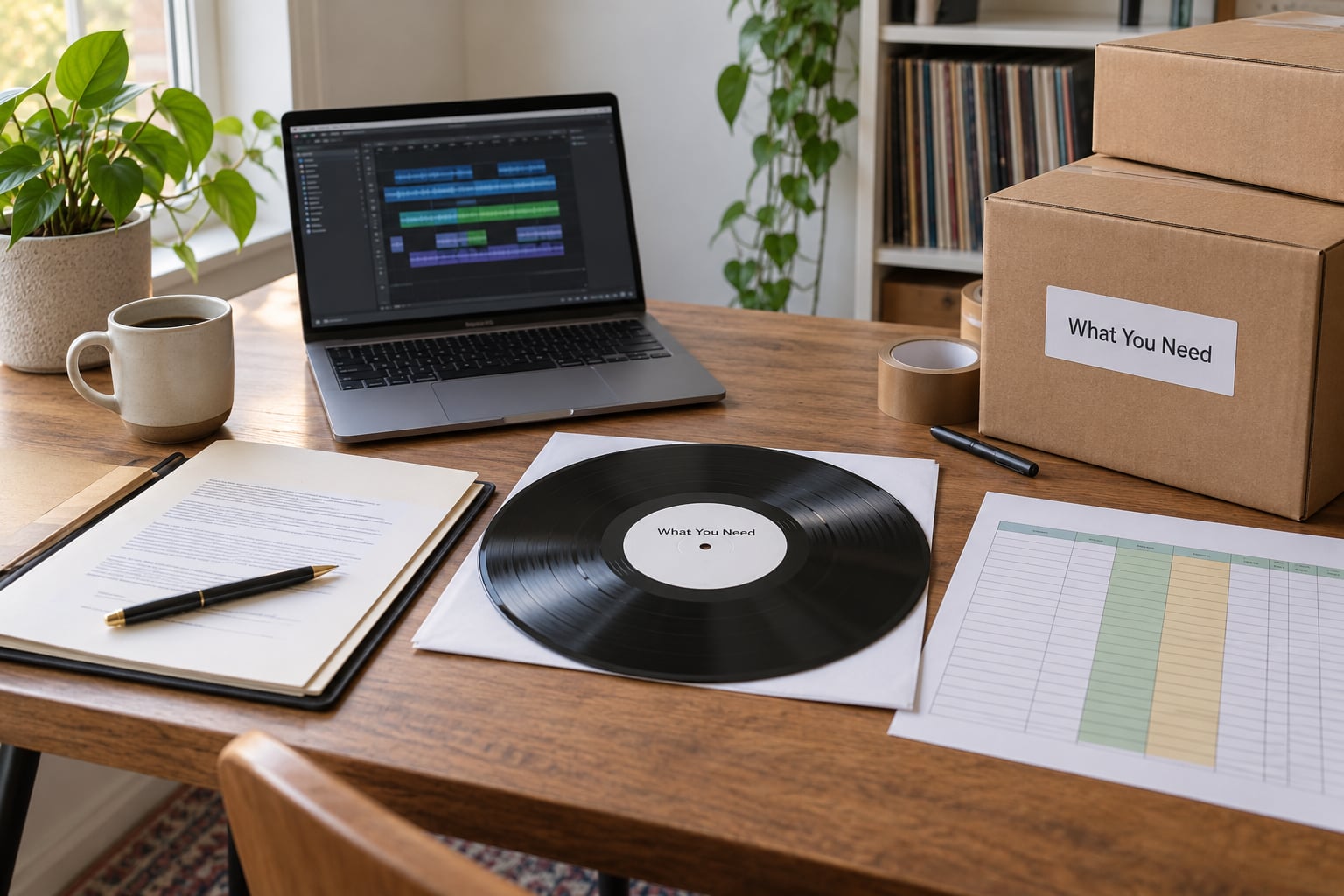
Before any money moves, you need a catalog plan, a cash reserve, documentation of who owns what, a registered business, a distribution relationship and a way to keep books. Here is the honest list.
- A catalog plan. How many releases you expect in year one, and in what order. Most beginners start with three to five, roughly every two months, which keeps the catalog alive without a payroll.
- A cash reserve. Money for costs that land before any revenue does. Registration fees, artwork, mastering, distribution, pressing and shipping all get paid up front.
- Rights documentation. Written proof that you own or control the master recording and the underlying composition for every track you release.
- A registered business. A sole proprietorship, partnership, LLC or corporation depending on where you live and how much risk you are carrying.
- Business banking and bookkeeping. A separate account and a way to track every cost per release. This is the step people skip and regret at tax time.
- A distribution relationship. Self-distribution through a digital distributor, or a third-party distributor who also handles physical fulfilment.
- Pressing contacts. Two or three plants you have asked for quotes, with minimum order quantities and turnaround times written down.
- A marketing plan you can fund. Not a list of channels. A budget and a named person responsible for each one.
One thing worth adding: a written reason the label exists that is not money. Founders with a clear mission last longer, because the slow years are inevitable.
Step-by-Step
The launch sequence below is ordered by cost. The early steps are cheap and reversible. The expensive ones — manufacturing and committing to artists — come last, once you know what you are doing.
Define Your Label’s Musical Identity
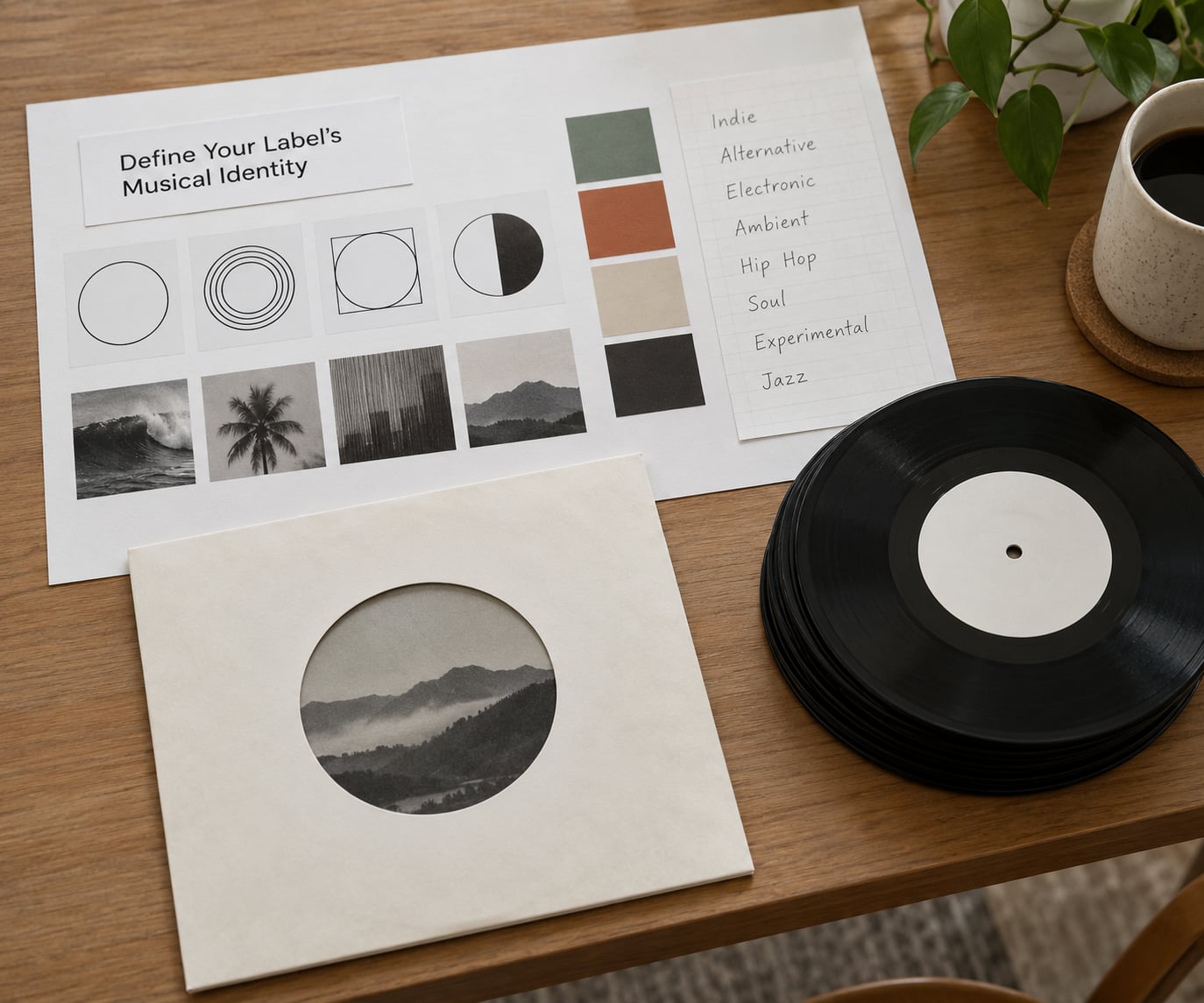
A label with a narrow sound is easier to follow and cheaper to promote than a label that takes anything. Pick a genre or a scene first — garage rock, punk, rockabilly, hardcore, vintage-inspired reissues — and write down who listens to it and where those people already gather.
Then test the idea against your budget. A reissue label for obscure 1970s punk needs archive research, licensing and mastering, and the audience is patient and loyal. A singles label for new garage bands needs video content, a live scene and constant posting. Both work. One requires far more upfront cash.
Set a mission in a single sentence and a visual identity beside it: two colours, one typeface, a sleeve layout. Collectors notice consistency long before they notice talent.
Choose the First Release and Rights
Your first release sets your catalog number, your template and your credibility. Pick something you can finish in four to six weeks rather than your best idea.
Then settle the rights question, which is where most self-published labels go wrong. There are two separate rights in every song. The master recording is the sound itself — you need permission from whoever owns it to release it. The composition, or the underlying song, is a separate copyright that pays a different set of royalties.
Decide deliberately which one you are taking. Owning the master means you control the release and can license it for film, television and ads. Owning only the publishing means someone else releases the record and you collect a share of the writing. Both are legitimate; mixing them up in a contract is not.
Whatever you sign, get a split agreement in writing before the session. Record who owns the master, who owns the composition, what the split is, and how long the deal lasts. Founders on music business forums repeat the same regret: they skipped contracts and got burned, or a band left and took its audience profiles with it.
Decide too whether you release original music, archival material, or both. Licensing an existing recording for reissue means finding the master owner, the label that released it, and the publishing, then paying for all of it before a single copy exists.
Create a Simple Business and Budget
You have four common options, and the right one depends on how much you are risking.
A sole proprietorship is the simplest and cheapest. You and the business are the same legal person, filing is straightforward, and profits flow to your personal tax return. The drawback is that personal assets are exposed if a release goes badly.
A partnership shares that exposure between partners and adds a second layer of paperwork and disagreement. An LLC separates the business from your personal assets and is the common choice for a small label. A corporation adds formal structure, more filings and more cost, and suits labels with outside investment or several owners.
Open a separate business bank account the week you register. Mix personal and label money and you lose the ability to tell whether a release made money.
Then build a per-release budget that covers recording, mixing and mastering, artwork and photography, registration and licensing fees, distribution and delivery, manufacturing, and promotion. Add a contingency of ten percent. Most first releases go over, not under.
Rules vary by country, state and local jurisdiction. Check what registration, licensing and tax obligations apply where you live, and talk to an accountant in your first year.
Register Names and Protect the Brand
Check the label name before you commit to it. Search the trademark databases of your country, check company registers, and search the music streaming platforms for anything similar in your genre. A name already used in another class or territory can still block you later.
Register the business, then file a trademark application if the name is central to what you are building. Entertainment labels typically fall under classes covering recorded music and entertainment services, but classification differs by country and a lawyer can confirm the right class quickly.
Secure the domain name and every social handle on the same day, even if the pages stay empty for months. Handle availability disappears fast in music.
Document what you own. Keep signed artwork releases, photographer permissions, logo source files, and a written record of who wrote and performed each song. When a licensing query arrives from a television show eighteen months later, that folder decides whether you can say yes.
Prepare the Release and Find Distribution
Distribution turns a finished recording into something a buyer can actually reach. There are three routes, and they suit different budgets.
Self-distribution through a digital distributor puts your release on streaming platforms and online stores directly. Fees are usually annual or per release, and many plans leave the label number on release. You keep control and do the metadata yourself.
A distributor’s label services or sub-distribution model handles more of the paperwork and offers release marketing add-ons. A third-party distributor also handles physical fulfilment, which matters if you are pressing records but not warehousing them yourself.
The difference comes down to bandwidth. If you enjoy uploading artwork, writing metadata and watching store previews, self-distribution saves money. If you would rather pay for that time, use services instead.
Whichever route, prepare the metadata before you upload: track titles with correct capitalisation, spelled-out artist and writer credits, the label name, catalog number, release date, and genre. Wrong metadata breaks royalty collection in ways that are hard to trace later, and correcting it after the fact can take months.
Also prepare the physical side: artwork files at press resolution, a mastered audio file, credits, liner notes, and promo material including a press release and a short description you can paste anywhere.
Manufacture and Sell Vinyl
Vinyl is where first-year losses happen, because the money leaves your account months before a single record is ordered.
Ask three plants for quotes and compare them on minimum order quantity, setup fees, mastering, plating, turnaround, packaging options and what happens if your tests arrive wrong. A run of a few hundred copies is the usual floor for a new label; anything smaller usually costs more per copy or is simply unavailable.
Approve a test pressing before the full run. Listen for surface noise on the quiet passages, check that the run-out groove carries your matrix or catalog number, and confirm the sleeve matches the agreed design. Inspect the first production copies against the test before releasing them.
Work out the unit economics on paper before committing: cost per copy including setup and mastering, your retail price, the wholesale margin you need for record shops and stockists, and how many copies you must sell to cover the run. Then remember that small runs carry a higher cost per copy, so a modest wholesale margin covers less ground than it looks.
Reduce risk with preorders through your own site, or with a campaign platform that funds part of the pressing in exchange for early orders.
Build Demand and Release the First Record
Work backwards from the release date with a calendar. Six to eight weeks out is a normal window: press release drafted, artwork final, distributors loaded, pitch editors approached.
From four weeks out, post consistently. Short clips of the band, studio outtakes, and the story behind the record all outperform a single link drop. Contact independent record shops and collectors directly with a one-paragraph pitch and a listen link, because a personal email lands better than a mass blast.
Plan the launch itself: a listening party at a venue, a record stall at a local fair, or a stream with a host from the scene. Submit to independent radio, relevant podcasts and playlist editors where the track fits.
Afterwards, measure. How many units sold through which channel, how many preorders, what the pressing actually cost per copy, and how much promotion money produced sales. Write it down. Your second release should be cheaper per copy and better promoted than your first, and that only happens if you looked at the numbers.
Common Mistakes to Avoid
These are the expensive beginner errors, each with the correction that would have prevented it.
- Choosing a name before checking conflicts. Fix: search trademark databases, company registers and streaming platforms before you fall in love with a name.
- Ordering more vinyl than your audience can absorb. One founder described pressing five hundred records and selling forty. Fix: start at the plant’s minimum, or fund part of the run with preorders.
- Signing without a written contract. Fix: put splits, term, delivery commitments, reversion and audit rights in a document before recording starts, and have a lawyer review your first one.
- Skipping metadata. Fix: verify every credit, ISRC and UPC with a second person before delivery.
- Underestimating fulfilment. Fix: decide early who picks, packs, ships and handles returns, and price shipping into the retail price rather than absorbing it.
- Treating streaming as the only channel. Fix: build at least one owned channel, such as a mailing list or direct sales site, so you keep a relationship when platform terms change.
- Launching with no cash reserve. Fix: keep enough in the account to cover the next two releases at their current cost before release one goes out.
One more worth naming: signing artists too early. Before you have a catalog and a track record, promising a marketing budget you cannot deliver damages the relationship permanently.
Frequently Asked Questions
Do I need an LLC to start a record label?
No, but most small labels choose one. A sole proprietorship is the cheapest and simplest route, though your personal assets stay exposed if something goes wrong. An LLC separates the business from your personal assets and keeps liability contained. Entities differ by country and state, so check your local rules and pick with an accountant.
Can I start a record label with no money?
You can start, but you cannot manufacture. With very little you can register a business, claim an ISRC, release digitally through a distributor and build an audience with free tools. Vinyl and physical product need money before they need sales, so defer them. Many labels begin with merch and use those margins to fund the first pressing.
How much money do I need to start a record label?
For a digital-first label, a realistic first year runs from the low hundreds for registration and release costs up into the low thousands with promotion. A lean label that presses vinyl by the few hundred needs several thousand more, because manufacturing and fulfilment are paid before any revenue arrives. Full-service operations run well beyond that.
What rights do I actually need to release a record?
Two separate rights. The master recording is the sound itself, and you need the owner’s permission to distribute it. The composition is the underlying song, with its own copyright and its own royalty stream. Many labels hold only one of them. Write down which you are acquiring, for how long and in which territories, before you spend money on manufacturing.
How many records should I press for a first release?
Most plants set a floor in the low hundreds, and that floor usually costs more per copy than a larger run. Start there, approve a test pressing, and price out the wholesale margin your record shops need. Preorders through a campaign platform can fund part of the run. A second run is easy once a first one sells; the risk is overcommitting on the first.
Should I use a distributor or release the record myself?
Self-distribution through a digital distributor keeps you in control of metadata and costs less as your catalog grows, but it takes your time. Distributor label services handle more paperwork and offer promotional options. A third-party distributor also manages physical fulfilment, which matters if you are not warehousing records yourself. Most first labels start self-distributed and add services later.
Conclusion
If you take three actions this week, make them these. Choose a narrow musical identity and write it down, so you know exactly what belongs on the label and what does not. Then clear the rights on your first release, both the master and the composition, in a signed document.
Finally, build a conservative per-release budget before any money reaches a pressing plant. Most people who succeed at this start small, sell what they made, measure what it cost, and let the second release be better than the first.