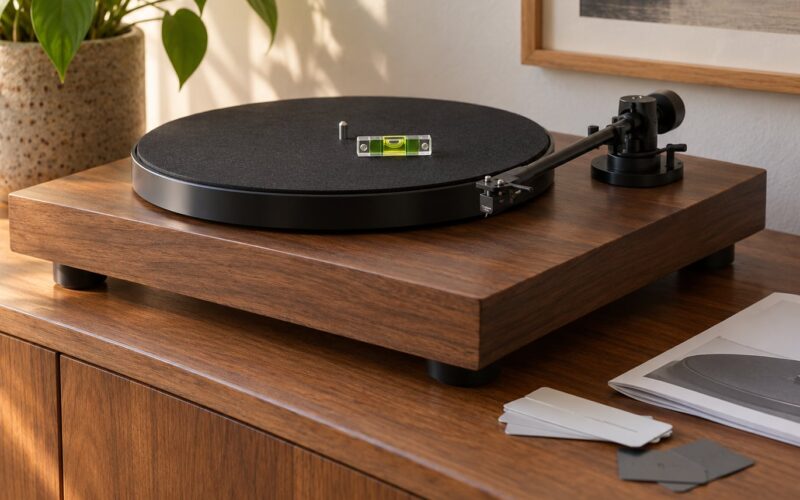
What is anti-skate on a turntable? It is a small mechanism that pushes the tonearm gently outward, against the inward drag that friction creates as the stylus rides a spinning groove. Without it the arm creeps toward the centre of the record, and once it starts creeping, the tracking gets worse the further in it goes.
That inward pull is not a fault. It is built into the geometry of every tonearm ever made, which is why almost every turntable worth owning has some way of cancelling it. The trick is cancelling it properly, because a badly adjusted anti-skate causes more trouble than having none at all.
Table of Contents
- What Is Anti-Skate on a Turntable?
- How Anti-Skate Works in a Tonearm
- Why nobody sets anti-skate to maximum
- The four mechanism types you will meet
- What Is the Difference Between Anti-Skate and Tracking Force?
- How to Set Anti-Skate on a Turntable
- Which calibration method is worth it?
- Common Anti-Skate Problems and Fixes
- Do All Turntables Have Anti-Skate?
- Frequently Asked Questions
- What is anti-skate on a turntable?
- What should my anti-skate be set at?
- What happens if anti-skate is too high?
- Should anti-skate match my VTF number?
- Does stylus shape change the anti-skate setting?
- Does anti-skate affect sound quality?
- Conclusion: Start with the Smallest Correct Adjustment
What Is Anti-Skate on a Turntable?
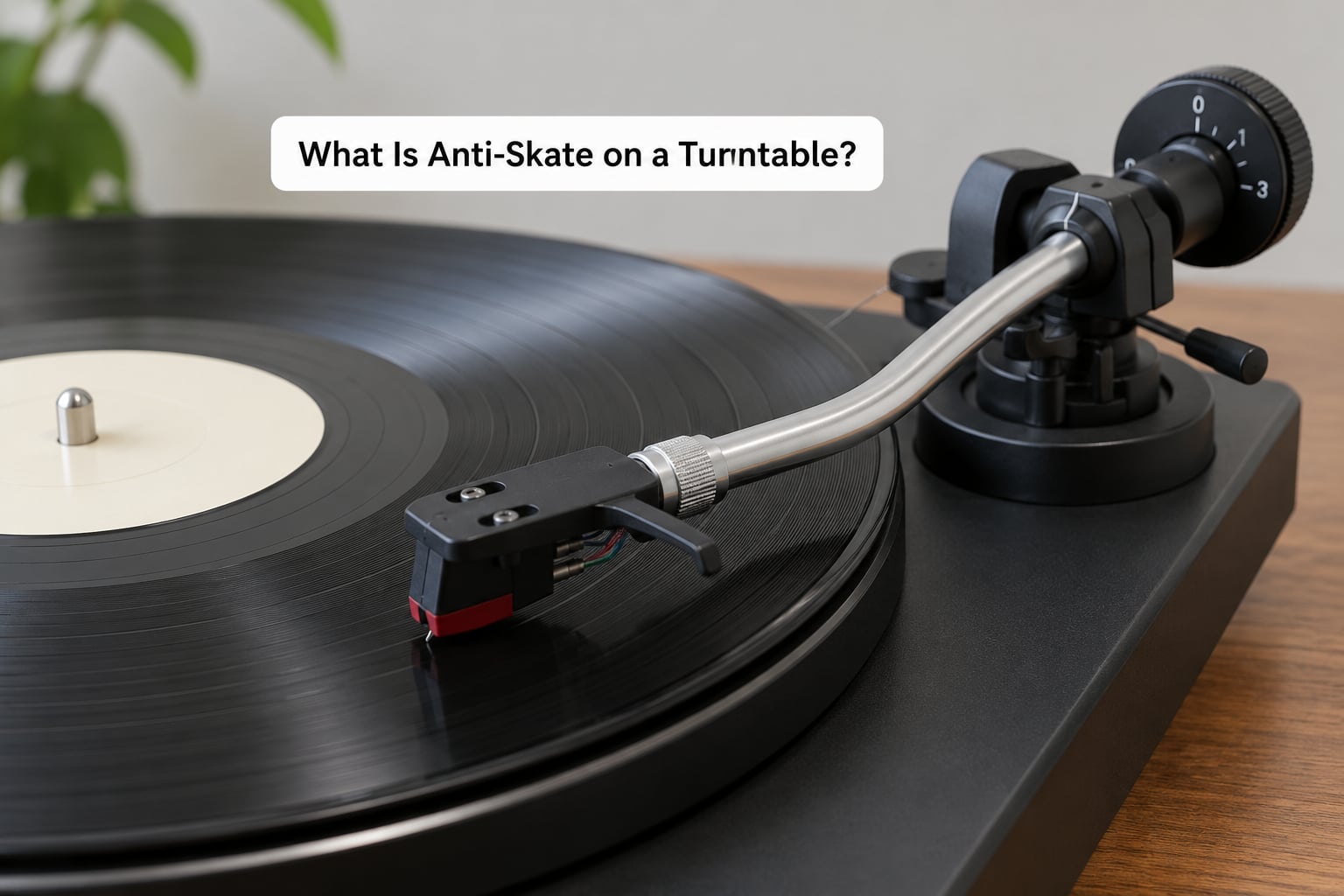
Anti-skate is a friction-based adjuster, usually a small numbered dial or scale near the tonearm pivot, that applies a controlled outward force to the arm. You set it so the stylus sits in the groove without sliding toward the spindle or being yanked away from it.
A few words that show up in every manual are worth defining up front, because most of the confusion around anti-skate comes from mixing them up.
- Tonearm: the pivoted arm that carries the cartridge across the record.
- Stylus and cantilever: the tiny diamond tip at the end of the cantilever, suspended in a compliant mount so it can move with the groove walls.
- Vertical tracking force (VTF): the downward weight the stylus puts on the groove, set by the counterweight and measured in grams.
- Skating force: the sideways force that drags the arm inward, produced by friction in the groove.
- Turntable: the motor, platter and arm assembly. A vinyl player is the same thing with a phono stage and speakers added.
What anti-skate is not: it is not a way of holding the arm out for longer. It does not raise the arm, does not change tracking force, and does not replace a balanced tonearm. It only pushes sideways, and only a little.
The confusion usually traces back to the counterweight, because both controls sit near the back of the arm. The counterweight is the heavy cylinder that slides along the rear of the arm tube and sets how hard the stylus presses down. Turn that and you change VTF. The anti-skate adjuster is a separate, much smaller control that only pushes outward, and setting it correctly is impossible until the counterweight is balanced and the tracking force is right.
How Anti-Skate Works in a Tonearm
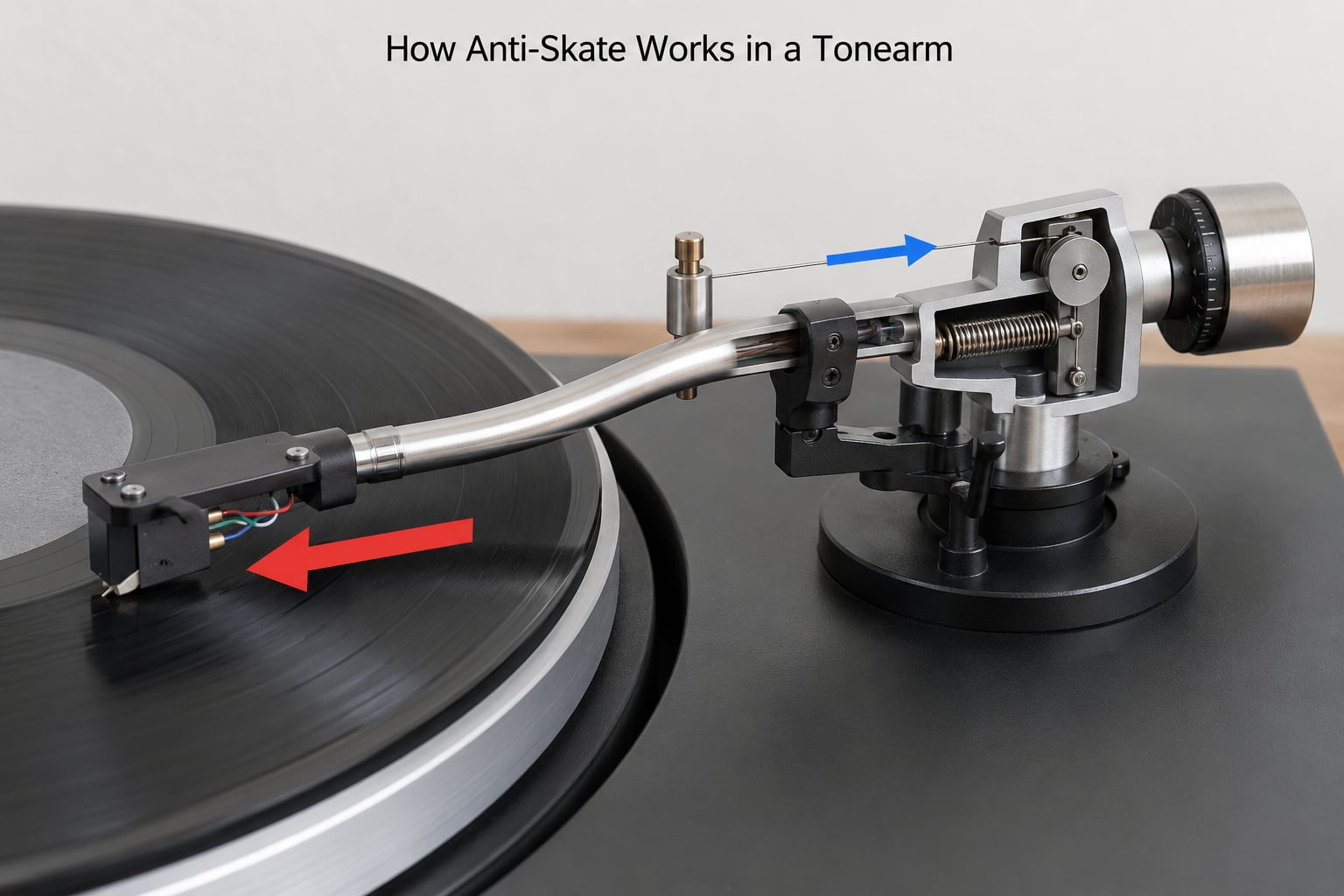
The physics is short once you see it. A tonearm is deliberately set at an offset angle so that the stylus can reach across the record to the spindle while the arm stays roughly straight, which gives even tracking and keeps the headshell from colliding with the record label. That offset angle is also what creates the problem: the stylus is sitting in a groove wall at an angle, and friction between diamond and vinyl pulls the whole arm toward the inside of the record.
Left alone, that force deflects the cantilever sideways against its suspension. The arm creeps inward, the stylus sits at a slightly wrong angle in the groove, and the tracking error grows as the grooves get closer together toward the label.
Anti-skate applies a force in the opposite direction through a small shoe, weight, string or lever that touches the arm tube near the pivot. Set correctly, the two forces balance and the net sideforce on the stylus is close to zero, so the arm sits still in the groove and the cantilever is free to do its actual job of following the modulations of the music.
Why nobody sets anti-skate to maximum
If inward pull is a bad thing, why not simply overpower it? Because anti-skate force is applied as a sideways push on the arm tube, and the arm tube is not the stylus. Too much of it changes the effective geometry of the arm, shifts the arm’s pivot behaviour under load, and can push the stylus against the outer groove wall hard enough to hurt tracking rather than help it. A Vinylengine contributor quantified the target: roughly 0.2 grams of anti-skate against a 1.6 gram VTF, which is a small number most dials never approach.
Anti-skate is also not a constant across a record. The required value shifts with groove depth, the tracking angle as the arm swings inward, dust, and the surface condition of the vinyl. One useful sanity check from the forums: playing a wet record reduces friction, so if the arm suddenly sits still on a side it normally skates through, your setting is probably a little high rather than a little low.
The four mechanism types you will meet
| Type | How it works | How you adjust it |
|---|---|---|
| Dial or scale | A rotating ring shifts a pivoting shoe against the arm tube, with the force on a scale in grams | Turn the dial slowly while watching the arm |
| Hanging weight | A small weight hangs on a thread from a post behind the pivot, pulling outward | Add or remove supplied washers |
| String and lever | A line connected to the arm is tensioned by a lever | Move the lever or alter string tension |
| Electronic | A sensor measures arm position and a servo nudges the arm to hold a fixed point | Often a fixed preset, sometimes adjustable |
All four do the same job, but they do not behave identically. A dial gives fairly even adjustment and reads in grams, which makes it easy to reason with. A hanging weight gives coarser steps and no scale at all, so it is adjusted by feel. Electronic systems hold a position rather than a force, which is more consistent from record to record but is fixed to that arm’s geometry.
What Is the Difference Between Anti-Skate and Tracking Force?
They act on different axes, solve different problems, and are adjusted in a fixed order. Confusing them is the most common setup mistake, and it is easy to make because both are set within a few minutes of each other.
| Tracking force (VTF) | Anti-skate | |
|---|---|---|
| Direction | Straight down into the groove | Sideways, outward, along the arm tube |
| Problem it solves | How firmly the stylus rides the groove wall | How fast the arm creeps toward the spindle |
| Typical value | Set to the cartridge maker’s recommendation, commonly around 1.5 to 2 grams | A small fraction of VTF, often a few tenths of a gram |
| Control | Counterweight, read on a VTF dial or scale | Anti-skate dial, hanging weight, lever or servo |
| Set too low or too little | Undertracking, distortion, skipped notes, and a loose feel in the groove | Arm drifts inward, inner-groove distortion, drifting across the record |
| Set too high or too much | Excess wear on stylus and vinyl, dull sound | Arm pushed outward, channel imbalance, worse tracking than no anti-skate at all |
| Order of operations | First, always | Last, and only after VTF is confirmed |
One point that surprises people: you do not need a lot of it. A contributor on the Audiogon vinyl thread who measured the actual skating force with an AnalogMagik reported that the factory instruction to match the anti-skate number to the VTF number gives roughly twice what is needed, and that about half the instructed value is a safer starting point. The manual number is an upper bound dressed up as a target.
How to Set Anti-Skate on a Turntable
Set it in this order, and do not skip the first two steps. Most frustrating anti-skate problems are really balance, VTF or alignment problems that the anti-skate dial was asked to compensate for.
- Level the deck and confirm the arm height. A deck sitting on a slope biases the arm toward one side and no amount of anti-skate corrects it properly.
- Balance the tonearm. With the arm floating off its rest and the anti-skate fully backed off, adjust the counterweight until the arm is perfectly level at any point along its length. If it is not level here, nothing after this works.
- Set the tracking force. Move the arm to the point where your manual specifies the reading, usually at the bearing end of the arm. Use a digital tracking force gauge if you have one, because dial markings are frequently optimistic.
- Set anti-skate to zero. Back the dial all the way off. Some hanging-weight designs simply hang with no washers added.
- Cue the stylus and watch. Lower the arm with the cueing lever about 25 mm from the spindle on a record surface. Let it run and watch whether it moves. A slow steady creep inward means you need more. A stationary arm means you are close.
- Add anti-skate in small steps. Turn the dial up a fraction at a time, re-cueing from the same spot each time, until the arm stops drifting and just holds position.
- Verify across a whole side. The requirement changes as the arm swings inward, so check the outer third, the middle and the run-out. What matters is no consistent drift in either direction across a full side.
- Confirm by ear. Play something with steady high-frequency content, such as cymbals or a female vocal, and listen for sibilance and brightness in one channel against a dullness in the other. The channel that is bright and hissy is the channel being pulled too far outward.
Which calibration method is worth it?
| Method | Equipment | What it proves | Difficulty |
|---|---|---|---|
| Drift test | Nothing | Shows a clear inward creep, but not the exact balance point | Easy |
| By ear | A familiar record | Catches gross imbalance reliably, subtle errors poorly | Easy, needs a reference |
| Blank record | A scrapped LP | Shows drift clearly, since there is no music to hide it | Easy |
| Calibration record | A dedicated test disc | The only method that measures the drift pattern precisely | Moderate, needs a disc |
You will also see the lift-and-recue-into-the-same-groove test suggested online. It is useful as a quick check, though one member on the Vinylengine forum rightly points out that anti-skate only acts while the stylus is in the groove, so the test tells you about drift and not about the balance point. Treat it as a smoke alarm, not a measuring instrument.
Whatever method you use, read the diagnostic direction carefully. Too much anti-skate shows as sibilance and a bright, etched edge in one channel, with the cartridge visibly leaning away from the spindle. Too little shows as a dull, thin channel and a cartridge leaning toward the spindle. Owners often hear a dull channel and go hunting for a cartridge or phono stage fault instead, which sends them down the wrong path for weeks.
Common Anti-Skate Problems and Fixes
Almost every anti-skate complaint resolves into one of six cases. Work down the list from the top before you start replacing parts or blaming a cartridge.
| Symptom | Likely cause | Fix |
|---|---|---|
| Arm creeps steadily inward across the side | Not enough anti-skate | Increase in small steps, re-cueing from the same point each time |
| Cartridge leaning outward, one channel bright and sibilant | Too much anti-skate | Back the dial off until the lean disappears |
| Cartridge leaning toward the spindle, one channel dull | Not enough anti-skate | Add a little more, then re-check the run-out |
| Skipping or looping on a specific track | Undertracking from low VTF, a worn stylus, or a deep scratch | Check VTF and balance first, then stylus condition, then anti-skate last |
| Distortion that appears only in the inner grooves | Arm has drifted inward, or VTF is below the cartridge’s requirement | Re-cue further out and reset; confirm VTF against the cartridge spec |
| Stereo imbalance that comes and goes | A setting that only holds part of the record, or inconsistent groove geometry | Reset at zero and work up slowly, checking three points across the side |
One tell sits outside the visible symptoms. Retipping technicians report receiving a large share of styli worn mostly on one side, and the usual explanation offered for that wear pattern is a persistently mis-set anti-skate that loads the stylus asymmetrically. It is worth knowing that a cantilever is no longer straight, or that one flank of the tip is polished flat, because that is a lead to check rather than a certainty about your setup.
On older decks, a mechanical fault can imitate a drift problem. A slipping idler or a dry idler wheel in a belt-drive or idler-drive turntable can cause the arm to wander, and a binding cueing lever or a bent arm tube does the same. Check that the arm moves freely from rest to rest before adjusting anything else.
Finally, do not over-credit anti-skate. It genuinely helps the stylus track quietly in the inner grooves and it does help keep left and right evenly loaded, which is the trackability benefit collectors are right to value. It does not protect your records the way the folk claim suggests, because the dominant factor in wear is tracking force and stylus condition, not a fraction of a gram of sideforce. If records are wearing out early, check the VTF first.
Do All Turntables Have Anti-Skate?
No. A great many decks ship with no anti-skate adjustment at all, and that is not automatically a defect. Some arms rely on alignment and geometry alone, and a well-aligned arm with a compliant cantilever will track acceptably without any correction. The absence of the control just means you cannot fine-tune if something is off.
What you are likely to find instead varies by machine. Budget and mid-range belt-drive decks almost always have a numbered dial. Arms with a separate anti-skate post behind the pivot often use a hanging weight with supplied washers. Some Japanese and European arms use a string and lever, and a handful of modern decks use an electronic anti-skate that holds the arm at a fixed position without an owner-adjustable control.
On a deck with no anti-skate, the honest answer is that there is nothing to set. Spend your effort on the three things that pay off far more: balance the tonearm properly, confirm tracking force with a gauge rather than a printed dial, and get the arm height and alignment right. Most drift problems attributed to missing anti-skate are actually one of those three.
One more thing to verify before trusting a setting: whether the dials are honest. Owners on Audiogon report that the SME 3009 and JVC Victor UA-7082 arms have dials that match reality closely, while other arms are noticeably off. If a drift test and the dial disagree, the gauge wins.
Frequently Asked Questions
What is anti-skate on a turntable?
Anti-skate is a mechanism that applies a small, controlled outward force to the tonearm. It cancels the inward skating force created by friction between the stylus and the spinning groove. Set correctly, it keeps the arm steady in the groove, protects tracking in the quiet inner grooves, and keeps both stereo channels evenly loaded.
What should my anti-skate be set at?
Far less than most manuals imply. A measurement-based report on the Audiogon vinyl thread found the instructed setting is about double what is actually needed, and another contributor measured roughly 0.2 grams of anti-skate against a 1.6 gram tracking force. Start at zero, cue about 25 mm from the spindle, and increase only until the arm stops drifting.
What happens if anti-skate is too high?
The arm is pushed outward and the cartridge visibly leans away from the spindle. You will hear sibilance, brightness and etched high frequencies in one channel while the opposite channel goes dull. Tracking can end up worse than with no anti-skate at all, because the added sideforce changes how the arm behaves in the groove. Back the dial off in small steps.
Should anti-skate match my VTF number?
No, not any more. Most manuals say to set the anti-skate dial to the same number as the VTF dial, and that figure works as a ceiling rather than a target. Measurements reported by owners suggest the required force is a small fraction of tracking force, so about half the instructed value is a more realistic starting point, adjusted by watching the arm rather than the dial.
Does stylus shape change the anti-skate setting?
No. Skating force depends on the friction between diamond and vinyl and on the arm geometry, not on the contact area of the tip. A fine line, elliptical, Shibata or more exotic profile does not need a different anti-skate value from any other profile. What does change the requirement is tracking force, groove condition and how far the arm has swung inward, so re-check the setting after a retip.
Does anti-skate affect sound quality?
It does, though more indirectly than the anti-skate label suggests. A wrongly set anti-skate causes channel imbalance and inner-groove distortion, and both are clearly audible. A correct setting mainly removes those faults rather than adding something of its own. It also slightly reduces the effective tracking force, so if your tracking force is already at the low end, check it again after setting anti-skate.
Conclusion: Start with the Smallest Correct Adjustment
What is anti-skate on a turntable? A small outward force that cancels the inward pull of friction, and nothing more. Balance the tonearm, set the tracking force with a gauge rather than a printed dial, set anti-skate to zero, then add only enough to stop the arm drifting inward. Check it at the outer edge, in the middle and at the run-out, and if one channel sounds bright and sibilant while the other goes dull, you have turned it too far.
Resist the urge to make it precise. The required force changes continuously across a record, so treat any number as an approximation and let the arm, not the dial, be the final judge.