Record Store Day is controversial because the artificial scarcity, early queues and resale pressure that make the event feel special also hand most of the value to people who are not there for the music. Supporters see a yearly celebration of independent shops and physical culture; critics see a marketing machine that rewards resellers and chain stores.
That is the honest summary, and it is not the only honest summary. The same collector can attend every April, love the in-store performances, and still think the exclusives are manufactured scarcity. Most of the argument comes down to a handful of design choices that were sensible in 2007 and have aged badly as vinyl got bigger.
Here is what the event was built to do, where the disagreement actually sits, and what you can do differently if you decide to show up. I have read through the threads on r/vinyl, r/RecordStoreDay and the Steve Hoffman forums that dominate this debate, and the pattern is remarkably consistent.
Table of Contents
- Why Record Store Day Is Controversial?
- The Record Store Day Debate at a Glance
- What Record Store Day Was Created to Do
- Why Record Store Day Divides Vinyl Collectors
- 1. Artificial scarcity built by the labels
- 2. Only two or three copies per store
- 3. Resellers, not fans, take the prize
- 4. A markup for packaging, not sound
- 5. The queue as a wealth filter
- 6. CDs quietly dropped out
- 7. Chain stores inside an indie celebration
- 8. Exhaustion
- How Limited Releases and Queues Create Problems
- The Resale Debate: Collecting or Flipping?
- Why collectors split over buying to resell
- Do Independent Record Stores Really Benefit?
- How Regional Access Makes the Experience Unequal
- What Critics Get Right—and What Supporters Miss
- How to Shop Record Store Day More Fairly
- Frequently Asked Questions
- Is Record Store Day bad for record shops?
- Why do record stores limit purchases on Record Store Day?
- Is it illegal to buy records and sell them for more?
- Do independent record stores really make money on Record Store Day?
- Should vinyl collectors participate if they dislike the controversy?
- What to Do at the Next Record Store Day
Why Record Store Day Is Controversial?
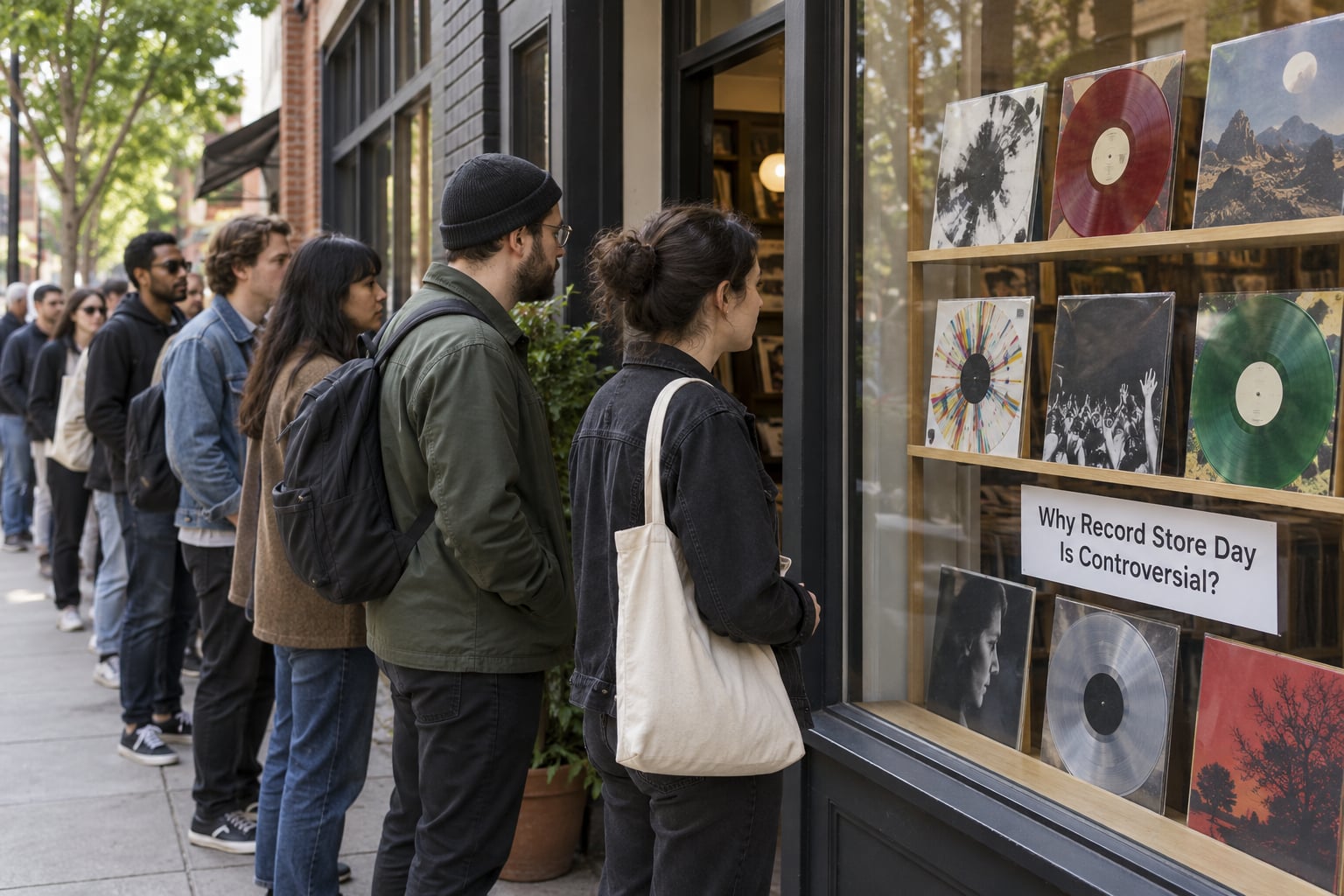
Record Store Day is controversial because it turns an uneven playing field into a feature. Labels press a small number of exclusive records, send two or three copies to each participating shop, and the resulting scramble produces queues, disappointed fans and resale listings at several times the original cost. The event was founded to support independent record stores, yet the biggest beneficiaries are often major labels, chain shops and people who buy to sell rather than to listen.
The other half of the dispute is format. Record Store Day was built to celebrate record shops in general, but over time the releases have become almost entirely vinyl. Collectors of CDs, who also sustain independent shops, have watched their format quietly drop out of the biggest retail weekend of the year.
Both criticisms have factual backing, and both have honest counter-arguments. That is why the question keeps coming back every year instead of being settled.
The Record Store Day Debate at a Glance
| Point of disagreement | What supporters say | What critics say |
|---|---|---|
| Limited editions | Rare editions give the day a reason to exist and fund the shops | Scarcity is manufactured by the label, not by demand |
| Queues | They are part of the ritual and the payoff for real fans | They reward people with free time and cash, not people with more love of music |
| Two or three copies per store | Pressing capacity and minimum order quantities force small runs | A handful of fans win a prize while most leave with nothing |
| Resale | Second-hand trade is how most collectors buy anyway | Buying to resell at a markup drains the community and misprices records |
| Markup on exclusives | Better packaging and a numbered edition justify a premium | Sound quality is often identical to a standard pressing |
| Vinyl only | Vinyl is what the shops most need promoted | The event was about record shops, not about one plastic format |
| Chain participation | More shops selling vinyl is good for the format | A chain store taking part undercuts the independent mission |
Read that table as a snapshot of the argument, not a verdict. Almost every row has a defensible answer on the other side, which is exactly why this debate outlasts every news cycle.
What Record Store Day Was Created to Do
Record Store Day started in 2007 as a fairly simple idea: pick one Saturday in April, give independent record shops a reason to fill the street, and give music fans a day that belongs to physical media rather than to an algorithm.
Independent shops provided the music. Labels provided the exclusives. In return, the event gave stores something no ordinary week offers: a morning where people queue outside before opening, browse the racks, meet the people who staff the counter, and often stay to hear an in-store performance. That trade is still the heart of it.
The format has also grown more complicated than most people expect. There is now a main April event and a second Black Friday Record Store Day later in the year, and they do not work the same way. The April date is the big one, with headline exclusives and the queues that go with them. Black Friday Record Store Day is more of a retail weekend, with different releases and far less ceremony. Newcomers regularly mix the two up and end up queueing for a title that was never part of the April list.
Why Record Store Day Divides Vinyl Collectors
Most of the heat comes down to a short list of grievances. These are the ones collectors raise most often, in roughly this order of volume.
1. Artificial scarcity built by the labels
Nothing about a colored vinyl edition is inherently rare. The run length is chosen by the label, and a run that could be five times larger costs it very little more. The scarcity is a marketing decision dressed up as a production constraint.
2. Only two or three copies per store
For a headline release, a participating shop may receive a handful of copies. Divide that by the length of the queue and the maths gets bleak very fast. Collectors report arriving for a title their store never received, with no explanation from staff.
3. Resellers, not fans, take the prize
Someone in the Steve Hoffman forums put it plainly in the January 2026 discussion: people who actually want the albums cannot get them in time because scalpers scoop up all the extra copies, only to flip them at roughly three times what they paid.
4. A markup for packaging, not sound
RSD editions frequently cost noticeably more than the standard pressing of the same record, and the extra money usually buys an art print, a poster or a numbered sleeve. Weight and mastering are frequently identical, so the collector gets a display object rather than a better record.
5. The queue as a wealth filter
Getting a copy early requires being able to lose a Saturday night, or a Friday night, or several hours of sleep. Critics call that an access problem: the event rewards disposable time and disposable cash instead of taste or dedication.
6. CDs quietly dropped out
The event was created for record shops, not for plastic discs specifically. CD buyers were largely abandoned in favour of vinyl, which one collector on r/Cd_collectors put down to frustration at the format being oversold rather than underappreciated. CD box sets still sell well in shops that stock them.
7. Chain stores inside an indie celebration
A petition circulated asking for a large chain retailer to be removed from Record Store Day participation on the grounds that it contradicts the event’s purpose. The complaint is less about vinyl than about what participation implies about who the event serves.
8. Exhaustion
The loudest signal in 2026 came from a thread titled along the lines of this event no longer being enjoyable, which pulled hundreds of comments. Repeat buyers describe the same loop every year: queue early, buy two records, watch both appear online, and resolve to skip it next time.
How Limited Releases and Queues Create Problems
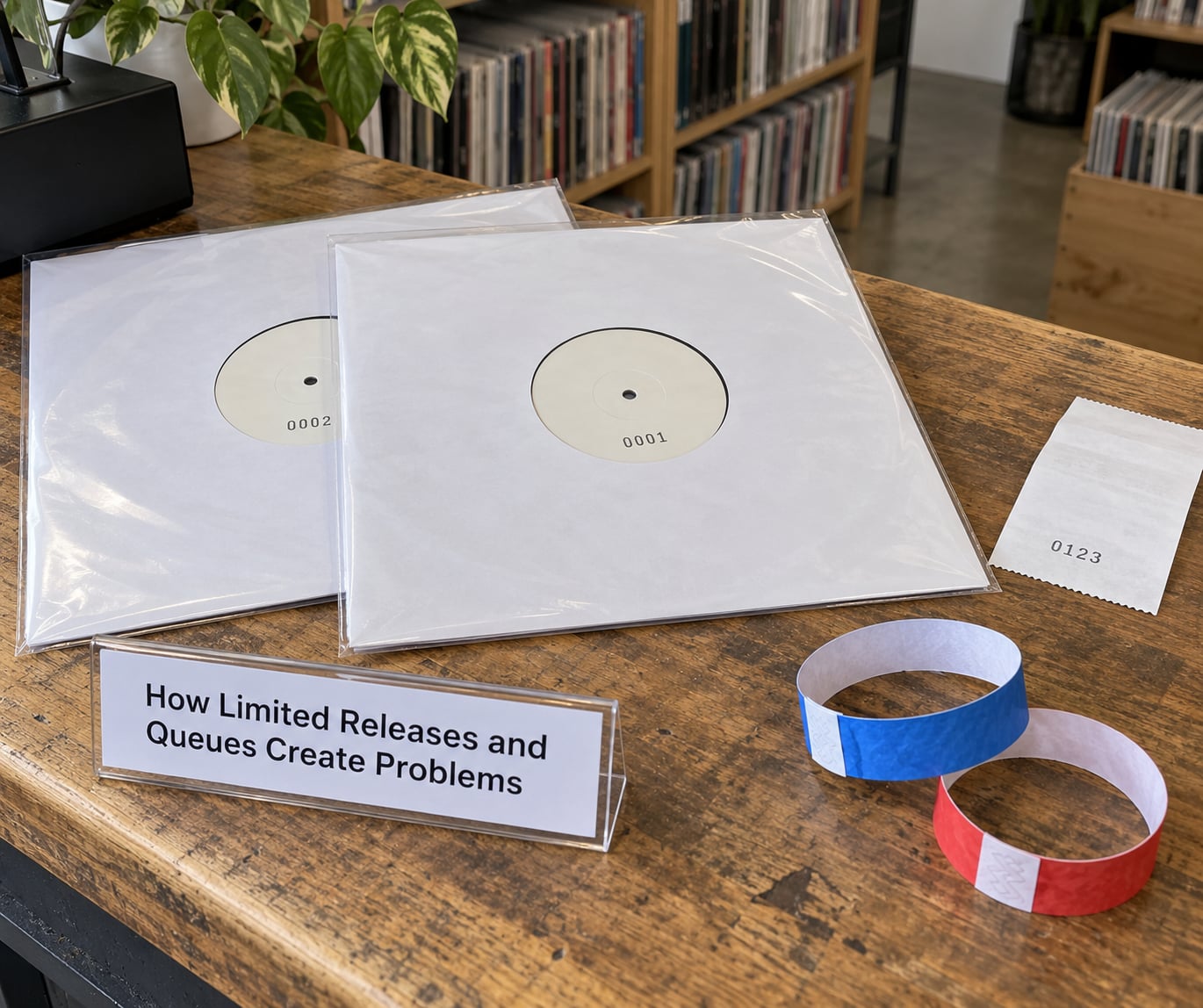
The two-copies-per-store rule is the hinge of the whole controversy, and almost nobody explains it. Pressing plants have finite capacity, labels set minimum order quantities for a run, and a special edition costs more per unit than a standard pressing because of setup and smaller quantities. Two or three per store is a direct consequence of that arithmetic.
Once you understand it, the problems become predictable. A store in a big city might get three copies of a headline title; a store in a town with one participating shop might get one, or might get nothing at all. Every extra layer the event adds on top, a numbered edition, a poster, a foil-stamped jacket, eats into what is left for actual records.
Retailers have adapted in different ways, and the differences explain why experiences vary so much. Some shops run a lottery or ticket draw for high-demand titles, which levels the playing field and removes the queue entirely. Others sell strictly first come, first served with a one-per-customer limit. A few post the allocation on their own site the night before. Each choice makes somebody happy and somebody else annoyed.
Numbered receipts and one-per-customer rules also attract their own problems. Buyers asking shops to police how many copies a person buys at the counter rarely get a warm reception, and the rule is easy to circumvent anyway. Anyone can buy two at nine in the morning.
The Resale Debate: Collecting or Flipping?
The most heated exchange in collector forums is not about scarcity in the abstract. It is about what it means to buy with the intention of selling later. A long-term collector and a speculator can make the same purchase in the same queue, and the community reacts to them very differently.
Why collectors split over buying to resell
The defensive case is straightforward: people buy records to make money, and always have. Somebody who buys a reissue, plays it twice and sells it on is not committing a crime, and a secondary market is how most people discover records they want. Restraint that only wealthy collectors could follow would be its own kind of gatekeeping.
The critical case is just as practical. When a small number of copies reach a local shop and the winner is someone who never intended to play the record, the collector who wanted it loses it. The record then comes back online at a multiple of what the shop charged, and the money leaves the neighbourhood entirely. Multiply that across dozens of headline releases and the picture changes: the shop sells the same record it would have sold anyway, at a bigger markup, to someone who was never going to come back.
Collectors who resent the practice are usually not anti-commerce. They are arguing about who an exclusive is for. That is also why so many long-time buyers now skip the queue and buy from specialist resellers instead. If a third party is taking the copies regardless, they argue, you may as well skip the waiting and support the shop whenever convenient.
Do Independent Record Stores Really Benefit?
The economics are genuinely mixed, and honest shop owners say so themselves. The gains are real: a morning with a crowd that buys coffee, food and impulse items, a chance to show the shop to people who have never walked in, and a spike in visibility for the staff who work there. For a small retailer, one strong April morning can cover a week of quiet trading.
So is it pure profit? Not quite. Staffing for security and queue management costs money. Unsold exclusives become dead weight that ties up space and cash in a format where the shop cannot easily discount it later. And the margin on a scarce RSD edition is not dramatically better than the margin on ordinary new releases, so the day is not automatically a payday.
A thread on r/vinyl titled Record Store Day is harming, not helping, independent music shops argues that the benefits land with major labels and sellers rather than shops. The thread draws plenty of agreement, but it tends to assume the crowd and the profit go to the same place. In practice they do not, which is why some shops now schedule extra in-store performances and events on the day and treat RSD as a door-opener rather than a sales strategy.
It also depends where you are. A shop in a city with six participating stores competes with five others for the same customers. A rural shop with no competition gets the whole crowd, and often has to turn people away.
How Regional Access Makes the Experience Unequal
Two collectors can queue the same number of hours and end up with completely different results, and geography explains a lot of it. Where you live decides how many participating stores exist, how big they are, and how many copies each one is likely to receive. Someone within walking distance of four shops has four chances. Someone in a county with a single participating shop has one.
Population density matters too. City shops receive allocations that sound small in isolation but add up fast. Small-town shops can end up with two copies of a headline record and a queue of forty.
Reservation policies widen the gap further. Shops that run lotteries remove the queue entirely, which helps people who work on a Saturday morning. Shops that sell first come, first served reward exactly the opposite person. Neither is wrong, but the choice should be published well in advance, and part of the criticism is that buyers often learn about it at 7am in a car park.
Online ordering has also changed the arithmetic. Long-time buyers increasingly skip the queue and buy exclusives from specialist resellers after the weekend, which is convenient but means the shop and the collector never meet.
What Critics Get Right—and What Supporters Miss
The critics are right about the mechanics. Scarcity is designed rather than accidental, the per-store allocation is tiny by intention or capacity, the markup often buys packaging rather than sound, and resellers do capture value that fans generated. Anyone who says none of that is happening is either new to the format or not being straight with you.
They are also right about the mission drift. The event began as a day for record shops and now functions largely as a day for vinyl, with the chain-store petition and the shrinking CD presence both pointing at the same drift.
Where critics are weaker is the causal story. They tend to assume the crowd that arrives converts into shop profit, and skip the part where most of those people are not in the shop long enough to browse. They also treat every sale above cost as exploitation, which forgets that a record shop running on thin margins needs the difference between a slow Saturday and a busy one. And they rarely account for the shops that treat the day as a community event with performances and signings, which is what the founder described in the first place.
Supporters are right that the day is measurably good for physical music and that independent shops would not turn it down. They are wrong to wave away the access and resale arguments as bad attitude. The reforms are not mysterious: publish allocations early, make lotteries the default, and say plainly what the extra money in an RSD edition actually buys you.
How to Shop Record Store Day More Fairly
If you decide to go, a little preparation removes most of the frustration.
- Check the participating store list the night before. Not every shop stocks every release, and some titles never reach smaller shops at all.
- Ask about lotteries and reservation rules in advance. If your shop draws names, you can skip the queue entirely and plan around the result.
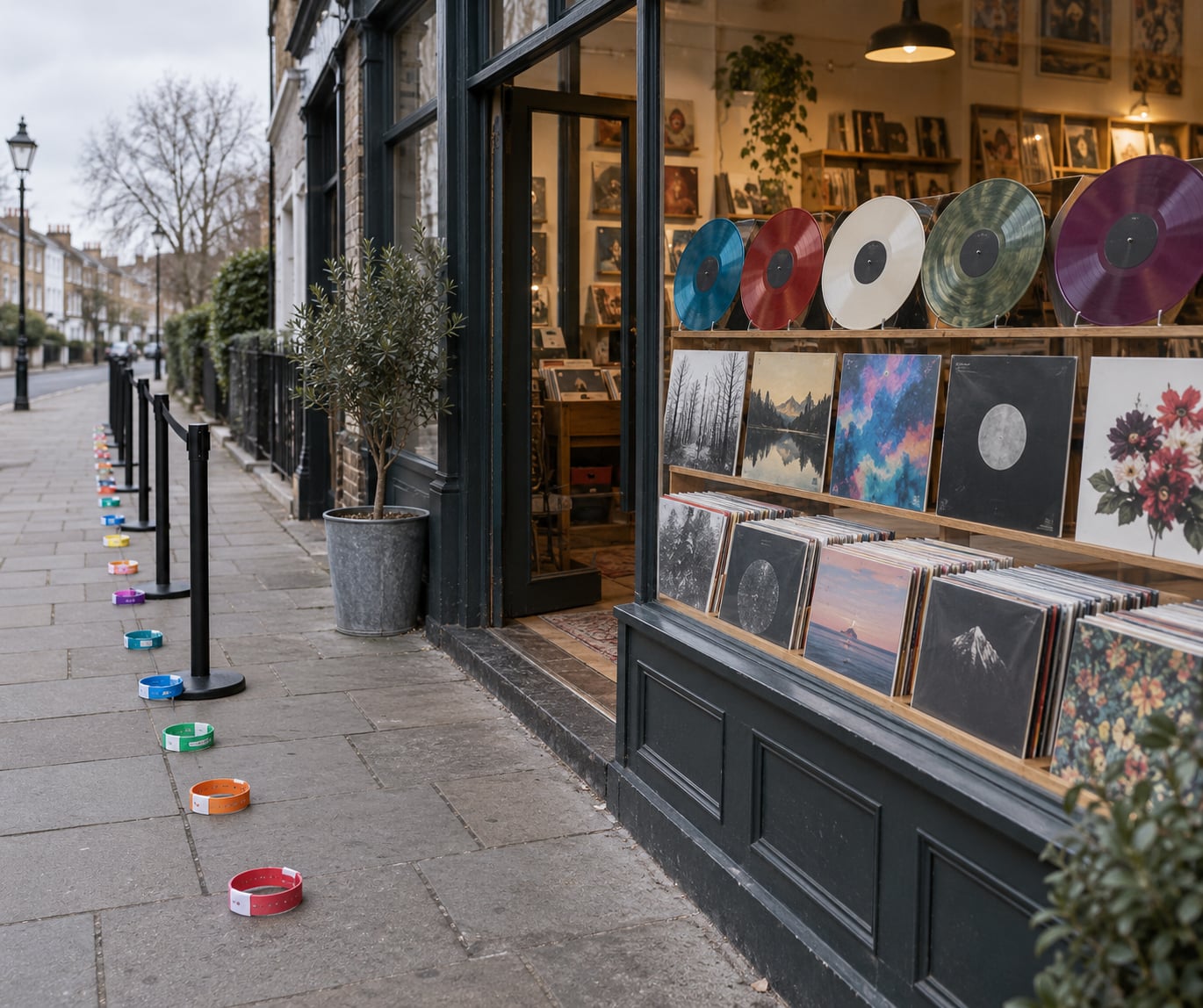
- Do not trust unofficial markers. People use queue markers and numbered wristbands with no connection to any shop. There is no official marker system, so a numbered band means nothing.
- Respect the purchase limits. The two-per-customer rule exists so the shelf does not empty into one pair of hands. Buying around it is the fastest way to be disliked by the people you queued with.
- Decide what you actually want first. A list written on Friday night saves money and saves a bad purchase, because the queue itself is very persuasive.
- Play the records. RSD pressings often get resold unopened, which tells nobody anything except that the copy did its job at the display shelf.
- Report fake listings rather than chasing sellers. Report the listing to the marketplace and move on. Public arguments with resellers cost everyone else their afternoon.
- Support your local shop on other days too. This is the least glamorous point on the list and probably the most important one for the stores that are actually at risk.
Frequently Asked Questions
Is Record Store Day bad for record shops?
It is good for revenue on one day and mixed for the rest of the year. Shops report strong April mornings, better visibility and impulse spending. They also carry staffing, security and unsold exclusive costs, and the margin on a limited edition is not much better than on an ordinary release. The honest answer is that the day helps, but not as much as participants claim.
Why do record stores limit purchases on Record Store Day?
Because headline exclusives often arrive as two or three copies per shop. Pressing plants have finite capacity and labels set minimum order quantities, which forces short runs. Retailers cap purchases to stop one buyer clearing the allocation, though caps are unevenly enforced and easy to work around by returning at closing time.
Is it illegal to buy records and sell them for more?
No, and this is the part many collectors get wrong. Buying a record and reselling it at a higher price is legal in most places, and second-hand trading is how most people find affordable records. The disagreement is about community norms rather than law: when a small allocation is bought purely to sell, collectors feel the shop lost the copy and the fan lost their chance.
Do independent record stores really make money on Record Store Day?
They make some, and the amount varies hugely by location. A city shop competing with five others sees a slice of the crowd, while a shop with no nearby competitor may turn people away. Shops that treat the day as a community event with performances tend to do better than shops that treat it purely as a sales day.
Should vinyl collectors participate if they dislike the controversy?
Plenty of collectors who dislike the queues and the reselling still show up, because the day is also the best advertisement physical music gets and the shops need the footfall. The usual compromise is to skip the dawn queue, buy in the afternoon, and support your local shop through the rest of the year. Participation is not a loyalty test either way.
What to Do at the Next Record Store Day
Check the official participating store list and that shop’s own rules before the weekend, then decide what you genuinely want to own. Most of the anger in this debate comes from turning up hoping something will be left rather than choosing on purpose.
Everything after that is preference. Some collectors buy in the afternoon and spend the rest of the day listening to what they got. Others now skip the queues entirely and buy from specialist sellers afterwards. Neither approach is a moral position, and treating participation or refusal as a loyalty test is the fastest way to keep an argument going that the shops do not need.