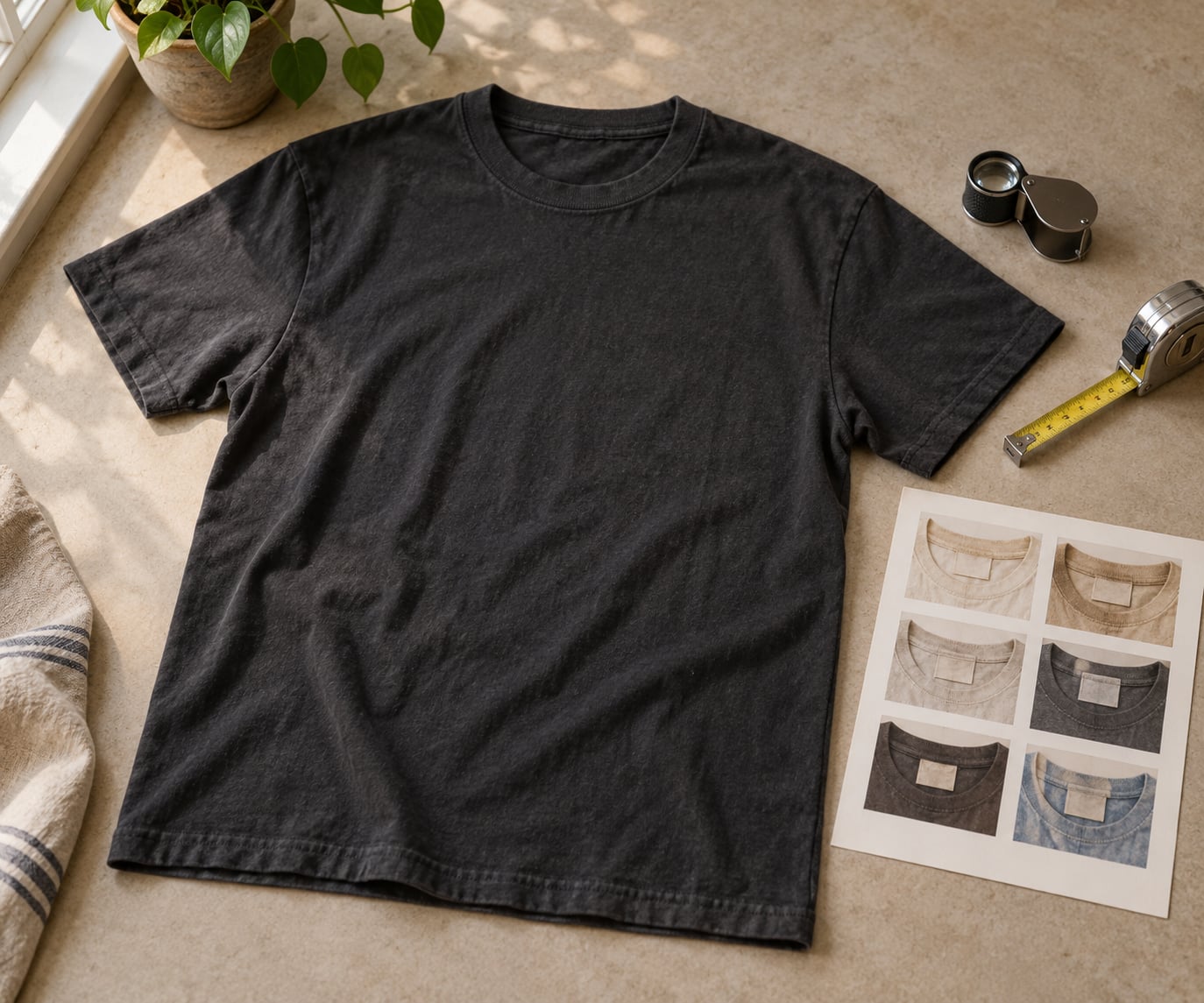
The short answer to how to spot a fake band T-shirt from the seventies is that you judge it in four physical layers, in order: the collar tag, the stitching and cut, the fabric blend, and the print and its ink. A modern reproduction almost always fails at least two of those at once. A genuine 1970s shirt usually has something odd going on that a fake has carefully avoided.
That oddity is the point. The most-shared teaching example in this hobby is a poll where two shirts were presented side by side: one in near-mint condition with a bright, saturated print and no tag, the other stained, faded and tagged. Collectors picked the wrong one almost unanimously. The stained one was real.
One piece of advice needs correcting before anything else, because it is repeated across half the guides online. The rule that a missing copyright line means the shirt is a fake is true of modern licensed merchandise. It is backwards for the seventies. Most genuine 1970s concert shirts were unlicensed vanity press or parking-lot press runs with no licensor, no licensee imprint and no legal entity anywhere on the garment.
The routine below takes about ten minutes once you have the habit. Bring a loupe and do it in daylight.
Table of Contents
- What You Need
- Step-by-Step: How to Spot a Fake Band T-Shirt From the Seventies
- How to spot a fake band t shirt from the seventies: establish the exact issue first
- Examine the neck label and care tag
- Check whether the screen print sits correctly on the fabric
- Compare the graphic and lettering closely
- Inspect the fabric, cut, and construction
- Check colours against dated references
- Look for signs of modern or later production
- Distinguish wear, deliberate aging, and replacement parts
- Verify the garment’s history and seller evidence
- Use the evidence to assign confidence and avoid overpaying
- Common Mistakes
- Frequently Asked Questions
- Can washing a vintage band T-shirt help determine whether it is real?
- Does a missing tag prove that a 1970s band T-shirt is fake?
- Why might a genuine vintage shirt have a modern or replacement tag?
- Can an expert authenticate a band T-shirt from photos?
- How should I buy a questionable vintage band T-shirt online?
- What To Do First With Any Claimed 1970s Shirt
What You Need
Authentication fails more often from bad lighting than from bad eyesight. Everything below is worthless under a warm bulb at a market stall at six in the evening.
- A 10x loupe. The cheapest useful tool in the hobby. It turns stitching density, ink laydown and halftone dots into something you can actually judge. Without one, you can still run a fingertip across the hem and feel the difference.
- A small flashlight. Side-lighting the print reveals cracks and ink separation that are invisible head-on, and side-lighting the collar seam reveals a swapped label.
- A measuring tape. Body width, shoulder-to-shoulder and sleeve length are cheap, objective and hard for a seller to argue with.
- A neutral, flat surface in daylight. A white sheet on a table by a window. No wood grain, no patterned tablecloth, no coloured walls bouncing light back.
- Dated reference photographs. Period concert photography, posters, tour handbills and magazine ads from the specific year. This is what makes graphic verification possible rather than impressionistic.
- A blank-maker reference. Know that Artex, Oneita, Stedman, Spruce, National Spinning, Screen Stars and Hanes all ran period blanks, and know which are 50/50 and which are all cotton.
- A second opinion. A shop that grades tees in person, a record-store memorabilia contact, or a collector who has handled hundreds of them. Admitting a piece is beyond you is normal practice, not failure.
Step-by-Step: How to Spot a Fake Band T-Shirt From the Seventies
How to spot a fake band t shirt from the seventies: establish the exact issue first
Start by identifying the exact object, because you cannot authenticate a general memory of seventies merchandise. You need the band, the approximate year, the tour, the venue or city, the catalog number if one exists, the artist credited on the graphic, and which known variation this is meant to be.
Many a “rare” shirt turns out to be the third variation of a design that ran for two years. Others are a single tour date from a regional leg that played forty venues. Write it down before you touch the garment, and be suspicious of a seller who describes it only as a seventies tour tee.
Check the graphic’s internal logic while you are at it. A 1975 shirt carrying a logo the band did not adopt until 1981, or a date from a tour the band did not run, is wrong on its face and needs no further testing. Confidence here is high, because the error is in the artwork rather than in the physical evidence.
Examine the neck label and care tag
The collar tag is still the check collectors rank first, and for good reason: it is the cheapest thing for a forger to get wrong and the easiest thing for you to date. Turn the shirt inside out at the shoulder seam and read the neck label in full before you look at anything else.
Genuine period labels are usually printed or woven in a single ink colour on a thin, papery or slightly glossy tag that has yellowed unevenly and frayed at the fold. Look at the stitching that holds it in: small, tight, slightly irregular machine stitching, not a modern lockstitch machine’s perfect even feed. Check the size format, which in the seventies was usually a letter, a number, or S-M-L on a separate flag rather than the modern S/M/L/XL/XXL system.
Now the fibre content. Most domestic 1970s blanks were a 50/50 cotton-poly blend, and the care tag often said so plainly. All-cotton exists for this decade too, particularly on the softer European and later-period blanks, so it is not a disqualifier on its own. A tag claiming ringspun, tri-blend, or a modern elastane content is decisive against a 1970s claim, because those fibres did not exist in commercial apparel at that scale.
The distinction that catches people is period versus replacement. A blank tag with no brand and no size at all may be a genuine relic of the era, or it may be a cheap tag someone sewn onto a modern blank. Turn it over: look for a fold crease in the same shape as the surrounding fabric, matching yellowing on the fold lines, and a wear pattern where the collar has rubbed it. New thread on old cloth is the tell.
Check whether the screen print sits correctly on the fabric
Original 1970s prints were laid onto the garment as it was made, so the artwork relates to the panels it crosses. A hand-pulled screen that runs over a seam, or stops short of the edge in a way that tracks the cutting pattern, was printed for that specific blank. A graphic that floats in the middle of the chest with a suspiciously even margin all round was placed on a modern, perfectly rectangular panel.
Look at the ink itself under the loupe. Period inks were water-based and discharge, or rubber-bumper based on a thin rubber stamp. With five decades on them they show ink sitting slightly proud of or slightly sunk into the fibre, faint cracking along the flex lines, and a subtle halo where the ink has spread a fraction into the surrounding yarn. Discharge ink genuinely removes dye and leaves the fabric lighter under the graphic, which is why faded 1970s prints so often read as lighter than the shirt.
A modern plastisol screen print behaves differently. It sits on the surface as a film, feels like a slight ridge under your fingertip, and usually has a uniform thickness across large flat areas. Mild surface cracking on a fifty-year-old shirt is normal and is a positive, not a flaw. Slight registration wobble is also normal: colours landing a fraction of a millimetre off-register was part of hand-pulling, and a fake with machine-perfect registration is the thing to worry about.
Compare the graphic and lettering closely
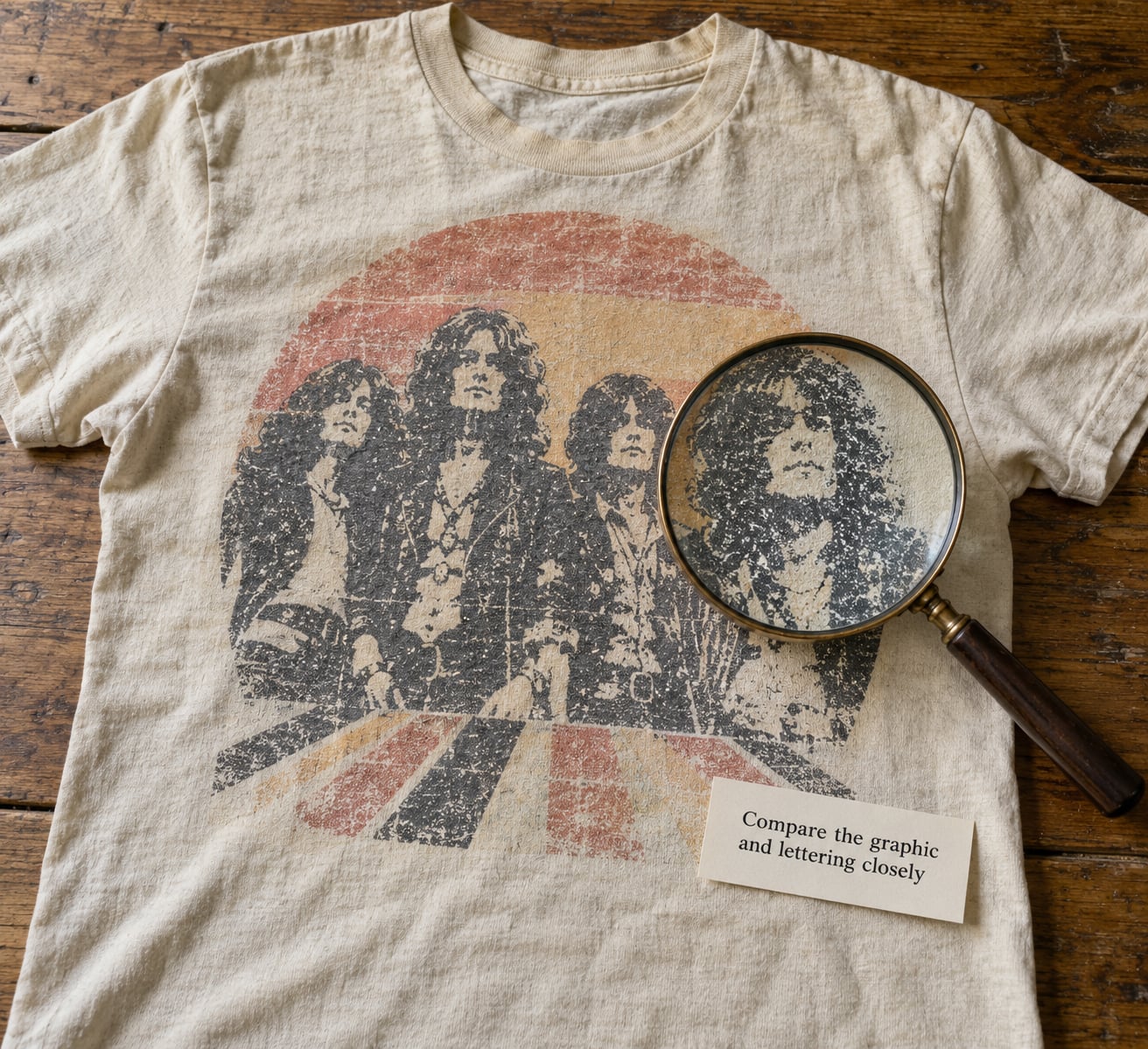
Compare the artwork against dated references rather than against a current logo file. The 2010s version of a band’s mark is usually a redraw, and it differs from the 1970s original in letter shapes, spacing and outline weight. Bring the shirt to the comparison, not the comparison to memory.
Check spelling exactly as printed, including the errors. Real 1970s merchandise contains misspelled song titles, mislabelled tour cities and typographic oddities that a modern clean-up would have fixed. Letter outlines are the strongest signal: hand-drawn and hand-cut artwork has wobble in the outline and variable stroke weight within a single letter, while a vector redrawn decades later has uniform geometry that is subtly wrong in a way that is hard to articulate but easy to see once you have seen both.
Look at image proportions and the artwork credit line. A credit naming a screen shop, an artist, or a printer that did not exist yet is a clear anachronism. Check the slogan wording against period posters and handbills; a phrase the band adopted two years later tells you the shirt is later. Confidence: high when you have a dated reference, low when you are working from a single modern image.
Inspect the fabric, cut, and construction
Date the blank itself. Turn the shirt inside out and run a finger along the shoulder-to-shoulder seam, the side seams, the sleeve hems and the bottom hem. Single-needle stitching throughout, including the bottom hem, points to an era when coverstitch machines were not standard on this kind of garment. Double-stitched hems and shoulder-to-shoulder taping became the norm later and, on a shirt claimed as 1970s, are a strong argument against it.
Check the collar. Period collars are often ribbed with a visible join and a slightly open, soft roll rather than the tight bound collar of a modern blank. The body is boxy and short relative to the sleeve, with a high armpit seam that drops lower than you would expect on a current shirt. Tubular knit construction with no side seams is another period trait. Tubular knits do exist on modern performance shirts, so treat this as supporting evidence rather than proof.
Fabric hand tells you something too. 50/50 cotton-poly has a weight and a slightly slick dry hand that all-cotton lacks, and it drapes differently. Thinner than expected points to a later or lighter blank. Do not over-read hand-feel on its own, because wash history changes it, and a heavily washed modern tri-blend can feel deceptively period.
Check colours against dated references
Colour is the check most often argued about and the least decisive on its own. A claimed 1974 Black Sabbath shirt in bright cherry red probably is not 1974, but the photograph you are judging it against was shot on a different film stock, printed on a different paper, and now scanned with a white balance shift.
So gather several dated examples of the same design before drawing any conclusion, and prefer examples photographed in flat daylight. Check the fade pattern instead of the shade. Genuine sun fade is directional: it starts where the garment hung, the shoulders and upper chest, and the fold lines, because that is where light hit it. A shirt faded evenly all over, or faded in a soft halo around the graphic only, was aged deliberately or washed to order.
Look for signs of modern or later production
This check is about the things a 1970s garment simply cannot have. Modern blanks usually carry a printed tagless label inside the collar, a barcode or QR label, or a synthetic care label in a format that did not exist before the Care Labeling rules of the late 1960s and 1971. In 1971 the Textile Fiber Products Identification Act also made fibre content and country of origin mandatory on apparel, which is a useful dating floor rather than a ceiling.
On the print side, direct-to-garment printing has no halftone structure and no screen mesh pattern; its edges are digitally smooth and it sits within the fibre. Heat-transfer and iron-on paper have a continuous film bonded to the surface, a slightly glossy feel, and edges that can be lifted at a corner. Digital artwork reworks now circulate too, sometimes AI-generated, which breaks comparison against period photography entirely.
Finally, check the era of the blank against the era of the claim. Several of the most widely reproduced shirts are printed on mid-2000s blanks, which read to an experienced eye as slightly too clean, with a collar that is a fraction too tight. A modern blank is not automatically fake, since a 1990s reprint is itself vintage. It simply cannot be sold as 1970s.
Distinguish wear, deliberate aging, and replacement parts
Real wear has a story and a location. It concentrates where a body puts stress: collar stretch, elbow and cuff abrasion, a fade band at the hem, small pulls. The fabric goes soft and thin rather than uniformly rough, and holes appear where the fabric has genuinely worn through rather than at a decorative grid.
Artificial distressing has a pattern that wear does not. Uniform sandpaper distressing hits the same points at the same intensity, often symmetrically on both sleeves. Chemical fading produces pale, even blotching with a smell and a hard-edged tide line. Paint or bleach spatter sits on the surface and does not follow fibre direction.
Then there is dry rot, which is the real condition fault of the seventies and gets mistaken for both. It shows as a weak, dusty, sometimes faintly yellowed area, usually on the lower front or back where damp sat against the body. Cotton that crumbles under light pressure has genuine dry rot, and it is not evidence of a fake.
Replacement parts change a shirt without making it fraudulent. A replaced collar, a restitched hem, an aftermarket tag and a professionally replaced graphic were all ordinary repairs in an era when shirts were worn until they fell apart and then patched. Document them, price them as repairs, and do not treat the shirt as fraudulent on that basis alone.
Verify the garment’s history and seller evidence
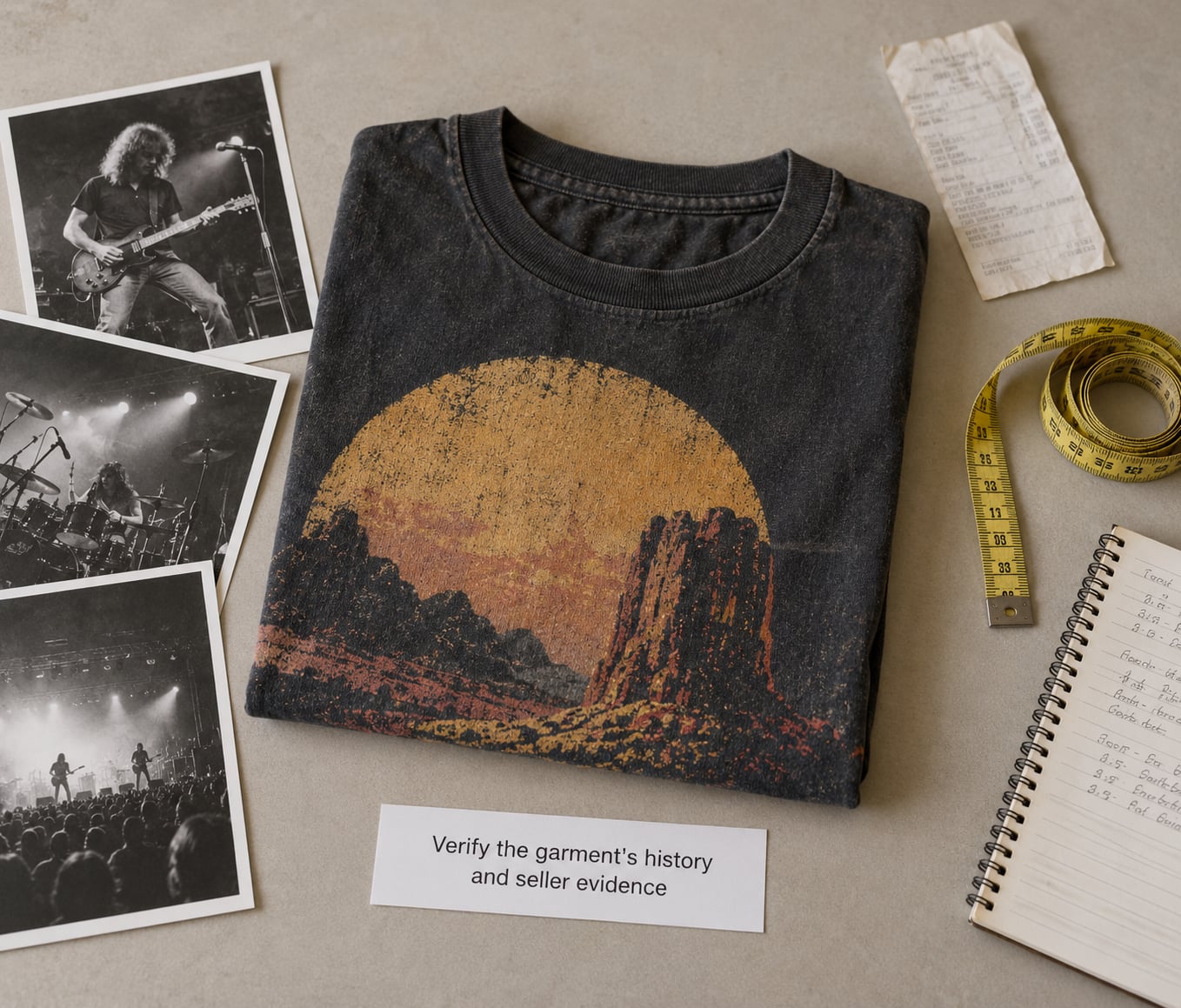
Physical evidence settles what the shirt is. Provenance settles whether the story matches. Dated photographs of the person wearing it, receipts, prior sale records, a tour itinerary, and a consistent description across listings all count for something, and a seller who has kept notes for years is telling you something real.
Check tour history against setlist.fm and Concert Archives, which hold dated venue listings. It takes two minutes and it catches a surprising number of claimed rarities. A shirt listing a city the band never played that year is not rare. It is wrong.
Watch for confident storytelling that no document supports. Long, detailed, emotion-laden descriptions with no photographs of the tag or hem are a pattern. So are sellers with hundreds of near-identical items in the same condition, because a warehouse of pristine shirts is itself the tell. And ask for three specific photographs before you buy: the neck label and collar seam, the bottom hem turned inside out, and a raking-light close-up of the print.
A seller who declines is telling you something too. That said, plenty of honest sellers photograph badly. Judge the refusal, not the camera.
Use the evidence to assign confidence and avoid overpaying
Score each check as pass, fail or unclear, then read the total rather than any single result. Four or more passes with no fails is a genuine shirt. Two fails means walk away, regardless of how good the print looks. One fail with everything else clean usually means a repair, a tag swap or a later production, and the price should reflect that.
The honest state of this hobby is that a single defect is inconclusive and certainty is rare. Nobody authenticates from a listing photo alone, and anyone who claims to is either being generous or selling. What you are really doing is building a case that either holds up or collapses under one more question.
Price by the evidence you gathered, not by the number in the listing. Ask for another opinion when you are at three out of five passes and the amount at stake matters to you. And if a seller applies time pressure, that is information about the shirt, not about the deal.
Common Mistakes
Trusting a single old-looking label. Tags get swapped, and an anachronistic tag on a modern blank is the current standard of reproduction. Always corroborate the tag with stitching and fabric.
Treating fading as proof of age. Chemical fading, wash-dye and sandpaper distressing all imitate sun fade. Fade pattern and location tell the difference, not the mere fact of fading.
Judging from one marketplace photo. Flattened, colour-corrected, cropped photos hide exactly what you need. If the seller will not send the three specific shots, assume you are being shown a different shirt.
Assuming every modern-looking detail is fraudulent. A 1990s reprint is vintage in its own right, and a well-made fan shirt is a legitimate object with its own value. The cultural question and the authenticity question are not the same question, and collectors who confuse them end up selling good shirts for nothing.
Paying for a story instead of evidence. Provenance adds value when it is documented. Vivid description is not documentation, and it is free for anyone to write.
One more worth naming: the missing copyright line. Collectors on the vintage tee forums argue about it constantly, and the confusion runs in both directions. For a 1970s shirt, no copyright line is normal and unremarkable. For anything from the 1990s onward, its absence is a genuine warning sign.
Frequently Asked Questions
Can washing a vintage band T-shirt help determine whether it is real?
It can damage the shirt and it still will not give you a verdict. Washing softens fabric and lifts ink, so it changes the very evidence you were checking. What it does do is reveal work that was already there: a paper transfer may peel away, plastisol may crack across every flex line at once, and a modern fibre blend may pill where a 50/50 cotton-poly does not. Check the fabric and print first, in the dry, under a loupe.
Does a missing tag prove that a 1970s band T-shirt is fake?
No, and this is the most expensive misconception in the hobby. Tags were cut off, worn through, lost in the wash or removed on purpose by someone who wanted a clean collar. Plenty of genuine period shirts have no label at all. Date those shirts by their fabric, stitching, cut and ink instead. A Gildan or Bella+Canvas tag on a claimed 1970s shirt, however, is decisive evidence against the claim.
Why might a genuine vintage shirt have a modern or replacement tag?
Three reasons, in rough order of how often they happen. The original tag wore away and someone replaced it with whatever blank was on hand. A seller swapped in a tag to make an ordinary shirt read as rare. Or the shirt was reissued years later and someone relabelled it as an original. You can usually tell by comparing the fold crease, the yellowing and the thread against the surrounding fabric, so look at the tag inside out before you read anything on it.
Can an expert authenticate a band T-shirt from photos?
An expert can narrow it down and flag what to check in person, but nobody signs off a high-value garment from a listing photo. Useful photos include the neck label and collar seam, the bottom hem turned inside out, a raking-light close-up of the print, and a shot showing the shirt lying flat with a tape measure in frame. A confident yes from photos alone should be treated as a reason to get a second opinion, not a reason to commit.
How should I buy a questionable vintage band T-shirt online?
Treat the photos as evidence to be tested, not as confirmation. Request the three specific shots before paying, ask what the blank maker is and when the seller acquired it, and run the listing description against tour records on setlist.fm and Concert Archives. Walk away if the seller declines closer inspection or applies deadline pressure. If you are buying to resell, keep every photograph and note in a dated file, because provenance is what makes your sale defensible later.
What To Do First With Any Claimed 1970s Shirt
Write down the exact band, year, tour and variation before you look at anything else, so you are authenticating a specific object rather than a memory. Then check the collar tag, the hem stitching, the fabric blend and the print, in that order, and write down pass or fail for each.
If the provenance does not line up with what the physical evidence shows, walk away. The 2026 market for genuine seventies band shirts is thin enough that a doubtful piece today becomes tomorrow’s cheap repro, and no story is worth that.