Collecting concert posters means gathering the printed art made for a live show, then keeping it flat, dry and out of direct sunlight so it still looks sharp in twenty years. Most people start with the one they carried home from a show they loved, then build outward from there. The collecting part is easy. The protecting and documenting part is where beginners lose money, and that is what this guide covers end to end.
The honest truth is that most concert posters are not rare treasure. They are affordable, physical reminders of a night you actually attended, and a handful of design-heavy editions are genuinely worth serious money. Treating those two facts at the same time is the whole game.
Below is the full sequence: what to buy before you start, how to pick a focus, how to tell what you are holding, what to inspect, where to buy, how to store and frame, and how to keep records.
Table of Contents
- What You Need
- Step-by-Step: Build Your Concert Poster Collection
- 1. Choose the Music and Artists You Want to Collect
- 2. Learn How to Identify Concert Posters
- 3. Check Condition Before You Buy
- 4. Find Reliable Places to Buy
- 5. Store and Display Posters Safely
- 6. Track Your Collection and Spending
- Common Mistakes
- Frequently Asked Questions
- Are concert posters worth anything?
- Where can I get concert posters?
- What is the most sought-after concert poster of all time?
- How much do posters cost at concerts?
- Is it better to roll or fold a poster?
- Who are some famous concert poster artists?
- Conclusion
What You Need
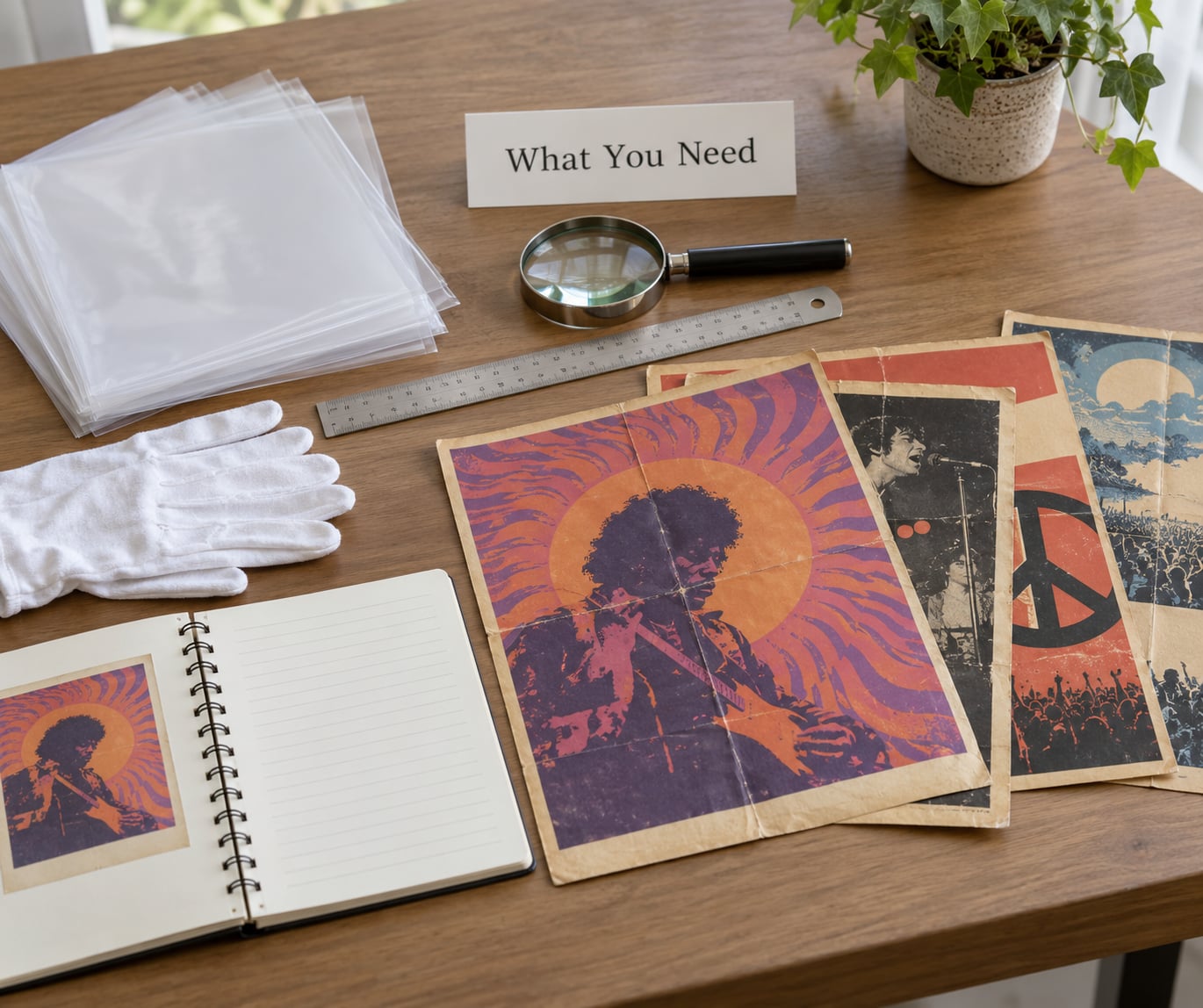
None of this is expensive, and all of it is easier to buy before you need it than to source the night a poster gets ruined.
- White cotton gloves or clean dry hands. Paper conservators work with clean hands more often than gloves, because cotton grips paper better than nitrile. Gloves matter most on anything with ink on the surface.
- Acid-free lignin-free sleeves and folders. These are the folders a poster can sit inside for years without the paper discolouring or becoming brittle.
- A poster tube with an inner diameter larger than the rolled poster. Buy the biggest that fits your format rather than a thin poster tube from an office supply aisle.
- A ruler and a magnifying glass. Dimensions are the fastest authenticity check you have, and you want both in hand before you commit.
- Archival mat board and a frame. Match the board to a standard poster size so you can swap prints without reframing.
- A collection log. A spreadsheet works, and a notebook with a phone camera for provenance photos works nearly as well.
One more preparation step pays for itself immediately. Standardise on a poster size your frames fit, so a wall of twelve prints uses four frame sizes instead of twelve. Collectors who deliberately buy the same format report far less frustration later.
Step-by-Step: Build Your Concert Poster Collection
1. Choose the Music and Artists You Want to Collect
Start narrow. A beginner who decides to chase “punk posters” will drown; a beginner who decides to collect a single touring band, a single venue, or a single decade has a target and a way to know when the hunt is done.
Pick the lane that matches what you already listen to. Punk and hardcore flyers from the eighties, garage and rockabilly show bills, classic rock tour posters, or the poster series a single band commissioned for each tour leg. Local scenes are underrated too, because small venue posters are cheap, plentiful and rarely handled well by sellers.
Then learn the merch table mechanics. Limited editions and signed stock sell out fast, and collectors report runs of 100 disappearing in minutes at Pearl Jam shows. Queue early, ask the merch staff which variant is limited before you buy, and check whether the premium tier includes a better print rather than just a heavier poster.
2. Learn How to Identify Concert Posters
Every poster carries details that either confirm what it is or expose a reproduction: the artist or band, the tour or event date, the venue and city, the printer or designer credit, the paper dimensions, and any edition or print-run numbering.
Original gig posters were produced to promote one specific show and usually carry a printer credit on the reverse along with the paper size. Artist prints and limited editions are usually numbered, sometimes hand-signed by the designer, and normally arrive with a certificate of authenticity. A reprint sold years later as merchandise reproduces the design but was never the show’s advertising art.
Size is the quickest first test. Check the printed dimensions against the sheet in your hand and compare with listings for the same design. A reproduction in a size no printer ever ran is a warning.
Designers worth recognising by name add another layer: Wes Wilson for the psychedelic San Francisco scene, Roger Dean for progressive rock and Yes, Bob Cato for the New York club poster tradition, and Arik Braun for Swiss and international work. Knowing the credit tells you which era and which city a poster belongs to, which is half of authenticity.
Collectors on r/Puscifer have run into exactly this confusion, asking where the official poster ends and the knock-off begins when reproductions of the same design turn up online at prices that look wrong for the object.
3. Check Condition Before You Buy
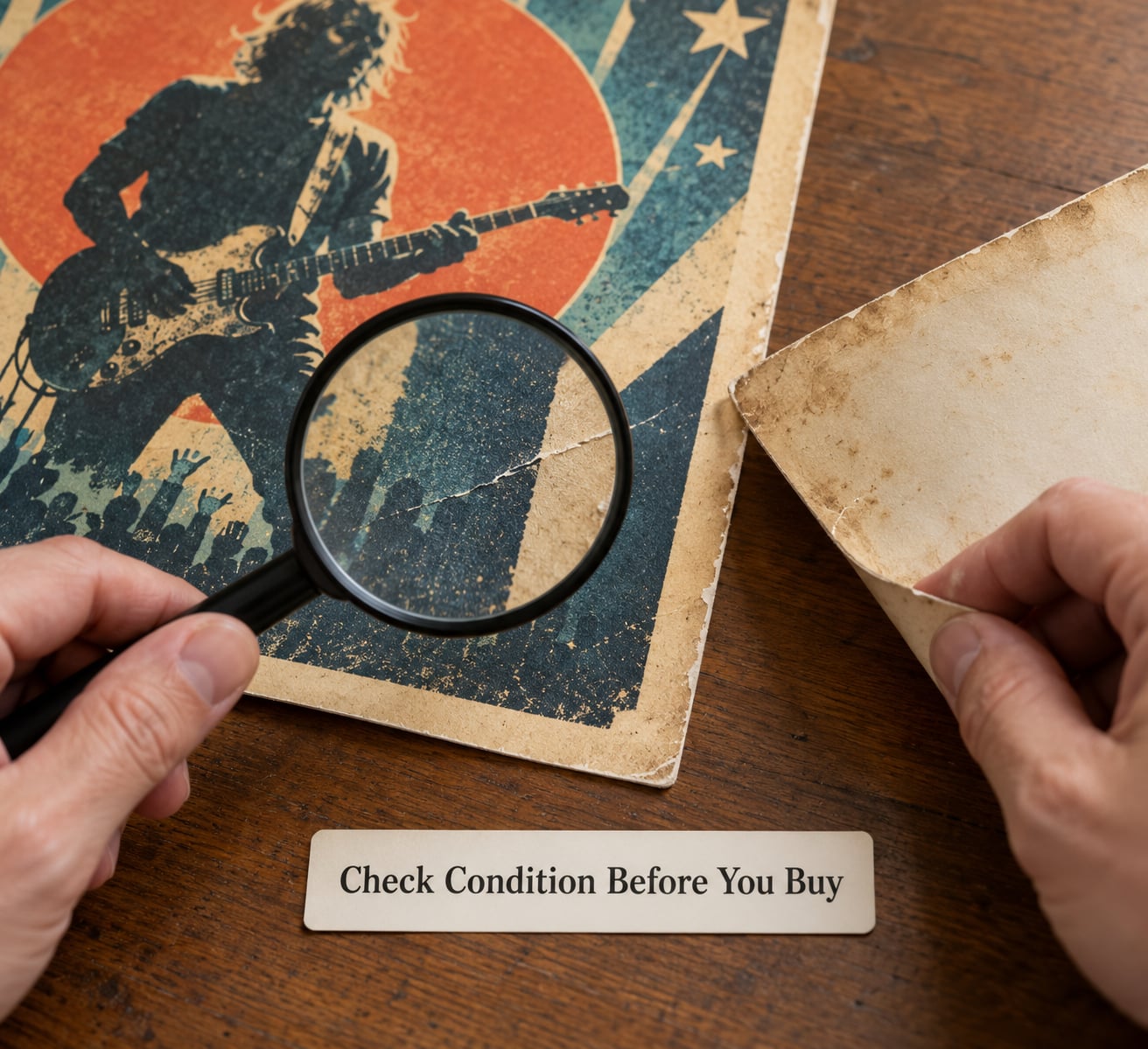
Condition is where the money leaks. Look at the sheet in good light, front and back, before you agree on anything.
- Folds and creases. A single sharp fold permanently cuts value; soft corner curl usually does not.
- Tears and edge wear. Check corners and the edge that would have sat in a frame rabbet.
- Fading and sun damage. Uneven colour across the sheet usually means it hung on a wall somewhere.
- Trimming. Short edges mean the sheet lost paper, which counts as damage to most collectors.
- Restoration. Ask about any infill, backing or reattachment. Disclosed restoration lowers value; undisclosed restoration ends the sale.
- Verso marks. Tape residue, writing or sun-through discolouration on the back are all recorded in grading.
For anything older than about forty years, smell is a legitimate check. A musty or sour scent points to past damp exposure and a risk of mould, so quarantine it in a sealed folder and let a professional look before it goes near the rest of your collection.
The trip home matters as much as the inspection. Do not fold a poster to fit a bag, and do not leave it on a car seat in summer heat. Roll it loosely around the widest tube that fits with a layer of acid-free tissue over the image, or carry it flat in a rigid portfolio if the drive is short.
4. Find Reliable Places to Buy
Collectors start at shows and then branch out. Beyond the merch table, the realistic sources are specialist dealers, established record shops with a poster wall, auction houses such as Hake’s, Bonhams and Christie’s for high-end pieces, and long-running fan sellers who post the provenance behind each print.
Online marketplaces are where most beginners get hurt, because reproductions sit next to originals in the same search results. Read the listing closely: a numbered edition should state the run size and include a certificate of authenticity, and photos should show the reverse with the printer credit.
Flea markets, estate sales and attic clearouts are wonderful and entirely unfiltered. Assume nothing until you have checked dimensions, credits and edition marks against a known example of the same design. Paper conservators and specialist dealers exist precisely because this check is hard to do well as a beginner.
5. Store and Display Posters Safely
Store flat when you can. Rolling is second best, and folding is the only answer to no options.
Flat archival storage in lignin-free folders inside a rigid box is the safest home for a growing collection, and it scales better than most people expect. Tubes protect well against bending but take up a lot of room, and they collect dust at the edges where the paper meets the cap. Many collectors fall back to tubes behind the couch once the wall fills up, which works until the shelf above it gets used.
Keep the room cool, dry and stable. Avoid basements, attics, garages and exterior walls, where temperature and humidity swing hardest. Light is the quiet enemy: even filtered daylight fades ink, so nothing goes on a wall that receives direct sun.
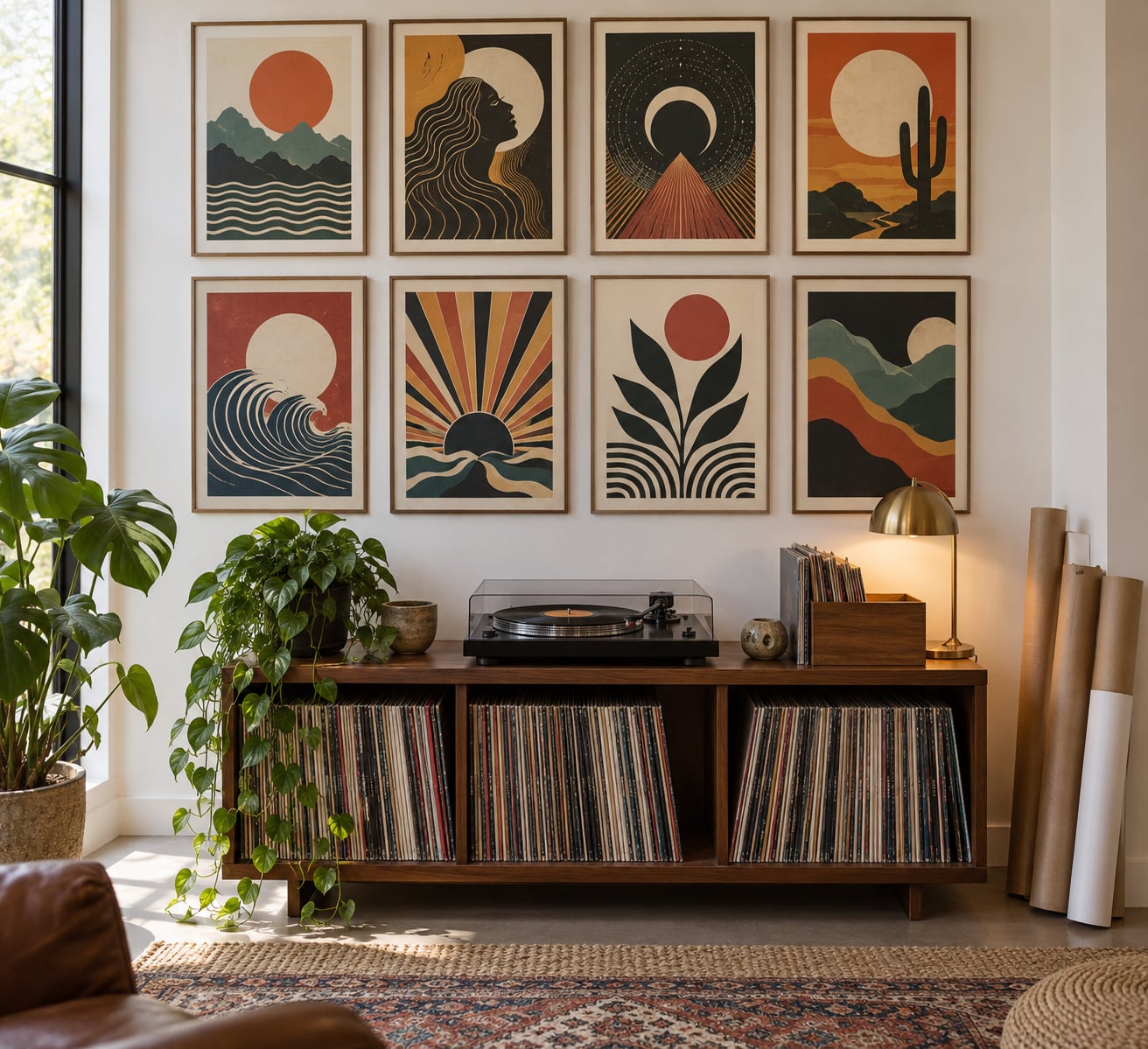
For framing, use an acid-free mat with a window slightly smaller than the sheet so the print never touches the glazing, and choose UV-filtering glass. Standard poster sizes such as 12 by 18, 18 by 24 and 24 by 36 match frames sold at big-box craft stores, where collectors regularly report buying frames on sale for a few dollars each. Cheap frames are genuinely fine.
What to skip: pushpins driven straight into the print, ordinary tape on the face, dry mounting or lamination, and foam backing board. Any of those causes damage you cannot undo. Museum conservators use Japanese paper hinges with wheat starch paste when mounting is genuinely necessary, which is well beyond beginner territory.
6. Track Your Collection and Spending
A simple log turns a stack of posters into a collection. For each piece, record the artist, the event or tour date, the venue and city, the designer or printer credit, the size, the edition size or numbering, the condition grade, where you got it and when, what you paid, and a photo of the reverse.
That reverse photo is the piece most beginners skip and later wish they had. It captures the printer credit and condition in one shot, and a dated record of condition slows any argument about damage years later.
Also note the total spent per year. Posters add up quietly, and a collection that looks cheap on any single purchase can become a real line item by December.
Common Mistakes
Buying a reproduction believing it is original. Fix: check dimensions against a known example, confirm the printer credit on the reverse, and treat a missing certificate of authenticity on a limited edition as a no.
Ignoring condition because the price feels low. Fix: grade the sheet yourself before you buy, not after it arrives damaged in the post.
Using non-archival storage. Fix: acid-free lignin-free folders, buffered tissue, no plastic sleeves for long-term storage.
Paying more than comparable sales justify. Fix: look up sold listings for the same design, size and edition, not just current asking prices, and discount anything sold unsigned that you assumed was signed.
Failing to record provenance. Fix: photograph the reverse and note the source the day the poster enters the collection.
Hanging prints in direct sunlight. Fix: UV-filtering glass, and no wall that gets a full day of sun.
Short version of what works: one genre or one band, one standard size, one archival box, one log sheet. Boring and effective. Collectors who keep the same format and the same storage habit end up with walls that stay displayable, which is the real goal.
Frequently Asked Questions
Are concert posters worth anything?
Most are not, and the honest answer is that they are worth far more as memories and as decoration than as investments. Value climbs steeply when a design is genuinely scarce, the print run was small, the piece is hand-signed, and condition is clean with the original certificate of authenticity. Posters by known designers in good condition hold value best. Check sold listings for the same design before believing any asking figure.
Where can I get concert posters?
Start at the show itself, where the merch table carries the official tour poster and any limited editions, and queue early because numbered runs sell out fast. Beyond that, look at specialist dealers, record shops with poster walls, auction houses for high-end pieces, and long-running fan sellers. Flea markets and estate sales are cheap and completely unfiltered, so inspect every sheet before you pay. Online listings need the most checking.
What is the most sought-after concert poster of all time?
The 1969 Woodstock original posters are usually cited first, and they are the benchmark for the hobby. Other heavily pursued pieces include the early Grateful Dead and Jefferson Airplane psychedelic designs, and the film posters for Apocalypse Now. Among them, the rarest are the small runs, the hand-signed examples and anything printed for a single show rather than a whole tour. Provenance and condition decide the rest.
How much do posters cost at concerts?
Prices at shows depend almost entirely on the merch tier and the edition. A standard venue or tour poster is the cheapest item on the table. Foil and heavier-stock variants cost a step more, numbered limited editions with a certificate cost considerably more again, and hand-signed or artist-signed pieces sit at the top of the range and usually sell out during the show. Ask staff which tier is limited before you buy anything.
Is it better to roll or fold a poster?
Flat is always best, rolled is second best, and folding is last. A fold leaves a permanent line that cuts value and weakens the paper. When rolling, use a tube wider than the poster, roll the image side out, put acid-free tissue over the print first, and never leave a rolled poster in a hot car. For long-term storage of a whole collection, flat archival folders inside a rigid box beat tubes on space and dust.
Who are some famous concert poster artists?
Wes Wilson is the name most rock collectors learn first, with his flowing psychedelic work for the San Francisco scene. Roger Dean built an instantly recognisable style for progressive rock bands including Yes. Bob Cato is closely tied to the New York club and venue poster scene, and Arik Braun brought a Swiss modernist approach to international rock work. Naming the designer on a print tells you its era, city and scene at a glance.
Conclusion
Pick one narrow focus, such as a single band, a genre or a decade, and stay inside it for your first year. Inspect condition properly, front and back, before you pay rather than after the poster arrives. Document every purchase and photograph the reverse the same day.
Everything else is detail. Get the supplies, choose one standard size, keep the collection flat and dry and out of the sun, and let the wall build itself over time.