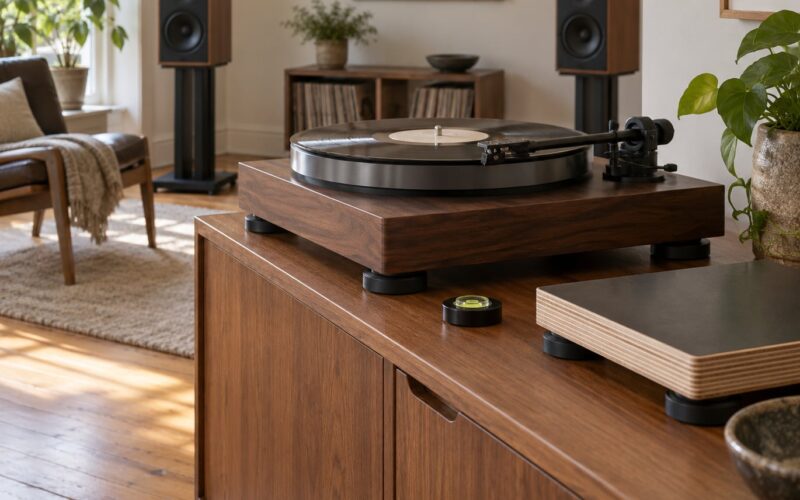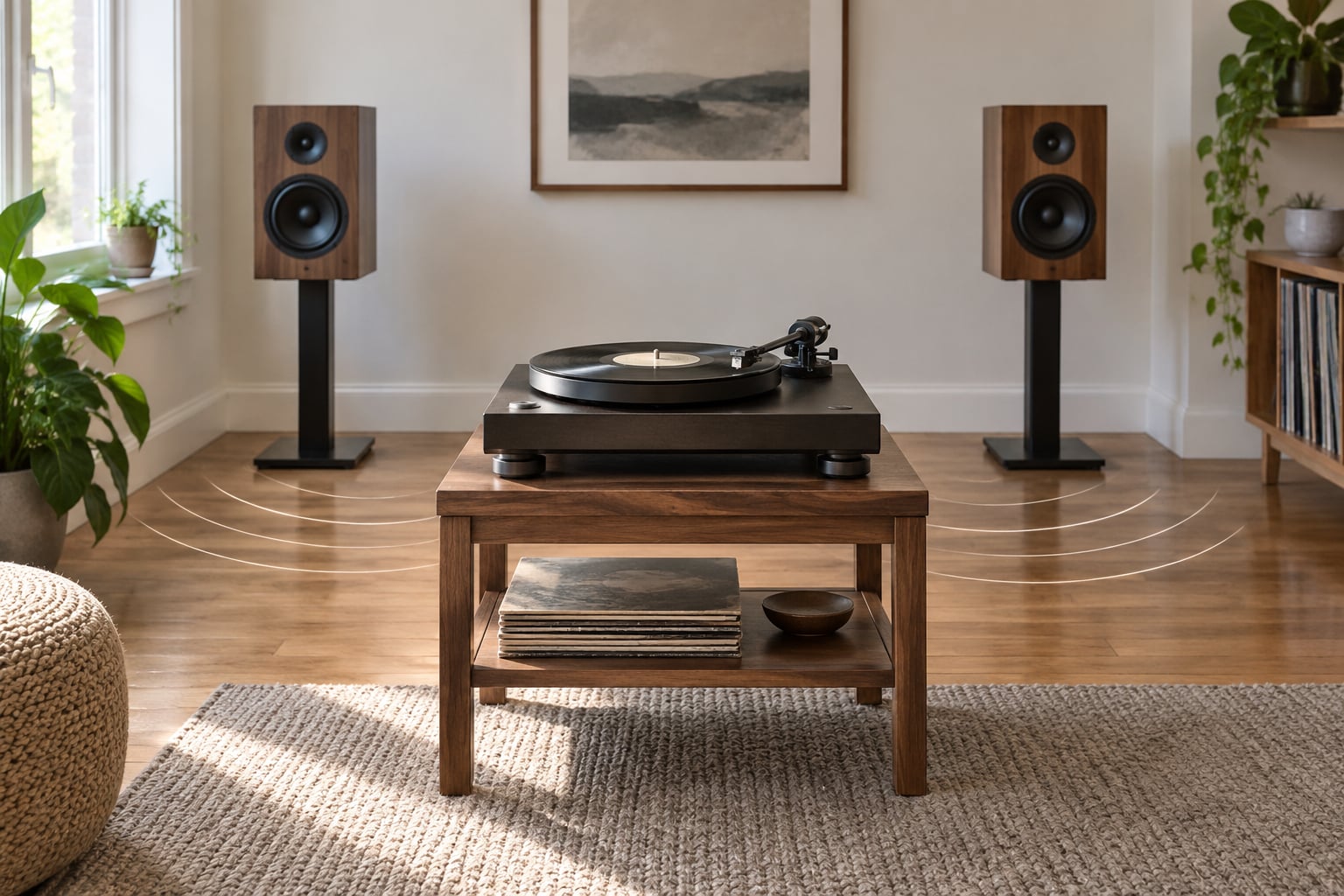
Acoustic feedback from speakers to a turntable is what happens when the music your speakers are playing moves the record’s stylus, the cartridge turns that movement into an electrical signal, and your amplifier plays it back through the same speakers. The sound chases itself in a circle and comes back louder each time, usually as rising rumble, a warbling growl, or woofers that seem to lose control above a certain volume.
A record player is not a loud object. Moving magnet cartridges typically put out somewhere between 2 and 6 millivolts per channel at typical tracking levels, which is why a phono stage exists at all. If you can hear your turntable from across the room, something is wrong with the setup, not with the deck.
The tricky part is that most of what people call acoustic feedback is not really travelling through the air. More often it moves through the shelf, the cabinet, or the floor as vibration, and that changes which fix actually works.
Table of Contents
- What Is Acoustic Feedback From Speakers to a Turntable?
- How Speaker Vibrations Reach a Turntable
- What Causes Feedback During Vinyl Playback?
- Why it only happens above a certain volume
- Why the room and the record both matter
- Is It Acoustic Feedback or Mechanical Feedback?
- How to Tell If Your Speakers Are Causing the Problem
- Run the towel test
- Mute the phono input
- Check distance and angle
- Use your hands
- How to Prevent Speaker Vibration From Reaching a Turntable
- Why stacking layers of isolation can backfire
- How to build a DIY isolation platform
- When the Problem Comes From the Turntable Instead
- Frequently Asked Questions
- What is audio feedback?
- Why am I getting a hum from my turntable?
- Is it okay to put my speakers on the same surface as my turntable?
- How can I isolate my turntable from vibration?
- Can I make a DIY turntable isolation platform?
- Does the turntable dust cover make feedback worse?
- Conclusion
What Is Acoustic Feedback From Speakers to a Turntable?
The short version: a turntable is a mechanical device that senses tiny vibrations, and a loudspeaker is a mechanical device that produces large ones. Put them close enough together and the output of one becomes part of the input of the other.
That closes a feedback loop. The speakers push air and shake whatever furniture they are standing on. That energy travels through the surface, arrives at the turntable plinth, and rocks the tonearm or the platter. The stylus moves in the groove, the cartridge converts the movement into voltage, the phono stage amplifies it, the power amplifier amplifies it again, and the cones push out more energy. Each pass through the loop is a little stronger than the last.
Left alone, the loop settles into a self-sustaining tone. It usually starts around 20 to 60 Hz where turntables are most sensitive to motion, though some setups lock in much higher. A user on r/turntables reported a loop that only appeared at higher volume and sat around 300 Hz, with the fault going away entirely after a new stylus.
Untreated, it caps how loud you can play. It smears the low end, makes the stylus jump or chatter, and in the worst cases will chew through a record groove over time.
How Speaker Vibrations Reach a Turntable
There are three paths, and they need different fixes.
| Transmission path | How it travels | Typical setup |
|---|---|---|
| Air-borne | Sound pressure pushes on the dust cover and plinth directly | Speaker a few inches from the deck, dust cover on, open-back monitors |
| Structure-borne | Cabinet vibration moves through the shelf, cabinet, wall or floor | Turntable and speakers sharing a dresser or sideboard |
| Plinth-borne | The heavy plinth moves slightly and shakes the tonearm bearing | Turntable on a hollow table, folding stand or loft floor |
Structure-borne transfer is the one that catches people out. The speakers are not throwing sound at the turntable through the air, they are hammering the furniture it is standing on. On AVForums, a user who folded a large bath towel under each speaker and turned the volume up found the woofer problem vanished completely, which proved the energy was coming through the shared cabinet rather than across the room.
Members on AudioKarma and AVForums converge on the same conclusion from different directions: decouple both ends. Isolating only the turntable leaves the speakers hammering the shelf, and isolating only the speakers leaves the deck sitting on a resonant panel.
One small trick worth knowing about, mentioned in forum threads but rarely written up properly: run your interconnects at a right angle to any mains or speaker cable. Two cables running parallel for a metre exchange far more vibration energy than the same two cables crossing once.
What Causes Feedback During Vinyl Playback?
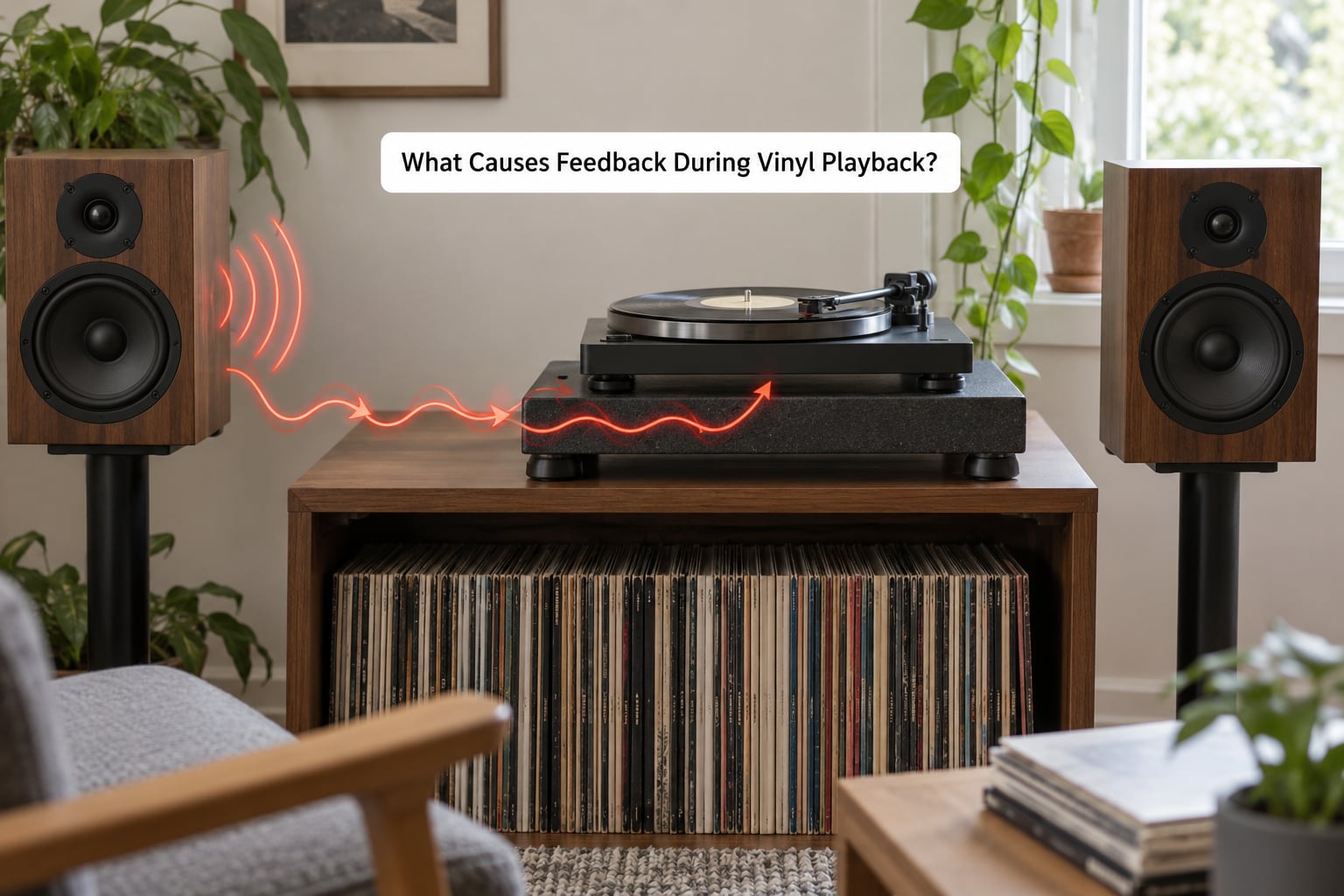
Most cases come down to a handful of repeat offenders.
- Speakers sharing the turntable’s surface. A dresser or sideboard acts as one big speaker-enclosure coupling device. This is the single most reported cause in small-room setups.
- A subwoofer on the same floor. Sub energy is enormous and continuous, and it drives the floor and the cabinet the turntable is standing on.
- Low-frequency room modes. A corner or a narrow room piles up bass at a specific pitch, and that pitch is often exactly where your setup wants to loop.
- Dust cover resonance. A lightweight hinged lid becomes a little drum head. Fluance’s own support documentation recommends removing it during playback for this reason.
- Speaker stands that are too light or too short. A stand that shares the floor with the subwoofer’s cabinet is not a barrier to anything.
- Loose components. A floating dust cover hinge, a loose RCA pin, or an unsecured plinth screw adds microphonic behaviour that a good deck would otherwise ignore.
- High cartridge output into too much gain. A moving coil cartridge plus a high-gain phono stage plus a tone control wound open is a lot of loop gain available for no benefit.
Why it only happens above a certain volume
The gain in the loop has to reach one for the loop to run away, and it rises with volume. Below that point the speakers move a little, the turntable picks up a little, and the return signal is buried under the music.
Push the volume up and the whole chain scales together, except the tiny mechanical coupling between the speakers and the plinth, which scales with bass content rather than with the midrange and treble you are actually hearing. Bass-heavy records therefore trigger it far sooner than a quiet piano trio. Turn up the bass control or the low end of a graphic EQ and the threshold drops again.
Why the room and the record both matter
A record with deep, sustained low end excites the system far more than one that does not. Owners chasing this problem often blame a specific LP for being defective when the record is simply doing its job into a marginal setup.
The building matters just as much. Floating timber floors and loft conversions with plasterboard walls leave very little between you and the joists, so the same deck on a concrete slab in a bungalow may never show the problem at all. That is why the fix that works in one house fails in the next.
Is It Acoustic Feedback or Mechanical Feedback?
It is both, and the terms get used interchangeably on forums when they should not be.
Acoustic feedback proper is sound pressure in the air pushing on something. Take the dust cover off a deck sitting very close to a speaker and the level of it drops noticeably, which is the cleanest proof of an air path. For almost every other home setup, the useful term is mechanical feedback: vibration moving through solids.
Another sense of the word deserves a mention because it causes real confusion. If a phono stage or cable picks up sound from the speakers electrically, the microphone effect turns your stylus into a microphone, and the loop is electrical rather than mechanical. It sounds similar and it responds to the same tests, but no amount of isolation will fix it, because the coupling happens inside the cable.
The practical difference: an air problem gets better when you close the distance, a structure-borne problem gets better when you decouple the furniture, and an electrical one gets better when you fix the ground or the cable routing.
How to Tell If Your Speakers Are Causing the Problem
Five minutes of testing will tell you more than an hour of theorising. Work through these in order and stop when the noise changes or disappears.
Run the towel test
Fold a thick bath towel and put one under each speaker, then raise the volume to where the problem shows up. If the rumble and the woofer trouble disappear, the energy was coming through the shared surface and you have a structure-borne problem.
Then repeat the same test with a towel under the turntable instead. If that fixes it, you need to decouple the deck. If neither towel changes anything, move on to the next test.
Mute the phono input
Drop the volume to zero and leave the record playing. A mechanical or air problem needs the audio path open, so the noise keeps going. If it stops dead when the volume goes to zero and comes back with the music, you are hearing your speakers plainly rather than looking at a feedback loop at all.
Check distance and angle
Slide the speakers a few feet further away and see whether it improves. Then rotate them so they fire across the room rather than at the turntable. Small rooms rarely allow a big move, but even thirty centimetres usually shifts the threshold enough to tell you something.
Use your hands
Put a hand on the speaker cabinet and the turntable plinth while the problem runs. Feel for buzz in the cabinet, then on the shelf, then on the plinth. That simple check tells you where the energy is entering the system.
Here is how the three common noises differ:
| Noise | What you hear | What causes it |
|---|---|---|
| Acoustic feedback loop | Rumble that swells and warbles, worse with bass-heavy records | Speakers moving the stylus, loudness-dependent |
| Mains hum | Steady 50 or 60 Hz buzz that never changes | Ground loop, poor earth, cable routing |
| Rumble on a stationary platter | Low noise with no record playing at all | Turntable motor or plinth, not the speakers |
How to Prevent Speaker Vibration From Reaching a Turntable
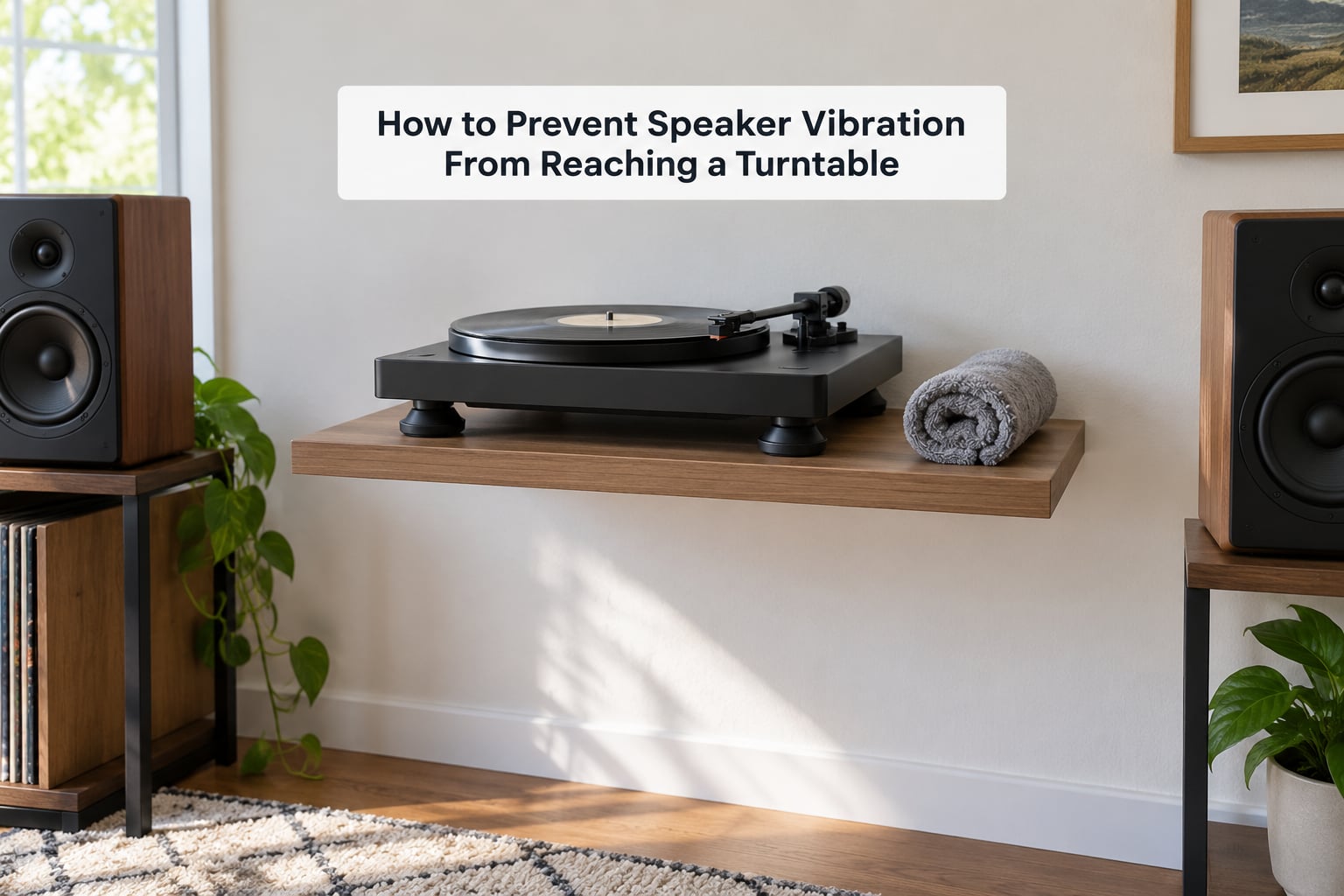
Work down this list and stop as soon as the problem goes. Each step costs more effort and money than the one before it.
- Move the speakers off the shared surface. Free, immediate, and more effective than anything you can buy. Even a metre of separation breaks most couplings.
- Take the dust cover off for playback. Costs nothing and removes the air path in most setups.
- Put the turntable somewhere solid. Move it off a hollow sideboard or folding stand onto a dense surface with real legs reaching the floor.
- Decouple with feet or a platform. Sorbothane domes or similar isolation feet under each foot of the deck are the cheapest genuine improvement.
- Isolate the speakers too. Decoupling one end only gets you half the benefit.
- Mount the turntable on a wall shelf. Consistently rated the single highest-impact fix by experienced members on AudioKarma and AVForums, because it removes the furniture from the path entirely.
- Add a subsonic filter in the phono stage. Rolls off the very low content that drives the loop, usually set around 20 to 25 Hz.
- Pull the bass back. Cutting a few decibels at 80 Hz on the speakers or the amp raises the volume threshold without touching the music you actually enjoy.
- Upgrade the turntable. Only worth it if the deck already has a suspended subchassis or a properly damped plinth. Decks with those designs barely care where they are put.
Why stacking layers of isolation can backfire
The princess-and-the-pea effect is the reason those nine steps are ordered the way they are. Isolation pads work by decoupling two masses with a compliant layer between them. Compress the pad until it behaves like a solid block and you have built one large mass instead of two small ones, which is sometimes better and sometimes worse.
Cutting board, then feet, then another cutting board, then a layer of foam is the standard stack and it is not always an improvement. Add layers one at a time and listen after each one.
How to build a DIY isolation platform
This is the version several people on AVForums converged on, and it costs less than a ready-made platform.
- Cut a thick board. Roughly 450 by 350 mm, at least 38 mm thick, from hardwood or dense plywood.
- Drill four recesses. Counterbore them slightly so four Sorbothane domes seat flush with the top face instead of rocking.
- Seat the domes. Press each one into its recess so it stands proud by a few millimetres.
- Set the board on a mass. A paving slab or a piece of concrete gives the platform something heavy to sit on.
- Place the turntable on top. Check level and make sure the plinth is not rocking on one foot.
One owner on AVForums got a verified fix from a precast concrete flagstone paired with Sorbothane domes on a cutting board, and another resolved the same problem by moving isolation feet from beneath a subwoofer to beneath the three feet of the turntable. Both are worth trying before spending on a purpose-built plinth.
On materials, three words matter. Mass loading stops a heavy surface from moving. Decoupling stops vibration travelling from one surface to the next. Damping absorbs the energy that gets through anyway. Feet and pads handle decoupling, slabs handle mass, and foam or heavy felt handles damping. Most problems need the first two.
When the Problem Comes From the Turntable Instead
Some symptoms that look like speaker feedback are not. These are worth ruling out before you spend money on isolation.
- A worn or bent stylus. A damaged cantilever rides the groove differently and raises the mechanical noise floor. Some owners on r/turntables report the loop disappeared after a fresh stylus, which fits a cartridge problem rather than a room problem.
- A cartridge or tonearm problem. Moving magnet cartridges have higher compliance than moving coil designs, which changes how the arm responds to a resonance. A resonance sitting in the low end can amplify feedback rather than prevent it.
- Grounding faults. A poor earth or a cable with a compromised shield produces steady hum, not level-dependent rumble. Ruling this out takes two minutes with the volume at zero.
- Excessive gain. Turning the tone control open on the phono stage adds gain exactly where the loop lives. Close it and listen again.
- A warped record. A dip in the groove lifts the stylus off the record, the arm bounces, and the transient makes a startling amount of noise. It looks nothing like a loop.
Loose internal tonearm wiring, a failing motor bearing and an out-of-alignment cartridge all belong to a technician. Do not open the plinth unless the deck is out of warranty and you already know what you are doing.
One last piece of perspective. Veterans on AudioKarma keep repeating that if the music sounds good, a loop you can only trigger by thumping the plinth with your knuckle is not worth chasing. Spend that effort on a better deck instead. Feedback that limits your listening volume is a real problem; feedback you can provoke on purpose and never hear otherwise is a curiosity.
Frequently Asked Questions
What is audio feedback?
Audio feedback is a loop where a sound comes back into the system that made it and gets amplified again. With a turntable, the speakers move the stylus, the cartridge turns that movement into a signal, and the amplifier plays it back louder. The result is a rising rumble or warble that builds each time it passes through the loop.
Why am I getting a hum from my turntable?
A steady hum that does not change with the music is almost always electrical, not acoustic. Check the ground connection between turntable, phono stage and amplifier, and make sure no mains cable runs alongside your signal cables. Acoustic feedback instead rises and falls with volume and gets worse on bass-heavy records.
Is it okay to put my speakers on the same surface as my turntable?
It is the most common cause of feedback in small rooms, and it is worth avoiding. Speaker vibration travels straight through the shared cabinet into the plinth and tonearm. If you have no other surface, put isolation feet under both the speakers and the turntable, and take the dust cover off during playback.
How can I isolate my turntable from vibration?
Start by moving the turntable onto solid furniture with legs that reach the floor. Add Sorbothane or similar isolation feet under each foot of the deck, and put feet under the speakers as well. Mounting the deck on a wall shelf removes the furniture from the path entirely and is the fix experienced members recommend most often.
Can I make a DIY turntable isolation platform?
Yes. Cut a hardwood or plywood board about 450 by 350 mm and at least 38 mm thick. Seat four Sorbothane domes in counterbored recesses so they sit almost flush with the surface. Put the board on a paving slab or piece of concrete, level it, and set the turntable on top.
Does the turntable dust cover make feedback worse?
It can, especially on a lightweight hinged lid. A dust cover behaves like a small drum head that resonates when the speakers play, adding an air-borne path straight into the plinth. Fluance’s support documentation recommends removing the cover during playback for that reason.
Conclusion
Fold a towel under each speaker and turn the volume up. If the rumble disappears, move the speakers off the turntable’s surface, drop the dust cover into its rest position, and put the deck on something solid. Everything after that is refinement.