Azimuth adjustment is the process of correcting the sideways tilt of a phono cartridge so that, viewed head-on, the cartridge body sits square to the record and the stylus rests evenly between the two groove walls. It is a small rotation, often a couple of degrees, and it is the setting most worth checking after a cartridge change.
Plenty of people arrive at this search meaning something else entirely. In surveying and navigation, an azimuth is a horizontal bearing measured clockwise from north, and in astronomy it is the same idea applied to the sky. This guide is about the audio meaning, which is what almost everyone setting up a turntable actually wants. Updated for 2026.
Table of Contents
- Quick Answer
- What Is Azimuth Adjustment?
- What Does Azimuth Adjustment Do for Stereo Sound?
- How Is Azimuth Adjustment Different From V-Shaped Stylus Adjustment?
- What Causes Azimuth Adjustment to Be Wrong?
- How Do I Check the Azimuth Adjustment on My Turntable?
- Checking azimuth by eye and mirror
- Using a loupe or a phone
- Using an azimuth block
- Checking with a test record or meter
- How Do I Set Azimuth Adjustment Correctly?
- Should Azimuth Adjustment Be Set Before or After Cartridge Tracking Force?
- What Are the Best Methods for Setting Azimuth Adjustment?
- Can Azimuth Adjustment Fix Bad Sound on a Turntable?
- Frequently Asked Questions
- Does azimuth adjustment really affect sound quality?
- Do I need to adjust azimuth on a new turntable?
- What tool do I use to measure turntable azimuth?
- Is azimuth the same as VTA, SRA or rake angle?
- What is azimuth in surveying and navigation?
- Why does my used turntable’s cartridge not look parallel to the record?
Quick Answer
- What it is: the left-to-right rotation of the cartridge in its headshell, seen from directly in front of the tonearm.
- Why it matters: a stereo record stores each channel on a different 45-degree groove wall, so a tilted cartridge bleeds one channel into the other.
- The target: both directions of crosstalk balanced, not one direction minimised.
- Who needs it: anyone who has swapped a cartridge, bought a deck second-hand, or is hearing a flat or lopsided soundstage.
- What to use: a mirror and patience for a visual check, an azimuth block or test record for a measured one, an oscilloscope or fozgometer for laboratory accuracy.
- When to skip it: a factory-aligned turntable you have never touched is usually already correct.
What Is Azimuth Adjustment?
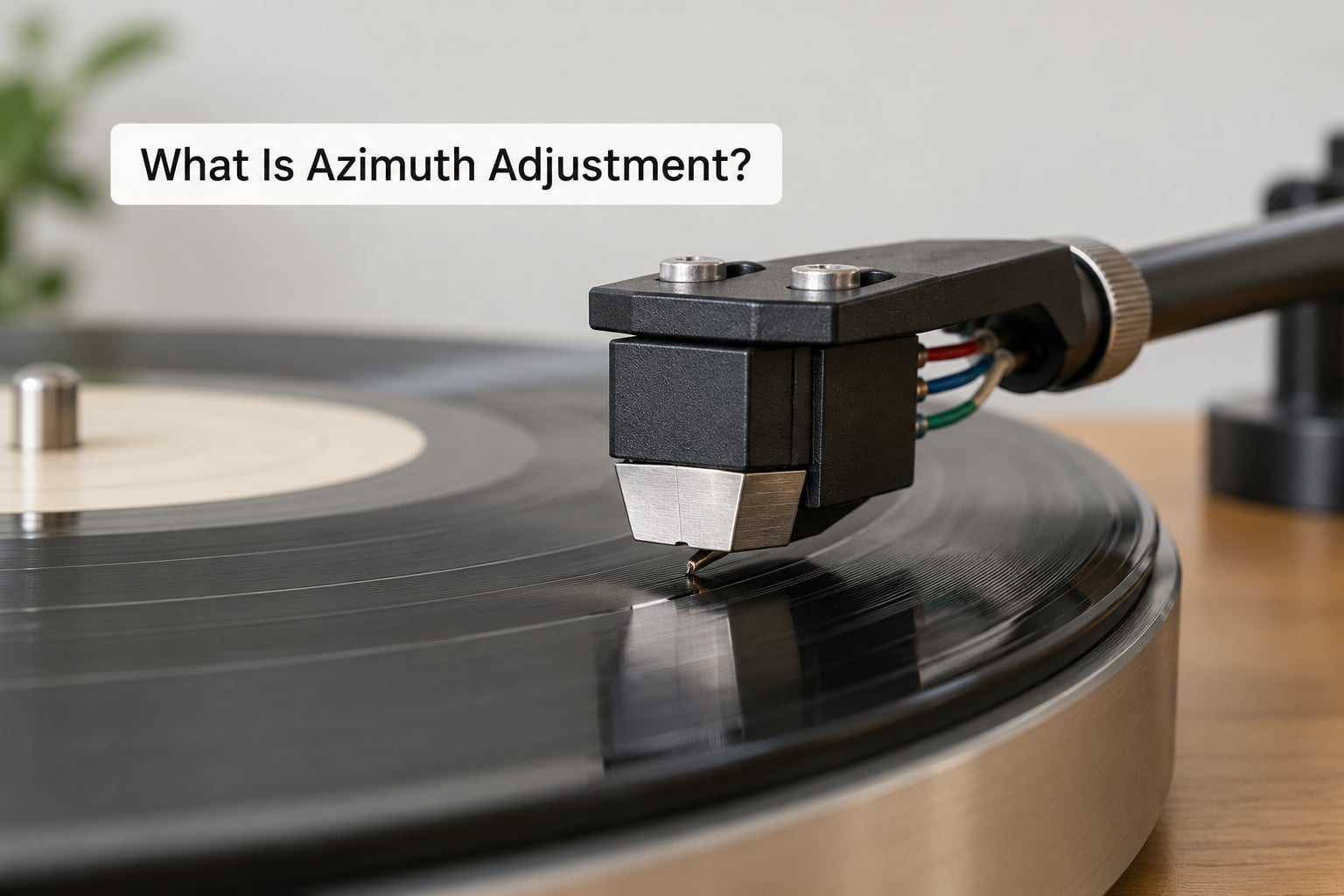
Azimuth is the angle between the cartridge’s mounting plane and the true vertical, when you look at the front of the tonearm head-on. On a record cut in stereo, the left channel is cut into one wall of the V-shaped groove and the right channel into the other, each wall cut at 45 degrees. A cartridge is built with its two coil generators sitting at 90 degrees to their own groove wall.
Rotate the cartridge and both relationships break at once: one generator drifts off perpendicular with its wall while the other gains angle. Neither coil is fully aligned with the groove it is meant to read, so each picks up a little of the opposite channel. That leak is called channel crosstalk, and it is the whole reason azimuth exists as a setting.
When the cartridge is square, the stylus sits centred in the groove with equal contact on both walls, the crosstalk from each channel into the other is equal in both directions, and the stereo image holds its shape from the first track of a record to the last.
What Does Azimuth Adjustment Do for Stereo Sound?
The goal is balance, not elimination. You are not trying to drive crosstalk to zero, which is physically impossible. You are trying to make the leakage from left into right match the leakage from right into left, and that balance is what produces a wide, stable soundstage.
Unbalanced azimuth shows up in ways people describe long before they can name the cause:
- A collapsed soundstage. Everything bunches toward the middle instead of spreading across the room.
- Instruments that drift sideways. A voice starts centred and wanders a few inches as the track plays.
- Tonal imbalance. One channel sounds duller or thinner, usually with more sibilance.
- Reduced separation. Bass from one channel muddies the other, which tightens the low end and smears kick and bass together.
- Extra wear. A stylus riding at an angle works harder against the groove wall for the whole side of a record.
How audible is it? Cartridge manufacturers assemble the coil bobbins and cantilever to a tolerance of roughly 1.5 to 3.0 degrees, so a well-built cartridge can already be close to right before you touch anything. Errors of five to ten degrees do show up on small-batch cartridges and on units that have been mounted carelessly. Below a degree or two, most listeners will not hear a change on anything but a quiet, exposed recording.
How Is Azimuth Adjustment Different From V-Shaped Stylus Adjustment?
They are two different procedures that unfortunately share a name, and mixing them up is the most common source of frustration in cartridge setup. True azimuth adjustment rotates the entire cartridge in its headshell until it is square to the record. The target is the cartridge body reading vertical from the front.
The V-shaped adjustment rotates the cartridge about its own mounting holes so that, in side profile, the cantilever lines up with a V whose apex sits at the stylus. The target here is the V angle specified for the cartridge, usually visible on the manufacturer’s alignment template, and it is a head-on-versus-side-on confusion: a cartridge can be perfectly square from the front and still sit at the wrong V angle.
Why it matters practically: the V adjustment changes the effective rake, which changes stylus rake angle and vertical tracking angle. That moves the cartridge, which means a cartridge set for V can end up slightly out of azimuth. If you are working from a factory alignment template, follow the template’s order and recheck azimuth afterwards. Loosening the same screws twice to chase two different targets is how cartridges get dropped and bent.
What Causes Azimuth Adjustment to Be Wrong?
Most crooked azimuth traces back to one of a handful of things:
- Cartridge mounted by hand. Bolting a cartridge into a headshell at whatever angle looks right is the single most common cause, and it is easy to do.
- A second-hand turntable. Owners frequently report a cartridge that plainly does not look parallel to the record on a used deck, sometimes because of a bent arm tube or a headshell that has been dropped.
- A cartridge swap without rechecking. The new cartridge sits wherever the old one was, and the two are rarely the same shape.
- A loose headshell or set screw. Nothing holds the rotation once the arm has been moved or jostled in transit.
- A bent tonearm or headshell collar. Look down the arm from above: if the arm tube is not parallel to the record, no amount of headshell adjustment will square the cartridge.
- Later setup changes. Changing alignment geometry, tracking force or vertical tracking angle can move the cartridge enough to matter. Setting azimuth and then changing everything else leaves it out again.
One caution belongs here, and it comes from a real service case rather than theory. There are documented instances of an expensive cartridge being twisted more than five degrees out of alignment by someone over-correcting in the belief that more adjustment must be better. Turn the screw, check, stop. If it does not improve, it was not azimuth.
How Do I Check the Azimuth Adjustment on My Turntable?
There are two families of check, visual and electrical, and they answer different questions.
Checking azimuth by eye and mirror
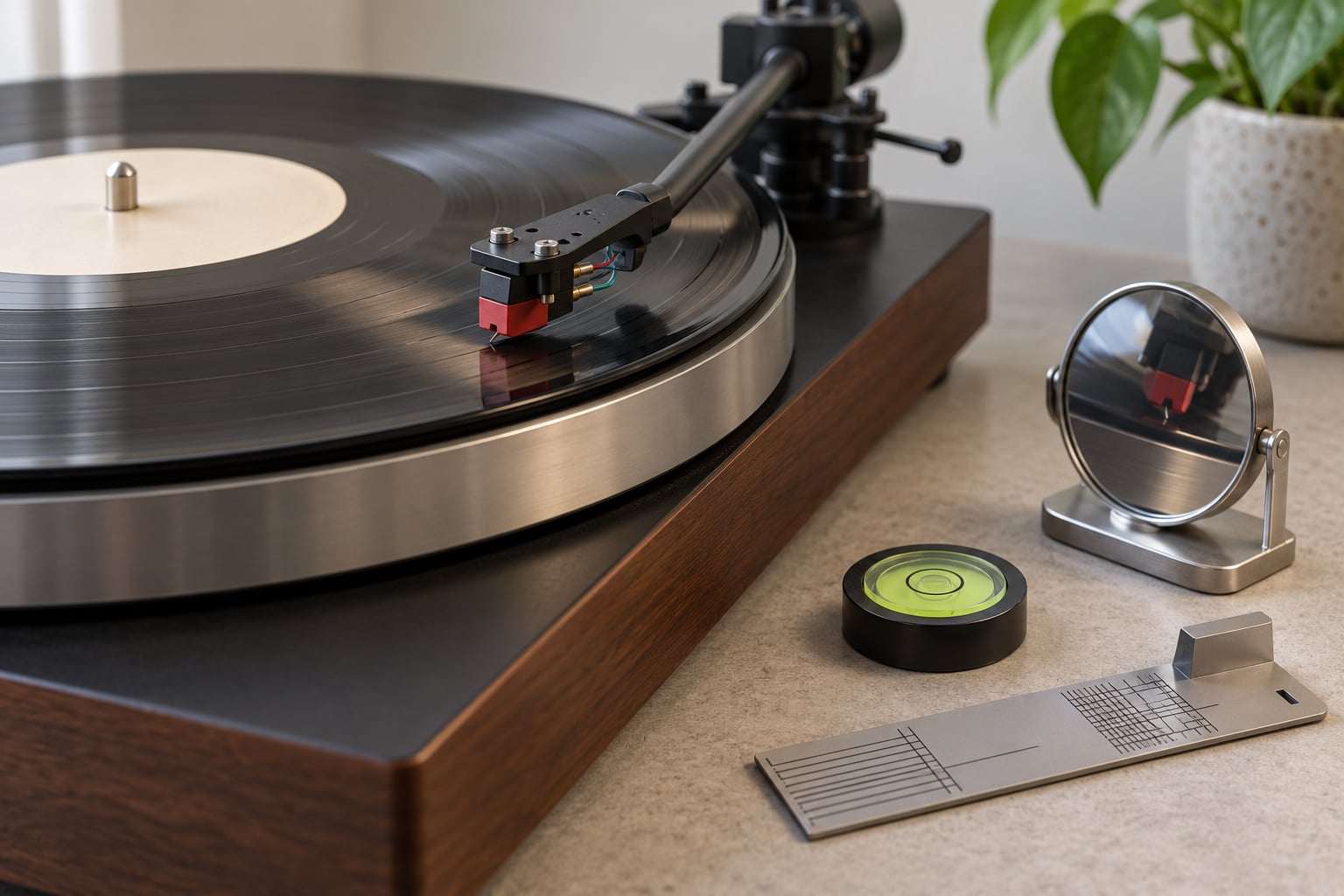
Park the tonearm over a stationary record with the dust cover off and the platter stopped. Put a small mirror flat on the record beside the cartridge, then crouch to eye level with the front of the headshell so your line of sight is horizontal and square. The reflection of the cartridge should sit directly above the reflection of its shadow, and the cartridge’s front face should read as a straight vertical line, not a leaning one.
Using a loupe or a phone
A 10x jeweller’s loupe is the cheapest serious tool here, and the magnifier zoom built into phone accessibility settings works surprisingly well as a free stand-in. Either one lets you judge the cartridge face against the headshell fingerplate, whose edge is machined parallel to the record.
Using an azimuth block
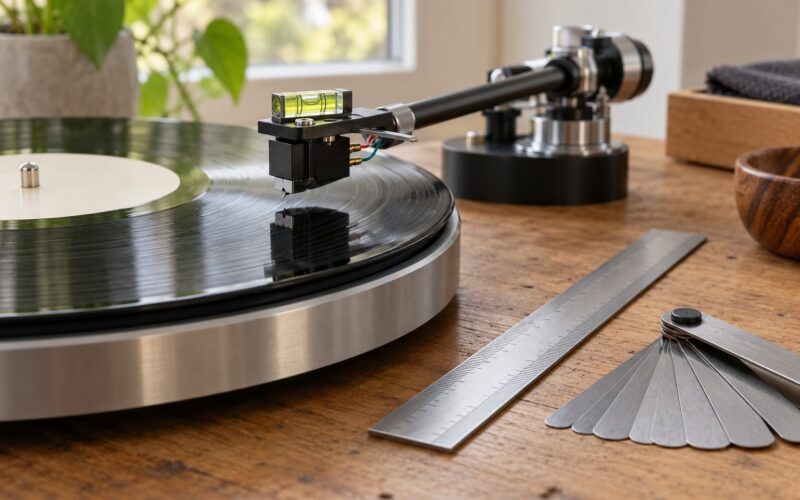
An azimuth block is a small precision level that sits on the record with its bubble against the cartridge face. For arms with no azimuth adjustment at all, it is the standard way to find out whether the headshell needs rotating or shimming. Users on r/turntables consistently rate this cheap physical tool above expensive electronic ones for everyday checks.
Checking with a test record or meter
Test records with dedicated azimuth tracks give you a repeatable musical target. For measurement, a fozgometer or an oscilloscope fed from the phono stage lets you watch the two crosstalk nulls and balance them against each other.
One limitation to know about before you trust any visual method: parallax. Your eye is never exactly in the plane of the record, so a tilted cartridge can look square. Visual methods are good to about a degree, which is plenty to fix a real problem and not enough to chase perfection.
How Do I Set Azimuth Adjustment Correctly?
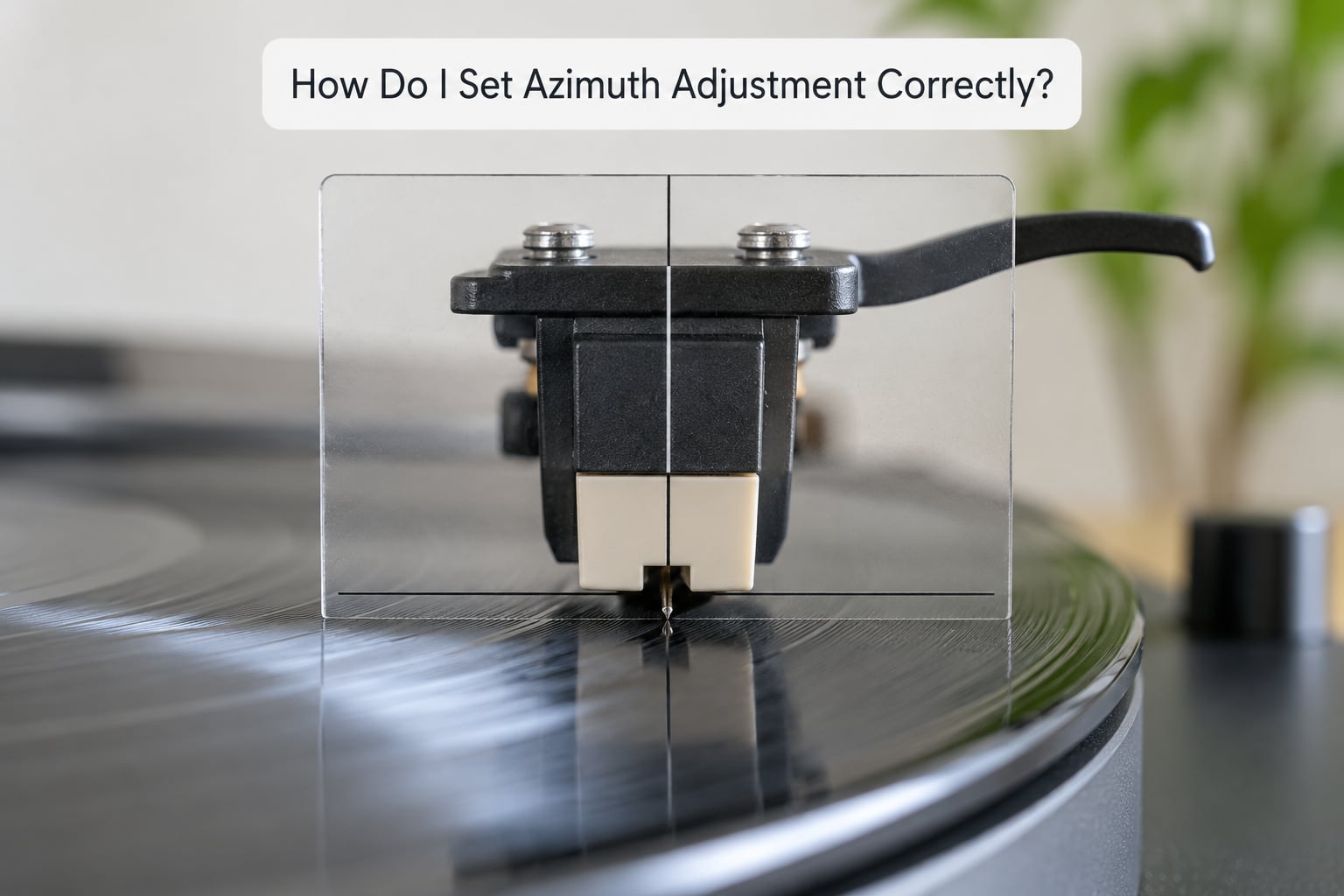
Before you touch a screwdriver, put the azimuth adjuster on your tonearm back to neutral, which on most designs means the bottom of the headshell is parallel to the platter. Manufacturer support pages for adjustable-arm models all give the same instruction. Work through these steps with the dust cover off and the platter stopped, and never force anything that resists.
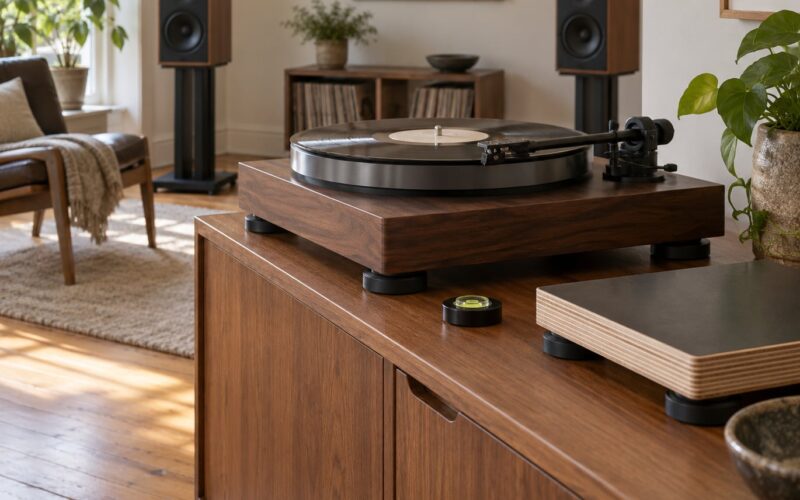
- Level the table. A bubble level on the plinth first, then confirm the platter itself is level. Azimuth measured on a tilted deck is azimuth measured wrong.
- Set tracking force. Get the gauge on the stylus and dial in the cartridge’s specified force before anything else, so the arm sits at its normal height.
- Park and lock the arm. Secure it in the rest, or hold the headshell gently. Working on a swinging arm wastes the adjustment.
- Find the set screw. There are three common hardware layouts: a set screw at the headshell that loosens the cartridge mount, a screw at the tonearm base that loosens the whole arm tube, and a rotating collar on an adjustable headshell. If none of them exist, your arm is fixed.
- Loosen only enough to rotate. A fraction of a turn. Over-loosening lets the whole headshell drop onto the arm rest.
- Rotate and view square-on. Turn the cartridge until its face reads vertical from directly in front. Watch your view, not the reflection alone; both together beat either.
- Retighten snugly, no more. Then repeat step 6. Firm is enough, and over-torquing small brass screws is how threads get damaged.
- Verify and listen. Confirm with a mirror or test record, then play something with hard-panned instruments and a solid centre vocal.
If your tonearm has no adjustment at all, the options are gentler: rotate a removable headshell a fraction in its fitting, shim one side with a thin washer or a folded piece of paper, or choose a cartridge with a matching body. Never force a fixed headshell by twisting the cartridge itself.
Should Azimuth Adjustment Be Set Before or After Cartridge Tracking Force?
Set it after. Tracking force comes first because the arm’s resting height depends on it, and azimuth is a vertical-plane measurement that only means something at the height the stylus will actually ride. Anti-skate, alignment geometry and overhang also come before, since each of them can move the cartridge fractionally.
Azimuth is a late step in a good order of operations: level, alignment geometry, tracking force, overhang, VTA if the design allows, then azimuth, then anti-skate as a final trim. Any change after azimuth means checking azimuth again. Plenty of turntables ship with the azimuth adjuster disabled or set to neutral on purpose, so confirm it is actually movable before you assume it is a working adjustment.
What Are the Best Methods for Setting Azimuth Adjustment?
Every method trades cost against accuracy, and the honest answer is that the cheap methods are enough for most setups. The visual methods get you inside a degree, which is already better than the average second-hand system.
| Method | Cost | Typical accuracy | Tools needed | Best for |
|---|---|---|---|---|
| Mirror and eye level | Free | About 1 degree | Small mirror | Checking a setup before you spend anything |
| Phone magnifier zoom | Free | About 1 degree | Phone | A quick look when you have no loupe |
| Cartridge alignment template | Often included with the cartridge | About 1 degree | Template and stylus gauge | New cartridge installs, where V angle is set too |
| Azimuth block | Low | Under 0.5 degree | Precision level | Fixed arms with no adjuster, or checking a shim |
| Test record with azimuth track | Low | About 0.5 degree | Record and a good ear | Confirming a visual result by listening |
| Sound card with channel inversion | Free to low | Roughly 0.5 degree | Laptop, test record, cables | Balancing crosstalk in both directions at home |
| Fozgometer | High | Under 0.1 degree | Measurement device and test record | Repeatable numbers on a reference setup |
| Oscilloscope or analyser | High | Under 0.1 degree | Scope, probes, phono stage | Balanced crosstalk measurement and serious tweaking |
One method deserves a warning. Playing a mono signal and minimising one direction of crosstalk until the null is deepest does not find zero azimuth error, because the two crosstalk nulls are not symmetric on a real cartridge. Balance both directions instead, which is what the advanced crowd on AudioGon and Audio Science Review actually do.
Moving-coil and moving-magnet cartridges use the same geometry here, and both benefit from a square one. Low-output moving-coil designs simply make the result easier to hear on a quiet passage, since there is more headroom before the phono stage’s own noise floor gets in the way. That is the whole cartridge-specific difference: nothing about the geometry changes, only how much of the improvement you can actually hear.
Can Azimuth Adjustment Fix Bad Sound on a Turntable?
Sometimes, and the symptoms it fixes are specific: a collapsed or leaning soundstage, a vocal that drifts, one channel that sounds dull, and bass that blends across the middle. If your setup has a real azimuth error, correcting it is one of the cheapest audible improvements available, and it costs a screwdriver.
It will not fix a worn or bent stylus, a dead or damaged cartridge, an alignment geometry problem, tracking error from bad overhang, a worn stylus that is chewing the inner grooves, a noisy phono stage, or a record pressed with poor stereo separation in the first place. Those all need their own fix.
When a setup still sounds wrong after the adjustment, work down this list before touching another screw:
| Symptom | Likely cause | What to do |
|---|---|---|
| Soundstage collapsed inward, bass smeared between channels | Unbalanced azimuth | Check azimuth by mirror, then confirm both crosstalk directions balance |
| Vocal drifts to one side partway through a track | Tracking error or wrong alignment geometry | Reset the alignment geometry; azimuth will not follow a curved error |
| Treble duller on one channel | Azimuth error, or a dirty or worn stylus | Check azimuth first, then clean the stylus and check for wear |
| Right channel much louder on normal records, fine on mono | Cartridge mounted crookedly | Re-square the cartridge in the headshell rather than trimming a control |
| Sound changes completely between records | Pressing variation, not your setup | Compare several records before changing anything |
| Cartridge looks square but the arm tube leans | Bent tonearm or headshell collar | Headshell adjustment cannot fix a bent tube; that is a service job |
| Intermittent crackle that follows the music | Worn stylus or damaged cantilever | Replace the stylus; no setup change touches this |
Worth knowing the geography of a mistake before you make it. Azimuth and alignment geometry fail in opposite ways: a bad azimuth collapses the image inward, while tracking error moves it sideways across the record. If the stage is narrow, start with azimuth. If things drift, skip to the geometry.
If you align the azimuth and the soundstage stays flat, stop. The honest technical position, argued at length by cartridge makers, is that a correctly assembled cartridge needs no adjustment at all, and that a static azimuth error only exists when the cartridge was mounted crookedly. Check your work once, correct a real error if you find one, and then leave it alone.
Frequently Asked Questions
Does azimuth adjustment really affect sound quality?
Yes, when there is a real error to correct. A tilted cartridge lets each channel leak into the other unevenly, which narrows the soundstage, drifts instruments sideways and dulls one channel. The improvement is obvious after a cartridge swap and inaudible on a setup that was already square, which is why checking before adjusting matters more than adjusting.
Do I need to adjust azimuth on a new turntable?
Usually not. Factory-aligned decks with an untouched factory cartridge are typically within a degree or two of correct, which is closer than most people can measure by eye. Azimuth becomes worth checking after a cartridge change, a second-hand purchase, or any time the headshell has been loosened or the arm has been knocked.
What tool do I use to measure turntable azimuth?
A mirror and an eye-level view will get you close, and a phone magnifier is a free upgrade to that. A small azimuth block gives a repeatable answer and is the right tool for arms with no adjustment. Test records and sound card crosstalk checks confirm the result by ear and by measurement, while fozgometers and oscilloscopes are for reference setups.
Is azimuth the same as VTA, SRA or rake angle?
No, and they are adjusted from different positions. Azimuth is a left-to-right rotation seen from the front of the arm. Vertical tracking angle and stylus rake angle describe front-to-back geometry seen from the side, and are set with the rest of the cartridge geometry. Overhang and anti-skate are arm adjustments rather than cartridge adjustments.
What is azimuth in surveying and navigation?
In surveying, an azimuth is a horizontal angle measured clockwise from north, running from 0 to 360 degrees. Surveyors work with whole-circle azimuth, reduced or quadrant bearings, and bearing azimuths. To reverse an azimuth, add 180 degrees and subtract 360 if you pass zero. In astronomy the same idea becomes the horizontal position of a star in the sky.
Why does my used turntable’s cartridge not look parallel to the record?
On a second-hand deck it is worth taking seriously, because the usual causes are real: a cartridge mounted by hand, a headshell dropped in transit, or a bent arm tube. Look down the arm first and check the tube is parallel to the record, since a bent tube cannot be corrected at the headshell. If the arm is straight, the headshell rotation and a shim are the safe options.
Start with a level check, then set the tracking force and mount the cartridge squarely in the first place. Only then reach for the azimuth screw at the headshell. Most flat-sounding setups are misaligned somewhere other than azimuth, and a few careful minutes now save you from chasing the wrong adjustment for years.