This guide is about a phono cartridge for a turntable, with a stylus that rides a groove, not about ink or toner. Most new cartridges need 20 to 30 hours of ordinary record playback before they settle, and moving coils usually want more than moving magnets. Treat it as a setup routine with a track record count at the end, not as a ritual.
The honest part first: the physical settling of a cartridge suspension is small, real, and mostly done inside that first 30 hours. Everything dramatic you read online is a mix of that settling, your ears adapting to a new tonality, and the earliest, fastest stylus wear smoothing sharp edges. About a third of owners hear nothing at all, and nothing about a cartridge ever needs a device to prove it.
So here is how to break in a new cartridge without wrecking a record, a stylus, or your weekend. It takes about an hour of careful work, then about a month of playing records the way you always do.
Table of Contents
- What You Need
- Step-by-Step: How to Break In a New Cartridge
- Check the Cartridge and Turntable Compatibility
- Install and Align the Cartridge
- Set Tracking Force and Anti-Skate
- Set the Phono Stage and Play Records Gradually
- Common Mistakes
- Frequently Asked Questions
- How long does it take to break in a new cartridge?
- Should I increase the tracking force to make a new cartridge sound better?
- How many hours should I play a new cartridge?
- Does a new cartridge need a break-in record?
- Why does my new cartridge sound harsh and metallic?
- What to Do First
What You Need
You need very little, and most of it you can improvise. A phono cartridge that physically fits your headshell, the turntable it goes on, and a fresh needle are the non-negotiables.
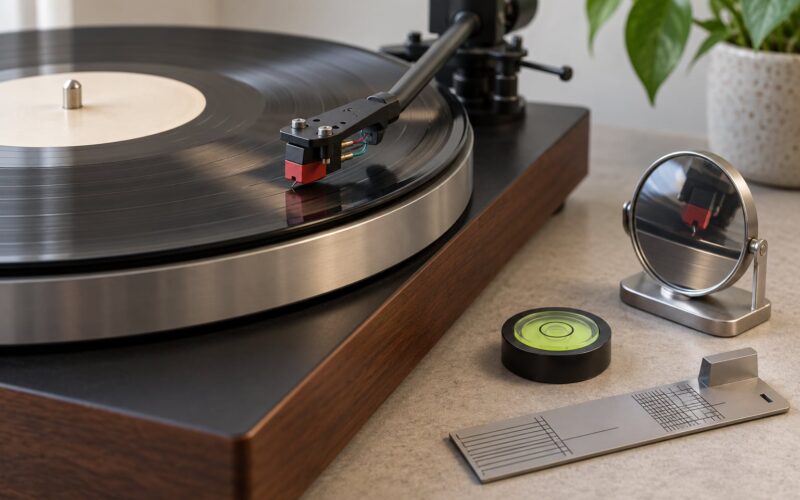
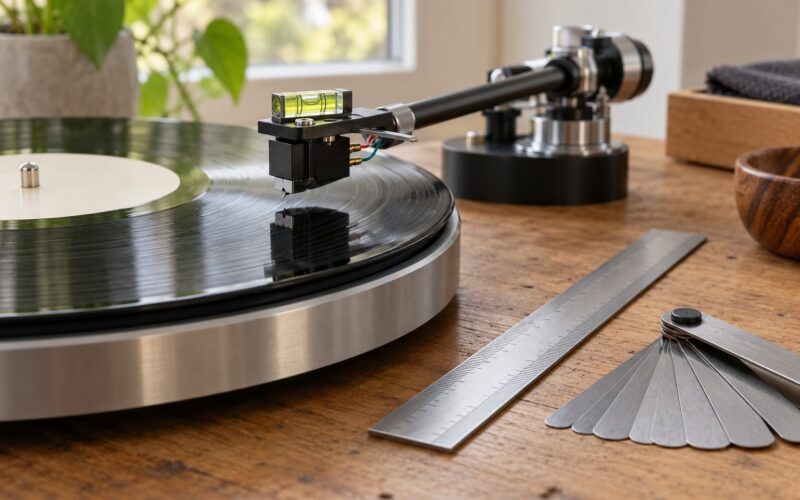
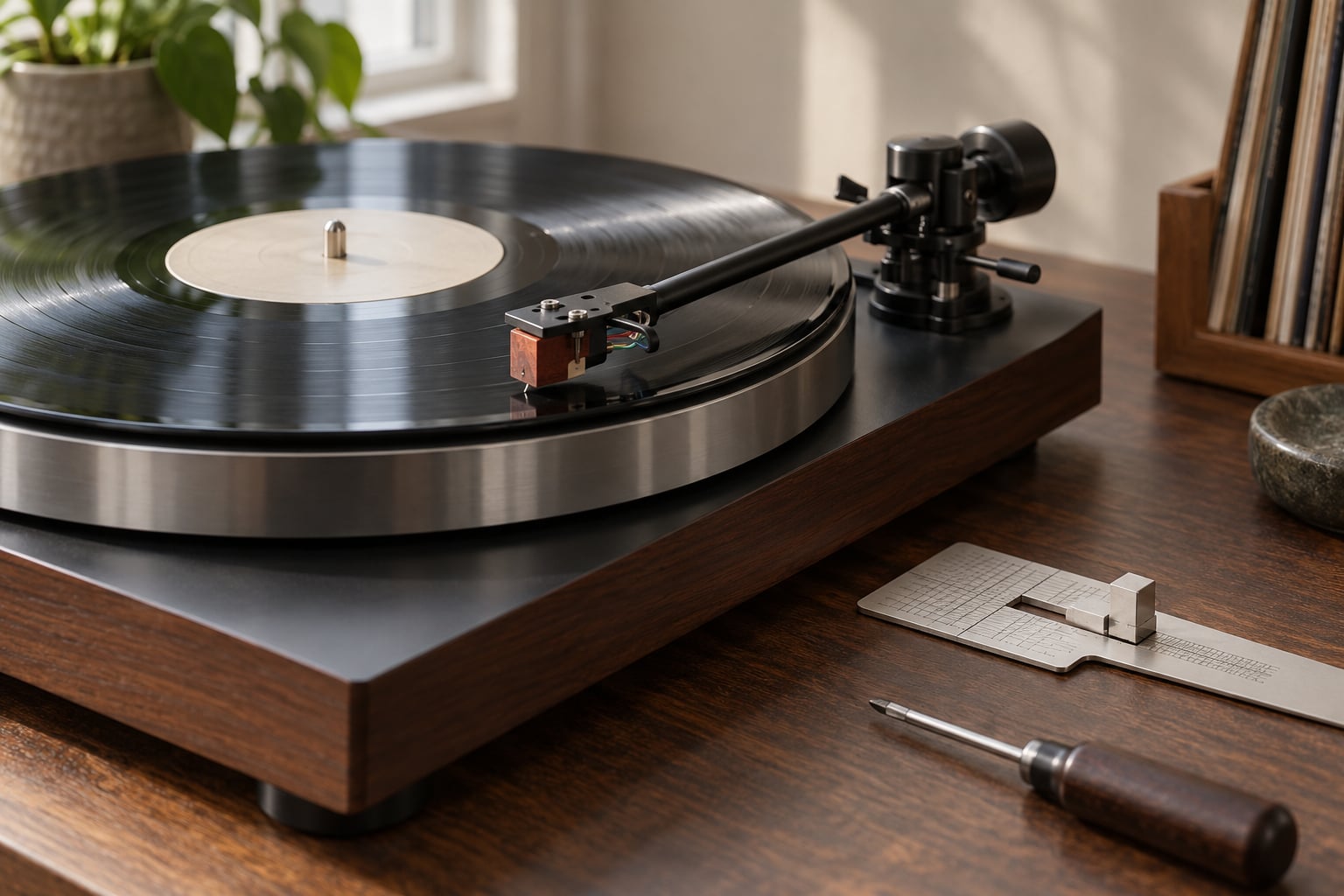
- A stylus alignment gauge and a tracking force gauge for a turntable with adjustable tracking weight. A gauge is a plastic or acrylic plate with a small lens or mirror.
- The small hex screwdriver and finger-tightening hardware that came with the cartridge.
- A carbon fibre stylus cleaning brush. Pull it toward you, along the direction the stylus travels, never across it.
- A record cleaning brush or cloth, plus a few records in good condition that you are not precious about.
- A rough idea of the cartridge maker’s recommended tracking-force range, usually printed on the packaging or in the manual.
One distinction worth making before you start. Almost everything you do here is a normal, reversible setup routine: alignment, tracking force, anti-skate, phono stage settings. None of it permanently alters the cartridge in a way you cannot undo.
What gets sold as break-in claims something different, namely that the cartridge’s sound continues to change substantially after 50 hours, 100 hours, or two weeks. That claim is disputed, and the honest position is that the settled change is modest and mostly finished early. If a cartridge sounds wrong, more hours will not fix it.
Step-by-Step: How to Break In a New Cartridge
Check the Cartridge and Turntable Compatibility
Start by confirming the cartridge actually suits the arm and the headshell before you touch a screwdriver. Three things matter: the mounting hole pattern, the tonearm’s effective length and offset, and whether the cartridge needs its own phono stage or will work with a built-in one.
Most headshells take the standard two-hole pattern, and most manufacturers supply the correct screws and spacers. If your cartridge is a high-output moving coil, check that your phono preamp actually has a moving-coil gain setting, because a moving coil into a moving-magnet stage will sound thin and quiet at best.
How do you know the compatibility step worked? The fasteners thread cleanly into the headshell by hand with no forcing, and you can lower the arm onto its rest without the cartridge touching the headshell shell. You should not need any adapter at all.
Install and Align the Cartridge
Fit the cartridge, attach the tonearm, and set alignment before you play anything at all. Rough out the alignment and the first few hours are wasted, because the stylus wears fastest at the very beginning.
Connect the terminals with the correct channel orientation, red to right and white or green to left. Then drop the stylus onto the alignment gauge and use the small screws to set height and overhang until the gauge reads correct. Work in tiny increments, tightening the fasteners by finger only, and check your work twice.
You know this step worked when the gauge lens sits centred and stays centred through a full check, the cartridge body is square in the headshell, and the arm needs no shoving to move. Forcing the tonearm sideways to make it track is never part of a break-in procedure. Nobody ever breaks a cartridge in by pushing the stylus harder into the record.
Set Tracking Force and Anti-Skate
Set the vertical tracking force inside the maker’s stated range, using the manufacturer or turntable maker’s recommended figure where one exists. Start at the low end of that range if you want the least stylus wear, and add a fraction of a gram at a time only if the arm skips.
Then set anti-skate. It is the most neglected control in the whole process, and it is the one that can undo good work. Anti-skate applies a tiny sideways force to cancel the arm’s inward pull; set too high, it drags the stylus across the groove wall, rotates the diamond out of its correct azimuth, and can produce exactly the harsh, etched sound people blame on an unbroken-in cartridge.
Judge these two settings by listening. With the volume moderate, the arm should glide without you pushing it and without you noticing any inward drag, there should be no skipping or hesitation on a well-cleaned record, and the sound should be even rather than etched on one side. If it fails, fix the setup instead of playing more hours.
Set the Phono Stage and Play Records Gradually
Match your phono stage before you start. Set the cartridge loading to match the maker’s guidance for impedance and capacitance, and if you have no guidance, a moderate capacitance setting around 100 pF suits most moving magnets. Set phono stage gain to match the cartridge type and keep the volume well below where the system would clip.
Then play records gradually and normally. Use records in good condition that you care about only mildly. Start with a handful of familiar albums rather than a delicate mono press, keep the volume moderate, and let the arm run for an hour or two without constant cueing.
Break-in hours commonly quoted, with attribution:
- Audio-Technica guidance for its VM series: up to 20 hours for the stylus, none for the cartridge body. That is the manufacturer’s position, that the stylus needs play time and the cartridge does not.
- Forum consensus on AudioShark: 20 to 30 hours, commonly given as the window for the suspension to settle.
- User reports on AudioCircle: 30 hours, with the first 10 rough. Anecdotal, but consistent across cartridge types.
- Tom Port at Better Records, for a high-output moving coil: 50 hours before serious listening. Longer for moving coils, which tend to be stiffer and more heavily damped.
- Shure, relayed on VinylEngine: two weeks of regular play, the most conservative figure in circulation.
Most people land somewhere in the 20 to 50 hour range. Moving magnets, especially entry-level models, settle fastest, and Audio-Technica VM cartridges are widely reported to sound good straight out of the box with only a subtle change. Moving coils with highly damped suspensions take longer, and a stylus on a fixed-coil or moving-iron design cannot rotate into the groove the way a moving-coil diamond can, so those often need far less.
Two things to keep in mind while the hours tick by. First, stylus wear is front-loaded, so the first hours do the most settling and the most damage; careful alignment, correct anti-skate and a cleaning brush can keep total stylus life around 500 to 1000 hours. Second, roughly 50 hours of a single-sided album is about 12 hours of music, so 20 to 30 hours is closer to a fortnight of ordinary listening than it sounds. A forum poster on HiFi Haven put the tradeoff better than anyone: the moment a piece of gear is broken in, it begins to break down.
There is one more step almost nobody mentions. About 30 to 50 hours in, set your azimuth again with the alignment gauge, because a relaxed suspension can shift the optimum point slightly. A blogger running an identical new cartridge against a used one found the relaxed cartridge needed its azimuth reset to recover the precision without the metallic edge.
Common Mistakes
Skipping alignment is the first and most common error. A cartridge that tracks badly never breaks in properly, because the suspension is being pushed sideways instead of moving freely.
Setting excessive tracking force is the second. More force does not produce better break-in, it produces more stylus wear and worse tracking. Stay inside the maker’s range.
Leaving anti-skate at zero, or cranking it to fight a drifting arm, is the third. Zero anti-skate lets the stylus sit off-centre in the groove; too much rotates the diamond out of azimuth within hours. Soundsmith argues this is the single variable most break-in advice ignores, and that a fixed-coil design bonded over most of its surface simply cannot rotate out of position in the first place.
Then there are the shortcuts. White noise, pink noise, backwash devices and dedicated break-in rigs were dismissed out on the audiophile forums years ago for good reason: a stylus does not respond to signal level, only to groove contact. Play records.
The last mistake is expecting a transformation. If your new cartridge sounds harsh and metallic on the first two records, that is normal and it will not become a completely different cartridge at hour 40. If it still sounds wrong after a good setup and 20 hours, you have an alignment problem, an anti-skate problem, or a damaged stylus.
Frequently Asked Questions
How long does it take to break in a new cartridge?
Most phono cartridges settle within 20 to 30 hours of ordinary record playback, with 50 hours being a conservative figure for a high-output moving coil. Moving magnets settle fastest; stiffer moving coils take longer. About a third of owners hear no change at all, and that is fine.
Should I increase the tracking force to make a new cartridge sound better?
No. Set the tracking force inside the cartridge maker’s recommended range and use the least that gives stable playback. Turning it up does not speed up break-in, it just increases stylus wear and reduces tracking accuracy, which makes the sound worse.
How many hours should I play a new cartridge?
There is no universal number. Play records at a moderate level through a correctly aligned, correctly set-up system and judge it by whether it tracks cleanly and stays consistent from side to side. If it skips, distorts or drifts, fix the setup rather than adding hours.
Does a new cartridge need a break-in record?
Usually not. An alignment gauge and several well-maintained records in good condition are more useful than any dedicated break-in disc. Do not park a new stylus on a record for days to soften it, as some old guidance suggests, because that wears a groove into the lead-out area.
Why does my new cartridge sound harsh and metallic?
That is what an unsettled suspension and unpolished diamond facets usually sound like, and it typically softens over the first 20 to 30 hours. It is also what a bad azimuth setting, an anti-skate dial wound too high, or a dirty record sounds like, so check the setup before blaming the cartridge.
What to Do First
Align the cartridge properly with a gauge, set the tracking force at the low end of the maker’s range, get anti-skate right, and then forget about break-in and play about 30 hours of ordinary records at a moderate volume.
Come back at hour 30 with the alignment gauge and re-check your azimuth, because that is the step that makes the settled sound as good as it can be. Skip the gadgets, skip the special records, and never park a new stylus on a disc for days. That is the whole method.